The persuasive
discourse (p.192-194)
        Day 7
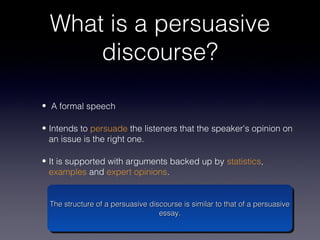
What is a persuasive
      discourse?

• A formal speech

• Intends to persuade the listeners that the speaker's opinion on
  an issue is the right one.

• It is supported with arguments backed up by statistics,
  examples and expert opinions.


  The structure of a persuasive discourse is similar to that of a persuasive
  The structure of a persuasive discourse is similar to that of a persuasive
                                   essay.
                                   essay.
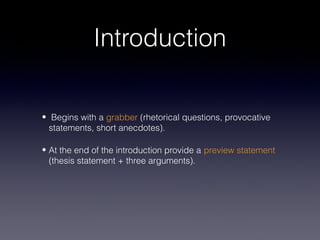
Introduction

• Begins with a grabber (rhetorical questions, provocative
  statements, short anecdotes).

• At the end of the introduction provide a preview statement
  (thesis statement + three arguments).
Body

• The speaker's three arguments are developed.

• Each argument is introduced with a transition term.

• Back up your arguments with at least two of the following types
  of evidence: statistics, expert opinion, example.
Conclusion

• Begins with a transition term (To conclude, in summary, to
  finish) followed by a summary statement (a rephrased
  summary statement).

• The speaker ends with a clincher (connecting with the
  introduction, demonstrating the importance of a thesis
  statement, offering a solution).
Persuasive strategies

• Keep it short and simple.

• Repeat yourself.

• Use transition terms (see p.198)

• Ask questions (rhetorical and directed).
A few don'ts

• Don't read your speech.

• Don't stand in one place.

• Don't talk to just one or two people in the audience.

• Don't avoid making eye contact.

The persuasive discourse day 7

  • 1.
  • 2.
    What is apersuasive discourse? • A formal speech • Intends to persuade the listeners that the speaker's opinion on an issue is the right one. • It is supported with arguments backed up by statistics, examples and expert opinions. The structure of a persuasive discourse is similar to that of a persuasive The structure of a persuasive discourse is similar to that of a persuasive essay. essay.
  • 3.
    Introduction • Begins witha grabber (rhetorical questions, provocative statements, short anecdotes). • At the end of the introduction provide a preview statement (thesis statement + three arguments).
  • 4.
    Body • The speaker'sthree arguments are developed. • Each argument is introduced with a transition term. • Back up your arguments with at least two of the following types of evidence: statistics, expert opinion, example.
  • 5.
    Conclusion • Begins witha transition term (To conclude, in summary, to finish) followed by a summary statement (a rephrased summary statement). • The speaker ends with a clincher (connecting with the introduction, demonstrating the importance of a thesis statement, offering a solution).
  • 6.
    Persuasive strategies • Keepit short and simple. • Repeat yourself. • Use transition terms (see p.198) • Ask questions (rhetorical and directed).
  • 7.
    A few don'ts •Don't read your speech. • Don't stand in one place. • Don't talk to just one or two people in the audience. • Don't avoid making eye contact.