MODAL VERBS
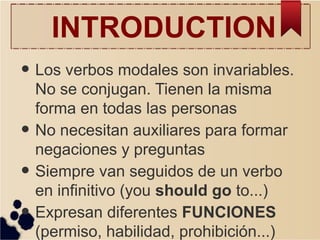
INTRODUCTION
• Los verbos modales son invariables.
•
•
•

No se conjugan. Tienen la misma
forma en todas las personas
No necesitan auxiliares para formar
negaciones y preguntas
Siempre van seguidos de un verbo
en infinitivo (you should go to...)
Expresan diferentes FUNCIONES
(permiso, habilidad, prohibición...)
PROBABILITY
• Present/ future
o

That story COULD/ MIGHT be true
(vaguely probable)
(esa historia podría ser verdad)

That story MAY be true (probable)
(quizá sea verdad)
o That story MUST be true (highly
probable, certain)
(debe ser verdad)
o
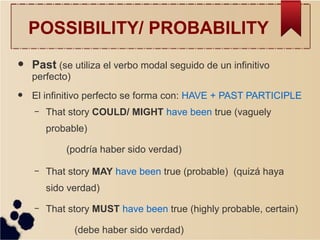
POSSIBILITY/ PROBABILITY

•

Past (se utiliza el verbo modal seguido de un infinitivo

•

El infinitivo perfecto se forma con: HAVE + PAST PARTICIPLE

perfecto)

–

That story COULD/ MIGHT have been true (vaguely
probable)
(podría haber sido verdad)

–

That story MAY have been true (probable) (quizá haya
sido verdad)

–

That story MUST have been true (highly probable, certain)
(debe haber sido verdad)
OBLIGATION
• Present/ future (deber, tener que)

I MUST write a card for my mother
because it's her birthday
o I HAVE TO start work at 8:30
o She HAS TO be at home by 11.
Past (debía, tenía que)
o Yesterday I HAD TO go to hospital
o Last week she HAD TO take care of
her grandmother
o

•
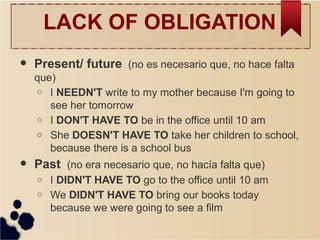
LACK OF OBLIGATION
•

Present/ future (no es necesario que, no hace falta

•

Past (no era necesario que, no hacía falta que)

que)
o I NEEDN'T write to my mother because I'm going to
see her tomorrow
o I DON'T HAVE TO be in the office until 10 am
o She DOESN'T HAVE TO take her children to school,
because there is a school bus
o
o

I DIDN'T HAVE TO go to the office until 10 am
We DIDN'T HAVE TO bring our books today
because we were going to see a film
PROHIBITION
•

Present/ future (no se debe, no se puede, está

•

Past (no se podía, estaba prohibido)

prohibido)
o You MUSTN'T smoke in public places
o You CAN'T drive over 50 Km/hour in urban areas
o
o

We COULDN'T vote in last year's elections because
we were 17 years old.
They COULDN'T work in the USA because they
didn't have a work permit
ADVICE
• Present/ future (deberías, no deberías)
o

You SHOULD go to the doctor if you
don't feel well

o

You SHOULDN'T be late

o

You OUGHT TO ask the teacher if you
don't understand the exercise
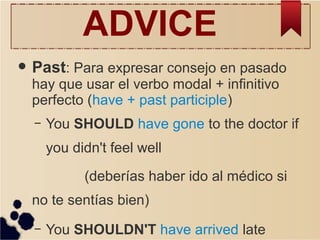
ADVICE
•

Past: Para expresar consejo en pasado hay que usar el verbo
modal + infinitivo perfecto (have + past participle)
–

You SHOULD have gone to the doctor if you didn't feel well
(deberías haber ido al médico si no te sentías bien)

–

You SHOULDN'T have arrived late
( no deberías haber llegado tarde)

–

You OUGHT TO have asked the teacher if you didn't
understand the exercise (deberías haberle preguntado al
profesor)
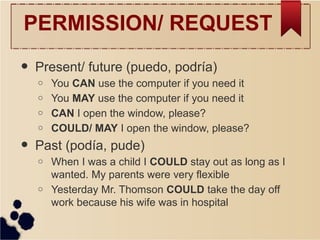
PERMISSION/ REQUEST
•

Present/ future (puedo, podría)
You CAN use the computer if you need it
o You MAY use the computer if you need it
o CAN I open the window, please?
o COULD/ MAY I open the window, please?
o

•

Past (podía, pude)
When I was a child I COULD stay out as long as I
wanted. My parents were very flexible
o Yesterday Mr. Thomson COULD take the day off work
because his wife was in hospital
o
ABILITY
•

Present/ future (saber, poder, ser capaz)
o
o
o

•

I CAN speak three languages
I AM ABLE TO speak three languages
I CAN'T speak Japanese

Past (sabía, podía, era capaz)
o
o
o

I COULD ride a bike when I was 6
She HAS BEEN ABLE TO learn German in ten
months
You COULDN'T read when you were 2 years old
SOME PRACTICE
●

Click here

●

Click here

●

Click here

●

Click here

●

Click here

●

Click here

Modal verbs

  • 1.
  • 2.
    INTRODUCTION • Los verbosmodales son invariables. • • • No se conjugan. Tienen la misma forma en todas las personas No necesitan auxiliares para formar negaciones y preguntas Siempre van seguidos de un verbo en infinitivo (you should go to...) Expresan diferentes FUNCIONES (permiso, habilidad, prohibición...)
  • 3.
    PROBABILITY • Present/ future o Thatstory COULD/ MIGHT be true (vaguely probable) (esa historia podría ser verdad) That story MAY be true (probable) (quizá sea verdad) o That story MUST be true (highly probable, certain) (debe ser verdad) o
  • 4.
    POSSIBILITY/ PROBABILITY • Past (seutiliza el verbo modal seguido de un infinitivo • El infinitivo perfecto se forma con: HAVE + PAST PARTICIPLE perfecto) – That story COULD/ MIGHT have been true (vaguely probable) (podría haber sido verdad) – That story MAY have been true (probable) (quizá haya sido verdad) – That story MUST have been true (highly probable, certain) (debe haber sido verdad)
  • 5.
    OBLIGATION • Present/ future(deber, tener que) I MUST write a card for my mother because it's her birthday o I HAVE TO start work at 8:30 o She HAS TO be at home by 11. Past (debía, tenía que) o Yesterday I HAD TO go to hospital o Last week she HAD TO take care of her grandmother o •
  • 6.
    LACK OF OBLIGATION • Present/future (no es necesario que, no hace falta • Past (no era necesario que, no hacía falta que) que) o I NEEDN'T write to my mother because I'm going to see her tomorrow o I DON'T HAVE TO be in the office until 10 am o She DOESN'T HAVE TO take her children to school, because there is a school bus o o I DIDN'T HAVE TO go to the office until 10 am We DIDN'T HAVE TO bring our books today because we were going to see a film
  • 7.
    PROHIBITION • Present/ future (nose debe, no se puede, está • Past (no se podía, estaba prohibido) prohibido) o You MUSTN'T smoke in public places o You CAN'T drive over 50 Km/hour in urban areas o o We COULDN'T vote in last year's elections because we were 17 years old. They COULDN'T work in the USA because they didn't have a work permit
  • 8.
    ADVICE • Present/ future(deberías, no deberías) o You SHOULD go to the doctor if you don't feel well o You SHOULDN'T be late o You OUGHT TO ask the teacher if you don't understand the exercise
  • 9.
    ADVICE • Past: Para expresarconsejo en pasado hay que usar el verbo modal + infinitivo perfecto (have + past participle) – You SHOULD have gone to the doctor if you didn't feel well (deberías haber ido al médico si no te sentías bien) – You SHOULDN'T have arrived late ( no deberías haber llegado tarde) – You OUGHT TO have asked the teacher if you didn't understand the exercise (deberías haberle preguntado al profesor)
  • 10.
    PERMISSION/ REQUEST • Present/ future(puedo, podría) You CAN use the computer if you need it o You MAY use the computer if you need it o CAN I open the window, please? o COULD/ MAY I open the window, please? o • Past (podía, pude) When I was a child I COULD stay out as long as I wanted. My parents were very flexible o Yesterday Mr. Thomson COULD take the day off work because his wife was in hospital o
  • 11.
    ABILITY • Present/ future (saber,poder, ser capaz) o o o • I CAN speak three languages I AM ABLE TO speak three languages I CAN'T speak Japanese Past (sabía, podía, era capaz) o o o I COULD ride a bike when I was 6 She HAS BEEN ABLE TO learn German in ten months You COULDN'T read when you were 2 years old
  • 12.
    SOME PRACTICE ● Click here ● Clickhere ● Click here ● Click here ● Click here ● Click here