VERBS (2)
Modal Verbs (03)
Modal Verbs: in context
2 min
What are modal verbs?
Modal verbs are a small group of verbs, which are very different from normal
verbs.
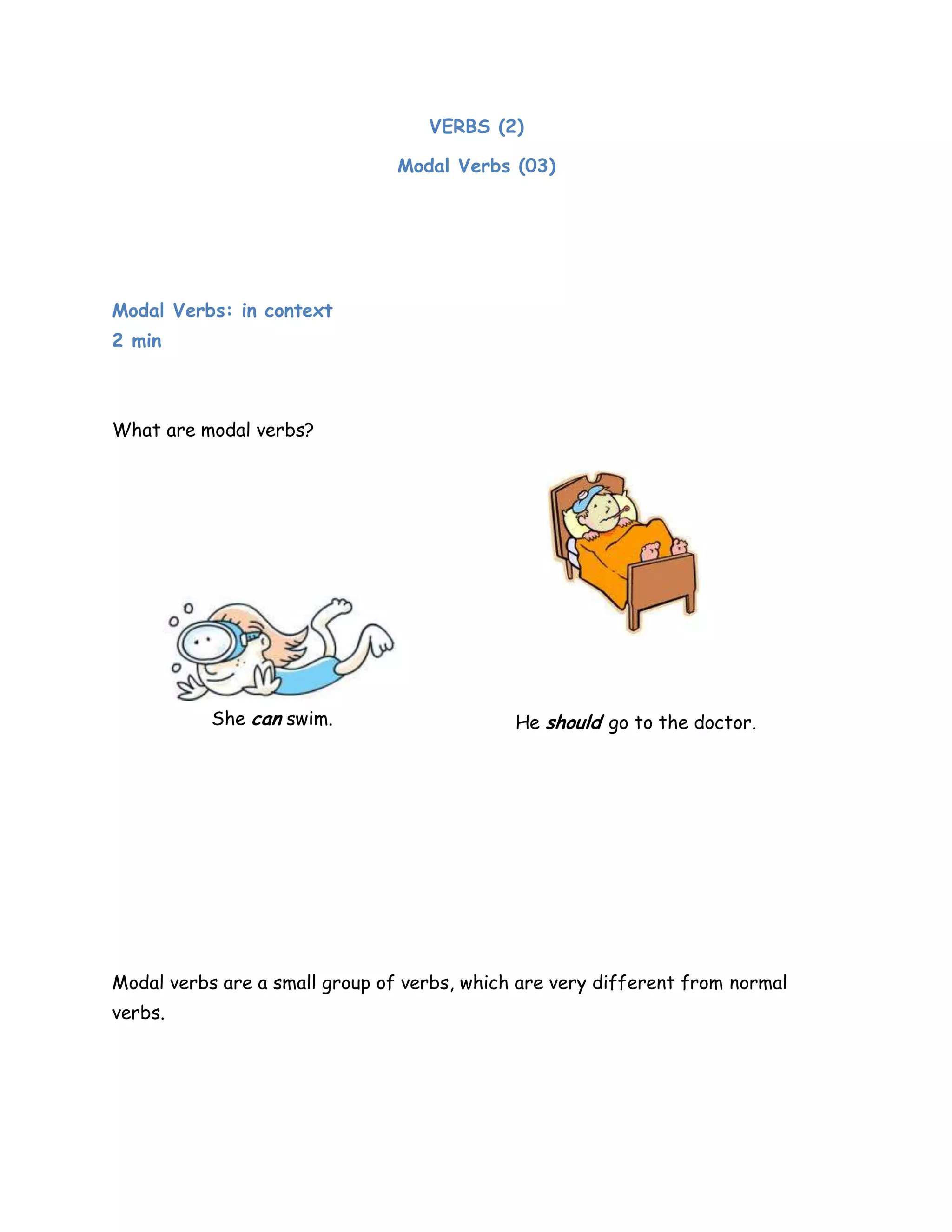
She can swim. He should go to the doctor.
Common Modal Verbs and their Particularities
28 min
Which verbs are common modal verbs?
Can, could, may, might, should, must, shall, will, would
How are modal verbs different from other verbs?
- They do not take “s” in the third person: he can, she must, it could
- They use “not” in the negative form: they may not, we should not
- They cannot be used in the past or in the future tenses
- There is no “to” after them: I can do, you must see
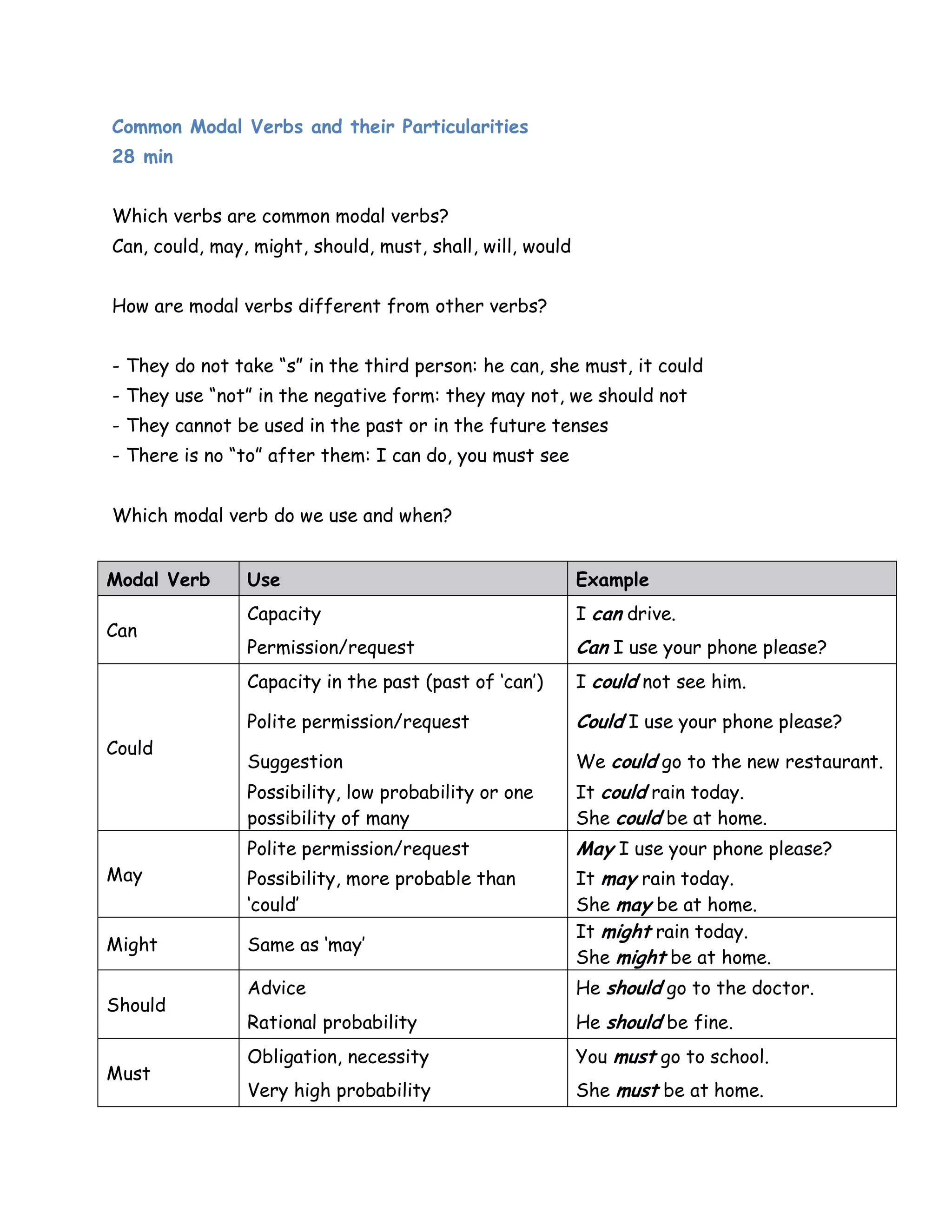
Which modal verb do we use and when?
Modal Verb Use Example
Can
Capacity I can drive.
Permission/request Can I use your phone please?
Could
Capacity in the past (past of „can‟) I could not see him.
Polite permission/request Could I use your phone please?
Suggestion We could go to the new restaurant.
Possibility, low probability or one
possibility of many
It could rain today.
She could be at home.
May
Polite permission/request May I use your phone please?
Possibility, more probable than
„could‟
It may rain today.
She may be at home.
Might Same as „may‟
It might rain today.
She might be at home.
Should
Advice He should go to the doctor.
Rational probability He should be fine.
Must
Obligation, necessity You must go to school.
Very high probability She must be at home.
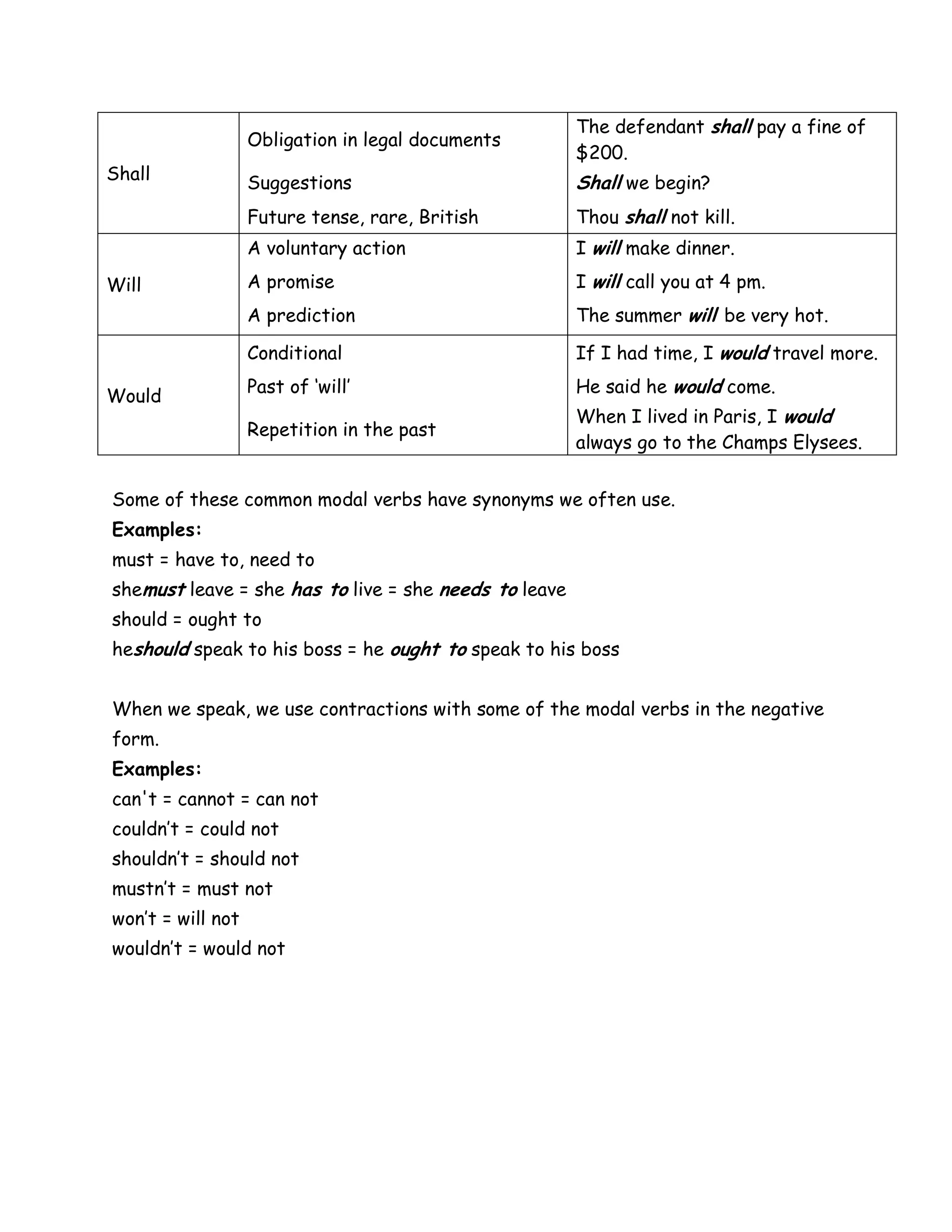
Shall
Obligation in legal documents
The defendant shall pay a fine of
$200.
Suggestions Shall we begin?
Future tense, rare, British Thou shall not kill.
Will
A voluntary action I will make dinner.
A promise I will call you at 4 pm.
A prediction The summer will be very hot.
Would
Conditional If I had time, I would travel more.
Past of „will‟ He said he would come.
Repetition in the past
When I lived in Paris, I would
always go to the Champs Elysees.
Some of these common modal verbs have synonyms we often use.
Examples:
must = have to, need to
shemust leave = she has to live = she needs to leave
should = ought to
heshould speak to his boss = he ought to speak to his boss
When we speak, we use contractions with some of the modal verbs in the negative
form.
Examples:
can't = cannot = can not
couldn‟t = could not
shouldn‟t = should not
mustn‟t = must not
won‟t = will not
wouldn‟t = would not
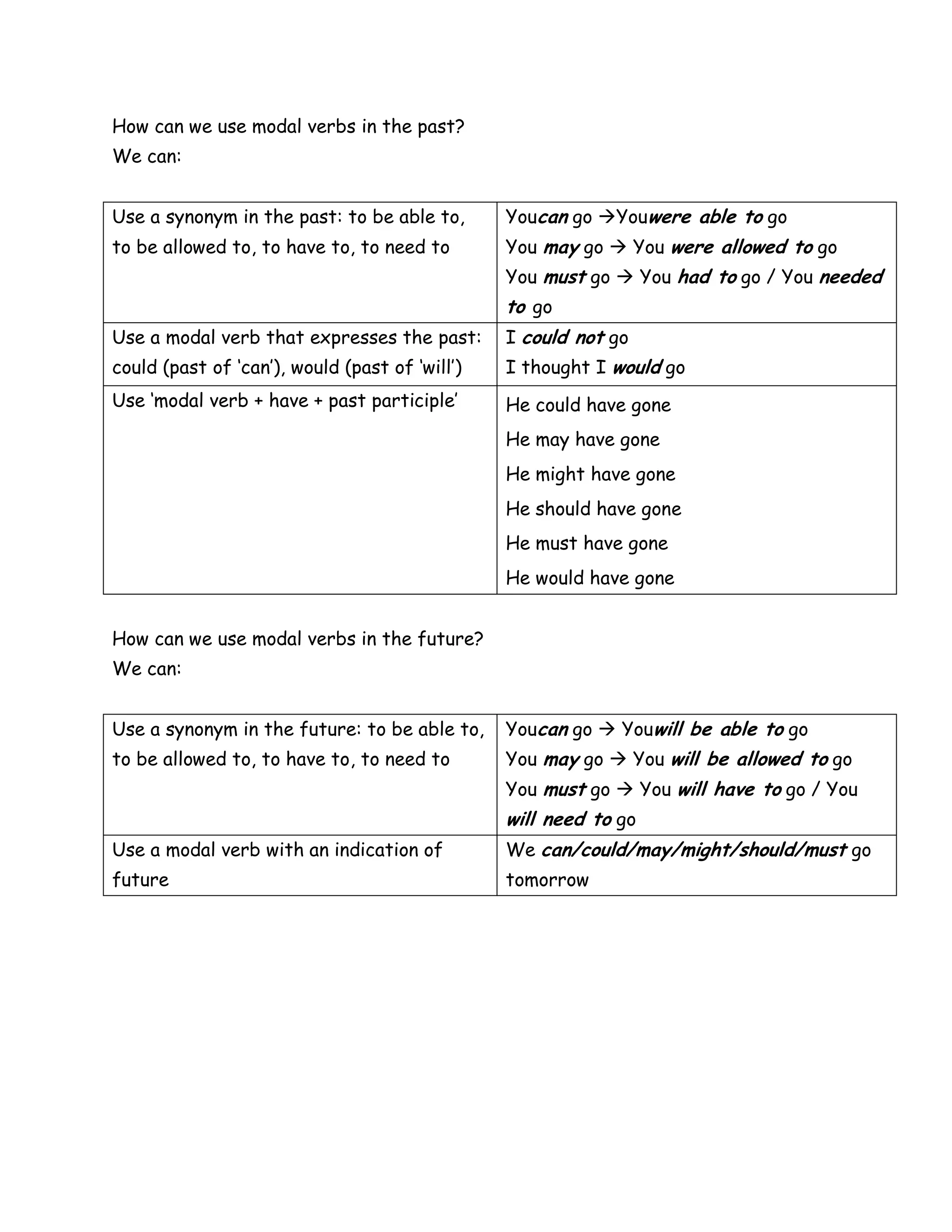
How can we use modal verbs in the past?
We can:
Use a synonym in the past: to be able to,
to be allowed to, to have to, to need to
Youcan go Youwere able to go
You may go  You were allowed to go
You must go  You had to go / You needed
to go
Use a modal verb that expresses the past:
could (past of „can‟), would (past of „will‟)
I could not go
I thought I would go
Use „modal verb + have + past participle‟ He could have gone
He may have gone
He might have gone
He should have gone
He must have gone
He would have gone
How can we use modal verbs in the future?
We can:
Use a synonym in the future: to be able to,
to be allowed to, to have to, to need to
Youcan go  Youwill be able to go
You may go  You will be allowed to go
You must go  You will have to go / You
will need to go
Use a modal verb with an indication of
future
We can/could/may/might/should/must go
tomorrow
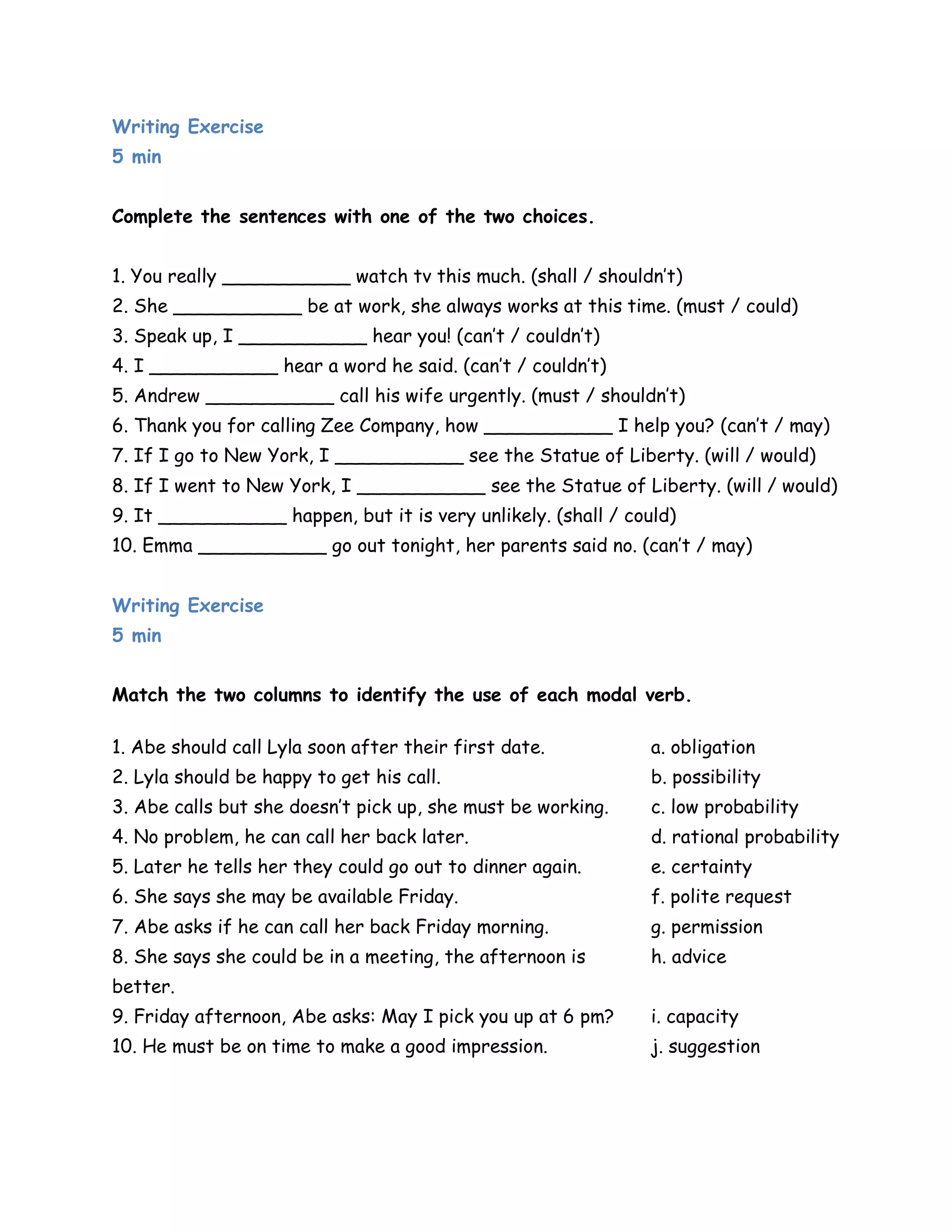
Writing Exercise
5 min
Complete the sentences with one of the two choices.
1. You really ___________ watch tv this much. (shall / shouldn‟t)
2. She ___________ be at work, she always works at this time. (must / could)
3. Speak up, I ___________ hear you! (can‟t / couldn‟t)
4. I ___________ hear a word he said. (can‟t / couldn‟t)
5. Andrew ___________ call his wife urgently. (must / shouldn‟t)
6. Thank you for calling Zee Company, how ___________ I help you? (can‟t / may)
7. If I go to New York, I ___________ see the Statue of Liberty. (will / would)
8. If I went to New York, I ___________ see the Statue of Liberty. (will / would)
9. It ___________ happen, but it is very unlikely. (shall / could)
10. Emma ___________ go out tonight, her parents said no. (can‟t / may)
Writing Exercise
5 min
Match the two columns to identify the use of each modal verb.
1. Abe should call Lyla soon after their first date. a. obligation
2. Lyla should be happy to get his call. b. possibility
3. Abe calls but she doesn‟t pick up, she must be working. c. low probability
4. No problem, he can call her back later. d. rational probability
5. Later he tells her they could go out to dinner again. e. certainty
6. She says she may be available Friday. f. polite request
7. Abe asks if he can call her back Friday morning. g. permission
8. She says she could be in a meeting, the afternoon is
better.
h. advice
9. Friday afternoon, Abe asks: May I pick you up at 6 pm? i. capacity
10. He must be on time to make a good impression. j. suggestion
Writing Exercise
5 min
Complete the sentences with a modal verb from this list, without using the
same one twice: can, could, may, might, should, must, shall, will, would
1. Children ___________ go to school.
2. Before you make a decision, you___________ speak to a specialist.
3. I___________ ride a horse, I love horse riding.
4. Let‟s go,___________ we?
5. Jake___________ speak some English before the training.
6. ___________ I please speak to Mrs. Sanders?
7. I promise I___________ buy you a new phone.
8. He___________ join us later, he is not sure.
9. If I were you, I ___________ take this opportunity.
Writing Exercise
5 min
Match each sentence to a sentence with the same meaning.
1. Jack must write a report tomorrow. a. She needs to help him, or the report
will not be finished on time.
2. Jack couldn‟t write it yesterday. b. Jennifer‟s boss says she is allowed to
help Jack.
3. Jennifer says she can help him
tomorrow.
c. Jack will have to write a report
tomorrow.
4. She has to help him, or the report will
not be finished on time.
d. Jennifer says she will be able to help
him tomorrow.
5. Jennifer‟s boss says she may help
Jack.
e. Jack wasn‟t able to write it yesterday.
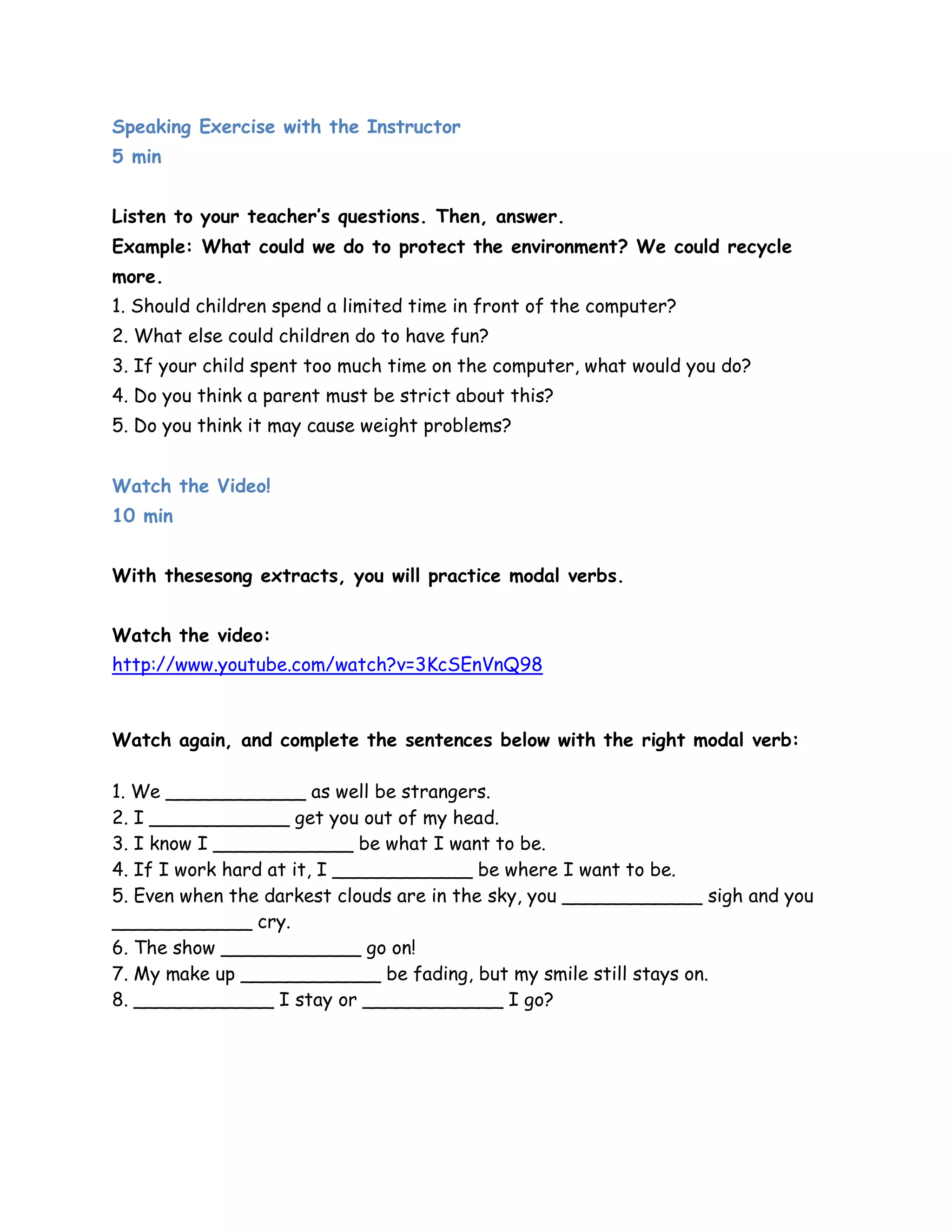
Speaking Exercise with the Instructor
5 min
Listen to your teacher’s questions. Then, answer.
Example: What could we do to protect the environment? We could recycle
more.
1. Should children spend a limited time in front of the computer?
2. What else could children do to have fun?
3. If your child spent too much time on the computer, what would you do?
4. Do you think a parent must be strict about this?
5. Do you think it may cause weight problems?
Watch the Video!
10 min
With thesesong extracts, you will practice modal verbs.
Watch the video:
http://www.youtube.com/watch?v=3KcSEnVnQ98
Watch again, and complete the sentences below with the right modal verb:
1. We ____________ as well be strangers.
2. I ____________ get you out of my head.
3. I know I ____________ be what I want to be.
4. If I work hard at it, I ____________ be where I want to be.
5. Even when the darkest clouds are in the sky, you ____________ sigh and you
____________ cry.
6. The show ____________ go on!
7. My make up ____________ be fading, but my smile still stays on.
8. ____________ I stay or ____________ I go?
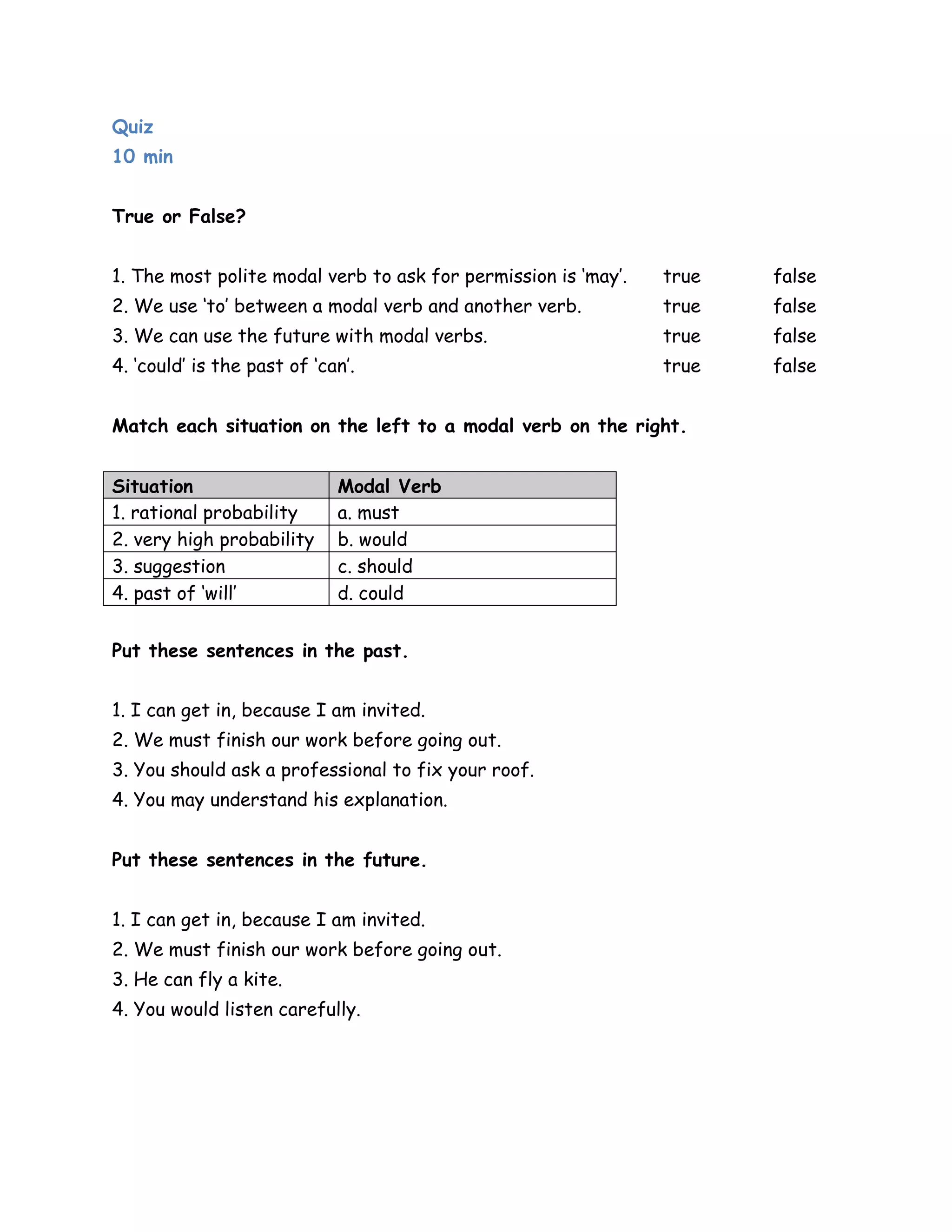
Quiz
10 min
True or False?
1. The most polite modal verb to ask for permission is „may‟. true false
2. We use „to‟ between a modal verb and another verb. true false
3. We can use the future with modal verbs. true false
4. „could‟ is the past of „can‟. true false
Match each situation on the left to a modal verb on the right.
Situation Modal Verb
1. rational probability a. must
2. very high probability b. would
3. suggestion c. should
4. past of „will‟ d. could
Put these sentences in the past.
1. I can get in, because I am invited.
2. We must finish our work before going out.
3. You should ask a professional to fix your roof.
4. You may understand his explanation.
Put these sentences in the future.
1. I can get in, because I am invited.
2. We must finish our work before going out.
3. He can fly a kite.
4. You would listen carefully.

03 modal verbs pdf

  • 1.
    VERBS (2) Modal Verbs(03) Modal Verbs: in context 2 min What are modal verbs? Modal verbs are a small group of verbs, which are very different from normal verbs. She can swim. He should go to the doctor.
  • 2.
    Common Modal Verbsand their Particularities 28 min Which verbs are common modal verbs? Can, could, may, might, should, must, shall, will, would How are modal verbs different from other verbs? - They do not take “s” in the third person: he can, she must, it could - They use “not” in the negative form: they may not, we should not - They cannot be used in the past or in the future tenses - There is no “to” after them: I can do, you must see Which modal verb do we use and when? Modal Verb Use Example Can Capacity I can drive. Permission/request Can I use your phone please? Could Capacity in the past (past of „can‟) I could not see him. Polite permission/request Could I use your phone please? Suggestion We could go to the new restaurant. Possibility, low probability or one possibility of many It could rain today. She could be at home. May Polite permission/request May I use your phone please? Possibility, more probable than „could‟ It may rain today. She may be at home. Might Same as „may‟ It might rain today. She might be at home. Should Advice He should go to the doctor. Rational probability He should be fine. Must Obligation, necessity You must go to school. Very high probability She must be at home.
  • 3.
    Shall Obligation in legaldocuments The defendant shall pay a fine of $200. Suggestions Shall we begin? Future tense, rare, British Thou shall not kill. Will A voluntary action I will make dinner. A promise I will call you at 4 pm. A prediction The summer will be very hot. Would Conditional If I had time, I would travel more. Past of „will‟ He said he would come. Repetition in the past When I lived in Paris, I would always go to the Champs Elysees. Some of these common modal verbs have synonyms we often use. Examples: must = have to, need to shemust leave = she has to live = she needs to leave should = ought to heshould speak to his boss = he ought to speak to his boss When we speak, we use contractions with some of the modal verbs in the negative form. Examples: can't = cannot = can not couldn‟t = could not shouldn‟t = should not mustn‟t = must not won‟t = will not wouldn‟t = would not
  • 4.
    How can weuse modal verbs in the past? We can: Use a synonym in the past: to be able to, to be allowed to, to have to, to need to Youcan go Youwere able to go You may go  You were allowed to go You must go  You had to go / You needed to go Use a modal verb that expresses the past: could (past of „can‟), would (past of „will‟) I could not go I thought I would go Use „modal verb + have + past participle‟ He could have gone He may have gone He might have gone He should have gone He must have gone He would have gone How can we use modal verbs in the future? We can: Use a synonym in the future: to be able to, to be allowed to, to have to, to need to Youcan go  Youwill be able to go You may go  You will be allowed to go You must go  You will have to go / You will need to go Use a modal verb with an indication of future We can/could/may/might/should/must go tomorrow
  • 5.
    Writing Exercise 5 min Completethe sentences with one of the two choices. 1. You really ___________ watch tv this much. (shall / shouldn‟t) 2. She ___________ be at work, she always works at this time. (must / could) 3. Speak up, I ___________ hear you! (can‟t / couldn‟t) 4. I ___________ hear a word he said. (can‟t / couldn‟t) 5. Andrew ___________ call his wife urgently. (must / shouldn‟t) 6. Thank you for calling Zee Company, how ___________ I help you? (can‟t / may) 7. If I go to New York, I ___________ see the Statue of Liberty. (will / would) 8. If I went to New York, I ___________ see the Statue of Liberty. (will / would) 9. It ___________ happen, but it is very unlikely. (shall / could) 10. Emma ___________ go out tonight, her parents said no. (can‟t / may) Writing Exercise 5 min Match the two columns to identify the use of each modal verb. 1. Abe should call Lyla soon after their first date. a. obligation 2. Lyla should be happy to get his call. b. possibility 3. Abe calls but she doesn‟t pick up, she must be working. c. low probability 4. No problem, he can call her back later. d. rational probability 5. Later he tells her they could go out to dinner again. e. certainty 6. She says she may be available Friday. f. polite request 7. Abe asks if he can call her back Friday morning. g. permission 8. She says she could be in a meeting, the afternoon is better. h. advice 9. Friday afternoon, Abe asks: May I pick you up at 6 pm? i. capacity 10. He must be on time to make a good impression. j. suggestion
  • 6.
    Writing Exercise 5 min Completethe sentences with a modal verb from this list, without using the same one twice: can, could, may, might, should, must, shall, will, would 1. Children ___________ go to school. 2. Before you make a decision, you___________ speak to a specialist. 3. I___________ ride a horse, I love horse riding. 4. Let‟s go,___________ we? 5. Jake___________ speak some English before the training. 6. ___________ I please speak to Mrs. Sanders? 7. I promise I___________ buy you a new phone. 8. He___________ join us later, he is not sure. 9. If I were you, I ___________ take this opportunity. Writing Exercise 5 min Match each sentence to a sentence with the same meaning. 1. Jack must write a report tomorrow. a. She needs to help him, or the report will not be finished on time. 2. Jack couldn‟t write it yesterday. b. Jennifer‟s boss says she is allowed to help Jack. 3. Jennifer says she can help him tomorrow. c. Jack will have to write a report tomorrow. 4. She has to help him, or the report will not be finished on time. d. Jennifer says she will be able to help him tomorrow. 5. Jennifer‟s boss says she may help Jack. e. Jack wasn‟t able to write it yesterday.
  • 7.
    Speaking Exercise withthe Instructor 5 min Listen to your teacher’s questions. Then, answer. Example: What could we do to protect the environment? We could recycle more. 1. Should children spend a limited time in front of the computer? 2. What else could children do to have fun? 3. If your child spent too much time on the computer, what would you do? 4. Do you think a parent must be strict about this? 5. Do you think it may cause weight problems? Watch the Video! 10 min With thesesong extracts, you will practice modal verbs. Watch the video: http://www.youtube.com/watch?v=3KcSEnVnQ98 Watch again, and complete the sentences below with the right modal verb: 1. We ____________ as well be strangers. 2. I ____________ get you out of my head. 3. I know I ____________ be what I want to be. 4. If I work hard at it, I ____________ be where I want to be. 5. Even when the darkest clouds are in the sky, you ____________ sigh and you ____________ cry. 6. The show ____________ go on! 7. My make up ____________ be fading, but my smile still stays on. 8. ____________ I stay or ____________ I go?
  • 8.
    Quiz 10 min True orFalse? 1. The most polite modal verb to ask for permission is „may‟. true false 2. We use „to‟ between a modal verb and another verb. true false 3. We can use the future with modal verbs. true false 4. „could‟ is the past of „can‟. true false Match each situation on the left to a modal verb on the right. Situation Modal Verb 1. rational probability a. must 2. very high probability b. would 3. suggestion c. should 4. past of „will‟ d. could Put these sentences in the past. 1. I can get in, because I am invited. 2. We must finish our work before going out. 3. You should ask a professional to fix your roof. 4. You may understand his explanation. Put these sentences in the future. 1. I can get in, because I am invited. 2. We must finish our work before going out. 3. He can fly a kite. 4. You would listen carefully.