MODAL VERBS
KEVIN ANDRÉS MEJÍA SOTO
ANDRÉS FERNANDO CARVAJAL LOPERA
JOHANN ALBERTO BOCANEGRA MEUSBURGUER
NICOLAS ERAZO ARANA
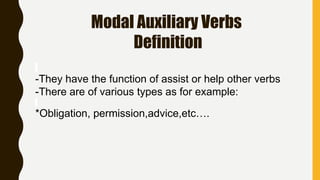
Modal Auxiliary Verbs
Definition
-They have the function of assist or help other verbs
-There are of various types as for example:
*Obligation, permission,advice,etc….
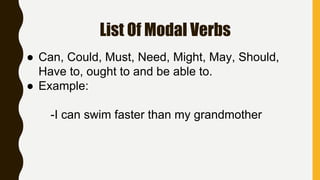
List Of Modal Verbs
● Can, Could, Must, Need, Might, May, Should,
Have to, ought to and be able to.
● Example:
-I can swim faster than my grandmother
Structure of Modal Verbs
A: Subject+modal+infinitive
N: Subject+modal(n´t)+infinitive
I: (Wh) Modal+subject+inf.?
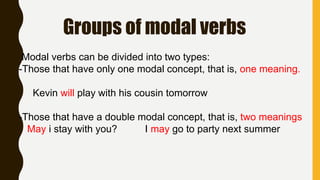
Groups of modal verbs
Modal verbs can be divided into two types:
-Those that have only one modal concept, that is, one meaning.
Kevin will play with his cousin tomorrow
-Those that have a double modal concept, that is, two meanings
May i stay with you? I may go to party next summer
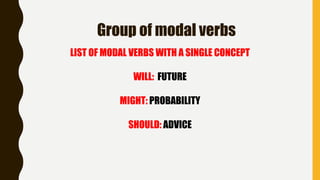
Group of modal verbs
LIST OF MODAL VERBS WITH A SINGLE CONCEPT
WILL: FUTURE
MIGHT: PROBABILITY
SHOULD: ADVICE
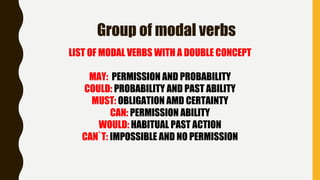
Group of modal verbs
LIST OF MODAL VERBS WITH A DOUBLE CONCEPT
MAY: PERMISSION AND PROBABILITY
COULD: PROBABILITY AND PAST ABILITY
MUST: OBLIGATION AMD CERTAINTY
CAN: PERMISSION ABILITY
WOULD: HABITUAL PAST ACTION
CAN`T: IMPOSSIBLE AND NO PERMISSION
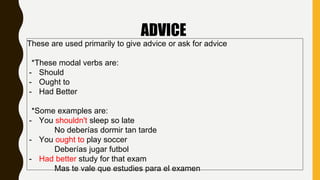
ADVICE
These are used primarily to give advice or ask for advice
*These modal verbs are:
- Should
- Ought to
- Had Better
*Some examples are:
- You shouldn't sleep so late
No deberías dormir tan tarde
- You ought to play soccer
Deberías jugar futbol
- Had better study for that exam
Mas te vale que estudies para el examen
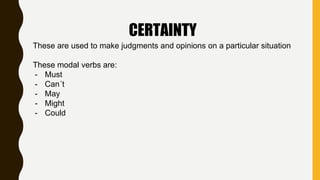
CERTAINTY
These are used to make judgments and opinions on a particular situation
These modal verbs are:
- Must
- Can´t
- May
- Might
- Could
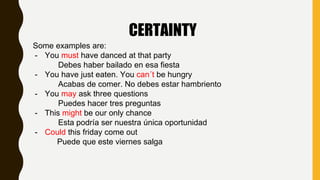
CERTAINTY
Some examples are:
- You must have danced at that party
Debes haber bailado en esa fiesta
- You have just eaten. You can´t be hungry
Acabas de comer. No debes estar hambriento
- You may ask three questions
Puedes hacer tres preguntas
- This might be our only chance
Esta podría ser nuestra única oportunidad
- Could this friday come out
Puede que este viernes salga
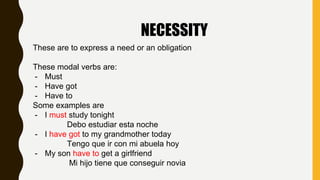
NECESSITY
These are to express a need or an obligation
These modal verbs are:
- Must
- Have got
- Have to
Some examples are
- I must study tonight
Debo estudiar esta noche
- I have got to my grandmother today
Tengo que ir con mi abuela hoy
- My son have to get a girlfriend
Mi hijo tiene que conseguir novia
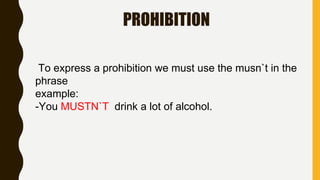
PROHIBITION
To express a prohibition we must use the musn`t in the
phrase
example:
-You MUSTN`T drink a lot of alcohol.
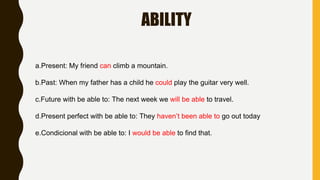
ABILITY
a.Present: My friend can climb a mountain.
b.Past: When my father has a child he could play the guitar very well.
c.Future with be able to: The next week we will be able to travel.
d.Present perfect with be able to: They haven’t been able to go out today
e.Condicional with be able to: I would be able to find that.
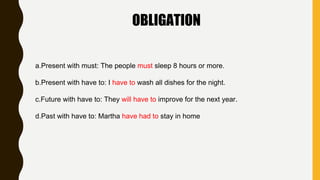
OBLIGATION
a.Present with must: The people must sleep 8 hours or more.
b.Present with have to: I have to wash all dishes for the night.
c.Future with have to: They will have to improve for the next year.
d.Past with have to: Martha have had to stay in home
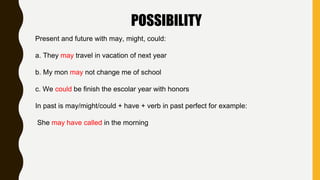
POSSIBILITY
Present and future with may, might, could:
a. They may travel in vacation of next year
b. My mon may not change me of school
c. We could be finish the escolar year with honors
In past is may/might/could + have + verb in past perfect for example:
She may have called in the morning

Modal verbs

  • 1.
    MODAL VERBS KEVIN ANDRÉSMEJÍA SOTO ANDRÉS FERNANDO CARVAJAL LOPERA JOHANN ALBERTO BOCANEGRA MEUSBURGUER NICOLAS ERAZO ARANA
  • 2.
    Modal Auxiliary Verbs Definition -Theyhave the function of assist or help other verbs -There are of various types as for example: *Obligation, permission,advice,etc….
  • 3.
    List Of ModalVerbs ● Can, Could, Must, Need, Might, May, Should, Have to, ought to and be able to. ● Example: -I can swim faster than my grandmother
  • 4.
    Structure of ModalVerbs A: Subject+modal+infinitive N: Subject+modal(n´t)+infinitive I: (Wh) Modal+subject+inf.?
  • 5.
    Groups of modalverbs Modal verbs can be divided into two types: -Those that have only one modal concept, that is, one meaning. Kevin will play with his cousin tomorrow -Those that have a double modal concept, that is, two meanings May i stay with you? I may go to party next summer
  • 6.
    Group of modalverbs LIST OF MODAL VERBS WITH A SINGLE CONCEPT WILL: FUTURE MIGHT: PROBABILITY SHOULD: ADVICE
  • 7.
    Group of modalverbs LIST OF MODAL VERBS WITH A DOUBLE CONCEPT MAY: PERMISSION AND PROBABILITY COULD: PROBABILITY AND PAST ABILITY MUST: OBLIGATION AMD CERTAINTY CAN: PERMISSION ABILITY WOULD: HABITUAL PAST ACTION CAN`T: IMPOSSIBLE AND NO PERMISSION
  • 8.
    ADVICE These are usedprimarily to give advice or ask for advice *These modal verbs are: - Should - Ought to - Had Better *Some examples are: - You shouldn't sleep so late No deberías dormir tan tarde - You ought to play soccer Deberías jugar futbol - Had better study for that exam Mas te vale que estudies para el examen
  • 9.
    CERTAINTY These are usedto make judgments and opinions on a particular situation These modal verbs are: - Must - Can´t - May - Might - Could
  • 10.
    CERTAINTY Some examples are: -You must have danced at that party Debes haber bailado en esa fiesta - You have just eaten. You can´t be hungry Acabas de comer. No debes estar hambriento - You may ask three questions Puedes hacer tres preguntas - This might be our only chance Esta podría ser nuestra única oportunidad - Could this friday come out Puede que este viernes salga
  • 11.
    NECESSITY These are toexpress a need or an obligation These modal verbs are: - Must - Have got - Have to Some examples are - I must study tonight Debo estudiar esta noche - I have got to my grandmother today Tengo que ir con mi abuela hoy - My son have to get a girlfriend Mi hijo tiene que conseguir novia
  • 12.
    PROHIBITION To express aprohibition we must use the musn`t in the phrase example: -You MUSTN`T drink a lot of alcohol.
  • 13.
    ABILITY a.Present: My friendcan climb a mountain. b.Past: When my father has a child he could play the guitar very well. c.Future with be able to: The next week we will be able to travel. d.Present perfect with be able to: They haven’t been able to go out today e.Condicional with be able to: I would be able to find that.
  • 14.
    OBLIGATION a.Present with must:The people must sleep 8 hours or more. b.Present with have to: I have to wash all dishes for the night. c.Future with have to: They will have to improve for the next year. d.Past with have to: Martha have had to stay in home
  • 15.
    POSSIBILITY Present and futurewith may, might, could: a. They may travel in vacation of next year b. My mon may not change me of school c. We could be finish the escolar year with honors In past is may/might/could + have + verb in past perfect for example: She may have called in the morning