PRONOUNS
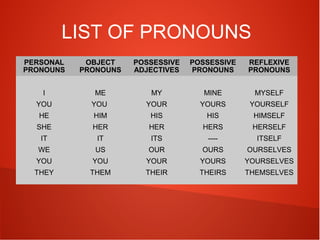
LIST OF PRONOUNS
PERSONAL
PRONOUNS

OBJECT
PRONOUNS

POSSESSIVE
ADJECTIVES

POSSESSIVE
PRONOUNS

REFLEXIVE
PRONOUNS

I

ME

MY

MINE

MYSELF

YOU

YOU

YOUR

YOURS

YOURSELF

HE

HIM

HIS

HIS

HIMSELF

SHE

HER

HER

HERS

HERSELF

IT

IT

ITS

----

ITSELF

WE

US

OUR

OURS

OURSELVES

YOU

YOU

YOUR

YOURS

YOURSELVES

THEY

THEM

THEIR

THEIRS

THEMSELVES
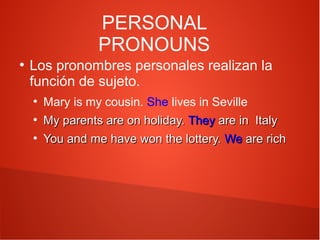
PERSONAL
PRONOUNS
●

Los pronombres personales realizan la
función de sujeto.
●
●
●

Mary is my cousin. She lives in Seville
My parents are on holiday. They are in Italy
You and me have won the lottery. We are rich
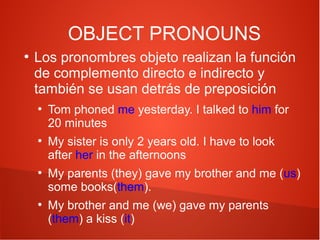
OBJECT PRONOUNS
●

Los pronombres objeto realizan la función
de complemento directo e indirecto y
también se usan detrás de preposición
●

●

●

●

Tom phoned me yesterday. I talked to him for
20 minutes
My sister is only 2 years old. I have to look
after her in the afternoons
My parents (they) gave my brother and me (us)
some books(them).
My brother and me (we) gave my parents
(them) a kiss (it)
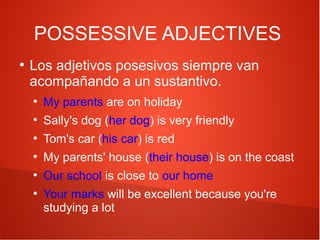
POSSESSIVE ADJECTIVES
●

Los adjetivos posesivos siempre van
acompañando a un sustantivo.
●

My parents are on holiday

●

Sally's dog (her dog) is very friendly

●

Tom's car (his car) is red

●

My parents' house (their house) is on the coast

●

Our school is close to our home

●

Your marks will be excellent because you're
studying a lot
POSSESSIVE
PRONOUNS
●

Sustituyen a adjetivo posesivo + sustantivo;
en español serían “mío, tuyo, suyo, etc.”
●

This is my book. It's mine

●

This is your book. It's yours

●

This is Tom's book. It's his

●

This is Mary's book. It's hers

●

This is my parents' book. It's theirs
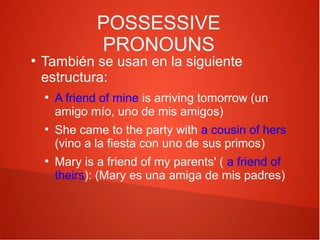
POSSESSIVE
PRONOUNS

●

También se usan en la siguiente
estructura:
●

●

●

A friend of mine is arriving tomorrow (un
amigo mío, uno de mis amigos)
She came to the party with a cousin of hers
(vino a la fiesta con uno de sus primos)
Mary is a friend of my parents' ( a friend of
theirs): (Mary es una amiga de mis padres)
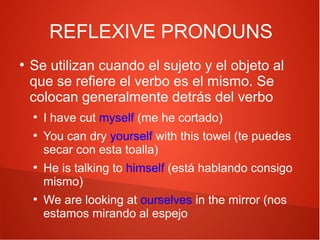
REFLEXIVE PRONOUNS
●

Se utilizan cuando el sujeto y el objeto al
que se refiere el verbo es el mismo. Se
colocan generalmente detrás del verbo
●
●

●

●

I have cut myself (me he cortado)
You can dry yourself with this towel (te puedes
secar con esta toalla)
He is talking to himself (está hablando consigo
mismo)
We are looking at ourselves in the mirror (nos
estamos mirando al espejo
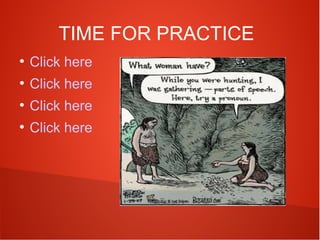
TIME FOR PRACTICE
●

Click here

●

Click here

●

Click here

●

Click here
TIME FOR PRACTICE
●

Click here

●

Click here

●

Click here

●

Click here

Pronouns