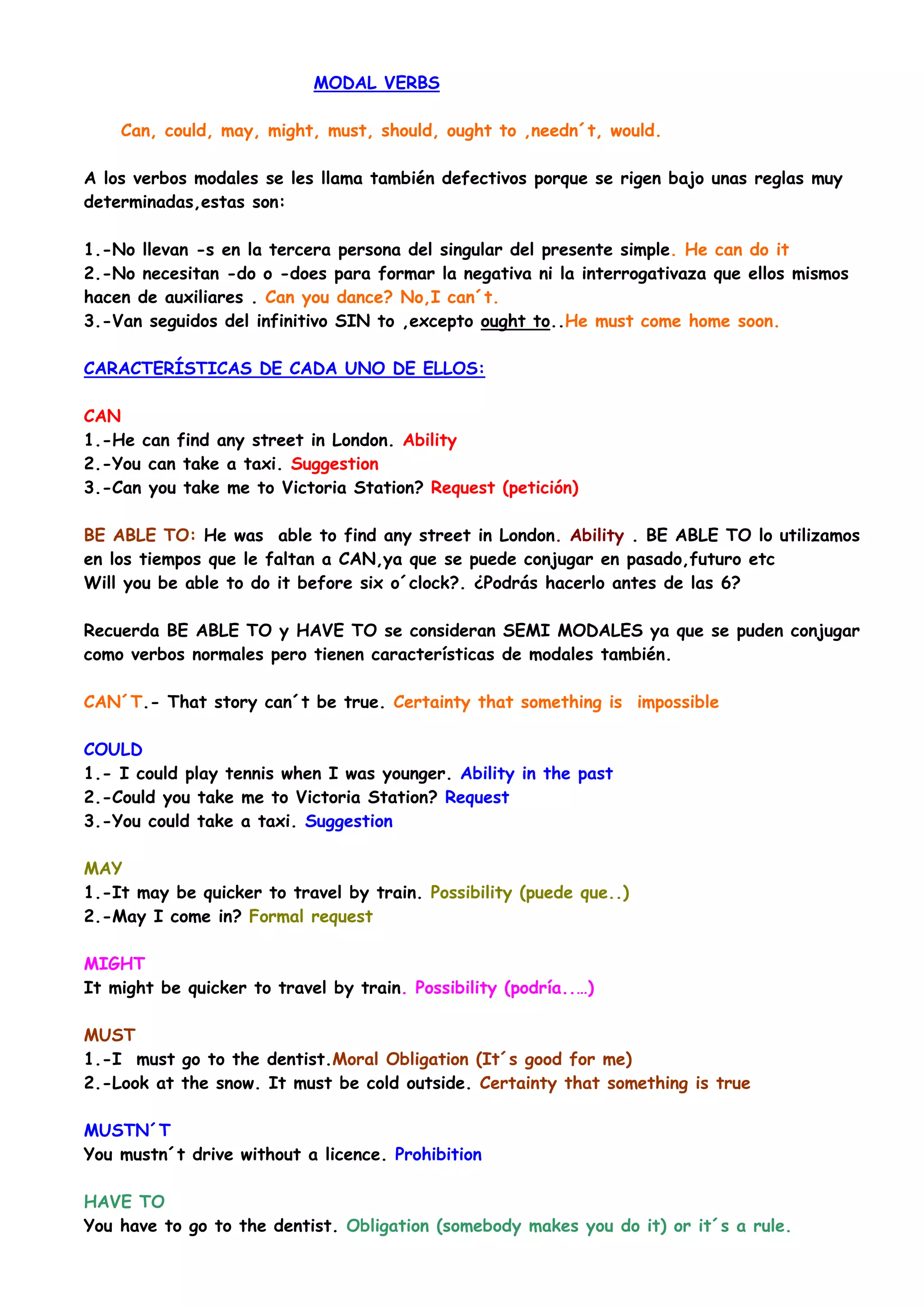
MODAL VERBS
Can, could, may, might, must, should, ought to ,needn´t, would.
A los verbos modales se les llama también defectivos porque se rigen bajo unas reglas muy
determinadas,estas son:
1.-No llevan -s en la tercera persona del singular del presente simple. He can do it
2.-No necesitan -do o -does para formar la negativa ni la interrogativaza que ellos mismos
hacen de auxiliares . Can you dance? No,I can´t.
3.-Van seguidos del infinitivo SIN to ,excepto ought to..He must come home soon.
CARACTERÍSTICAS DE CADA UNO DE ELLOS:
CAN
1.-He can find any street in London. Ability
2.-You can take a taxi. Suggestion
3.-Can you take me to Victoria Station? Request (petición)
BE ABLE TO: He was able to find any street in London. Ability . BE ABLE TO lo utilizamos
en los tiempos que le faltan a CAN,ya que se puede conjugar en pasado,futuro etc
Will you be able to do it before six o´clock?. ¿Podrás hacerlo antes de las 6?
Recuerda BE ABLE TO y HAVE TO se consideran SEMI MODALES ya que se puden conjugar
como verbos normales pero tienen características de modales también.
CAN´T.- That story can´t be true. Certainty that something is impossible
COULD
1.- I could play tennis when I was younger. Ability in the past
2.-Could you take me to Victoria Station? Request
3.-You could take a taxi. Suggestion
MAY
1.-It may be quicker to travel by train. Possibility (puede que..)
2.-May I come in? Formal request
MIGHT
It might be quicker to travel by train. Possibility (podría..…)
MUST
1.-I must go to the dentist.Moral Obligation (It´s good for me)
2.-Look at the snow. It must be cold outside. Certainty that something is true
MUSTN´T
You mustn´t drive without a licence. Prohibition
HAVE TO
You have to go to the dentist. Obligation (somebody makes you do it) or it´s a rule.
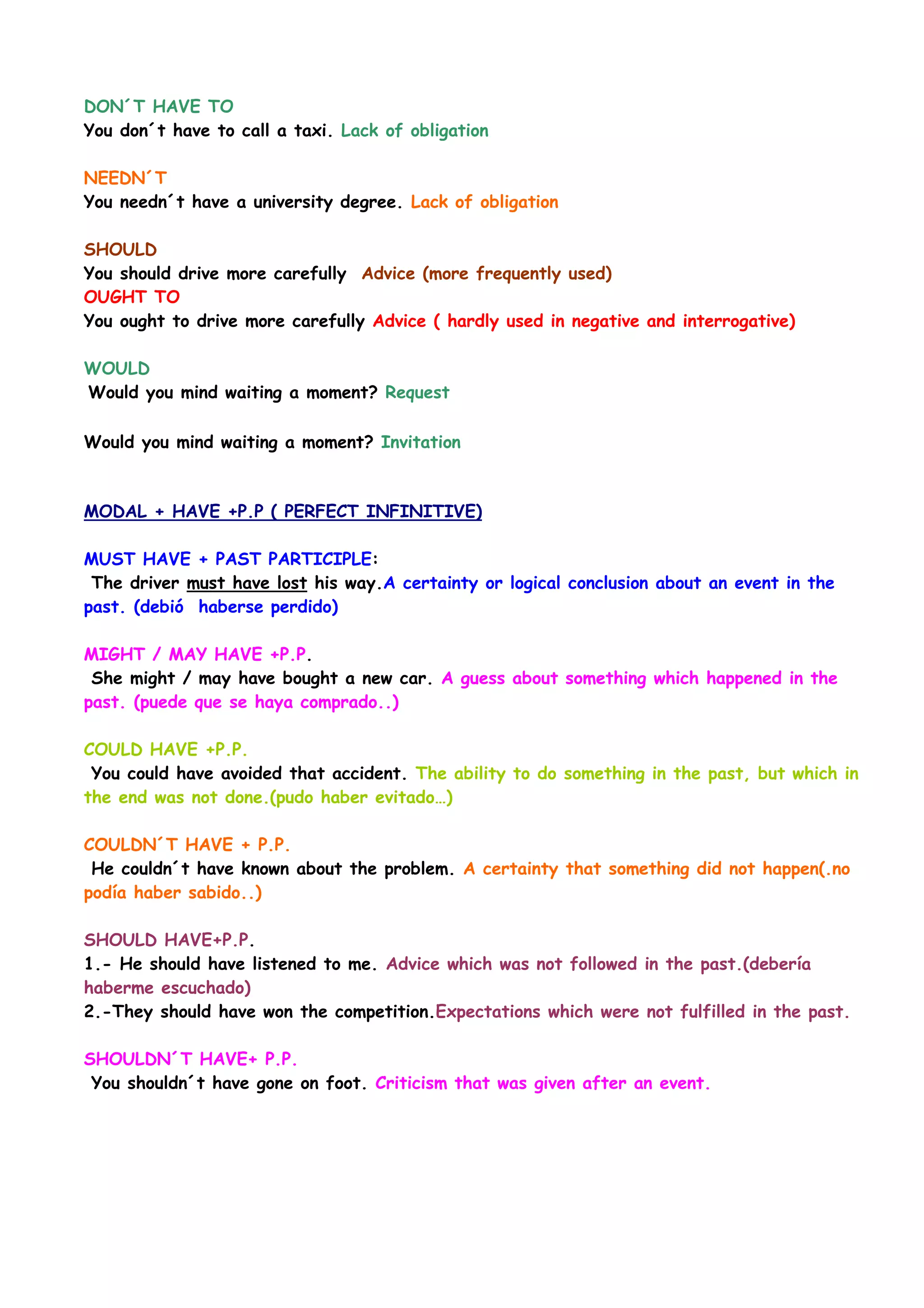
DON´T HAVE TO
You don´t have to call a taxi. Lack of obligation
NEEDN´T
You needn´t have a university degree. Lack of obligation
SHOULD
You should drive more carefully Advice (more frequently used)
OUGHT TO
You ought to drive more carefully Advice ( hardly used in negative and interrogative)
WOULD
Would you mind waiting a moment? Request
Would you mind waiting a moment? Invitation
MODAL + HAVE +P.P ( PERFECT INFINITIVE)
MUST HAVE + PAST PARTICIPLE:
The driver must have lost his way.A certainty or logical conclusion about an event in the
past. (debió haberse perdido)
MIGHT / MAY HAVE +P.P.
She might / may have bought a new car. A guess about something which happened in the
past. (puede que se haya comprado..)
COULD HAVE +P.P.
You could have avoided that accident. The ability to do something in the past, but which in
the end was not done.(pudo haber evitado…)
COULDN´T HAVE + P.P.
He couldn´t have known about the problem. A certainty that something did not happen(.no
podía haber sabido..)
SHOULD HAVE+P.P.
1.- He should have listened to me. Advice which was not followed in the past.(debería
haberme escuchado)
2.-They should have won the competition.Expectations which were not fulfilled in the past.
SHOULDN´T HAVE+ P.P.
You shouldn´t have gone on foot. Criticism that was given after an event.

Modal+verbs+new!!

  • 1.
    MODAL VERBS Can, could,may, might, must, should, ought to ,needn´t, would. A los verbos modales se les llama también defectivos porque se rigen bajo unas reglas muy determinadas,estas son: 1.-No llevan -s en la tercera persona del singular del presente simple. He can do it 2.-No necesitan -do o -does para formar la negativa ni la interrogativaza que ellos mismos hacen de auxiliares . Can you dance? No,I can´t. 3.-Van seguidos del infinitivo SIN to ,excepto ought to..He must come home soon. CARACTERÍSTICAS DE CADA UNO DE ELLOS: CAN 1.-He can find any street in London. Ability 2.-You can take a taxi. Suggestion 3.-Can you take me to Victoria Station? Request (petición) BE ABLE TO: He was able to find any street in London. Ability . BE ABLE TO lo utilizamos en los tiempos que le faltan a CAN,ya que se puede conjugar en pasado,futuro etc Will you be able to do it before six o´clock?. ¿Podrás hacerlo antes de las 6? Recuerda BE ABLE TO y HAVE TO se consideran SEMI MODALES ya que se puden conjugar como verbos normales pero tienen características de modales también. CAN´T.- That story can´t be true. Certainty that something is impossible COULD 1.- I could play tennis when I was younger. Ability in the past 2.-Could you take me to Victoria Station? Request 3.-You could take a taxi. Suggestion MAY 1.-It may be quicker to travel by train. Possibility (puede que..) 2.-May I come in? Formal request MIGHT It might be quicker to travel by train. Possibility (podría..…) MUST 1.-I must go to the dentist.Moral Obligation (It´s good for me) 2.-Look at the snow. It must be cold outside. Certainty that something is true MUSTN´T You mustn´t drive without a licence. Prohibition HAVE TO You have to go to the dentist. Obligation (somebody makes you do it) or it´s a rule.
  • 2.
    DON´T HAVE TO Youdon´t have to call a taxi. Lack of obligation NEEDN´T You needn´t have a university degree. Lack of obligation SHOULD You should drive more carefully Advice (more frequently used) OUGHT TO You ought to drive more carefully Advice ( hardly used in negative and interrogative) WOULD Would you mind waiting a moment? Request Would you mind waiting a moment? Invitation MODAL + HAVE +P.P ( PERFECT INFINITIVE) MUST HAVE + PAST PARTICIPLE: The driver must have lost his way.A certainty or logical conclusion about an event in the past. (debió haberse perdido) MIGHT / MAY HAVE +P.P. She might / may have bought a new car. A guess about something which happened in the past. (puede que se haya comprado..) COULD HAVE +P.P. You could have avoided that accident. The ability to do something in the past, but which in the end was not done.(pudo haber evitado…) COULDN´T HAVE + P.P. He couldn´t have known about the problem. A certainty that something did not happen(.no podía haber sabido..) SHOULD HAVE+P.P. 1.- He should have listened to me. Advice which was not followed in the past.(debería haberme escuchado) 2.-They should have won the competition.Expectations which were not fulfilled in the past. SHOULDN´T HAVE+ P.P. You shouldn´t have gone on foot. Criticism that was given after an event.