PRESENTED BY:
AMITA B.CHOULIGER
contents• What is mobile number portability
• History of MNP
• MNP in India
• Types of MNP
• Architecture
• Technical Aspects
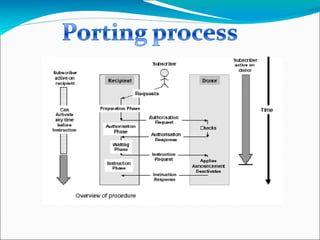
• Porting Process
• Benefits of MNP
• Advantages and Disadvantages
• Future Implementation
• Conclusion
• References
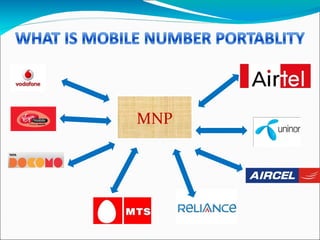
MNP
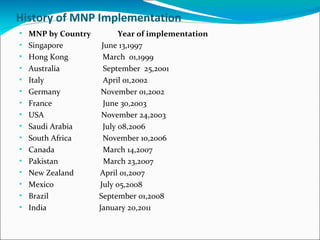
History of MNP Implementation
• MNP by Country Year of implementation
• Singapore June 13,1997
• Hong Kong March 01,1999
• Australia September 25,2001
• Italy April 01,2002
• Germany November 01,2002
• France June 30,2003
• USA November 24,2003
• Saudi Arabia July 08,2006
• South Africa November 10,2006
• Canada March 14,2007
• Pakistan March 23,2007
• New Zealand April 01,2007
• Mexico July 05,2008
• Brazil September 01,2008
• India January 20,2011
MNP in India
 On March 8 2006, the Telecom Regularity Authority of India (TRAI) issued draft
regulations to facilitate mobile number portability in India and submitted its
recommendations to the Department of Telecommunication (Dot). Finally, the Dot
recommended service provider number portability including service portability
(portability between GSM and CDMA) for all mobile service operators. It was decided to
implement the all-call-query approach for mobile number portability.
 The Dot has divided the whole country into two zones for MNP—north-west zone and
south-east zone—and awarded licenses to two vendors to work as MNP clearing house
administrators.
 Mobile number portability was started as a pilot project in Haryana on November 25,
2010 and has been implemented across the nation from January 20, 2011.
 Recently, the government of India approved New Telecom Policy-2012 (NTP), which
aims to abolish roaming charges across the country and facilitate nationwide (inter-
circle) mobile number portability
1. SERVICE OPERATOR PORTABILITY
2. LOCATION PORTABILITY
3. SERVICE PORTABILITY
• NUMBER POOLING
• NUMBER PORTABILITY DATABASE
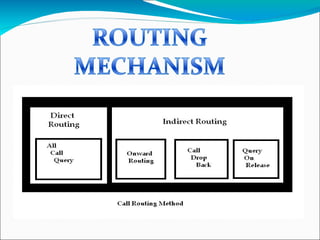
• ROUTING MECHANISM
NUMBER POOLING
Due to shortages of numbering resources FCC had approved a National
Number Pooling plan for network resource optimization
The concept of pooling is based on the fact that whole blocks of telephone
numbers, held by some service providers, are not assigned or in service.
Pooling allows these currently unassigned blocks of numbers to be
reassigned to other service providers in need of numbers, as they request
and show need.
As that supply depletes, service providers will request additional numbering
resources from the industry inventory maintained by the Pooling
Administrator
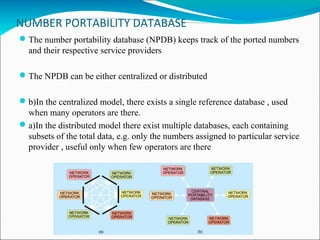
NUMBER PORTABILITY DATABASE
The number portability database (NPDB) keeps track of the ported numbers
and their respective service providers
The NPDB can be either centralized or distributed
b)In the centralized model, there exists a single reference database , used
when many operators are there.
a)In the distributed model there exist multiple databases, each containing
subsets of the total data, e.g. only the numbers assigned to particular service
provider , useful only when few operators are there
• The Originating Network receives a
Msg /call from the caller and send a
query to a centrally administered Number
Portability Database (NPDB)
• The NPDB returns the routing number
associated with the dialed directory
number.
• The Originating Network uses the
routing number to route the call to the
new serving network.
• The Originating Network receives a call
from the caller and routes the call to the
donor network
• The donor network detects that the
dialed directory number has been ported
out of the donor switch and checks with an
internal network-specific NPDB
• The internal NPDB returns the routing
number associated with the dialed
directory number
• The donor network uses the routing
number to route the call to the new
serving network.
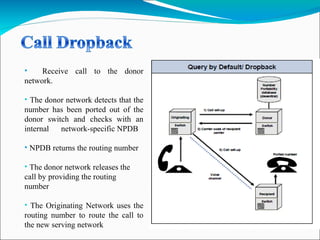
• Receive call to the donor
network.
• The donor network detects that the
number has been ported out of the
donor switch and checks with an
internal network-specific NPDB
• NPDB returns the routing number
• The donor network releases the
call by providing the routing
number
• The Originating Network uses the
routing number to route the call to
the new serving network
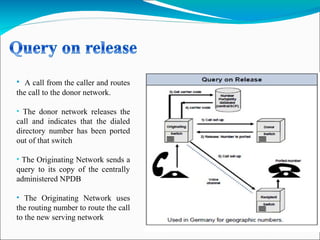
• A call from the caller and routes
the call to the donor network.
• The donor network releases the
call and indicates that the dialed
directory number has been ported
out of that switch
• The Originating Network sends a
query to its copy of the centrally
administered NPDB
• The Originating Network uses
the routing number to route the call
to the new serving network
BENEFITS OF MOBILE NUMBER
PORTABILITY
 MNP gives best benefit to the customer, as they do not
have to change their number, eliminating a great headache of
communicating the new number to all his/her important
contacts
 MNP will keep all the mobile network providers on an alert
 Network provider will really treat the customer as a
king. You will get lightning response and great customer
service from your existing mobile network providers
ADVANTAGES DISADVANTAGES
Can retain existing mobile
number.
Just for a small fee of 19/-
You can switch from GSM to
CDMA and vice versa
Change in location having
same number
cannot switch again for the next
90 days.
Change in hand set when
change in platform
FUTURE IMPLEMENTATION
 
switch from one geographic location to other i.e. having one
number across the country. Example if your number is
registered in Karnataka you can switch to a service provider
in Gujarat
Not loosing balance on prepaid cards.
Changing from CDMA-to-GSM or vice-versa without
change in handset
If the customer has extra services, like caller tune, GPRS,
voice mail and others alike, then these services will not be
lost
CONCLUSION
Number portability removes important barrier to increased competition in
the telecommunications sector.
As such, it brings challenges and opportunities for old and new
telecommunications providers
To be successful in the competitive telecommunications environment,
carriers have to carefully analyze their network and administrative
infrastructures, select the best number portability solution for their needs
and exploit the benefits of increased customer choice that NP provides
References
  Suresh A.S January - April (2011), International Journal of Management
Research and Development (IJMRD), Mobile number portability-opportunities and
challenges.
 Aoki, R. and J. Small (1999), The economics of number portability: Switching
costs and two-part tariffs, working paper, University of Auckland.
 
 Detecon Number Portability
Web based references
 FCC, 1996. Telecommunications Act of 1996, Pub. LA.No. 104-104, 110 Stat. 56 (1996).
http://www.fcc.gov/telecom.html
 Network Working Group http://www.ietf.org/rfc/rfc3482.txt
 Wikipedia, Mobile Number Portability
http://en.wikipedia.org/wiki/Mobile_number_portability
mobile-number-portability

mobile-number-portability

  • 1.
  • 2.
    contents• What ismobile number portability • History of MNP • MNP in India • Types of MNP • Architecture • Technical Aspects • Porting Process • Benefits of MNP • Advantages and Disadvantages • Future Implementation • Conclusion • References
  • 3.
  • 4.
    History of MNPImplementation • MNP by Country Year of implementation • Singapore June 13,1997 • Hong Kong March 01,1999 • Australia September 25,2001 • Italy April 01,2002 • Germany November 01,2002 • France June 30,2003 • USA November 24,2003 • Saudi Arabia July 08,2006 • South Africa November 10,2006 • Canada March 14,2007 • Pakistan March 23,2007 • New Zealand April 01,2007 • Mexico July 05,2008 • Brazil September 01,2008 • India January 20,2011
  • 5.
    MNP in India On March 8 2006, the Telecom Regularity Authority of India (TRAI) issued draft regulations to facilitate mobile number portability in India and submitted its recommendations to the Department of Telecommunication (Dot). Finally, the Dot recommended service provider number portability including service portability (portability between GSM and CDMA) for all mobile service operators. It was decided to implement the all-call-query approach for mobile number portability.  The Dot has divided the whole country into two zones for MNP—north-west zone and south-east zone—and awarded licenses to two vendors to work as MNP clearing house administrators.  Mobile number portability was started as a pilot project in Haryana on November 25, 2010 and has been implemented across the nation from January 20, 2011.  Recently, the government of India approved New Telecom Policy-2012 (NTP), which aims to abolish roaming charges across the country and facilitate nationwide (inter- circle) mobile number portability
  • 6.
    1. SERVICE OPERATORPORTABILITY 2. LOCATION PORTABILITY 3. SERVICE PORTABILITY
  • 8.
    • NUMBER POOLING •NUMBER PORTABILITY DATABASE • ROUTING MECHANISM
  • 9.
    NUMBER POOLING Due toshortages of numbering resources FCC had approved a National Number Pooling plan for network resource optimization The concept of pooling is based on the fact that whole blocks of telephone numbers, held by some service providers, are not assigned or in service. Pooling allows these currently unassigned blocks of numbers to be reassigned to other service providers in need of numbers, as they request and show need. As that supply depletes, service providers will request additional numbering resources from the industry inventory maintained by the Pooling Administrator
  • 10.
    NUMBER PORTABILITY DATABASE Thenumber portability database (NPDB) keeps track of the ported numbers and their respective service providers The NPDB can be either centralized or distributed b)In the centralized model, there exists a single reference database , used when many operators are there. a)In the distributed model there exist multiple databases, each containing subsets of the total data, e.g. only the numbers assigned to particular service provider , useful only when few operators are there
  • 12.
    • The OriginatingNetwork receives a Msg /call from the caller and send a query to a centrally administered Number Portability Database (NPDB) • The NPDB returns the routing number associated with the dialed directory number. • The Originating Network uses the routing number to route the call to the new serving network.
  • 13.
    • The OriginatingNetwork receives a call from the caller and routes the call to the donor network • The donor network detects that the dialed directory number has been ported out of the donor switch and checks with an internal network-specific NPDB • The internal NPDB returns the routing number associated with the dialed directory number • The donor network uses the routing number to route the call to the new serving network.
  • 14.
    • Receive callto the donor network. • The donor network detects that the number has been ported out of the donor switch and checks with an internal network-specific NPDB • NPDB returns the routing number • The donor network releases the call by providing the routing number • The Originating Network uses the routing number to route the call to the new serving network
  • 15.
    • A callfrom the caller and routes the call to the donor network. • The donor network releases the call and indicates that the dialed directory number has been ported out of that switch • The Originating Network sends a query to its copy of the centrally administered NPDB • The Originating Network uses the routing number to route the call to the new serving network
  • 17.
    BENEFITS OF MOBILENUMBER PORTABILITY  MNP gives best benefit to the customer, as they do not have to change their number, eliminating a great headache of communicating the new number to all his/her important contacts  MNP will keep all the mobile network providers on an alert  Network provider will really treat the customer as a king. You will get lightning response and great customer service from your existing mobile network providers
  • 18.
    ADVANTAGES DISADVANTAGES Can retainexisting mobile number. Just for a small fee of 19/- You can switch from GSM to CDMA and vice versa Change in location having same number cannot switch again for the next 90 days. Change in hand set when change in platform
  • 19.
    FUTURE IMPLEMENTATION   switch fromone geographic location to other i.e. having one number across the country. Example if your number is registered in Karnataka you can switch to a service provider in Gujarat Not loosing balance on prepaid cards. Changing from CDMA-to-GSM or vice-versa without change in handset If the customer has extra services, like caller tune, GPRS, voice mail and others alike, then these services will not be lost
  • 20.
    CONCLUSION Number portability removesimportant barrier to increased competition in the telecommunications sector. As such, it brings challenges and opportunities for old and new telecommunications providers To be successful in the competitive telecommunications environment, carriers have to carefully analyze their network and administrative infrastructures, select the best number portability solution for their needs and exploit the benefits of increased customer choice that NP provides
  • 21.
    References   Suresh A.SJanuary - April (2011), International Journal of Management Research and Development (IJMRD), Mobile number portability-opportunities and challenges.  Aoki, R. and J. Small (1999), The economics of number portability: Switching costs and two-part tariffs, working paper, University of Auckland.    Detecon Number Portability Web based references  FCC, 1996. Telecommunications Act of 1996, Pub. LA.No. 104-104, 110 Stat. 56 (1996). http://www.fcc.gov/telecom.html  Network Working Group http://www.ietf.org/rfc/rfc3482.txt  Wikipedia, Mobile Number Portability http://en.wikipedia.org/wiki/Mobile_number_portability