

®
© 2014 MapR Technologies 1
®
© 2014 MapR Technologies
Machine Learning with Spark
Carol McDonald
®
© 2014 MapR Technologies 2
Agenda
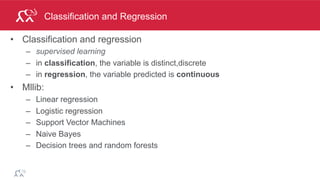
•  Classification
•  Clustering
•  Collaborative Filtering with Spark
•  Model training
•  Alternating Least Squares
•  The code
®
© 2014 MapR Technologies 3
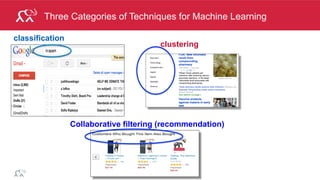
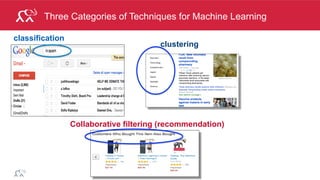
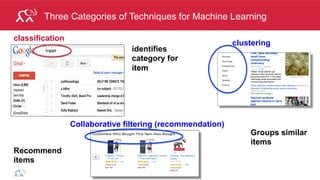
Three Categories of Techniques for Machine Learning
classification
Collaborative filtering (recommendation)
clustering
Groups similar
items
identifies
category for
item
Recommend
items
®
© 2014 MapR Technologies 4
What is classification
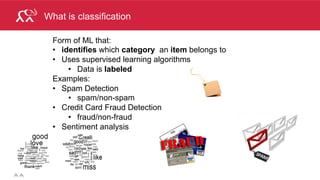
Form of ML that:
•  identifies which category an item belongs to
•  Uses supervised learning algorithms
•  Data is labeled
Examples:
•  Spam Detection
•  spam/non-spam
•  Credit Card Fraud Detection
•  fraud/non-fraud
•  Sentiment analysis
®
© 2014 MapR Technologies 5
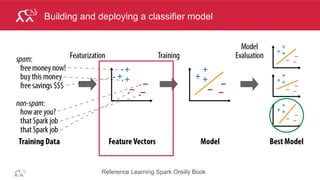
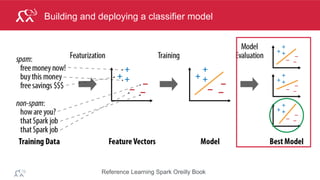
Building and deploying a classifier model
®
© 2014 MapR Technologies 6
If it walks/swims/quacks like a duck …
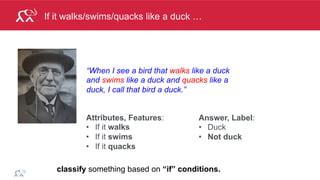
Attributes, Features:
•  If it walks
•  If it swims
•  If it quacks
“When I see a bird that walks like a duck
and swims like a duck and quacks like a
duck, I call that bird a duck.”
classify something based on “if” conditions.
Answer, Label:
•  Duck
•  Not duck
®
© 2014 MapR Technologies 7
… then it must be a duck
ducks not ducks
walks
quacks
swims
Label:
•  Duck
•  Not
duck
Features:
•  walks
•  swims
•  quacks
®
© 2014 MapR Technologies 8
Building and deploying a classifier model
Reference Learning Spark Oreilly Book
®
© 2014 MapR Technologies 9
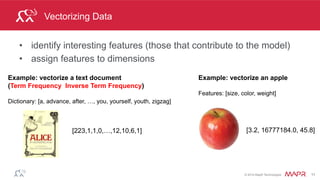
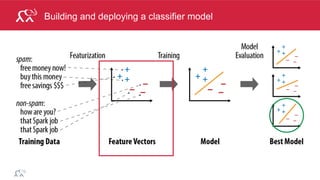
Vectorizing Data
•  identify interesting features (those that contribute to the model)
•  assign features to dimensions
Example: vectorize an apple
Features: [size, color, weight]
Example: vectorize a text document
(Term Frequency Inverse Term Frequency)
Dictionary: [a, advance, after, …, you, yourself, youth, zigzag]
[3.2, 16777184.0, 45.8][223,1,1,0,…,12,10,6,1]
®
© 2014 MapR Technologies 10
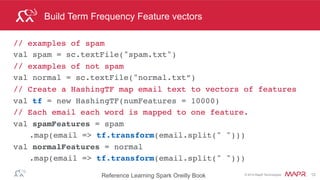
Build Term Frequency Feature vectors
// examples of spam
val spam = sc.textFile("spam.txt")
// examples of not spam
val normal = sc.textFile("normal.txt”)
// Create a HashingTF map email text to vectors of features
val tf = new HashingTF(numFeatures = 10000)
// Each email each word is mapped to one feature.
val spamFeatures = spam
.map(email => tf.transform(email.split(" ")))
val normalFeatures = normal
.map(email => tf.transform(email.split(" ")))
Reference Learning Spark Oreilly Book
®
© 2014 MapR Technologies 11
Building and deploying a classifier model
®
© 2014 MapR Technologies 12
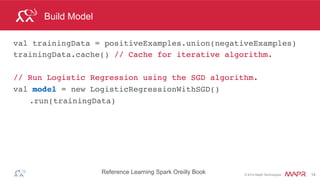
Build Model
val trainingData = positiveExamples.union(negativeExamples)
trainingData.cache() // Cache for iterative algorithm.
// Run Logistic Regression using the SGD algorithm.
val model = new LogisticRegressionWithSGD()
.run(trainingData)
Reference Learning Spark Oreilly Book
®
© 2014 MapR Technologies 13
Building and deploying a classifier model
Reference Learning Spark Oreilly Book
®
© 2014 MapR Technologies 14
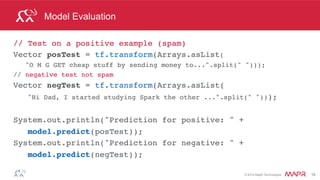
Model Evaluation
// Test on a positive example (spam)
Vector posTest = tf.transform(Arrays.asList(
"O M G GET cheap stuff by sending money to...".split(" ")));
// negative test not spam
Vector negTest = tf.transform(Arrays.asList(
"Hi Dad, I started studying Spark the other ...".split(" ")));
System.out.println("Prediction for positive: " +
model.predict(posTest));
System.out.println("Prediction for negative: " +
model.predict(negTest));
®
© 2014 MapR Technologies 15
Three Categories of Techniques for Machine Learning
classification
Collaborative filtering (recommendation)
clustering
®
© 2014 MapR Technologies 16
Clustering
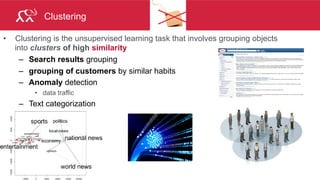
•  Clustering is the unsupervised learning task that involves grouping objects
into clusters of high similarity
–  Search results grouping
–  grouping of customers by similar habits
–  Anomaly detection
•  data traffic
–  Text categorization
®
© 2014 MapR Technologies 17
What is Clustering?
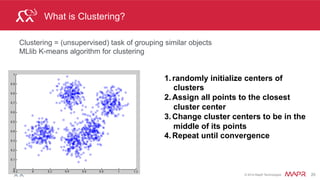
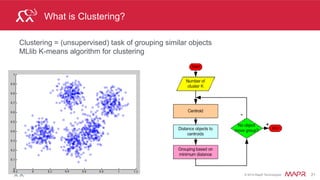
Clustering = (unsupervised) task of grouping similar objects
MLlib K-means algorithm for clustering
1.  randomly initialize centers of
clusters
2.  Assign all points to the closest
cluster center
3.  Change cluster centers to be in the
middle of its points
4.  Repeat until convergence
®
© 2014 MapR Technologies 18
What is Clustering?
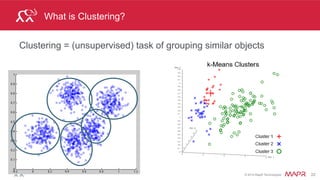
Clustering = (unsupervised) task of grouping similar objects
®
© 2014 MapR Technologies 19
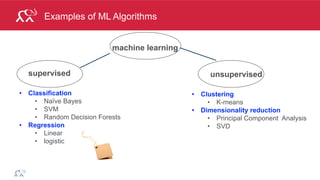
Examples of ML Algorithms
machine learning
supervised unsupervised
•  Classification
•  Naïve Bayes
•  SVM
•  Random Decision Forests
•  Regression
•  Linear
•  logistic
•  Clustering
•  K-means
•  Dimensionality reduction
•  Principal Component Analysis
•  SVD
®
© 2014 MapR Technologies 20
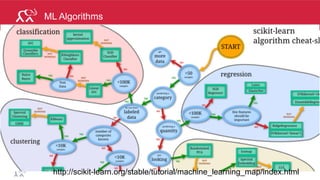
ML Algorithms
http://scikit-learn.org/stable/tutorial/machine_learning_map/index.html
®
© 2014 MapR Technologies 21
Three Categories of Techniques for Machine Learning
classification
Collaborative filtering (recommendation)
clustering
®
© 2014 MapR Technologies 22
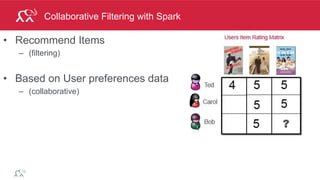
Collaborative Filtering with Spark
•  Recommend Items
–  (filtering)
•  Based on User preferences data
–  (collaborative)
®
© 2014 MapR Technologies 23
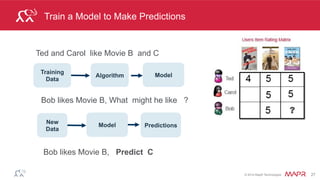
Train a Model to Make Predictions
New
Data
Model Predictions
Training
Data
ModelAlgorithm
Ted and Carol like Movie B and C
Bob likes Movie B, What might he like ?
Bob likes Movie B, Predict C
®
© 2014 MapR Technologies 24
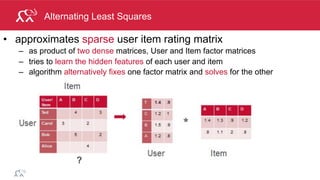
Alternating Least Squares
•  approximates sparse user item rating matrix
–  as product of two dense matrices, User and Item factor matrices
–  tries to learn the hidden features of each user and item
–  algorithm alternatively fixes one factor matrix and solves for the other
?
®
© 2014 MapR Technologies 25
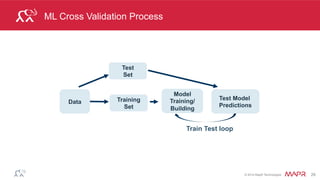
ML Cross Validation Process
Data
Model
Training/
Building
Test Model
Predictions
Test
Set
Train Test loop
Training
Set
®
© 2014 MapR Technologies 26
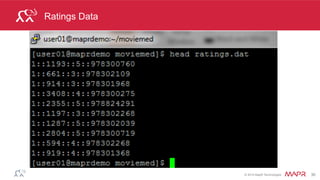
Ratings Data
®
© 2014 MapR Technologies 27
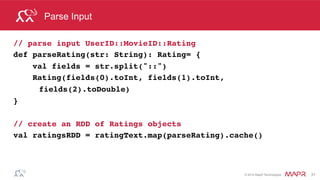
Parse Input
// parse input UserID::MovieID::Rating
def parseRating(str: String): Rating= {
val fields = str.split("::")
Rating(fields(0).toInt, fields(1).toInt,
fields(2).toDouble)
}
// create an RDD of Ratings objects
val ratingsRDD = ratingText.map(parseRating).cache()
®
© 2014 MapR Technologies 28
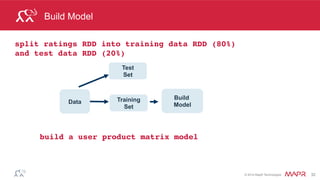
Build Model
Data
Build
Model
Test
Set
Training
Set
split ratings RDD into training data RDD (80%)
and test data RDD (20%)
build a user product matrix model
®
© 2014 MapR Technologies 29
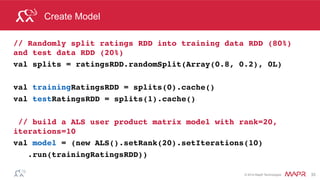
Create Model
// Randomly split ratings RDD into training data RDD (80%)
and test data RDD (20%)
val splits = ratingsRDD.randomSplit(Array(0.8, 0.2), 0L)
val trainingRatingsRDD = splits(0).cache()
val testRatingsRDD = splits(1).cache()
// build a ALS user product matrix model with rank=20,
iterations=10
val model = (new ALS().setRank(20).setIterations(10)
.run(trainingRatingsRDD))
®
© 2014 MapR Technologies 30
Get predictions
// get predicted ratings to compare to test ratings
val testUserProductRDD = testRatingsRDD.map {
case Rating(user, product, rating) => (user, product)
}
// call model.predict with test Userid, MovieId input data
val predictionsForTestRDD = model.predict(testUserProductRDD)
User, Movie
Test
Data
Model
Predicted
Ratings
®
© 2014 MapR Technologies 31
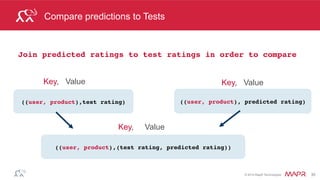
Compare predictions to Tests
Join predicted ratings to test ratings in order to compare
((user, product),test rating) ((user, product), predicted rating)
((user, product),(test rating, predicted rating))
Key, Value Key, Value
Key, Value
®
© 2014 MapR Technologies 32
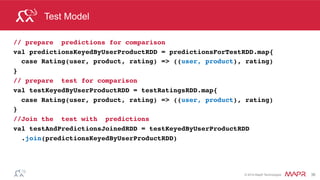
Test Model
// prepare predictions for comparison
val predictionsKeyedByUserProductRDD = predictionsForTestRDD.map{
case Rating(user, product, rating) => ((user, product), rating)
}
// prepare test for comparison
val testKeyedByUserProductRDD = testRatingsRDD.map{
case Rating(user, product, rating) => ((user, product), rating)
}
//Join the test with predictions
val testAndPredictionsJoinedRDD = testKeyedByUserProductRDD
.join(predictionsKeyedByUserProductRDD)
®
© 2014 MapR Technologies 33
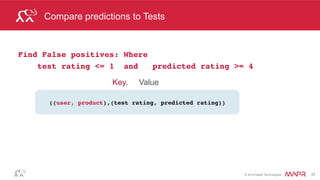
Compare predictions to Tests
Find False positives: Where
test rating <= 1 and predicted rating >= 4
((user, product),(test rating, predicted rating))
Key, Value
®
© 2014 MapR Technologies 34
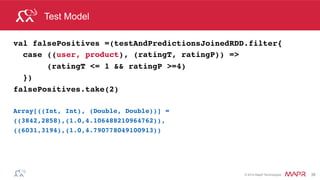
Test Model
val falsePositives =(testAndPredictionsJoinedRDD.filter{
case ((user, product), (ratingT, ratingP)) =>
(ratingT <= 1 && ratingP >=4)
})
falsePositives.take(2)
Array[((Int, Int), (Double, Double))] =
((3842,2858),(1.0,4.106488210964762)),
((6031,3194),(1.0,4.790778049100913))
®
© 2014 MapR Technologies 35
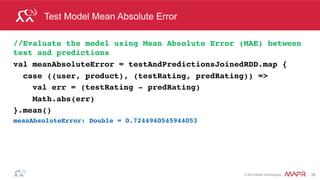
Test Model Mean Absolute Error
//Evaluate the model using Mean Absolute Error (MAE) between
test and predictions
val meanAbsoluteError = testAndPredictionsJoinedRDD.map {
case ((user, product), (testRating, predRating)) =>
val err = (testRating - predRating)
Math.abs(err)
}.mean()
meanAbsoluteError: Double = 0.7244940545944053
®
© 2014 MapR Technologies 36
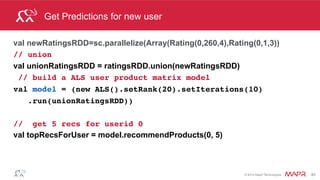
Get Predictions for new user
val newRatingsRDD=sc.parallelize(Array(Rating(0,260,4),Rating(0,1,3))
// union
val unionRatingsRDD = ratingsRDD.union(newRatingsRDD)
// build a ALS user product matrix model
val model = (new ALS().setRank(20).setIterations(10)
.run(unionRatingsRDD))
// get 5 recs for userid 0
val topRecsForUser = model.recommendProducts(0, 5)
®
© 2014 MapR Technologies 37
Soon to Come
•  Spark On Demand Training
–  https://www.mapr.com/services/mapr-academy/
•  Blogs and Tutorials:
–  Movie Recommendations with Collaborative Filtering
–  Spark Streaming
®
© 2014 MapR Technologies 38
Machine Learning Blog
•  https://www.mapr.com/blog/parallel-and-iterative-processing-
machine-learning-recommendations-spark
®
© 2014 MapR Technologies 39
Spark on MapR
•  Certified Spark Distribution
•  Fully supported and packaged by MapR in partnership with
Databricks
•  YARN integration
–  Spark can then allocate resources from cluster when needed
®
© 2014 MapR Technologies 40
References
•  Spark Online course: learn.mapr.com
•  Spark web site: http://spark.apache.org/
•  https://databricks.com/
•  Spark on MapR:
–  http://www.mapr.com/products/apache-spark
•  Spark SQL and DataFrame Guide
•  Apache Spark vs. MapReduce – Whiteboard Walkthrough
•  Learning Spark - O'Reilly Book
•  Apache Spark
®
© 2014 MapR Technologies 41
Q&A
@mapr maprtech
Engage with us!
MapR
maprtech
mapr-technologies

Apache Spark Machine Learning

  • 1.
    ® © 2014 MapRTechnologies 1 ® © 2014 MapR Technologies Machine Learning with Spark Carol McDonald
  • 2.
    ® © 2014 MapRTechnologies 2 Agenda •  Classification •  Clustering •  Collaborative Filtering with Spark •  Model training •  Alternating Least Squares •  The code
  • 3.
    ® © 2014 MapRTechnologies 3 Three Categories of Techniques for Machine Learning classification Collaborative filtering (recommendation) clustering Groups similar items identifies category for item Recommend items
  • 4.
    ® © 2014 MapRTechnologies 4 What is classification Form of ML that: •  identifies which category an item belongs to •  Uses supervised learning algorithms •  Data is labeled Examples: •  Spam Detection •  spam/non-spam •  Credit Card Fraud Detection •  fraud/non-fraud •  Sentiment analysis
  • 5.
    ® © 2014 MapRTechnologies 5 Building and deploying a classifier model
  • 6.
    ® © 2014 MapRTechnologies 6 If it walks/swims/quacks like a duck … Attributes, Features: •  If it walks •  If it swims •  If it quacks “When I see a bird that walks like a duck and swims like a duck and quacks like a duck, I call that bird a duck.” classify something based on “if” conditions. Answer, Label: •  Duck •  Not duck
  • 7.
    ® © 2014 MapRTechnologies 7 … then it must be a duck ducks not ducks walks quacks swims Label: •  Duck •  Not duck Features: •  walks •  swims •  quacks
  • 8.
    ® © 2014 MapRTechnologies 8 Building and deploying a classifier model Reference Learning Spark Oreilly Book
  • 9.
    ® © 2014 MapRTechnologies 9 Vectorizing Data •  identify interesting features (those that contribute to the model) •  assign features to dimensions Example: vectorize an apple Features: [size, color, weight] Example: vectorize a text document (Term Frequency Inverse Term Frequency) Dictionary: [a, advance, after, …, you, yourself, youth, zigzag] [3.2, 16777184.0, 45.8][223,1,1,0,…,12,10,6,1]
  • 10.
    ® © 2014 MapRTechnologies 10 Build Term Frequency Feature vectors // examples of spam val spam = sc.textFile("spam.txt") // examples of not spam val normal = sc.textFile("normal.txt”) // Create a HashingTF map email text to vectors of features val tf = new HashingTF(numFeatures = 10000) // Each email each word is mapped to one feature. val spamFeatures = spam .map(email => tf.transform(email.split(" "))) val normalFeatures = normal .map(email => tf.transform(email.split(" "))) Reference Learning Spark Oreilly Book
  • 11.
    ® © 2014 MapRTechnologies 11 Building and deploying a classifier model
  • 12.
    ® © 2014 MapRTechnologies 12 Build Model val trainingData = positiveExamples.union(negativeExamples) trainingData.cache() // Cache for iterative algorithm. // Run Logistic Regression using the SGD algorithm. val model = new LogisticRegressionWithSGD() .run(trainingData) Reference Learning Spark Oreilly Book
  • 13.
    ® © 2014 MapRTechnologies 13 Building and deploying a classifier model Reference Learning Spark Oreilly Book
  • 14.
    ® © 2014 MapRTechnologies 14 Model Evaluation // Test on a positive example (spam) Vector posTest = tf.transform(Arrays.asList( "O M G GET cheap stuff by sending money to...".split(" "))); // negative test not spam Vector negTest = tf.transform(Arrays.asList( "Hi Dad, I started studying Spark the other ...".split(" "))); System.out.println("Prediction for positive: " + model.predict(posTest)); System.out.println("Prediction for negative: " + model.predict(negTest));
  • 15.
    ® © 2014 MapRTechnologies 15 Three Categories of Techniques for Machine Learning classification Collaborative filtering (recommendation) clustering
  • 16.
    ® © 2014 MapRTechnologies 16 Clustering •  Clustering is the unsupervised learning task that involves grouping objects into clusters of high similarity –  Search results grouping –  grouping of customers by similar habits –  Anomaly detection •  data traffic –  Text categorization
  • 17.
    ® © 2014 MapRTechnologies 17 What is Clustering? Clustering = (unsupervised) task of grouping similar objects MLlib K-means algorithm for clustering 1.  randomly initialize centers of clusters 2.  Assign all points to the closest cluster center 3.  Change cluster centers to be in the middle of its points 4.  Repeat until convergence
  • 18.
    ® © 2014 MapRTechnologies 18 What is Clustering? Clustering = (unsupervised) task of grouping similar objects
  • 19.
    ® © 2014 MapRTechnologies 19 Examples of ML Algorithms machine learning supervised unsupervised •  Classification •  Naïve Bayes •  SVM •  Random Decision Forests •  Regression •  Linear •  logistic •  Clustering •  K-means •  Dimensionality reduction •  Principal Component Analysis •  SVD
  • 20.
    ® © 2014 MapRTechnologies 20 ML Algorithms http://scikit-learn.org/stable/tutorial/machine_learning_map/index.html
  • 21.
    ® © 2014 MapRTechnologies 21 Three Categories of Techniques for Machine Learning classification Collaborative filtering (recommendation) clustering
  • 22.
    ® © 2014 MapRTechnologies 22 Collaborative Filtering with Spark •  Recommend Items –  (filtering) •  Based on User preferences data –  (collaborative)
  • 23.
    ® © 2014 MapRTechnologies 23 Train a Model to Make Predictions New Data Model Predictions Training Data ModelAlgorithm Ted and Carol like Movie B and C Bob likes Movie B, What might he like ? Bob likes Movie B, Predict C
  • 24.
    ® © 2014 MapRTechnologies 24 Alternating Least Squares •  approximates sparse user item rating matrix –  as product of two dense matrices, User and Item factor matrices –  tries to learn the hidden features of each user and item –  algorithm alternatively fixes one factor matrix and solves for the other ?
  • 25.
    ® © 2014 MapRTechnologies 25 ML Cross Validation Process Data Model Training/ Building Test Model Predictions Test Set Train Test loop Training Set
  • 26.
    ® © 2014 MapRTechnologies 26 Ratings Data
  • 27.
    ® © 2014 MapRTechnologies 27 Parse Input // parse input UserID::MovieID::Rating def parseRating(str: String): Rating= { val fields = str.split("::") Rating(fields(0).toInt, fields(1).toInt, fields(2).toDouble) } // create an RDD of Ratings objects val ratingsRDD = ratingText.map(parseRating).cache()
  • 28.
    ® © 2014 MapRTechnologies 28 Build Model Data Build Model Test Set Training Set split ratings RDD into training data RDD (80%) and test data RDD (20%) build a user product matrix model
  • 29.
    ® © 2014 MapRTechnologies 29 Create Model // Randomly split ratings RDD into training data RDD (80%) and test data RDD (20%) val splits = ratingsRDD.randomSplit(Array(0.8, 0.2), 0L) val trainingRatingsRDD = splits(0).cache() val testRatingsRDD = splits(1).cache() // build a ALS user product matrix model with rank=20, iterations=10 val model = (new ALS().setRank(20).setIterations(10) .run(trainingRatingsRDD))
  • 30.
    ® © 2014 MapRTechnologies 30 Get predictions // get predicted ratings to compare to test ratings val testUserProductRDD = testRatingsRDD.map { case Rating(user, product, rating) => (user, product) } // call model.predict with test Userid, MovieId input data val predictionsForTestRDD = model.predict(testUserProductRDD) User, Movie Test Data Model Predicted Ratings
  • 31.
    ® © 2014 MapRTechnologies 31 Compare predictions to Tests Join predicted ratings to test ratings in order to compare ((user, product),test rating) ((user, product), predicted rating) ((user, product),(test rating, predicted rating)) Key, Value Key, Value Key, Value
  • 32.
    ® © 2014 MapRTechnologies 32 Test Model // prepare predictions for comparison val predictionsKeyedByUserProductRDD = predictionsForTestRDD.map{ case Rating(user, product, rating) => ((user, product), rating) } // prepare test for comparison val testKeyedByUserProductRDD = testRatingsRDD.map{ case Rating(user, product, rating) => ((user, product), rating) } //Join the test with predictions val testAndPredictionsJoinedRDD = testKeyedByUserProductRDD .join(predictionsKeyedByUserProductRDD)
  • 33.
    ® © 2014 MapRTechnologies 33 Compare predictions to Tests Find False positives: Where test rating <= 1 and predicted rating >= 4 ((user, product),(test rating, predicted rating)) Key, Value
  • 34.
    ® © 2014 MapRTechnologies 34 Test Model val falsePositives =(testAndPredictionsJoinedRDD.filter{ case ((user, product), (ratingT, ratingP)) => (ratingT <= 1 && ratingP >=4) }) falsePositives.take(2) Array[((Int, Int), (Double, Double))] = ((3842,2858),(1.0,4.106488210964762)), ((6031,3194),(1.0,4.790778049100913))
  • 35.
    ® © 2014 MapRTechnologies 35 Test Model Mean Absolute Error //Evaluate the model using Mean Absolute Error (MAE) between test and predictions val meanAbsoluteError = testAndPredictionsJoinedRDD.map { case ((user, product), (testRating, predRating)) => val err = (testRating - predRating) Math.abs(err) }.mean() meanAbsoluteError: Double = 0.7244940545944053
  • 36.
    ® © 2014 MapRTechnologies 36 Get Predictions for new user val newRatingsRDD=sc.parallelize(Array(Rating(0,260,4),Rating(0,1,3)) // union val unionRatingsRDD = ratingsRDD.union(newRatingsRDD) // build a ALS user product matrix model val model = (new ALS().setRank(20).setIterations(10) .run(unionRatingsRDD)) // get 5 recs for userid 0 val topRecsForUser = model.recommendProducts(0, 5)
  • 37.
    ® © 2014 MapRTechnologies 37 Soon to Come •  Spark On Demand Training –  https://www.mapr.com/services/mapr-academy/ •  Blogs and Tutorials: –  Movie Recommendations with Collaborative Filtering –  Spark Streaming
  • 38.
    ® © 2014 MapRTechnologies 38 Machine Learning Blog •  https://www.mapr.com/blog/parallel-and-iterative-processing- machine-learning-recommendations-spark
  • 39.
    ® © 2014 MapRTechnologies 39 Spark on MapR •  Certified Spark Distribution •  Fully supported and packaged by MapR in partnership with Databricks •  YARN integration –  Spark can then allocate resources from cluster when needed
  • 40.
    ® © 2014 MapRTechnologies 40 References •  Spark Online course: learn.mapr.com •  Spark web site: http://spark.apache.org/ •  https://databricks.com/ •  Spark on MapR: –  http://www.mapr.com/products/apache-spark •  Spark SQL and DataFrame Guide •  Apache Spark vs. MapReduce – Whiteboard Walkthrough •  Learning Spark - O'Reilly Book •  Apache Spark
  • 41.
    ® © 2014 MapRTechnologies 41 Q&A @mapr maprtech Engage with us! MapR maprtech mapr-technologies