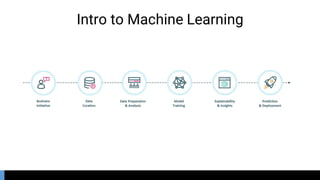
Intro to Machine Learning
For Product Managers
About me
Build Things
Product
Give & Tech
What’s the sexist job
you can think of?
Data Scientist: The Sexiest
Job of the 21st Century
“
”Harvard Business Review
What are we going to talk about?
Intro to ML
Evaluation metrics
Can we explain it?
Algorithms, pipelines, data cleaning, bias...
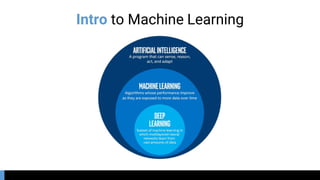
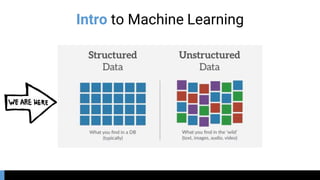
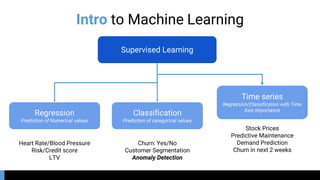
Intro to Machine Learning
Supervised Learning
Regression
Prediction of Numerical values
Classification
Prediction of categorical values
Time series
Regression/Classification with Time
Axis Importance
Churn: Yes/No
Customer Segmentation
Anomaly Detection
Stock Prices
Predictive Maintenance
Demand Prediction
Churn in next 2 weeks
Heart Rate/Blood Pressure
Risk/Credit score
LTV
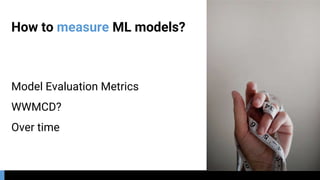
Model Evaluation Metrics
WWMCD?
Over time
How to measure ML models?
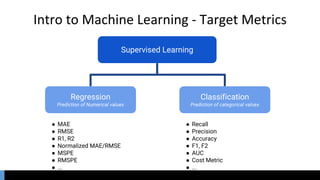
Intro to Machine Learning - Target Metrics
Supervised Learning
Regression
Prediction of Numerical values
Classification
Prediction of categorical values
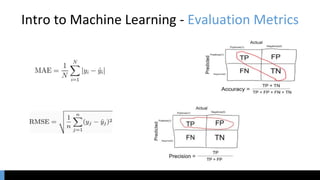
● MAE
● RMSE
● R1, R2
● Normalized MAE/RMSE
● MSPE
● RMSPE
● ...
● Recall
● Precision
● Accuracy
● F1, F2
● AUC
● Cost Metric
● ...
Intro to Machine Learning - Evaluation Metrics
What would Marty Cagan do?
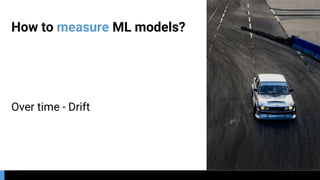
How to measure ML models?
Over time - Drift
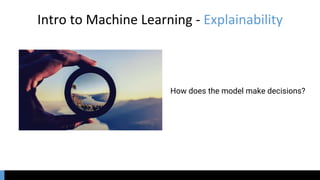
Intro to Machine Learning - Explainability
How does the model make decisions?
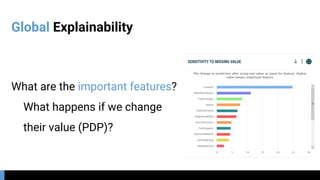
Global Explainability
What are the important features?
What happens if we change
their value (PDP)?
How can we explain a local prediction?
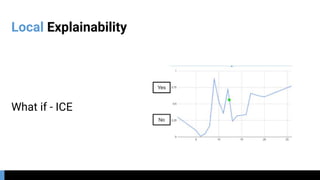
Local Explainability
What if - ICE
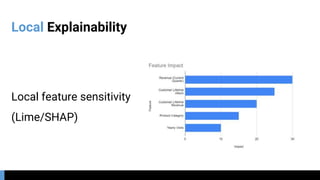
Local Explainability
Local feature sensitivity
(Lime/SHAP)
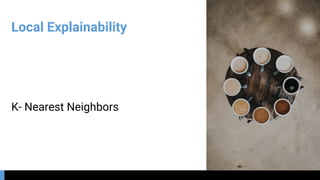
Local Explainability
K- Nearest Neighbors
If you’re reading this
We Made it :)
How to be awesome
Listen and don’t be an a-hole
Business value comes first
If you can solve without ML, go for it
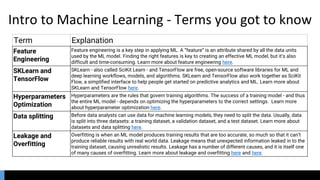
Intro to Machine Learning - Terms you got to know
Term Explanation
Feature
Engineering
Feature engineering is a key step in applying ML. A “feature” is an attribute shared by all the data units
used by the ML model. Finding the right features is key to creating an effective ML model, but it’s also
difficult and time-consuming. Learn more about feature engineering here.
SKLearn and
TensorFlow
SKLearn - also called SciKit Learn - and TensorFlow are free, open-source software libraries for ML and
deep learning workflows, models, and algorithms. SKLearn and TensorFlow also work together as SciKit
Flow, a simplified interface to help people get started on predictive analytics and ML. Learn more about
SKLearn and TensorFlow here.
Hyperparameters
Optimization
Hyperparameters are the rules that govern training algorithms. The success of a training model - and thus
the entire ML model - depends on optimizing the hyperparameters to the correct settings. Learn more
about hyperparameter optimization here.
Data splitting Before data analysts can use data for machine learning models, they need to split the data. Usually, data
is split into three datasets: a training dataset, a validation dataset, and a test dataset. Learn more about
datasets and data splitting here.
Leakage and
Overfitting
Overfitting is when an ML model produces training results that are too accurate, so much so that it can’t
produce reliable results with real world data. Leakage means that unexpected information leaked in to the
training dataset, causing unrealistic results. Leakage has a number of different causes, and it is itself one
of many causes of overfitting. Learn more about leakage and overfitting here and here.
Feedback me :)
eBook: How to add AI/ML to your product

Intro to ML for product school meetup

  • 1.
    Intro to MachineLearning For Product Managers
  • 2.
  • 3.
    What’s the sexistjob you can think of?
  • 4.
    Data Scientist: TheSexiest Job of the 21st Century “ ”Harvard Business Review
  • 5.
    What are wegoing to talk about? Intro to ML Evaluation metrics Can we explain it? Algorithms, pipelines, data cleaning, bias...
  • 6.
  • 7.
  • 8.
  • 9.
    Intro to MachineLearning Supervised Learning Regression Prediction of Numerical values Classification Prediction of categorical values Time series Regression/Classification with Time Axis Importance Churn: Yes/No Customer Segmentation Anomaly Detection Stock Prices Predictive Maintenance Demand Prediction Churn in next 2 weeks Heart Rate/Blood Pressure Risk/Credit score LTV
  • 10.
    Model Evaluation Metrics WWMCD? Overtime How to measure ML models?
  • 11.
    Intro to MachineLearning - Target Metrics Supervised Learning Regression Prediction of Numerical values Classification Prediction of categorical values ● MAE ● RMSE ● R1, R2 ● Normalized MAE/RMSE ● MSPE ● RMSPE ● ... ● Recall ● Precision ● Accuracy ● F1, F2 ● AUC ● Cost Metric ● ...
  • 12.
    Intro to MachineLearning - Evaluation Metrics
  • 13.
  • 14.
    How to measureML models? Over time - Drift
  • 15.
    Intro to MachineLearning - Explainability
  • 16.
    Intro to MachineLearning - Explainability How does the model make decisions?
  • 17.
    Global Explainability What arethe important features? What happens if we change their value (PDP)?
  • 18.
    How can weexplain a local prediction?
  • 19.
  • 20.
    Local Explainability Local featuresensitivity (Lime/SHAP)
  • 21.
  • 22.
    If you’re readingthis We Made it :)
  • 23.
    How to beawesome Listen and don’t be an a-hole Business value comes first If you can solve without ML, go for it
  • 24.
    Intro to MachineLearning - Terms you got to know Term Explanation Feature Engineering Feature engineering is a key step in applying ML. A “feature” is an attribute shared by all the data units used by the ML model. Finding the right features is key to creating an effective ML model, but it’s also difficult and time-consuming. Learn more about feature engineering here. SKLearn and TensorFlow SKLearn - also called SciKit Learn - and TensorFlow are free, open-source software libraries for ML and deep learning workflows, models, and algorithms. SKLearn and TensorFlow also work together as SciKit Flow, a simplified interface to help people get started on predictive analytics and ML. Learn more about SKLearn and TensorFlow here. Hyperparameters Optimization Hyperparameters are the rules that govern training algorithms. The success of a training model - and thus the entire ML model - depends on optimizing the hyperparameters to the correct settings. Learn more about hyperparameter optimization here. Data splitting Before data analysts can use data for machine learning models, they need to split the data. Usually, data is split into three datasets: a training dataset, a validation dataset, and a test dataset. Learn more about datasets and data splitting here. Leakage and Overfitting Overfitting is when an ML model produces training results that are too accurate, so much so that it can’t produce reliable results with real world data. Leakage means that unexpected information leaked in to the training dataset, causing unrealistic results. Leakage has a number of different causes, and it is itself one of many causes of overfitting. Learn more about leakage and overfitting here and here.
  • 25.
    Feedback me :) eBook:How to add AI/ML to your product

Editor's Notes

  • #21 Individual Conditional Expectation