● Data scientist at Cloudera
● Recently lead Apache Spark development at
Cloudera
● Before that, committing on Apache Hadoop
● Before that, studying combinatorial
optimization and distributed systems at
Brown
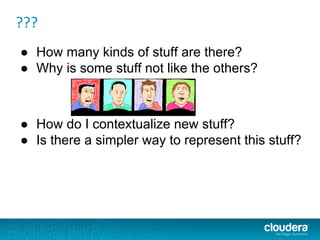
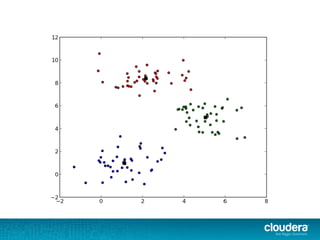
● How many kinds of stuff are there?
● Why is some stuff not like the others?
● How do I contextualize new stuff?
● Is there a simpler way to represent this stuff?
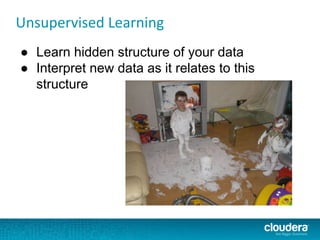
● Learn hidden structure of your data
● Interpret new data as it relates to this
structure
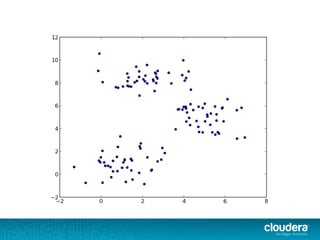
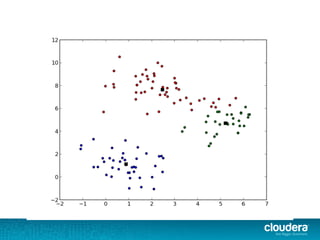
● Clustering
○ Partition data into categories
● Dimensionality reduction
○ Find a condensed representation of your
data
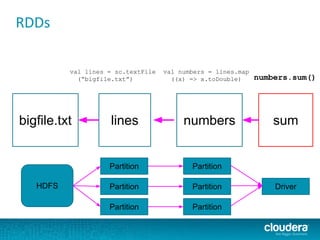
● Designing a system for processing huge
data in parallel
● Taking advantage of it with algorithms that
work well in parallel
bigfile.txt lines
val lines = sc.textFile
(“bigfile.txt”)
numbers
Partition
Partition
Partition
Partition
Partition
Partition
HDFS
sum
Driver
val numbers = lines.map
((x) => x.toDouble) numbers.sum()
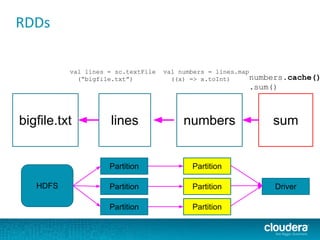
bigfile.txt lines
val lines = sc.textFile
(“bigfile.txt”)
numbers
Partition
Partition
Partition
Partition
Partition
Partition
HDFS
sum
Driver
val numbers = lines.map
((x) => x.toInt) numbers.cache()
.sum()
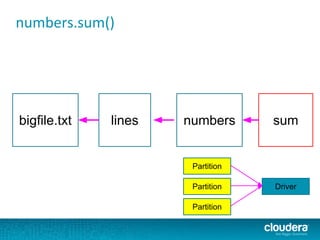
bigfile.txt lines numbers
Partition
Partition
Partition
sum
Driver
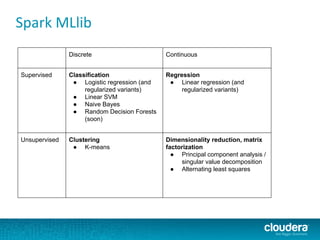
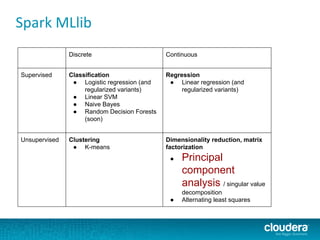
Discrete Continuous
Supervised Classification
● Logistic regression (and
regularized variants)
● Linear SVM
● Naive Bayes
● Random Decision Forests
(soon)
Regression
● Linear regression (and
regularized variants)
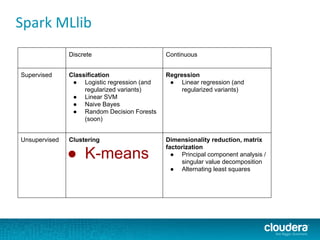
Unsupervised Clustering
● K-means
Dimensionality reduction, matrix
factorization
● Principal component analysis /
singular value decomposition
● Alternating least squares
Discrete Continuous
Supervised Classification
● Logistic regression (and
regularized variants)
● Linear SVM
● Naive Bayes
● Random Decision Forests
(soon)
Regression
● Linear regression (and
regularized variants)
Unsupervised Clustering
● K-means
Dimensionality reduction, matrix
factorization
● Principal component analysis /
singular value decomposition
● Alternating least squares
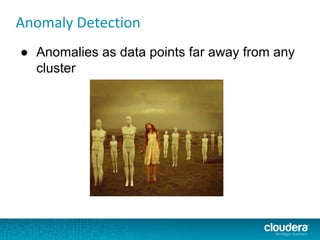
● Anomalies as data points far away from any
cluster
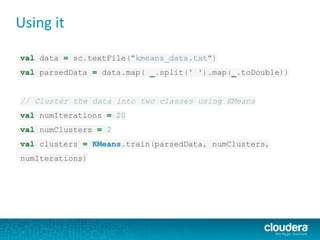
val data = sc.textFile("kmeans_data.txt")
val parsedData = data.map( _.split(' ').map(_.toDouble))
// Cluster the data into two classes using KMeans
val numIterations = 20
val numClusters = 2
val clusters = KMeans.train(parsedData, numClusters,
numIterations)
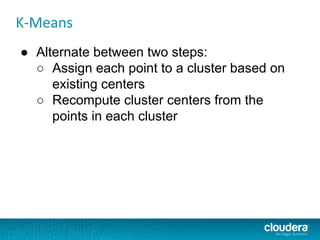
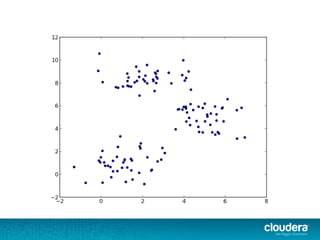
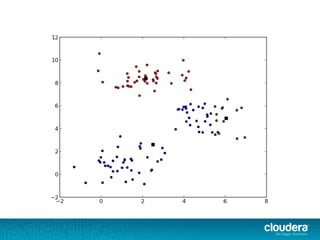
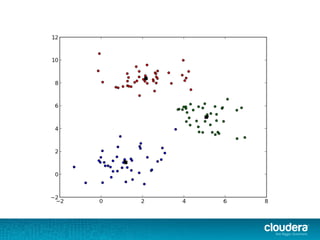
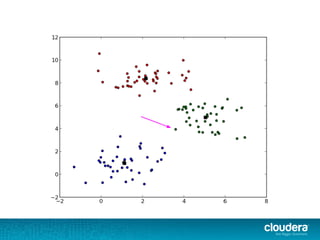
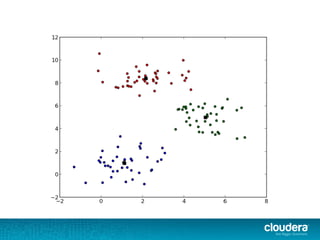
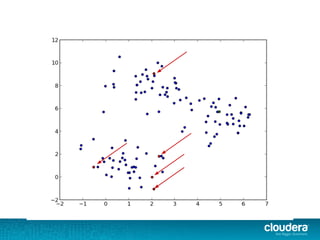
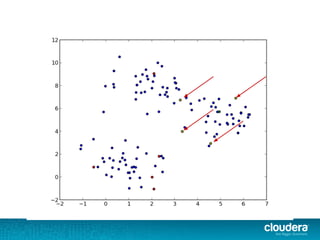
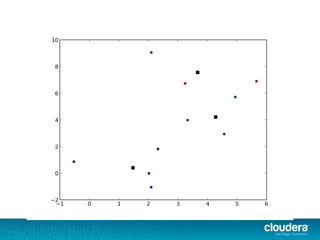
● Alternate between two steps:
○ Assign each point to a cluster based on
existing centers
○ Recompute cluster centers from the
points in each cluster
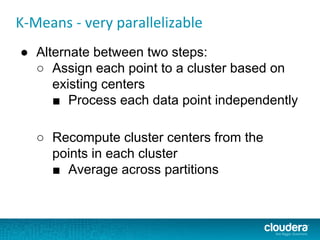
● Alternate between two steps:
○ Assign each point to a cluster based on
existing centers
■ Process each data point independently
○ Recompute cluster centers from the
points in each cluster
■ Average across partitions
// Find the sum and count of points mapping to each center
val totalContribs = data.mapPartitions { points =>
val k = centers.length
val dims = centers(0).vector.length
val sums = Array.fill(k)(BDV.zeros[Double](dims).asInstanceOf[BV[Double]])
val counts = Array.fill(k)(0L)
points.foreach { point =>
val (bestCenter, cost) = KMeans.findClosest(centers, point)
costAccum += cost
sums(bestCenter) += point.vector
counts(bestCenter) += 1
}
val contribs = for (j <- 0 until k) yield {
(j, (sums(j), counts(j)))
}
contribs.iterator
}.reduceByKey(mergeContribs).collectAsMap()
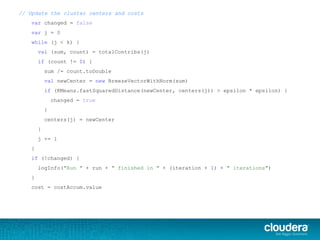
// Update the cluster centers and costs
var changed = false
var j = 0
while (j < k) {
val (sum, count) = totalContribs(j)
if (count != 0) {
sum /= count.toDouble
val newCenter = new BreezeVectorWithNorm(sum)
if (KMeans.fastSquaredDistance(newCenter, centers(j)) > epsilon * epsilon) {
changed = true
}
centers(j) = newCenter
}
j += 1
}
if (!changed) {
logInfo("Run " + run + " finished in " + (iteration + 1) + " iterations")
}
cost = costAccum.value
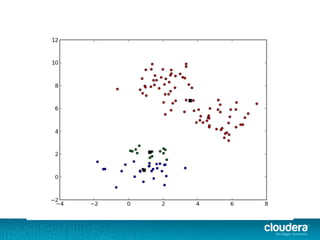
● K-Means is very sensitive to initial set of
center points chosen.
● Best existing algorithm for choosing centers
is highly sequential.
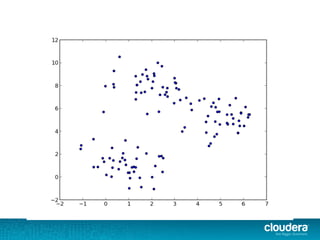
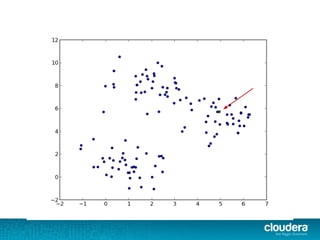
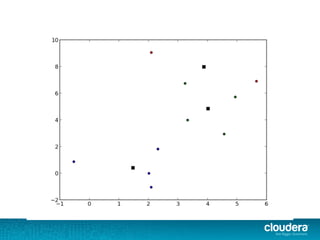
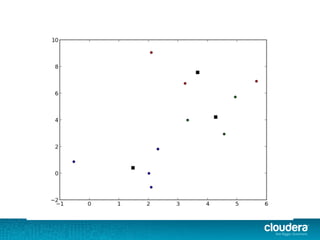
● Start with random point from dataset
● Pick another one randomly, with probability
proportional to distance from the closest
already chosen
● Repeat until initial centers chosen
● Initial cluster has expected bound of O(log k)
of optimum cost
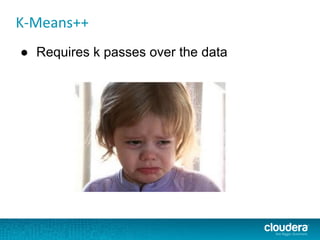
● Requires k passes over the data
● Do only a few (~5) passes
● Sample m points on each pass
● Oversample
● Run K-Means++ on sampled points to find
initial centers
Discrete Continuous
Supervised Classification
● Logistic regression (and
regularized variants)
● Linear SVM
● Naive Bayes
● Random Decision Forests
(soon)
Regression
● Linear regression (and
regularized variants)
Unsupervised Clustering
● K-means
Dimensionality reduction, matrix
factorization
● Principal
component
analysis / singular value
decomposition
● Alternating least squares
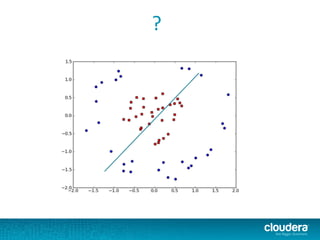
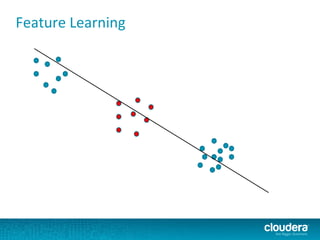
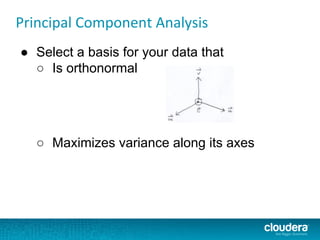
● Select a basis for your data that
○ Is orthonormal
○ Maximizes variance along its axes
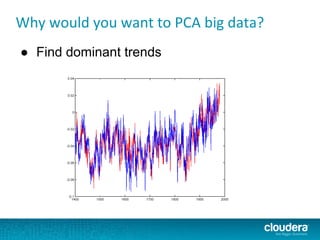
● Find dominant trends
● Find a lower-dimensional representation that
lets you visualize the data
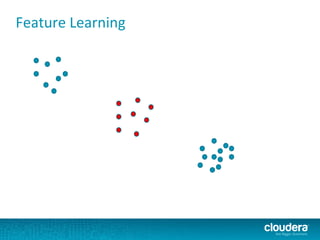
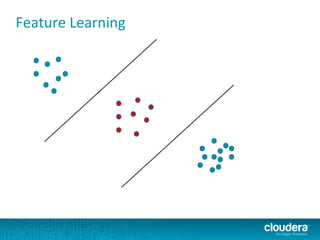
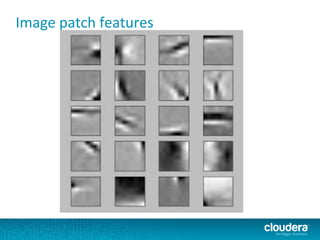
● Feature learning - find a representation that’
s good for clustering or classification
● Latent Semantic Analysis
val data: RDD[Vector] = ...
val mat = new RowMatrix(data)
// compute the top 5 principal components
val principalComponents =
mat.computePrincipalComponents(5)
// project data into subspace
val transformed = data.map(_.toBreeze *
mat.toBreeze)
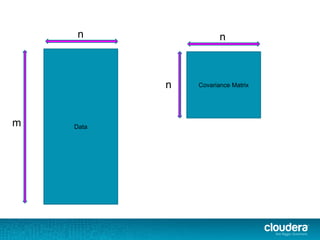
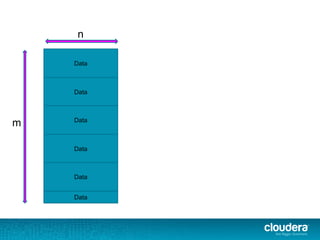
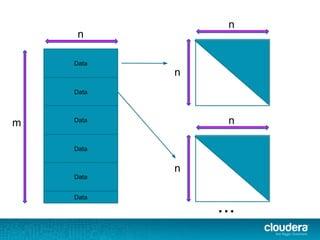
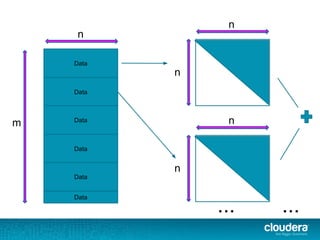
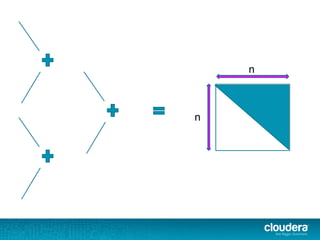
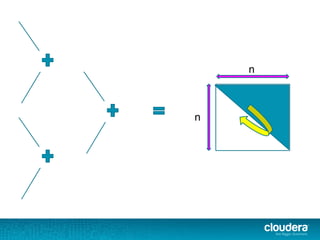
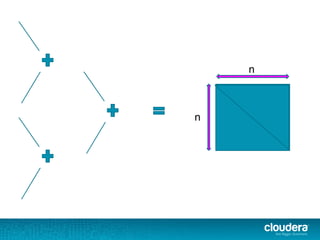
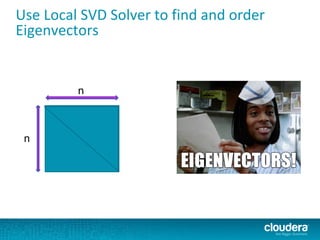
● Center data
● Find covariance matrix
● Its eigenvectors are the principal
components
Datam
n
Covariance Matrix
n
n
Data
m
n
Data
Data
Data
Data
Data
Data
m
n
Data
Data
Data
Data
Data
n
n
n
n
...
Data
m
n
Data
Data
Data
Data
Data
n
n
n
n
... ...
n
n
n
n
n
n
def computeGramianMatrix (): Matrix = {
val n = numCols().toInt
val nt: Int = n * (n + 1) / 2
// Compute the upper triangular part of the gram matrix.
val GU = rows.aggregate( new BDV[Double](new Array[Double](nt)))(
seqOp = (U, v) => {
RowMatrix.dspr( 1.0, v, U.data)
U
},
combOp = (U1, U2) => U1 += U2
)
RowMatrix.triuToFull(n, GU.data)
}
n
n
● n^2 must fit in memory
● Not yet implemented: EM algorithm can do it
with O(kn), where k is the number of
principal components

Unsupervised Learning with Apache Spark

  • 2.
    ● Data scientistat Cloudera ● Recently lead Apache Spark development at Cloudera ● Before that, committing on Apache Hadoop ● Before that, studying combinatorial optimization and distributed systems at Brown
  • 14.
    ● How manykinds of stuff are there? ● Why is some stuff not like the others? ● How do I contextualize new stuff? ● Is there a simpler way to represent this stuff?
  • 15.
    ● Learn hiddenstructure of your data ● Interpret new data as it relates to this structure
  • 16.
    ● Clustering ○ Partitiondata into categories ● Dimensionality reduction ○ Find a condensed representation of your data
  • 17.
    ● Designing asystem for processing huge data in parallel ● Taking advantage of it with algorithms that work well in parallel
  • 21.
    bigfile.txt lines val lines= sc.textFile (“bigfile.txt”) numbers Partition Partition Partition Partition Partition Partition HDFS sum Driver val numbers = lines.map ((x) => x.toDouble) numbers.sum()
  • 23.
    bigfile.txt lines val lines= sc.textFile (“bigfile.txt”) numbers Partition Partition Partition Partition Partition Partition HDFS sum Driver val numbers = lines.map ((x) => x.toInt) numbers.cache() .sum()
  • 24.
  • 27.
    Discrete Continuous Supervised Classification ●Logistic regression (and regularized variants) ● Linear SVM ● Naive Bayes ● Random Decision Forests (soon) Regression ● Linear regression (and regularized variants) Unsupervised Clustering ● K-means Dimensionality reduction, matrix factorization ● Principal component analysis / singular value decomposition ● Alternating least squares
  • 28.
    Discrete Continuous Supervised Classification ●Logistic regression (and regularized variants) ● Linear SVM ● Naive Bayes ● Random Decision Forests (soon) Regression ● Linear regression (and regularized variants) Unsupervised Clustering ● K-means Dimensionality reduction, matrix factorization ● Principal component analysis / singular value decomposition ● Alternating least squares
  • 31.
    ● Anomalies asdata points far away from any cluster
  • 37.
    val data =sc.textFile("kmeans_data.txt") val parsedData = data.map( _.split(' ').map(_.toDouble)) // Cluster the data into two classes using KMeans val numIterations = 20 val numClusters = 2 val clusters = KMeans.train(parsedData, numClusters, numIterations)
  • 38.
    ● Alternate betweentwo steps: ○ Assign each point to a cluster based on existing centers ○ Recompute cluster centers from the points in each cluster
  • 44.
    ● Alternate betweentwo steps: ○ Assign each point to a cluster based on existing centers ■ Process each data point independently ○ Recompute cluster centers from the points in each cluster ■ Average across partitions
  • 45.
    // Find thesum and count of points mapping to each center val totalContribs = data.mapPartitions { points => val k = centers.length val dims = centers(0).vector.length val sums = Array.fill(k)(BDV.zeros[Double](dims).asInstanceOf[BV[Double]]) val counts = Array.fill(k)(0L) points.foreach { point => val (bestCenter, cost) = KMeans.findClosest(centers, point) costAccum += cost sums(bestCenter) += point.vector counts(bestCenter) += 1 } val contribs = for (j <- 0 until k) yield { (j, (sums(j), counts(j))) } contribs.iterator }.reduceByKey(mergeContribs).collectAsMap()
  • 46.
    // Update thecluster centers and costs var changed = false var j = 0 while (j < k) { val (sum, count) = totalContribs(j) if (count != 0) { sum /= count.toDouble val newCenter = new BreezeVectorWithNorm(sum) if (KMeans.fastSquaredDistance(newCenter, centers(j)) > epsilon * epsilon) { changed = true } centers(j) = newCenter } j += 1 } if (!changed) { logInfo("Run " + run + " finished in " + (iteration + 1) + " iterations") } cost = costAccum.value
  • 48.
    ● K-Means isvery sensitive to initial set of center points chosen. ● Best existing algorithm for choosing centers is highly sequential.
  • 50.
    ● Start withrandom point from dataset ● Pick another one randomly, with probability proportional to distance from the closest already chosen ● Repeat until initial centers chosen
  • 51.
    ● Initial clusterhas expected bound of O(log k) of optimum cost
  • 52.
    ● Requires kpasses over the data
  • 53.
    ● Do onlya few (~5) passes ● Sample m points on each pass ● Oversample ● Run K-Means++ on sampled points to find initial centers
  • 63.
    Discrete Continuous Supervised Classification ●Logistic regression (and regularized variants) ● Linear SVM ● Naive Bayes ● Random Decision Forests (soon) Regression ● Linear regression (and regularized variants) Unsupervised Clustering ● K-means Dimensionality reduction, matrix factorization ● Principal component analysis / singular value decomposition ● Alternating least squares
  • 64.
    ● Select abasis for your data that ○ Is orthonormal ○ Maximizes variance along its axes
  • 66.
  • 67.
    ● Find alower-dimensional representation that lets you visualize the data ● Feature learning - find a representation that’ s good for clustering or classification ● Latent Semantic Analysis
  • 68.
    val data: RDD[Vector]= ... val mat = new RowMatrix(data) // compute the top 5 principal components val principalComponents = mat.computePrincipalComponents(5) // project data into subspace val transformed = data.map(_.toBreeze * mat.toBreeze)
  • 69.
    ● Center data ●Find covariance matrix ● Its eigenvectors are the principal components
  • 70.
  • 71.
  • 72.
  • 73.
  • 74.
  • 75.
  • 76.
  • 77.
    def computeGramianMatrix ():Matrix = { val n = numCols().toInt val nt: Int = n * (n + 1) / 2 // Compute the upper triangular part of the gram matrix. val GU = rows.aggregate( new BDV[Double](new Array[Double](nt)))( seqOp = (U, v) => { RowMatrix.dspr( 1.0, v, U.data) U }, combOp = (U1, U2) => U1 += U2 ) RowMatrix.triuToFull(n, GU.data) }
  • 78.
  • 79.
    ● n^2 mustfit in memory
  • 80.
    ● n^2 mustfit in memory ● Not yet implemented: EM algorithm can do it with O(kn), where k is the number of principal components