I. OBJECTIVES:
A. Content Standards:
The learners demonstrate understanding of different tech
niques to separate mixtures.
B. Performance Standard:
The learners should be able to separate desired materials
from common and local products.
C. Learning Competencies/Objectives:
Enumerate techniques in separating mixtures such as
picking, winnowing, decantation, use of magnet, sieving
, filtering, and evaporation. Demonstrate how a soluble is
separated from a liquid using evaporation.
Write the LC code for each
S6MT-Id-f-2
II. CONTENT: Separating Mixtures: Evaporation
III. LEARNING RESOURCES:
A. Reference
1. Teacher’s Guide: GRADE 6 SCIENCE ACTIVITIES page 44
2. Learner’s Materials pages
3. Textbook Pages
4. Additional Materials from Learning Resources (LR) portal
BEAM 4. 5 Explain what happens after Mixing Materials. Learning
Guides. Mix it Up. July 2009.pp. 5-7.
EASE Science II. Chemistry Module 4. Lesson 2. Chemistry III Text
book. Mapa, Amelia P., Ph.D., et al. 2001. pp. 42-45.
Science and Technology I: Integrated Science Textbook. NISMED.
2012. pp. 57-58.
A. Other Learning Resources
TeacherEngineering.n.d.https://www.teachengineering.org/activities/vi
ew/van_cleanupmess_act1 (accessed May52007)Multimedia
Presentation, Pictures, and Materials for the Activity
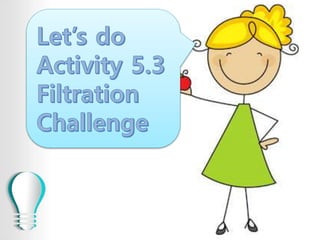
FILTRATION CHALLENGE
Activity 5.3
MATERIALS:
You have been hired by ACE Water Supply Company.
With the ongoing drought in the province, not enough
water is available for all the things we need to supply –
people, animals and plants. You will be given a sample
of the dirty water that has remained in the province, and
the standard for water testing "A," "B" and "C." A is
nearly ready for human use, B is nearly ready for
animal use, and C is nearly ready to water the plants.
You will be paid for their supply of filtered water: A
gets Php10 per mL, B gets Php5 per mL, and C gets Ph
p1 per mL.
Remember that you should not taste the water given
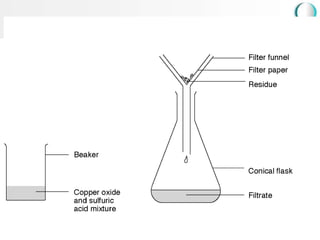
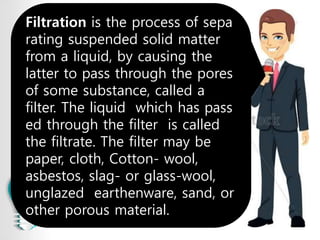
Filtration is the process of sepa
rating suspended solid matter
from a liquid, by causing the
latter to pass through the pores
of some substance, called a
filter. The liquid which has pass
ed through the filter is called
the filtrate. The filter may be
paper, cloth, Cotton- wool,
asbestos, slag- or glass-wool,
unglazed earthenware, sand, or
other porous material.
Separating Mixtures Filtration.pptx

Separating Mixtures Filtration.pptx

  • 2.
    I. OBJECTIVES: A. ContentStandards: The learners demonstrate understanding of different tech niques to separate mixtures. B. Performance Standard: The learners should be able to separate desired materials from common and local products. C. Learning Competencies/Objectives: Enumerate techniques in separating mixtures such as picking, winnowing, decantation, use of magnet, sieving , filtering, and evaporation. Demonstrate how a soluble is separated from a liquid using evaporation. Write the LC code for each S6MT-Id-f-2
  • 3.
    II. CONTENT: SeparatingMixtures: Evaporation III. LEARNING RESOURCES: A. Reference 1. Teacher’s Guide: GRADE 6 SCIENCE ACTIVITIES page 44 2. Learner’s Materials pages 3. Textbook Pages 4. Additional Materials from Learning Resources (LR) portal BEAM 4. 5 Explain what happens after Mixing Materials. Learning Guides. Mix it Up. July 2009.pp. 5-7. EASE Science II. Chemistry Module 4. Lesson 2. Chemistry III Text book. Mapa, Amelia P., Ph.D., et al. 2001. pp. 42-45. Science and Technology I: Integrated Science Textbook. NISMED. 2012. pp. 57-58. A. Other Learning Resources TeacherEngineering.n.d.https://www.teachengineering.org/activities/vi ew/van_cleanupmess_act1 (accessed May52007)Multimedia Presentation, Pictures, and Materials for the Activity
  • 32.
  • 35.
    You have beenhired by ACE Water Supply Company. With the ongoing drought in the province, not enough water is available for all the things we need to supply – people, animals and plants. You will be given a sample of the dirty water that has remained in the province, and the standard for water testing "A," "B" and "C." A is nearly ready for human use, B is nearly ready for animal use, and C is nearly ready to water the plants. You will be paid for their supply of filtered water: A gets Php10 per mL, B gets Php5 per mL, and C gets Ph p1 per mL. Remember that you should not taste the water given
  • 41.
    Filtration is theprocess of sepa rating suspended solid matter from a liquid, by causing the latter to pass through the pores of some substance, called a filter. The liquid which has pass ed through the filter is called the filtrate. The filter may be paper, cloth, Cotton- wool, asbestos, slag- or glass-wool, unglazed earthenware, sand, or other porous material.