Gender CommunicationHow to Reduce Barriers
FacilitatorVictoria Wors, SPHRBBA and MS in Human Resources ManagementCertified Birkman Method® ConsultantHuman Resources Professional with numerous years in various industries and working with different levels and cultures.
Currently consultant to small and mid-sized businesses to improved communications within teams and between specific individuals using the Birkman Assessment tool
Retained Human Resources Consultant to Premiere Employee Services, a St. Louis PEOWors Consulting, LLC				All Rights Reserved 2009
2341IntroductionCommunication Between GendersExamples of Male vs. Female StylesNon-Verbal Communication BarriersWors Consulting, LLC				All Rights Reserved 2009
IntroductionThe fact is, women and men tend to have vastly different communication styles - styles that often cause more friction than fraternity.Wors Consulting, LLC				All Rights Reserved 2009
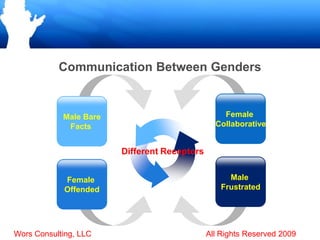
Communication Between GendersFemale OffendedMale FrustratedMale BareFacts Female CollaborativeDifferent ReceptorsWors Consulting, LLC				All Rights Reserved 2009
Female Communication StyleWomen generally adopt a collaborative communication style i.e. like to get input from others, talk about ideas out loud and ensure that everyone is on the same page when it comes to a project.Wors Consulting, LLC				All Rights Reserved 2009
Male CommunicationMen, on the other hand, don't need to have everyone on board. e.g. 'If you're not on the bus, get off the bus”.  Command and control.Wors Consulting, LLC				All Rights Reserved 2009
Exploring Case StudiesThe Differences between Men and Women: How the sexes handle the same situation in very different ways using 4 examples.Wors Consulting, LLC				All Rights Reserved 2009
Example #1 GOALS:People/process vs. Tasks/results Michael, Rob, Amy and Christina are in a business meeting discussing an effective approach for their latest project. During the meeting, Michael and Rob's interaction becomes noticeably heated. The two women immediately wish to calm the dispute and become very uncomfortable during the exchangeWors Consulting, LLC				All Rights Reserved 2009
Group DynamicWomen: Women's thought process works like a web: everything is interconnected. When it comes to a project, the people and the process are just as important as the end result. Amy and Christina were concerned with Michael and Rob, and how the group was arriving at its conclusion.Men: Men, on the other hand, are more task-oriented and fixated on the end result; the process is less important to them as long as the result is adequate. Michael and Rob's heated discussion had nothing to do with their relationship. It was merely a way for them to hash out a conclusion.Wors Consulting, LLC				All Rights Reserved 2009
Resulting Clash:Resulting Clash: Men become annoyed with women's tendency to discuss everything related to a project as a means of finding a solution. On the flip side, women become very concerned when coworkers clash.Wors Consulting, LLC				All Rights Reserved 2009
SolutionRecognize the differences for what they are and figure out what style(s) work best for the individual situation and group dynamic.Wors Consulting, LLC				All Rights Reserved 2009
Example #2:  Feelings vs. FactsMichael and Amy are working together on a project, as are Rob and Christina. The problem is that Michael and Christina are always late and never offer input. Amy tells her boss, "This simply isn't fair. I'm getting overworked and he isn't doing anything." Rob tells his boss, "Christina is consistently 2 hours late, and I had to take on her responsibilities AND mine."Wors Consulting, LLC				All Rights Reserved 2009
Group DynamicWomen: Women focus on feelings. Amy told her boss how she felt regarding the situation. Essentially, she stuck to value judgments.Men: Men focus on facts. Rob told his boss the concrete realities of the situation and remained objective.Wors Consulting, LLC				All Rights Reserved 2009
Resulting ClashMen consider feelings irrelevant in the workplace, so they become confused and/or frustrated when a woman airs grievances that have emotional foundations.Wors Consulting, LLC				All Rights Reserved 2009
SolutionWhen it comes to work, stick to the facts. Your co-worker might have made you feel taken advantage of, but your boss can only correct concrete problems.Wors Consulting, LLC				All Rights Reserved 2009
Example #3 Questions:  Asking vs. WithholdingDuring a weekly scheduling meeting, Amy's boss gives her a new assignment and explains the project. Amy asks several questions to clarify the purpose of the project and make sure she understands the tasks. Rob steals a look at the clock and gives a subtle sigh. The boss then turns to Rob with a different assignment. After hearing the explanation, Rob nods and the meeting continues.Wors Consulting, LLC				All Rights Reserved 2009
Group DynamicWomen: "Women ask questions to gather information.  It's how they attack problems and come up with solutions." Amy asked questions because she felt it would improve her performance on the job and prevent communication problems from arising down the line.Men: Men, on the other hand, talk to give information. They do not think aloud, sharing nascent ideas, but think to themselves until they have developed plan of action. What's more, Rob was actually annoyed that Amy asked so many questions.Wors Consulting, LLC				All Rights Reserved 2009
Why the Resulting Clash?Men view questions as a sign of weakness and assume the questioning coworker to be incompetent. On the other hand, "women assume that men know exactly what they're doing because they don't ask questions,”Wors Consulting, LLC				All Rights Reserved 2009
Solution Do what is needed to accomplish the task. If you ask 20 questions upfront and turn out a stellar result, there won't be anyone questioning your competencyWors Consulting, LLC				All Rights Reserved 2009
Example #4 Talking:  Weak Language vs. Direct LanguageMichael and Christina's assignment is to create a print ad for the company's new product. During brainstorming, Christina says, "I don't know how much you'll like this idea, but maybe we could use a light blue background." Michael considers this and says, "A white background will make it look cleaner."Wors Consulting, LLC				All Rights Reserved 2009
Group DynamicWomen: Women often discredit themselves in speech through disclaimers, such as Christina's. Weak language also includes tag lines ("That's a big success, don't you think?" or "That doesn't look right, does it?") and modifiers ("I'm just thinking..." or "Hopefully we can...").Men: Men tend to be more direct when they talk. "They cut to the chase”. Notice how Michael didn't use any tag lines or modifiers to undermine his idea. He spoke with confident authority.Wors Consulting, LLC				All Rights Reserved 2009
Why the Clash?When women use weak language, men view them as weak employees. Her lack of confidence is as a danger to accomplishing the task.Wors Consulting, LLC				All Rights Reserved 2009
SolutionEliminate weak language from your vocabulary. Period.Wors Consulting, LLC				All Rights Reserved 2009
Bridging additional barriers of communication in the workplaceGetting InterruptedSolution: Take control.Say: "Excuse me, I wasn't finished," or "Just a minute, I'm still talking.“2.  Someone takes credit for your idea.Solution: Correct that coworker!Say: "I just said that a second ago," or "Thank you for reiterating my point."Wors Consulting, LLC				All Rights Reserved 2009
Bridging additional barriers of communication in the workplaceYou have to critique someone else’s workSolution: Forget the fancy talk. Be direct. Say: "This section doesn't accomplish what we need it to."Wors Consulting, LLC				All Rights Reserved 2009
Non-Verbal Communication, What Your Behaviors Say About YouCommunication isn't only about speaking. In fact, your movements and presentation can actually speak volumes. Wors Consulting, LLC				All Rights Reserved 2009
Check for these Non-VerbalsNodding: Women nod to show that they understand something - "I see." Men interpret nodding as concurrence - "I agree." Too much nodding causes communication clashes. Smiling: Women smile more than men do, as a part of their expressive nature. So what's the problem? A woman is more likely to be interrupted if she's smiling. Wors Consulting, LLC				All Rights Reserved 2009

Gender Communication

  • 1.
  • 2.
    FacilitatorVictoria Wors, SPHRBBAand MS in Human Resources ManagementCertified Birkman Method® ConsultantHuman Resources Professional with numerous years in various industries and working with different levels and cultures.
  • 3.
    Currently consultant tosmall and mid-sized businesses to improved communications within teams and between specific individuals using the Birkman Assessment tool
  • 4.
    Retained Human ResourcesConsultant to Premiere Employee Services, a St. Louis PEOWors Consulting, LLC All Rights Reserved 2009
  • 5.
    2341IntroductionCommunication Between GendersExamplesof Male vs. Female StylesNon-Verbal Communication BarriersWors Consulting, LLC All Rights Reserved 2009
  • 6.
    IntroductionThe fact is,women and men tend to have vastly different communication styles - styles that often cause more friction than fraternity.Wors Consulting, LLC All Rights Reserved 2009
  • 7.
    Communication Between GendersFemaleOffendedMale FrustratedMale BareFacts Female CollaborativeDifferent ReceptorsWors Consulting, LLC All Rights Reserved 2009
  • 8.
    Female Communication StyleWomengenerally adopt a collaborative communication style i.e. like to get input from others, talk about ideas out loud and ensure that everyone is on the same page when it comes to a project.Wors Consulting, LLC All Rights Reserved 2009
  • 9.
    Male CommunicationMen, onthe other hand, don't need to have everyone on board. e.g. 'If you're not on the bus, get off the bus”. Command and control.Wors Consulting, LLC All Rights Reserved 2009
  • 10.
    Exploring Case StudiesTheDifferences between Men and Women: How the sexes handle the same situation in very different ways using 4 examples.Wors Consulting, LLC All Rights Reserved 2009
  • 11.
    Example #1 GOALS:People/processvs. Tasks/results Michael, Rob, Amy and Christina are in a business meeting discussing an effective approach for their latest project. During the meeting, Michael and Rob's interaction becomes noticeably heated. The two women immediately wish to calm the dispute and become very uncomfortable during the exchangeWors Consulting, LLC All Rights Reserved 2009
  • 12.
    Group DynamicWomen: Women'sthought process works like a web: everything is interconnected. When it comes to a project, the people and the process are just as important as the end result. Amy and Christina were concerned with Michael and Rob, and how the group was arriving at its conclusion.Men: Men, on the other hand, are more task-oriented and fixated on the end result; the process is less important to them as long as the result is adequate. Michael and Rob's heated discussion had nothing to do with their relationship. It was merely a way for them to hash out a conclusion.Wors Consulting, LLC All Rights Reserved 2009
  • 13.
    Resulting Clash:Resulting Clash:Men become annoyed with women's tendency to discuss everything related to a project as a means of finding a solution. On the flip side, women become very concerned when coworkers clash.Wors Consulting, LLC All Rights Reserved 2009
  • 14.
    SolutionRecognize the differencesfor what they are and figure out what style(s) work best for the individual situation and group dynamic.Wors Consulting, LLC All Rights Reserved 2009
  • 15.
    Example #2: Feelings vs. FactsMichael and Amy are working together on a project, as are Rob and Christina. The problem is that Michael and Christina are always late and never offer input. Amy tells her boss, "This simply isn't fair. I'm getting overworked and he isn't doing anything." Rob tells his boss, "Christina is consistently 2 hours late, and I had to take on her responsibilities AND mine."Wors Consulting, LLC All Rights Reserved 2009
  • 16.
    Group DynamicWomen: Womenfocus on feelings. Amy told her boss how she felt regarding the situation. Essentially, she stuck to value judgments.Men: Men focus on facts. Rob told his boss the concrete realities of the situation and remained objective.Wors Consulting, LLC All Rights Reserved 2009
  • 17.
    Resulting ClashMen considerfeelings irrelevant in the workplace, so they become confused and/or frustrated when a woman airs grievances that have emotional foundations.Wors Consulting, LLC All Rights Reserved 2009
  • 18.
    SolutionWhen it comesto work, stick to the facts. Your co-worker might have made you feel taken advantage of, but your boss can only correct concrete problems.Wors Consulting, LLC All Rights Reserved 2009
  • 19.
    Example #3 Questions: Asking vs. WithholdingDuring a weekly scheduling meeting, Amy's boss gives her a new assignment and explains the project. Amy asks several questions to clarify the purpose of the project and make sure she understands the tasks. Rob steals a look at the clock and gives a subtle sigh. The boss then turns to Rob with a different assignment. After hearing the explanation, Rob nods and the meeting continues.Wors Consulting, LLC All Rights Reserved 2009
  • 20.
    Group DynamicWomen: "Womenask questions to gather information. It's how they attack problems and come up with solutions." Amy asked questions because she felt it would improve her performance on the job and prevent communication problems from arising down the line.Men: Men, on the other hand, talk to give information. They do not think aloud, sharing nascent ideas, but think to themselves until they have developed plan of action. What's more, Rob was actually annoyed that Amy asked so many questions.Wors Consulting, LLC All Rights Reserved 2009
  • 21.
    Why the ResultingClash?Men view questions as a sign of weakness and assume the questioning coworker to be incompetent. On the other hand, "women assume that men know exactly what they're doing because they don't ask questions,”Wors Consulting, LLC All Rights Reserved 2009
  • 22.
    Solution Do whatis needed to accomplish the task. If you ask 20 questions upfront and turn out a stellar result, there won't be anyone questioning your competencyWors Consulting, LLC All Rights Reserved 2009
  • 23.
    Example #4 Talking: Weak Language vs. Direct LanguageMichael and Christina's assignment is to create a print ad for the company's new product. During brainstorming, Christina says, "I don't know how much you'll like this idea, but maybe we could use a light blue background." Michael considers this and says, "A white background will make it look cleaner."Wors Consulting, LLC All Rights Reserved 2009
  • 24.
    Group DynamicWomen: Womenoften discredit themselves in speech through disclaimers, such as Christina's. Weak language also includes tag lines ("That's a big success, don't you think?" or "That doesn't look right, does it?") and modifiers ("I'm just thinking..." or "Hopefully we can...").Men: Men tend to be more direct when they talk. "They cut to the chase”. Notice how Michael didn't use any tag lines or modifiers to undermine his idea. He spoke with confident authority.Wors Consulting, LLC All Rights Reserved 2009
  • 25.
    Why the Clash?Whenwomen use weak language, men view them as weak employees. Her lack of confidence is as a danger to accomplishing the task.Wors Consulting, LLC All Rights Reserved 2009
  • 26.
    SolutionEliminate weak languagefrom your vocabulary. Period.Wors Consulting, LLC All Rights Reserved 2009
  • 27.
    Bridging additional barriersof communication in the workplaceGetting InterruptedSolution: Take control.Say: "Excuse me, I wasn't finished," or "Just a minute, I'm still talking.“2. Someone takes credit for your idea.Solution: Correct that coworker!Say: "I just said that a second ago," or "Thank you for reiterating my point."Wors Consulting, LLC All Rights Reserved 2009
  • 28.
    Bridging additional barriersof communication in the workplaceYou have to critique someone else’s workSolution: Forget the fancy talk. Be direct. Say: "This section doesn't accomplish what we need it to."Wors Consulting, LLC All Rights Reserved 2009
  • 29.
    Non-Verbal Communication, WhatYour Behaviors Say About YouCommunication isn't only about speaking. In fact, your movements and presentation can actually speak volumes. Wors Consulting, LLC All Rights Reserved 2009
  • 30.
    Check for theseNon-VerbalsNodding: Women nod to show that they understand something - "I see." Men interpret nodding as concurrence - "I agree." Too much nodding causes communication clashes. Smiling: Women smile more than men do, as a part of their expressive nature. So what's the problem? A woman is more likely to be interrupted if she's smiling. Wors Consulting, LLC All Rights Reserved 2009