DEVELOPED BY- Chris Barker
DISCUSSED BY-
PIYUSH GUPTA
PRADYUMN SHARMA
NEERAJ MALIK
MANASVI SINGH
MAYANK SINGH
JASMEET SINGH
MISCOMMUNICATION
 Miscommunication is a result of many different factors
as information is transmitted through the channel of
communication. Basically, it happens when one side
doesn’t communicate enough information to the other
side, or we misinterpret the real meaning of their
words. In either case, we get a different understanding
than they intended. Thus, anything that prevents one
of understanding the message is a barrier to
communication.
Miscommunication may lead to
some ironies which may result in
a big loss.
CASE STUDY-
DISASTER CAUSED DUE TO
MISCOMMUNICATION.
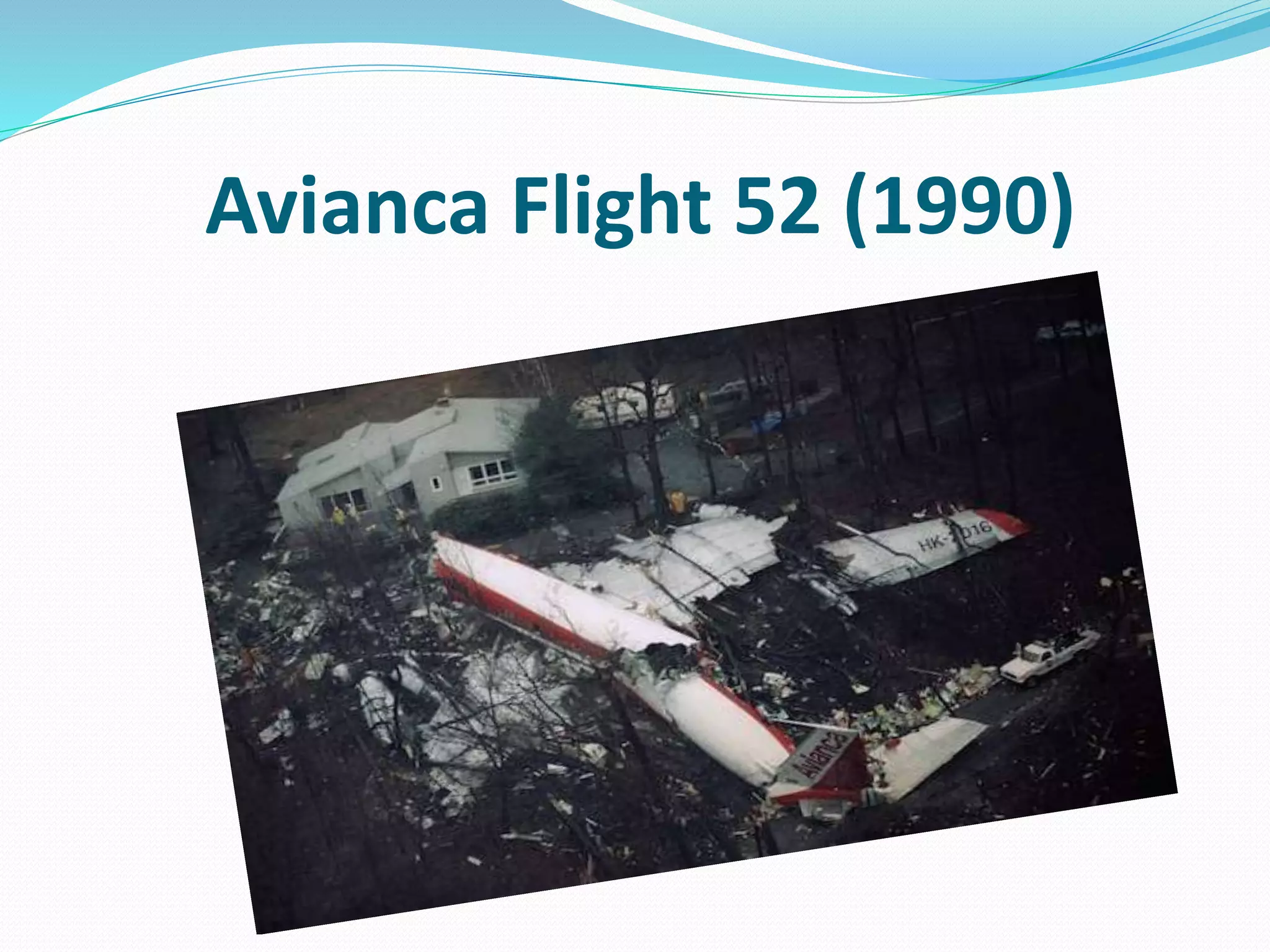
Avianca Flight 52 (1990)
On January 25, 1990, Avianca Flight 52 was carrying 149 passengers from
Bogotá, Colombia to New York. However, because of bad weather
conditions and air traffic congestion, the Boeing 707 was forced into a
holding pattern off the coast near New York. And after circling for nearly
an hour and a half, the aircraft was running low on fuel.
When Flight 52 arrived at Kennedy Airport, due to the fog and wind, only
one runway was open for the 33 planes that were attempting to land every
hour. What’s more, the flight was delayed again as the aircraft ahead of
them failed to touch down. Flight 52’s fuel situation soon became
desperate
Two crucial pieces of miscommunication led to the disaster that was to follow.
When the aircraft was passed from regional to local air traffic controllers, the
local controllers were not informed that the aircraft had too little fuel to reach
its alternative airport. Compounding the problem, crucially the aircraft’s crew
did not explicitly declare that there was “fuel emergency” to the local
controllers, which would have indicated that the plane was actually in danger
of crashing. And then suddenly something went wrong with their radio.
As a result, after missing its first attempt to land, the airplane was given a
landing pattern that it had too little fuel to execute. While the crew attempted
to manoeuvre the plane, its engines flamed out in quick succession. The
Boeing 707 slammed into the village of Cove Neck, Long Island, killing 65 of
its 149 passengers and eight out of nine of its crew.
REASONS FOR
MISCOMMUNICATION
 Inter departmental communication barrier.
 Incomplete information exchange.
 Lack of interest of people among person working in
organization.
 Physical barrier.
 Distorted mental state of the pilot while handling the
situation.
WHAT COULD HAVE BEEN DONE
TO AVOID THIS TRAGEDY DUE TO
MISCOMMUNICATION
 They had to immediately inform the respective
department.
 They must had provided complete information to
department.
 Informed department should had been took
immediate action.
 If the physical conditions were taken in consideration
this might not be happened.
 The pilot should act calmly during that situation.
In the technological world of modern air travel, there’s a certain
irony in the fact that the majority of aviation disasters are
caused by human error. And one of the most common forms of
error is miscommunication. Even if just one person makes a
mistake, the repercussions can be catastrophic.
Air travel is arguably one of the safest forms of transportation,
but when airplane crashes do happen, because of their nature,
they can take a devastating toll on human life.
SUMMARY-
•One should try to understand and listen the facts that other
want to communicate so in order to avoid loss due to
miscommunication.
•Person should collect all the details about the thing he have
to deal with.
•One should have control over his conscience while dealing
with pressure situation.
REFERENCES-
 http://www.booki.cc/managerial-communication-
from-zero-to-hero/introduction-what-is-
miscommunication-and-why-it-occurs/
 http://www.scribd.com/doc/76777327/Case-Studies-
in-Cross-Cultural-Miscommunication
 http://www.aspetersen.de/example_e.html

how miscommunication can lead to worst situation

  • 1.
    DEVELOPED BY- ChrisBarker DISCUSSED BY- PIYUSH GUPTA PRADYUMN SHARMA NEERAJ MALIK MANASVI SINGH MAYANK SINGH JASMEET SINGH
  • 2.
    MISCOMMUNICATION  Miscommunication isa result of many different factors as information is transmitted through the channel of communication. Basically, it happens when one side doesn’t communicate enough information to the other side, or we misinterpret the real meaning of their words. In either case, we get a different understanding than they intended. Thus, anything that prevents one of understanding the message is a barrier to communication.
  • 3.
    Miscommunication may leadto some ironies which may result in a big loss.
  • 4.
    CASE STUDY- DISASTER CAUSEDDUE TO MISCOMMUNICATION.
  • 5.
  • 6.
    On January 25,1990, Avianca Flight 52 was carrying 149 passengers from Bogotá, Colombia to New York. However, because of bad weather conditions and air traffic congestion, the Boeing 707 was forced into a holding pattern off the coast near New York. And after circling for nearly an hour and a half, the aircraft was running low on fuel. When Flight 52 arrived at Kennedy Airport, due to the fog and wind, only one runway was open for the 33 planes that were attempting to land every hour. What’s more, the flight was delayed again as the aircraft ahead of them failed to touch down. Flight 52’s fuel situation soon became desperate
  • 7.
    Two crucial piecesof miscommunication led to the disaster that was to follow. When the aircraft was passed from regional to local air traffic controllers, the local controllers were not informed that the aircraft had too little fuel to reach its alternative airport. Compounding the problem, crucially the aircraft’s crew did not explicitly declare that there was “fuel emergency” to the local controllers, which would have indicated that the plane was actually in danger of crashing. And then suddenly something went wrong with their radio. As a result, after missing its first attempt to land, the airplane was given a landing pattern that it had too little fuel to execute. While the crew attempted to manoeuvre the plane, its engines flamed out in quick succession. The Boeing 707 slammed into the village of Cove Neck, Long Island, killing 65 of its 149 passengers and eight out of nine of its crew.
  • 8.
    REASONS FOR MISCOMMUNICATION  Interdepartmental communication barrier.  Incomplete information exchange.  Lack of interest of people among person working in organization.  Physical barrier.  Distorted mental state of the pilot while handling the situation.
  • 9.
    WHAT COULD HAVEBEEN DONE TO AVOID THIS TRAGEDY DUE TO MISCOMMUNICATION  They had to immediately inform the respective department.  They must had provided complete information to department.  Informed department should had been took immediate action.  If the physical conditions were taken in consideration this might not be happened.  The pilot should act calmly during that situation.
  • 10.
    In the technologicalworld of modern air travel, there’s a certain irony in the fact that the majority of aviation disasters are caused by human error. And one of the most common forms of error is miscommunication. Even if just one person makes a mistake, the repercussions can be catastrophic. Air travel is arguably one of the safest forms of transportation, but when airplane crashes do happen, because of their nature, they can take a devastating toll on human life.
  • 11.
    SUMMARY- •One should tryto understand and listen the facts that other want to communicate so in order to avoid loss due to miscommunication. •Person should collect all the details about the thing he have to deal with. •One should have control over his conscience while dealing with pressure situation.
  • 12.