MANAGING COMMUNICATIONS
HUMAN BEHAVIOR IN
ORGANIZATION
To understand:
 The two-way communication process
 Barriers to communication
 Factors leading to effective communication
 Downward and upward communications
problems
Learning Objectives
Introduction
 Communication is ...
an ever-present activity
how people relate to one another
necessary for the health of organization
 Communication travels..
upward, downward, laterally
 Listening and humility are important
parts of the communication process
Communication Fundamentals
Communication is the transfer of information
understanding from one person to another
person
 The goal is for receivers to
understand the message as it was
intended
 Two people are required
There is no communication until a message is ...
 received
 interpreted
 understood
Communication Fundamentals
The Importance of Communication
Organizations cannot exist without
 Coordination of work
 Input to management
 Instructions
 Cooperation
 Feelings and needs
The Importance of Communication
If there is no communication,
Employees cannot know what their co-
workers are doing,
Management cannot receive information
inputs,
Supervisors and team leaders cannot give
instructions.
Two Way Communication Process
DEVELOP AN
IDEA
the sender wishes to transmit
STEP 1
Two Way Communication Process
ENCODE
The process of conversion of subject
matter into symbols.
STEP 2
Two Way Communication Process
TRANSMIT
Method used to exchange /
transmit the message
STEP 3
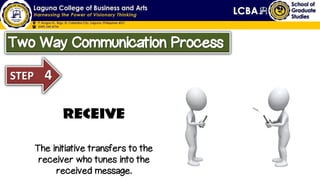
Two Way Communication Process
receive
The initiative transfers to the
receiver who tunes into the
received message.
STEP 4
Two Way Communication Process
decode
The process of conversion of
subject matter into symbols.
STEP 5
Two Way Communication Process
accept
The process of conversion of
subject matter into symbols.
STEP 6
Two Way Communication Process
use
The process wherein the
receiver will use the
information receive.
STEP 7
Two Way Communication Process
Provide feedback
Receiver acknowledge the message
and responds to the sender.
STEP 8
Communication Barriers (Noise)
emotions, values, and poor listening,
psychological distance..
occurs in environment..
arise from limitations in the
symbols..
PERSONAL
PHYSICAL
SEMANTIC
TRANSLATION
INFERENCE
JARGON
SLANG
3 Communication Symbols
 Social cues – positive or negative bits
of information that influence how people
react to a communication
 Readibility - the process of making
writing and speech more
understandable.
 used to clarify word communication
 known as nonverbal communication
handshake, smile, facial reaction
WORDS
PICTURES
ACTION
Impact of Barriers on the Communication Process
Organizational Communication
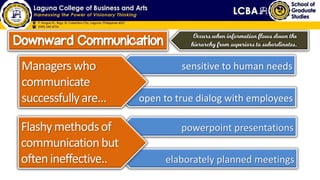
Occurs when information flows down the
hierarchy from superiors to subordinates.
elaborately planned meetings
powerpoint presentations
Downward Communication
open to true dialog with employees
sensitive to human needsManagerswho
communicate
successfullyare...
Flashymethodsof
communicationbut
oftenineffective..
 Develop a positive communication attitude
 Get informed
 Plan for communication
 Develop trust
 Communication overload
 Acceptance of communication
- quality is preferable to quantity
Downward Communication
PREREQUISITES
PROBLEMS
Questioning
Listening
Employee meeting
Open-door policy
Management by walking around
Participation in social groups
Upward Communication
Consists of messages from subordinates to
superiors and is more subject to distortion.
UPWARD
COMMUNICATION
PRACTICES
DIFFICULTIES
Delay
Filtering
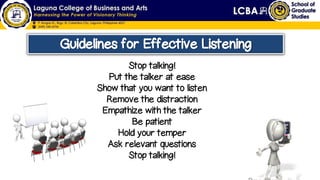
Stop talking!
Put the talker at ease
Show that you want to listen
Remove the distraction
Empathize with the talker
Be patient
Hold your temper
Ask relevant questions
Stop talking!
Guidelines for Effective Listening
Lateral Forms of Communication
Cross-communication
Boundary spanners
Networking
Ombudsperson
Electronic communication
Electronic mail
Blogs
Virtual offices
Other Forms of Communication
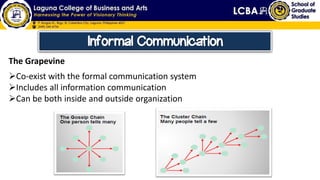
Informal Communication
The Grapevine
Co-exist with the formal communication system
Includes all information communication
Can be both inside and outside organization
Informal Communication
Lateral Forms of Communication
Often used as a synonym for “grapevine”
Information communicates without verification
Generally incorrect
Prompted by interest and ambiguity
Subject to filtering and elaborating
Types of Rumor
Historical and explanatory
Spontaneous and action-oriented
Positive or negative
Rumor
Case: A Breakdown in Communication
Vicky Smith is a single
mother with three
children
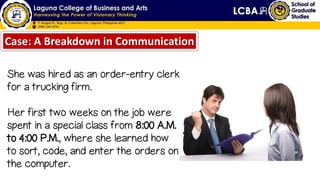
She was hired as an order-entry clerk
for a trucking firm.
Her first two weeks on the job were
spent in a special class from 8:00 A.M.
to 4:00 P.M., where she learned how
to sort, code, and enter the orders on
the computer.
Case: A Breakdown in Communication
An instructor worked with her constantly
at first, and then less frequently as she
gained skill and confidence.
Vicky was happy to have the job and
enjoyed her work schedule.
When the training was completed, she was told
to report to the order-entry department the
following Monday.
Case: A Breakdown in Communication
When she was first employed,
either Vicky failed to read and
understand the printed information
about her regular work schedule or
perhaps the recruiter forgot to tell
her that she was to fill a spot in a
special shift that worked from 4:00
A.M. until noon.
Case: A Breakdown in Communication
In any case Vicky failed to
report to work on the early schedule
on the first day of the regular work.
When she did arrive at 8:00 A.M. her
supervisor criticized her for lack of
responsibility.
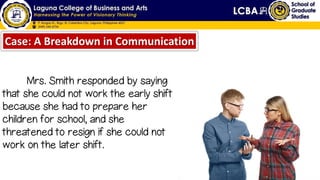
Case: A Breakdown in Communication
Mrs. Smith responded by saying
that she could not work the early shift
because she had to prepare her
children for school, and she
threatened to resign if she could not
work on the later shift.
Case: A Breakdown in Communication
Because of the heavy workload
and a difficult labor market, the
supervisor needed Vicky to do the job,
yet had no room for her in the 8:00
A.M. to 4:00 P.M. shift.
Case: A Breakdown in Communication
1. Analyze the communication problems in this case. Discuss ideas
such as upward and downward communication, listening and
feedback.
2. Explain how you would handle the employment situation at the end
of the case. What ideas from the lesson could be applied to help
resolve this problem?
Case: A Breakdown in Communication
Questions??

Managing communication

  • 1.
  • 2.
    To understand:  Thetwo-way communication process  Barriers to communication  Factors leading to effective communication  Downward and upward communications problems Learning Objectives
  • 3.
    Introduction  Communication is... an ever-present activity how people relate to one another necessary for the health of organization  Communication travels.. upward, downward, laterally  Listening and humility are important parts of the communication process
  • 4.
    Communication Fundamentals Communication isthe transfer of information understanding from one person to another person  The goal is for receivers to understand the message as it was intended  Two people are required
  • 5.
    There is nocommunication until a message is ...  received  interpreted  understood Communication Fundamentals
  • 6.
    The Importance ofCommunication Organizations cannot exist without  Coordination of work  Input to management  Instructions  Cooperation  Feelings and needs
  • 7.
    The Importance ofCommunication If there is no communication, Employees cannot know what their co- workers are doing, Management cannot receive information inputs, Supervisors and team leaders cannot give instructions.
  • 8.
  • 9.
    Two Way CommunicationProcess DEVELOP AN IDEA the sender wishes to transmit STEP 1
  • 10.
    Two Way CommunicationProcess ENCODE The process of conversion of subject matter into symbols. STEP 2
  • 11.
    Two Way CommunicationProcess TRANSMIT Method used to exchange / transmit the message STEP 3
  • 12.
    Two Way CommunicationProcess receive The initiative transfers to the receiver who tunes into the received message. STEP 4
  • 13.
    Two Way CommunicationProcess decode The process of conversion of subject matter into symbols. STEP 5
  • 14.
    Two Way CommunicationProcess accept The process of conversion of subject matter into symbols. STEP 6
  • 15.
    Two Way CommunicationProcess use The process wherein the receiver will use the information receive. STEP 7
  • 16.
    Two Way CommunicationProcess Provide feedback Receiver acknowledge the message and responds to the sender. STEP 8
  • 17.
    Communication Barriers (Noise) emotions,values, and poor listening, psychological distance.. occurs in environment.. arise from limitations in the symbols.. PERSONAL PHYSICAL SEMANTIC TRANSLATION INFERENCE JARGON SLANG
  • 18.
    3 Communication Symbols Social cues – positive or negative bits of information that influence how people react to a communication  Readibility - the process of making writing and speech more understandable.  used to clarify word communication  known as nonverbal communication handshake, smile, facial reaction WORDS PICTURES ACTION
  • 19.
    Impact of Barrierson the Communication Process
  • 20.
  • 21.
    Occurs when informationflows down the hierarchy from superiors to subordinates. elaborately planned meetings powerpoint presentations Downward Communication open to true dialog with employees sensitive to human needsManagerswho communicate successfullyare... Flashymethodsof communicationbut oftenineffective..
  • 22.
     Develop apositive communication attitude  Get informed  Plan for communication  Develop trust  Communication overload  Acceptance of communication - quality is preferable to quantity Downward Communication PREREQUISITES PROBLEMS
  • 23.
    Questioning Listening Employee meeting Open-door policy Managementby walking around Participation in social groups Upward Communication Consists of messages from subordinates to superiors and is more subject to distortion. UPWARD COMMUNICATION PRACTICES DIFFICULTIES Delay Filtering
  • 24.
    Stop talking! Put thetalker at ease Show that you want to listen Remove the distraction Empathize with the talker Be patient Hold your temper Ask relevant questions Stop talking! Guidelines for Effective Listening
  • 25.
    Lateral Forms ofCommunication Cross-communication Boundary spanners Networking Ombudsperson Electronic communication Electronic mail Blogs Virtual offices Other Forms of Communication
  • 26.
  • 27.
    The Grapevine Co-exist withthe formal communication system Includes all information communication Can be both inside and outside organization Informal Communication
  • 28.
    Lateral Forms ofCommunication Often used as a synonym for “grapevine” Information communicates without verification Generally incorrect Prompted by interest and ambiguity Subject to filtering and elaborating Types of Rumor Historical and explanatory Spontaneous and action-oriented Positive or negative Rumor
  • 29.
    Case: A Breakdownin Communication Vicky Smith is a single mother with three children
  • 30.
    She was hiredas an order-entry clerk for a trucking firm. Her first two weeks on the job were spent in a special class from 8:00 A.M. to 4:00 P.M., where she learned how to sort, code, and enter the orders on the computer. Case: A Breakdown in Communication
  • 31.
    An instructor workedwith her constantly at first, and then less frequently as she gained skill and confidence. Vicky was happy to have the job and enjoyed her work schedule. When the training was completed, she was told to report to the order-entry department the following Monday. Case: A Breakdown in Communication
  • 32.
    When she wasfirst employed, either Vicky failed to read and understand the printed information about her regular work schedule or perhaps the recruiter forgot to tell her that she was to fill a spot in a special shift that worked from 4:00 A.M. until noon. Case: A Breakdown in Communication
  • 33.
    In any caseVicky failed to report to work on the early schedule on the first day of the regular work. When she did arrive at 8:00 A.M. her supervisor criticized her for lack of responsibility. Case: A Breakdown in Communication
  • 34.
    Mrs. Smith respondedby saying that she could not work the early shift because she had to prepare her children for school, and she threatened to resign if she could not work on the later shift. Case: A Breakdown in Communication
  • 35.
    Because of theheavy workload and a difficult labor market, the supervisor needed Vicky to do the job, yet had no room for her in the 8:00 A.M. to 4:00 P.M. shift. Case: A Breakdown in Communication
  • 36.
    1. Analyze thecommunication problems in this case. Discuss ideas such as upward and downward communication, listening and feedback. 2. Explain how you would handle the employment situation at the end of the case. What ideas from the lesson could be applied to help resolve this problem? Case: A Breakdown in Communication Questions??