PRESENTED BY :-
VAIBHAVI VISHWANATH MHATRE
EN. NO. :- FS16EE035
1.1)ELECTRICAL LOSSES
1.2)CAUSES IN LOSSES REDUCTION
1.3)USEFUL SOLUTION
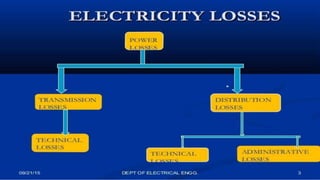
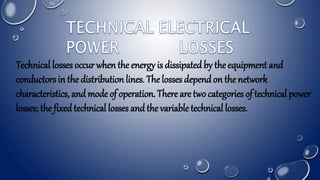
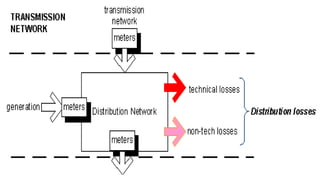
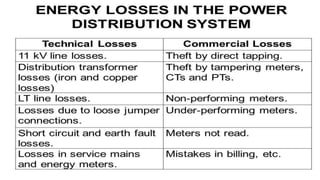
Technical losses occur when the energy is dissipatedby the equipment and
conductors in the distribution lines. The losses dependon the network
characteristics, andmode of operation. There are two categories of technical power
losses; the fixedtechnical losses andthe variable technical losses.
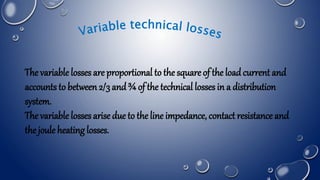
The variable losses are proportional to the square of the loadcurrent and
accounts to between 2/3 and¾ of the technical losses in a distribution
system.
The variable losses arise due to the line impedance, contact resistance and
the joule heating losses.
• The fixedlosses in the distribution lines account for between a quarter
and a third of the total technical losses. These are usuallyin the form
of heat and noise and occur whenever the transformeris energized.
The fixedlosses are not influencedby the amount of load current
flowing, but rather by
• The leakage current losses
• Open circuit losses
• Coronalosses
• Dielectric losses
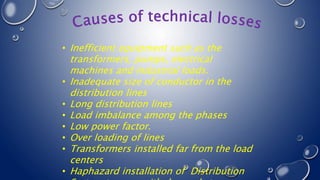
• Inefficient equipment such as the
transformers, pumps, electrical
machines and industrial loads.
• Inadequate size of conductor in the
distribution lines
• Long distribution lines
• Load imbalance among the phases
• Low power factor.
• Over loading of lines
• Transformers installed far from the load
centers
• Haphazard installation of Distribution
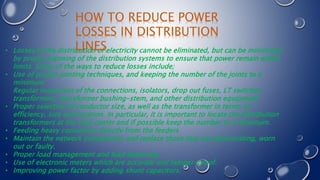
• Losses in the distribution of electricity cannot be eliminated, but can be minimized
by proper planning of the distribution systems to ensure that power remain within
limits. Some of the ways to reduce losses include;
• Use of proper jointing techniques, and keeping the number of the joints to a
minimum
Regular inspection of the connections, isolators, drop out fuses, LT switches,
transformers, transformer bushing-stem, and other distribution equipment.
• Proper selection of conductor size, as well as the transformer in terms of
efficiency, size and location. In particular, it is important to locate the distribution
transformers at the load center and if possible keep the number to a minimum.
• Feeding heavy consumers directly from the feeders
• Maintain the network components and replace those that are deteriorating, worn
out or faulty.
• Proper load management and load balancing
• Use of electronic meters which are accurate and tamper-proof.
• Improving power factor by adding shunt capacitors.
HOW TO REDUCE POWER
LOSSES IN DISTRIBUTION
LINES
Minimizing losses in power distribution system

Minimizing losses in power distribution system

  • 1.
    PRESENTED BY :- VAIBHAVIVISHWANATH MHATRE EN. NO. :- FS16EE035
  • 2.
    1.1)ELECTRICAL LOSSES 1.2)CAUSES INLOSSES REDUCTION 1.3)USEFUL SOLUTION
  • 5.
    Technical losses occurwhen the energy is dissipatedby the equipment and conductors in the distribution lines. The losses dependon the network characteristics, andmode of operation. There are two categories of technical power losses; the fixedtechnical losses andthe variable technical losses.
  • 6.
    The variable lossesare proportional to the square of the loadcurrent and accounts to between 2/3 and¾ of the technical losses in a distribution system. The variable losses arise due to the line impedance, contact resistance and the joule heating losses.
  • 7.
    • The fixedlossesin the distribution lines account for between a quarter and a third of the total technical losses. These are usuallyin the form of heat and noise and occur whenever the transformeris energized. The fixedlosses are not influencedby the amount of load current flowing, but rather by • The leakage current losses • Open circuit losses • Coronalosses • Dielectric losses
  • 8.
    • Inefficient equipmentsuch as the transformers, pumps, electrical machines and industrial loads. • Inadequate size of conductor in the distribution lines • Long distribution lines • Load imbalance among the phases • Low power factor. • Over loading of lines • Transformers installed far from the load centers • Haphazard installation of Distribution
  • 9.
    • Losses inthe distribution of electricity cannot be eliminated, but can be minimized by proper planning of the distribution systems to ensure that power remain within limits. Some of the ways to reduce losses include; • Use of proper jointing techniques, and keeping the number of the joints to a minimum Regular inspection of the connections, isolators, drop out fuses, LT switches, transformers, transformer bushing-stem, and other distribution equipment. • Proper selection of conductor size, as well as the transformer in terms of efficiency, size and location. In particular, it is important to locate the distribution transformers at the load center and if possible keep the number to a minimum. • Feeding heavy consumers directly from the feeders • Maintain the network components and replace those that are deteriorating, worn out or faulty. • Proper load management and load balancing • Use of electronic meters which are accurate and tamper-proof. • Improving power factor by adding shunt capacitors. HOW TO REDUCE POWER LOSSES IN DISTRIBUTION LINES