National Power Training Institute of Nigeria
BY
KHALIL Y. A.
POWER LOSSES -
EVALUATION
AUGUST, 2019
Getting to Know Each Other…
• Full Name
• Profession/Job role
• Years of experience
• What would you like to get out of this
Training?
Rules
WC
Smoking area
Course agenda
Emergency exit
Mobile phone
E
xi
t
Learning methods
Lecturing
Open Discussion
Group exercise
Case Studies
.................................power trainer with a difference
• Evaluate and estimate
technical and non-
technical lossesCOURSE
OBJECTIVES
At the end of this course all the participant should be able to:
POWER SYSTEM
LOSSES EVALUATION
AND ESTIMATION
2019
POWER LOSSES EVALUATION AND ESTIMATION
• Electricity has to be transmitted from large power plants to
the consumers via extensive networks.
• The transmission over long distances creates power losses.
• The major part of the energy losses comes from Joule effect
in transformers and power lines.
• The energy is lost as heat in the conductors.
LOSS EVALUATION/ESTIMATION
• Considering the main parts of a typical Transmission &
Distribution network, here are the average values of
power losses at the different steps*:
• 1-2% – Step-up transformer from generator to
Transmission line
• 2-4% – Transmission line
• 1-2% – Step-down transformer from Transmission line
to Distribution network
• 4-6% – Distribution network transformers and cables
• The overall losses between the power plant and
consumers is then in the range between 8 and 15%.
LOSS EVALUATION cont.
• This must not be mixed up with the efficiency of
power plants like nuclear, coal-fired or natural gas
turbine.
• These technologies are based on a thermodynamic
cycle, which efficiency is in the order of 35%.
• This means that the combustion of coal, for example,
will produce heat, which will be converted into
mechanical energy and then into electricity.
• From the energy assessment, it can be concluded
that 100 units saved at home can save 300 units
saved at the power plant. This should be a real
encouragement to save energy for a greener
environment.
LOSS EVALUATION cont.
• In order to develop a power loss reduction strategy, the
utilities first need to have a good knowledge of the
level of power losses in their systems.
• The knowledge comes from monitoring and evaluating
power losses on a constant basis.
• Loss evaluation is not a one-time event but needs to be
considered when developing all utility processes; e.g.,
operational procedures, planning and engineering
system expansions, purchasing materials, and defining
revenue assurance measures.
• With the evaluation process repeated periodically,
more and more data can be accumulated so that the
study results become more and more accurate to
reflect EDCs actual level of losses.
LOSS EVALUATION cont.• New technologies will help EDCs in improving the availability of
information as well as providing support to the power loss monitoring
and evaluation program.
• All EDCs shall continue the effort of installing revenue meters for those
unmetered customers as well as new customers to improve the
accuracy of energy consumption measurements.
• Furthermore, EDCs shall develop plan to install revenue class meters at
strategic locations, such as in 33kV/11kV substations to monitor
consumption of each outgoing feeder, as well as locations where a
feeder supplies loads belong to neighboring EDCs (referred as feeder
sharing).
• By collecting and analyzing these meter measurements, EDCs can
improve their capability of reducing power losses and increasing
revenue.
• Technologies will be helpful in EDC’s effort to monitor and evaluate
power losses, especially CIS, GIS, AMR and PSAT. These technologies
should have the highest priority in each EDC’s overall technology
advancement.
LOSS EVALUATION cont.
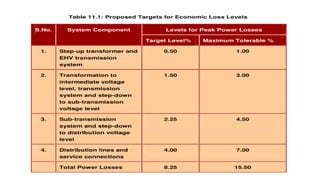
• Generally speaking;
LOSS EVALUATION cont.
HOW TO DETERMINE LOSSES OF A NETWORK
• Procedure to Determine Technical Losses on the 11 kV Feeder
• Technical losses on the 11 kV feeder are assessed by conducting load
flow analysis of the individual 11 kV feeder including distribution
transformer and LT distribution losses.
• We consider the steady state model to find technical losses and take
the loads to be of constant impedance.
• 1. Assessing Load Factor (LF) and Loss Load Factor (LLF)
• a) Copper losses of all transformers = Copper loss of each transformer capacity wise in
kWh x Numbers of transformers capacity wise in the feeder
HOW TO DETERMINE LOSSES OF A NETWORK (2)
• 2. Distribution Transformer Losses
• a) No-load losses, i.e., iron losses: No-load losses in kWh of one distribution
transformer = No load loss of transformer in kW x number of hours the transformer
was in service during the month
• b) Load losses, i.e., copper losses: Copper losses in kWh = Copper loss of each
transformer capacity wise in kW x (Actual load / Full load) 2 x number of hours the
transformer capacity wise was in service during the month x LLF
• 3. Calculation of LT Line and Network Losses
• a) The losses of LT network of each capacity transformer are computed by averaging
the losses of the LT network of all similar capacity transformers.
• b) The computed average losses of LT network radiating from each capacity
transformer are extrapolated for assessing the total energy losses of LT network on
the feeder.
HOW TO DETERMINE LOSSES OF A NETWORK (3)
• 4. 11 kV Feeder Loss
• The monthly energy losses in the feeder should be computed by extrapolating
the daily energy loss proportional to the energy sent out in the feeder, for all
feeders for all the months in the audit period.
• 5. Energy losses in loose jump connections, short circuit and earth
faults on the lines, service mains and energy meters are assumed to
be:
• a) 1% of the total energy sent out through the 11 kV line from the substation,
for the 11 kV lines of 20 km and more, and
• b) 0.5% of the total energy sent out through the 11 kV line from the
substation, for the 11 kV lines of less than 20 km.
HOW TO DETERMINE LOSSES OF A NETWORK (4)
HOW TO DETERMINE LOSSES OF A NETWORK (5)
• Energy losses in the feeder = Energy input to the 11 kV feeder −−−− Energy
sales
• Determining Commercial Losses
• The commercial losses are assessed by deducting technical losses from the total
losses of the feeder, i.e., the difference between energy sent out and the energy
sold. Thus,
• Commercial loss in the feeder = Energy loss −−−− Technical loss
• The following activities are undertaken to record these losses:
• The meter reading schedules of meter readers are revised and made coterminous
with distribution transformers. On that day, the distribution transformer meter is
also read and comparison is made between distribution transformer meter reading
and sum total of consumption recorded in all other consumer meters coming under
that distribution transformer. The difference is noted. If the losses are found to be
high, action is initiated to trace the installation causing losses.
LOSSES EVALUATION METHODS
•Manual loss computation
•MS Excel sheet
•Software – Power system analysis tool (PSAT)
REFERENCES
• A TURNAROUND STORY! ON THE AGGREGATE TECHNICAL AND COMMERCIAL (AT&C) LOSS REDUCTION FROM 53% TO 15% IN DELHI
AREA ACHIEVED IN 8 YEARS BY NDPL (NORTH DELHI POWER LIMITED) By Ajai Nirula .
• Reducing Technical and Non-Technical losses in the Power sector Background Paper for the World Bank Group Energy Sector Strategy,
July 2009
• Non-Technical losses – How do other countries tackle the problem? 22nd AMEU Technical Convention
• Management of electricity distribution network losses by Sohn Assiciates/Imperial college, London, February, 2014.
• Distribution network losses and reduction opportunities from UK DNO’s perspective, 23rd International Conference on Electricity
Distribution Lyon, 15-18 June 2015
• Power Loss Reduction on Primary Distribution Networks by Tap changing, Adejumobi I A and Adebisi O I of Electrical engineering
Department, College of Agriculture, Abeokuta, Nigeria, February, 2012.
• Reduction of power loss of Distribution system by Distribution Network Management, Sarang Pande and Dr. J G Ghodekar of
Department of Electrical Engineering, K.K. Wagh Institute of Engineering & Research, Nashik, India INTERNATIONAL JOURNAL OF
MULTIDISCIPLINARY SCIENCES AND ENGINEERING, VOL. 3, NO. 11, NOVEMBER 2012
• Evaluation of electric energy losses in Southern Governorates of Jordan Distribution Electric System, by Oda Refou, Qais Alsafasfeh
and Mohammed Al-sound of Electrical engineering Department, Tafila Technical University. International Journal of Energy
Engineering 2015, 5(2): 25-33
• http://electrical-engineering-portal.com/total-losses-in-power-distribution-and-transmission-lines-1 and http://electrical-
engineering-portal.com/total-losses-in-power-distribution-and-transmission-lines-2.
• Final report on Power Loss Reduction Technologies of 3 EDCs in Nigeria by DNVKEMA, June, 2013.
• Equipment and systems for outage and emergency management presentation @ Power Africa conference in Nigeria, October, 2013.
• Reliability Improvement of Distribution System presentation by Prof.Engr. Fertunato C. Lynes, Vice president of Manila Electric
Company, Philliphines @Power Africa Conference, October, 2013.
• NAPTIN Manual on Maintenance of Transformer and SwitchGear, developed in 2016 by Engr A. A. Gwaram and sponsored by GIZ.
• IEC document “Efficient Electrical Energy Transmission and Distribution” (2007)
• http://blog.schneider-electric.com/energy-management-energy-efficiency/2013/03/25/how-big-are-power-line-losses/
• NAPTIN presentations on Power loss reduction technologies training by DNVKEMA GERS consultant.
• Introduction to Distribution Automation and Impact of Distribution automation presentations by Dr Gers Juan, in NAPTIN Power loss
reduction programme, 2013.
• http://electrical-engineering-portal.com/total-losses-in-power-distribution-and-transmission-lines-1
• Energy conservation, audit and accounting, India, 2007.
.................................power trainer with a difference 22
THANKS FOR LISTENING

2. power system losses evaluation

  • 1.
    National Power TrainingInstitute of Nigeria BY KHALIL Y. A. POWER LOSSES - EVALUATION AUGUST, 2019
  • 2.
    Getting to KnowEach Other… • Full Name • Profession/Job role • Years of experience • What would you like to get out of this Training?
  • 3.
  • 4.
  • 5.
    .................................power trainer witha difference • Evaluate and estimate technical and non- technical lossesCOURSE OBJECTIVES At the end of this course all the participant should be able to:
  • 6.
  • 7.
    POWER LOSSES EVALUATIONAND ESTIMATION • Electricity has to be transmitted from large power plants to the consumers via extensive networks. • The transmission over long distances creates power losses. • The major part of the energy losses comes from Joule effect in transformers and power lines. • The energy is lost as heat in the conductors.
  • 8.
    LOSS EVALUATION/ESTIMATION • Consideringthe main parts of a typical Transmission & Distribution network, here are the average values of power losses at the different steps*: • 1-2% – Step-up transformer from generator to Transmission line • 2-4% – Transmission line • 1-2% – Step-down transformer from Transmission line to Distribution network • 4-6% – Distribution network transformers and cables • The overall losses between the power plant and consumers is then in the range between 8 and 15%.
  • 10.
    LOSS EVALUATION cont. •This must not be mixed up with the efficiency of power plants like nuclear, coal-fired or natural gas turbine. • These technologies are based on a thermodynamic cycle, which efficiency is in the order of 35%. • This means that the combustion of coal, for example, will produce heat, which will be converted into mechanical energy and then into electricity. • From the energy assessment, it can be concluded that 100 units saved at home can save 300 units saved at the power plant. This should be a real encouragement to save energy for a greener environment.
  • 11.
    LOSS EVALUATION cont. •In order to develop a power loss reduction strategy, the utilities first need to have a good knowledge of the level of power losses in their systems. • The knowledge comes from monitoring and evaluating power losses on a constant basis. • Loss evaluation is not a one-time event but needs to be considered when developing all utility processes; e.g., operational procedures, planning and engineering system expansions, purchasing materials, and defining revenue assurance measures. • With the evaluation process repeated periodically, more and more data can be accumulated so that the study results become more and more accurate to reflect EDCs actual level of losses.
  • 12.
    LOSS EVALUATION cont.•New technologies will help EDCs in improving the availability of information as well as providing support to the power loss monitoring and evaluation program. • All EDCs shall continue the effort of installing revenue meters for those unmetered customers as well as new customers to improve the accuracy of energy consumption measurements. • Furthermore, EDCs shall develop plan to install revenue class meters at strategic locations, such as in 33kV/11kV substations to monitor consumption of each outgoing feeder, as well as locations where a feeder supplies loads belong to neighboring EDCs (referred as feeder sharing). • By collecting and analyzing these meter measurements, EDCs can improve their capability of reducing power losses and increasing revenue. • Technologies will be helpful in EDC’s effort to monitor and evaluate power losses, especially CIS, GIS, AMR and PSAT. These technologies should have the highest priority in each EDC’s overall technology advancement.
  • 13.
    LOSS EVALUATION cont. •Generally speaking;
  • 14.
  • 15.
    HOW TO DETERMINELOSSES OF A NETWORK • Procedure to Determine Technical Losses on the 11 kV Feeder • Technical losses on the 11 kV feeder are assessed by conducting load flow analysis of the individual 11 kV feeder including distribution transformer and LT distribution losses. • We consider the steady state model to find technical losses and take the loads to be of constant impedance. • 1. Assessing Load Factor (LF) and Loss Load Factor (LLF) • a) Copper losses of all transformers = Copper loss of each transformer capacity wise in kWh x Numbers of transformers capacity wise in the feeder
  • 16.
    HOW TO DETERMINELOSSES OF A NETWORK (2) • 2. Distribution Transformer Losses • a) No-load losses, i.e., iron losses: No-load losses in kWh of one distribution transformer = No load loss of transformer in kW x number of hours the transformer was in service during the month • b) Load losses, i.e., copper losses: Copper losses in kWh = Copper loss of each transformer capacity wise in kW x (Actual load / Full load) 2 x number of hours the transformer capacity wise was in service during the month x LLF • 3. Calculation of LT Line and Network Losses • a) The losses of LT network of each capacity transformer are computed by averaging the losses of the LT network of all similar capacity transformers. • b) The computed average losses of LT network radiating from each capacity transformer are extrapolated for assessing the total energy losses of LT network on the feeder.
  • 17.
    HOW TO DETERMINELOSSES OF A NETWORK (3) • 4. 11 kV Feeder Loss • The monthly energy losses in the feeder should be computed by extrapolating the daily energy loss proportional to the energy sent out in the feeder, for all feeders for all the months in the audit period. • 5. Energy losses in loose jump connections, short circuit and earth faults on the lines, service mains and energy meters are assumed to be: • a) 1% of the total energy sent out through the 11 kV line from the substation, for the 11 kV lines of 20 km and more, and • b) 0.5% of the total energy sent out through the 11 kV line from the substation, for the 11 kV lines of less than 20 km.
  • 18.
    HOW TO DETERMINELOSSES OF A NETWORK (4)
  • 19.
    HOW TO DETERMINELOSSES OF A NETWORK (5) • Energy losses in the feeder = Energy input to the 11 kV feeder −−−− Energy sales • Determining Commercial Losses • The commercial losses are assessed by deducting technical losses from the total losses of the feeder, i.e., the difference between energy sent out and the energy sold. Thus, • Commercial loss in the feeder = Energy loss −−−− Technical loss • The following activities are undertaken to record these losses: • The meter reading schedules of meter readers are revised and made coterminous with distribution transformers. On that day, the distribution transformer meter is also read and comparison is made between distribution transformer meter reading and sum total of consumption recorded in all other consumer meters coming under that distribution transformer. The difference is noted. If the losses are found to be high, action is initiated to trace the installation causing losses.
  • 20.
    LOSSES EVALUATION METHODS •Manualloss computation •MS Excel sheet •Software – Power system analysis tool (PSAT)
  • 21.
    REFERENCES • A TURNAROUNDSTORY! ON THE AGGREGATE TECHNICAL AND COMMERCIAL (AT&C) LOSS REDUCTION FROM 53% TO 15% IN DELHI AREA ACHIEVED IN 8 YEARS BY NDPL (NORTH DELHI POWER LIMITED) By Ajai Nirula . • Reducing Technical and Non-Technical losses in the Power sector Background Paper for the World Bank Group Energy Sector Strategy, July 2009 • Non-Technical losses – How do other countries tackle the problem? 22nd AMEU Technical Convention • Management of electricity distribution network losses by Sohn Assiciates/Imperial college, London, February, 2014. • Distribution network losses and reduction opportunities from UK DNO’s perspective, 23rd International Conference on Electricity Distribution Lyon, 15-18 June 2015 • Power Loss Reduction on Primary Distribution Networks by Tap changing, Adejumobi I A and Adebisi O I of Electrical engineering Department, College of Agriculture, Abeokuta, Nigeria, February, 2012. • Reduction of power loss of Distribution system by Distribution Network Management, Sarang Pande and Dr. J G Ghodekar of Department of Electrical Engineering, K.K. Wagh Institute of Engineering & Research, Nashik, India INTERNATIONAL JOURNAL OF MULTIDISCIPLINARY SCIENCES AND ENGINEERING, VOL. 3, NO. 11, NOVEMBER 2012 • Evaluation of electric energy losses in Southern Governorates of Jordan Distribution Electric System, by Oda Refou, Qais Alsafasfeh and Mohammed Al-sound of Electrical engineering Department, Tafila Technical University. International Journal of Energy Engineering 2015, 5(2): 25-33 • http://electrical-engineering-portal.com/total-losses-in-power-distribution-and-transmission-lines-1 and http://electrical- engineering-portal.com/total-losses-in-power-distribution-and-transmission-lines-2. • Final report on Power Loss Reduction Technologies of 3 EDCs in Nigeria by DNVKEMA, June, 2013. • Equipment and systems for outage and emergency management presentation @ Power Africa conference in Nigeria, October, 2013. • Reliability Improvement of Distribution System presentation by Prof.Engr. Fertunato C. Lynes, Vice president of Manila Electric Company, Philliphines @Power Africa Conference, October, 2013. • NAPTIN Manual on Maintenance of Transformer and SwitchGear, developed in 2016 by Engr A. A. Gwaram and sponsored by GIZ. • IEC document “Efficient Electrical Energy Transmission and Distribution” (2007) • http://blog.schneider-electric.com/energy-management-energy-efficiency/2013/03/25/how-big-are-power-line-losses/ • NAPTIN presentations on Power loss reduction technologies training by DNVKEMA GERS consultant. • Introduction to Distribution Automation and Impact of Distribution automation presentations by Dr Gers Juan, in NAPTIN Power loss reduction programme, 2013. • http://electrical-engineering-portal.com/total-losses-in-power-distribution-and-transmission-lines-1 • Energy conservation, audit and accounting, India, 2007.
  • 22.
    .................................power trainer witha difference 22 THANKS FOR LISTENING