Memoona Arshad Group 11
Presented to: Sir Marat
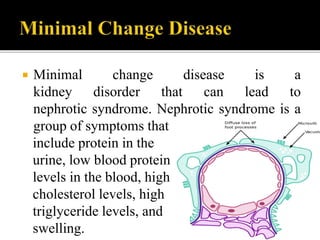
๏‚ก Minimal change disease is a
kidney disorder that can lead to
nephrotic syndrome. Nephrotic syndrome is a
group of symptoms that
include protein in the
urine, low blood protein
levels in the blood, high
cholesterol levels, high
triglyceride levels, and
swelling.
๏‚ก Each kidney is made of more than a million units called
nephrons, which filter blood and produce urine.
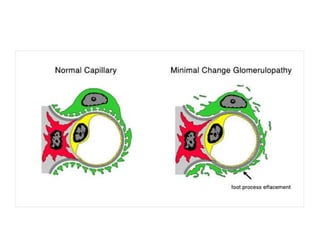
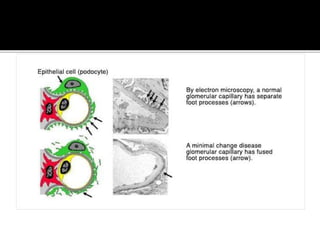
๏‚ก In minimal change disease, there is damage to the glomeruli.
These are the tiny blood vessels inside the nephron where
blood is filtered to make urine and waste is removed. The
disease gets its name because this damage is not visible under
a regular microscope. It can only be seen under a very
powerful microscope called an electron microscope.
๏‚ก Minimal change disease is the most common cause of
nephrotic syndrome in children. It is also seen in adults with
nephrotic syndrome, but is less common.
๏‚ก The cause is unknown, but the disease may occur after or be
related to:
๏‚ง Allergic reactions
๏‚ง Use of NSAIDs
๏‚ง Tumors
๏‚ง Vaccinations (flu and pneumococcal, though rare)
๏‚ง Viral infections
๏‚ก You may notice the following signs and symptoms of MCD:
๏‚ง Foamy urine due to large amounts of protein leaking into your urine,
called proteinuria
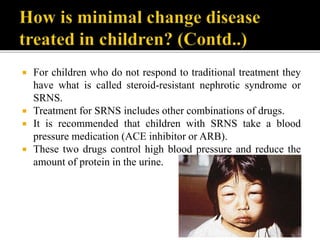
๏‚ง Swelling in body parts, like your ankles and around your eyes, due to fluid
building up in your body, called edema
๏‚ง Weight gain due to the fluid your body is not able to get rid of
๏‚ง Nephrotic Syndrome: A set of symptoms that happen together and affect
your kidneys.These include:
โ–ช Swelling in body parts like your legs, ankles, or around your eyes (edema)
โ–ช Large amounts of protein in your urine (proteinuria)
โ–ช Loss of protein in your blood
โ–ช High levels of fat or lipids in your blood (high cholesterol)
๏‚ก Always speak with your doctor if you experience any of these signs and
symptoms.
๏‚ก The first clues are the signs and symptoms. Your healthcare provider may run tests
to help understand the cause of your symptoms and find the proper treatment for
you.
๏‚ก These tests are:
๏‚ง Urine test
โ–ช A urine test will help find protein and blood in your urine.
๏‚ง Blood test
โ–ช A blood test will help find levels of protein, cholesterol, and wastes in your
blood.
๏‚ง Glomerular filtration rate (GFR)
โ–ช A blood test will be done to know how well your kidneys are filtering the
wastes from your body.
๏‚ง Kidney biopsy
โ–ช In this test, a tiny piece of your kidney is removed with a special needle, and
looked at under a microscope.
๏‚ก MCD is usually easier to treat than other glomerular
diseases.
๏‚ก The treatment plan for nephrotic syndrome in
children with MCD is usually with a type of drug
called a corticosteroid, often called steroids.
๏‚ก It is very important to not stop treatment suddenly.
๏‚ก By sticking to the full treatment plan, your child will
be less likely to relapse (experience the signs and
symptoms again).
๏‚ก For children who do not respond to traditional treatment they
have what is called steroid-resistant nephrotic syndrome or
SRNS.
๏‚ก Treatment for SRNS includes other combinations of drugs.
๏‚ก It is recommended that children with SRNS take a blood
pressure medication (ACE inhibitor or ARB).
๏‚ก These two drugs control high blood pressure and reduce the
amount of protein in the urine.
๏‚ก The treatment for nephrotic syndrome in adults with
MCD is usually with a type of drug called a
corticosteroid, often called steroids.
๏‚ก You may notice that you start getting better within
weeks, or less, although it may take an adult longer
to respond than a child.
๏‚ก It is important to stick with your treatment plan until
all medications are finished; even if your symptoms
go away sooner.
๏‚ก If you are a woman and want to have children, you should
speak with your healthcare provider to see how the medicines
you are given affect this process.
๏‚ก For symptoms of swelling (edema), your healthcare provider
may give you:
๏‚ง ACE inhibitor or ARB medicines
๏‚ง Diuretics (water pills)
๏‚ง Limit sodium (salt) in your diet
๏‚ก Minimal change disease is most common in very young
children but can occur in older children and adults.
๏‚ก It is by far the most common cause of nephrotic syndrome in
children, accounting for 70-90% of children >1 year of
age. After puberty, it is caused by minimal change disease
about half the time. Among young children, boys seem to be
more likely to develop minimal change disease than girls
(about 2:1).
๏‚ก Minimal change disease is seen in about 16 in every 100,000
children, being more common in South Asians and Native
Americans, but rarer in African Americans.
๏‚ก In adults, it accounts for less than 15% of adults diagnosed
with nephrotic syndrome.
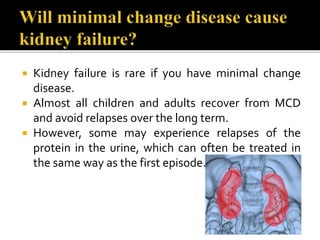
๏‚ก Kidney failure is rare if you have minimal change
disease.
๏‚ก Almost all children and adults recover from MCD
and avoid relapses over the long term.
๏‚ก However, some may experience relapses of the
protein in the urine, which can often be treated in
the same way as the first episode.
Minimal change disease

Minimal change disease

  • 1.
    Memoona Arshad Group11 Presented to: Sir Marat
  • 2.
    ๏‚ก Minimal changedisease is a kidney disorder that can lead to nephrotic syndrome. Nephrotic syndrome is a group of symptoms that include protein in the urine, low blood protein levels in the blood, high cholesterol levels, high triglyceride levels, and swelling.
  • 3.
    ๏‚ก Each kidneyis made of more than a million units called nephrons, which filter blood and produce urine. ๏‚ก In minimal change disease, there is damage to the glomeruli. These are the tiny blood vessels inside the nephron where blood is filtered to make urine and waste is removed. The disease gets its name because this damage is not visible under a regular microscope. It can only be seen under a very powerful microscope called an electron microscope.
  • 4.
    ๏‚ก Minimal changedisease is the most common cause of nephrotic syndrome in children. It is also seen in adults with nephrotic syndrome, but is less common. ๏‚ก The cause is unknown, but the disease may occur after or be related to: ๏‚ง Allergic reactions ๏‚ง Use of NSAIDs ๏‚ง Tumors ๏‚ง Vaccinations (flu and pneumococcal, though rare) ๏‚ง Viral infections
  • 6.
    ๏‚ก You maynotice the following signs and symptoms of MCD: ๏‚ง Foamy urine due to large amounts of protein leaking into your urine, called proteinuria ๏‚ง Swelling in body parts, like your ankles and around your eyes, due to fluid building up in your body, called edema ๏‚ง Weight gain due to the fluid your body is not able to get rid of ๏‚ง Nephrotic Syndrome: A set of symptoms that happen together and affect your kidneys.These include: โ–ช Swelling in body parts like your legs, ankles, or around your eyes (edema) โ–ช Large amounts of protein in your urine (proteinuria) โ–ช Loss of protein in your blood โ–ช High levels of fat or lipids in your blood (high cholesterol) ๏‚ก Always speak with your doctor if you experience any of these signs and symptoms.
  • 8.
    ๏‚ก The firstclues are the signs and symptoms. Your healthcare provider may run tests to help understand the cause of your symptoms and find the proper treatment for you. ๏‚ก These tests are: ๏‚ง Urine test โ–ช A urine test will help find protein and blood in your urine. ๏‚ง Blood test โ–ช A blood test will help find levels of protein, cholesterol, and wastes in your blood. ๏‚ง Glomerular filtration rate (GFR) โ–ช A blood test will be done to know how well your kidneys are filtering the wastes from your body. ๏‚ง Kidney biopsy โ–ช In this test, a tiny piece of your kidney is removed with a special needle, and looked at under a microscope.
  • 9.
    ๏‚ก MCD isusually easier to treat than other glomerular diseases. ๏‚ก The treatment plan for nephrotic syndrome in children with MCD is usually with a type of drug called a corticosteroid, often called steroids. ๏‚ก It is very important to not stop treatment suddenly. ๏‚ก By sticking to the full treatment plan, your child will be less likely to relapse (experience the signs and symptoms again).
  • 10.
    ๏‚ก For childrenwho do not respond to traditional treatment they have what is called steroid-resistant nephrotic syndrome or SRNS. ๏‚ก Treatment for SRNS includes other combinations of drugs. ๏‚ก It is recommended that children with SRNS take a blood pressure medication (ACE inhibitor or ARB). ๏‚ก These two drugs control high blood pressure and reduce the amount of protein in the urine.
  • 11.
    ๏‚ก The treatmentfor nephrotic syndrome in adults with MCD is usually with a type of drug called a corticosteroid, often called steroids. ๏‚ก You may notice that you start getting better within weeks, or less, although it may take an adult longer to respond than a child. ๏‚ก It is important to stick with your treatment plan until all medications are finished; even if your symptoms go away sooner.
  • 12.
    ๏‚ก If youare a woman and want to have children, you should speak with your healthcare provider to see how the medicines you are given affect this process. ๏‚ก For symptoms of swelling (edema), your healthcare provider may give you: ๏‚ง ACE inhibitor or ARB medicines ๏‚ง Diuretics (water pills) ๏‚ง Limit sodium (salt) in your diet
  • 13.
    ๏‚ก Minimal changedisease is most common in very young children but can occur in older children and adults. ๏‚ก It is by far the most common cause of nephrotic syndrome in children, accounting for 70-90% of children >1 year of age. After puberty, it is caused by minimal change disease about half the time. Among young children, boys seem to be more likely to develop minimal change disease than girls (about 2:1). ๏‚ก Minimal change disease is seen in about 16 in every 100,000 children, being more common in South Asians and Native Americans, but rarer in African Americans. ๏‚ก In adults, it accounts for less than 15% of adults diagnosed with nephrotic syndrome.
  • 14.
    ๏‚ก Kidney failureis rare if you have minimal change disease. ๏‚ก Almost all children and adults recover from MCD and avoid relapses over the long term. ๏‚ก However, some may experience relapses of the protein in the urine, which can often be treated in the same way as the first episode.