
Dr Narinder sharma
DNB Nephrology
Fortis Noida
 Described in 1913 by munk
 Also known as lipoid nephrosis because of
presence of lipids in tubular epithelial cells
and urine
 It is cause of Nephrotic syndrome in
70 -90% in children <10 yr
50% in older child
10-15% in adult
 More common in asia than north america or
europe
 Males more commonly affected
 Injury to podocytes and particularly slit
diaphragm cause protienuria.
 Likely due to pathological release of
circulation permeability factor by subset of T
cells causing protienuria
 Role of hemopexin which is normally present
in plasma but an altered isoform with
increase protease activity is seen
 Role of genes- Tumour necrosis factor
related apoptosis induced ligand (TRAIL) gene
 Genes coding IL6, IL13 activity increased
 Podocyte specific angiopoietin like 4
(ANGPLT4) overexpression on podocytes
cause loss of charge
 Loss of charge selectivity of GBM
 Increased activity of CD20 cells-role of
Rituximab
 Increase in CD80 expression on podocytes
 Decreased levels of dystroglycans which
anchor podocytes to GBM
 Increased activity of Melanocortin 1 receptor
seen- role of ACTH in a small trail
MCD is seen associated with
 Allergies
 NSAIDS (fenoprofen)
 Interferons, gold, lithium, rifampicin,
 Malignancies – Hodgkin lymphoma(ns variety)
 SLE, GVHD, stem cell transplant
 Children -relatively abrupt onset of
proteinuria and development of nephrotic
syndrome with heavy proteinuria,
hypoalbuminemia, and hyperlipidemia.
 Ascites, pleural effusion, pericardial effusion,
hepatomegaly, white nails, xanthoma can be
seen
 In children hematuria and HTN uncommon
while in older adults features seen commonly
 Protienuria >3.5 gm/day in adult and
>1gm/m2 in child
 Hypoalbuminemia
 Edema- Underfill or overfill mechanism
 Overfill mechanism defective ENAc activation
due to proteolytic enzymes due to heavy
protienuria
 Negative nitrogen balance
 Hypercoagulability
 Increased levels of fibrinogen, factor
2,5,7,8,10,12
 Decreased antithrombin 3, protein S.
 Infections capsular bacteria- Loss of
complement factor b , IgG , zinc, transferrin
 Peritonitis common in child S. Pneumonia, H
influenza
 Infections commonly URTI lead to relapse of
diseases
 Renal parameters are usually normal
 Dyslipidemia, atherosclerosis,
thromboembolic compications
 Loss of Vitamin D binding protien,
 Decreased levels of Cu, Fe, Zn
 Thrombosis are frequent due to increased
plasma viscosity, increased red cell
aggregation, low plasminogen levels, and low
levels of antithrombin III.
 IgG levels decreased
 IgM levels increased after remission
 Ig A , IgE levels high
 The ESR is increased as a consequence of the
hyperfibrinogenemia as well as
hypoalbuminemia.
 Total cholesterol , LDL and triglyceride levels
are increased, decrease in HDL due to urinary
loss
 Pseudohyponatremia
 Serum calcium may be low, largely due to
hypoproteinemia.
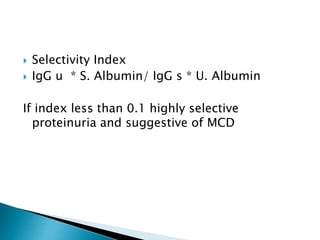
 Selectivity Index
 IgG u * S. Albumin/ IgG s * U. Albumin
If index less than 0.1 highly selective
proteinuria and suggestive of MCD
 Usually normal
 Sometime minimal focal segmental
prominence limited to 3-4 cells in matrix of
segment may be seen
 This mesangial prominence should have no
more than three or four cells embedded in
the matrix of a segment, and the matrix
should not be expanded to the extent that
capillary lumens are compromised.
 Lipid and protien deposits in tubular cells
stain with PAS stain
 Areas of interstitial fibrosis and tubular
atrophy raise possibilty of FSGS
 Focal proximal tubular epithelial flattening
(simplification), which is histologically
identical to that seen with ischemic AKI,
occurs in patients who have thesyndrome of
MCD with AKI
 No staining with IgG , IgM, IgA, C3, C4 or C1q
 Low level mesangial staining for IgM can be
seen but without mesangial electron dense
deposits on EM
 Effacement of foot process seen in EM which
diminish as diseases remits.
 Due to increased lipid absorption
intracytoplasmic densities can be seen.
 Findings non specific and seen in nephrotic
range protienuria.
 Well defined irregular focal segmental
staining for C3 and IgM should raise the
possibility of FSGS because sclerotic lesions
can be enriched for C3 and IgM
 Glomerular and tubular epithelial cell
cytoplasmic droplets and tubular casts may
stain positively for immunoglobulins and
other plasma proteins when there is
substantial
proteinuria
 During active nephrosis, the effacement often
is very extensive, with only a few scattered
intact foot processes. As the patient enters
remission, the extent of foot process
effacement diminishes.
 MCD is a diagnosis by exclusion that is made
only when there is no evidence by light,
immunofluorescence, and electron
microscopy for any other glomerular disease.
 Mostly in adults older than age 40
 Marked decrease in glomerular permeability
due to extensive foot process effacement,
tubular obstruction from proteinaceous casts,
and intrarenal hemodynamic change and
increased endothelin-1 expression in the
kidneys
 FSGS
 IgM nephropathy – mesangial deposits of
IgM, microscopic hematuria, less responsive
to steroids.
 Glomerular tip lesions - structural segmental
changes adjacent to tubular pole of bowman
capsule, benign lesion
 Thin membrane diseases
 Early stage of membranous nephropathy
 Primary FSGS diagnosis requires biopsy
findings of segmental glomerusclerosis in at
least 1 glomerulus in addition to diffuse foot
process effacement
 Sclerotic changes appear first at the
juxtamedullary glomeruli, which may not be
seen in a biopsy sample containing only outer
cortex or with <8 glomeruli on biopsy
 Level 1 ‘‘We recommend’’
 Level 2 ‘‘We suggest”
 Grade Quality of evidence Meaning
 A High We are confident that the true effect
lies close to that of the estimate of the effect.
 B Moderate The true effect is likely to be close
to the estimate of the effect, but there is a
possibility that it is substantially different.
 C Low The true effect may be substantially
different from the estimate of the effect.
 D Very Low The estimate of effect is very
uncertain, and often will be far from the truth.
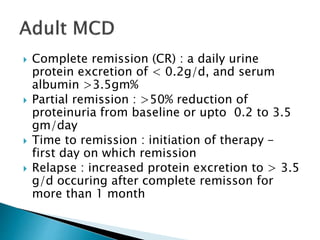
 Complete remission (CR) : a daily urine
protein excretion of < 0.2g/d, and serum
albumin >3.5gm%
 Partial remission : >50% reduction of
proteinuria from baseline or upto 0.2 to 3.5
gm/day
 Time to remission : initiation of therapy -
first day on which remission
 Relapse : increased protein excretion to > 3.5
g/d occuring after complete remisson for
more than 1 month
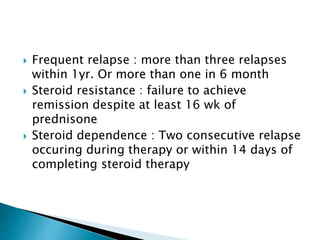
 Frequent relapse : more than three relapses
within 1yr. Or more than one in 6 month
 Steroid resistance : failure to achieve
remission despite at least 16 wk of
prednisone
 Steroid dependence : Two consecutive relapse
occuring during therapy or within 14 days of
completing steroid therapy
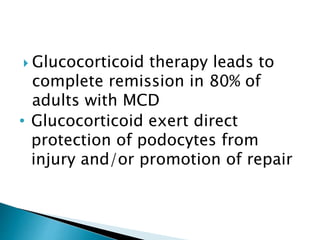
 Glucocorticoid therapy leads to
complete remission in 80% of
adults with MCD
• Glucocorticoid exert direct
protection of podocytes from
injury and/or promotion of repair
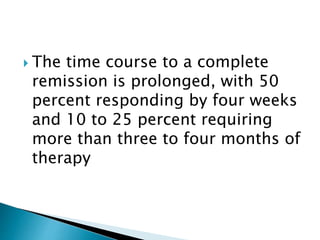
 The time course to a complete
remission is prolonged, with 50
percent responding by four weeks
and 10 to 25 percent requiring
more than three to four months of
therapy
 50 percent of glucocorticoid-responsive
adults will have a relapse, and frequent
relapses occur in 10 to 25 percent
 Steroid dependence is seen in 25 to 30
percent
 Remissions are typically abrupt, with the
patient being free of proteinuria within two to
three weeks from the time of initial response.
 In a majority of cases, response to therapy of
nephrotic MCD is of an "all or nothing" type.
 Partial responses are not characteristic of
MCD and, when seen, one should suspect a
possible misdiagnosis, most often FSGS
Most relapses occur within one year after
glucocorticoid therapy has been tapered or
discontinued
 Relapses may be triggered by allergies or
infections, especially viral infections
 Relapse occur in 40% of adults who had MCD
in childhood
 Treatment of initial episode of adult MCD
 Recommended that corticosteroids be given
for initial treatment of nephrotic syndrome.
(1C)
 Prednisolone be given at a daily single dose
of 1 mg/kg (maximum 80 mg) or alternate-
day single dose of 2 mg/kg (maximum 120
mg). (2C)
 Initial high dose of corticosteroids, be
maintained for a minimum period of 4 weeks
if complete remission is achieved, and for a
maximum period of 16 weeks if complete
remission is not achieved. (2C)
 After complete remission tapered slowly over
6 months(2D)
 Suggested using the same initial dose and
duration of corticosteroids for infrequent
relapses and given at least 4 weeks after
remission
In patients who remit suggested that
corticosteroids be tapered slowly over a total
period of up to 6 months after achieving
remission. (2D)
 For patients with relative contraindications or
intolerance to high-dose corticosteroids use
oral cyclophosphamide or CNIs(2D)
 Suggested oral cyclophosphamide 2–2.5
mg/kg/d for 8 weeks. (2C) or upto 12 weeks
OR CNI (cyclosporine 3–5 mg/kg/d or
tacrolimus 0.05–0.1 mg/kg/d in divided
doses) for 1–2 years for who have relapsed
despite cyclophosphamide, or for people who
wish to preserve their fertility. (2C)
 Aim for trough whole blood levels of 50-150
ng/ml of cyclosporine and 4-8 ng/ml blood
level of tacrolimus
 Suggested for MMF 500–1000 mg twice daily
for 1–2 years for patients who are intolerant
of corticosteroids, cyclophosphamide and
CNIs. (2D)
 Rituximab may be effective therapy in adults
with frequently relapsing or glucocorticoid-
dependent MCD. Its suggested rituximab
therapy be attempted in such patients who
have also failed to attain a durable remission
with cyclophosphamide or calcineurin
inhibitors..
Corticosteroid-resistant MCD
Approx 5% of patients
 Re-evaluate patients who are corticosteroid-
resistant for other causes of nephrotic
syndrome
 IV steroid can be tried
 Cyclosporine can be started in combination
with steroid
 Rituximab does not appear to be effective in
adults with glucocorticoid-resistant MCD and
therefore should be avoided in these patients
 Suggested that MCD patients who have AKI
be treated with renal replacement therapy as
indicated, but together with corticosteroids,
as for a first episode of MCD. (2D)
 For the initial episode of nephrotic syndrome
associated with MCD, statins not be used to
treat hyperlipidemia, and ACE-I or ARBs not
to be used in normotensive patients to lower
proteinuria. (2D) but if diseases is long
standing use these drugs
 For MCD who have rare relapse with
protienuria of non nephrotic range, tratment
doesnot require steroid but instead use ACEi
or ARB and can go for repeat biopsy.
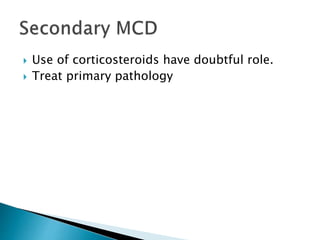
 Use of corticosteroids have doubtful role.
 Treat primary pathology
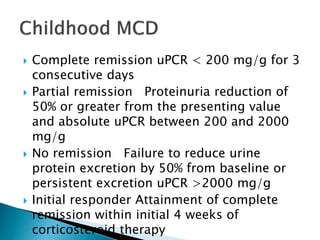
 Complete remission uPCR < 200 mg/g for 3
consecutive days
 Partial remission Proteinuria reduction of
50% or greater from the presenting value
and absolute uPCR between 200 and 2000
mg/g
 No remission Failure to reduce urine
protein excretion by 50% from baseline or
persistent excretion uPCR >2000 mg/g
 Initial responder Attainment of complete
remission within initial 4 weeks of
corticosteroid therapy
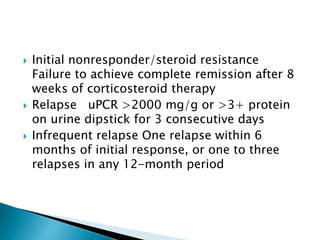
 Initial nonresponder/steroid resistance
Failure to achieve complete remission after 8
weeks of corticosteroid therapy
 Relapse uPCR >2000 mg/g or >3+ protein
on urine dipstick for 3 consecutive days
 Infrequent relapse One relapse within 6
months of initial response, or one to three
relapses in any 12-month period
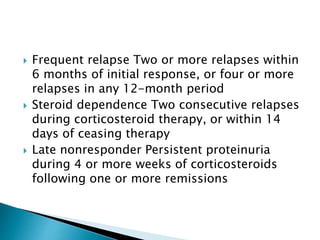
 Frequent relapse Two or more relapses within
6 months of initial response, or four or more
relapses in any 12-month period
 Steroid dependence Two consecutive relapses
during corticosteroid therapy, or within 14
days of ceasing therapy
 Late nonresponder Persistent proteinuria
during 4 or more weeks of corticosteroids
following one or more remissions
 Chilren 1-18 year of age
 oral prednisone be administered as a single
daily dose (1B) starting at 60 mg/m2/d or 2
mg/kg/d to a maximum 60 mg/d. (1D)
 Daily prednisone be given for 4–6 weeks (1C)
followed by alternate-day medication as a
single daily dose starting at 40 mg/m2 or 1.5
mg/kg (maximum 40 mg on alternate days)
(1D) and continued for 2–5 months with
tapering of the dose. (1B)
 75% of children respond in 2 weeks and 95%
by 4 weeks.
 Out of responders
No relapse 35%
Occasional relapse 20%
Frequent relapse 40%
 Infrequent relapses of SSNS in children be
treated with a single-daily dose of
prednisone 60 mg/m2 or 2 mg/kg (maximum
of 60 mg/d) until the child has been in
complete remission for at least 3 days. (2D)
 After achieving complete remission, children
be given prednisone as a single dose on
alternate days (40 mg/m2 per dose or 1.5
mg/kg per dose: maximum 40 mg on
alternate days) for at least 4 weeks. (2C)
 Relapses in children with FR or SD Nephrotic
Syndrome be treated with daily prednisone
until the child has been in remission for at
least 3 days, followed by alternate-day
prednisone for at least 3 months. (2C)
 Prednisone be given on alternate days in the
lowest dose to maintain remission(2D)
 Daily prednisone is given if alt dose not
effective(2D)
 At time of infection switch to daily dose if on
alt dose (2C)
 Corticosteroid-sparing agents be prescribed
for children with FR and SD who develop
steroid-related adverse effects. (1B)
 Cyclophosphamide or chlorambucil, be given
as corticosteroid-sparing agents for FR SSNS.
(1B)
 Cyclophosphamide or chlorambucil, be given
as corticosteroid-sparing agents for SD SSNS.
(2C)
 Cyclophosphamide (2 mg/kg/d) be given for
8–12 weeks (maximum cumulative dose 168
mg/kg). (2C)
 Avoid in children <5.5 year
 Cyclophosphamide not be started until the
child has achieved remission with
corticosteroids. (2D)
 Chlorambucil (0.1–0.2 mg/kg/d) may be
given for 8 weeks (maximum cumulative dose
11.2 mg/kg) as an alternative to
cyclophosphamide (2C)
 Second courses of alkylating agents not be
given. (2D)
 Steroid dependent patients respond better
than frequent relapsers
 Monitor complications and check for CBC
weekly
 levamisole be given as a corticosteroid-
sparing agent. (1B)
 Levamisole be given at a dose of 2.5 mg/kg
on alternate days (2B) for at least 12 months
(2C) as most children will relapse when
levamisole is given for shorter duration
 Levamisole, which is an immunostimulant
enhances antibody production and
phagocytic activity of PMNs and monocytes
 There are limited data regarding its use in
adults with MCD.
 Calcineurin inhibitors cyclosporine or
tacrolimus be given as corticosteroid-sparing
agents. (1C)
 Cyclosporine be administered at a dose of 4–
5 mg/kg/d (starting dose) in two divided
doses. (2C)
 Tacrolimus 0.1 mg/kg/d (starting dose) given
in two divided doses(2D)
 Blood levels of cyclosporine(trough level 50-
150 ng/ml and tacrolimus levels 4-8 ng/ml)
 Relapses very common. Hence used as long
term therapy at least 1 year(2C)
 MMF be given as a corticosteroid-sparing
agent. (2C)
 MMF (starting dose 1200 mg/m2/d) be given
in two divided doses for at least 12 months,
as most children will relapse when MMF is
stopped. (2C)
 Less effective than cyclosporine
 Rituximab be considered only in children with
SD SSNS who have continuing frequent
relapses despite optimal combinations of
prednisone and corticosteroid-sparing
agents, and/or who have serious adverse
effects of therapy. (2C)
Kidney biopsy done if
 Late non responders
 Suspicion of other pathology
 Deteoriation in renal functions
 CNi toxicity suspected
 Vaccination
Pneumococcal, Influenza
Only if steroid intake <1mg/kg/day
 minimum of 8 weeks treatment with
corticosteroids to define steroid resistance.
(2D)
 Diagnostic kidney biopsy;
 Evaluation of kidney function by GFR or eGFR;
 Quantitation of urine protein excretion
 Calcineurin inhibitor (CNI) as initial therapy
for children with SRNS.(1B)
 CNI therapy be continued for a minimum of 6
months and then stopped if a partial or
complete remission of proteinuria is not
achieved. (2C)
 CNIs be continued for a minimum of 12
months when at least a partial remission is
achieved by 6 months. (2C)
 Low-dose corticosteroid therapy be
combined with CNI therapy. (2D)
 Treatment with ACE-I or ARBs for children
with SRNS
 Mycophenolate mofetil (2D), high-dose
corticosteroids (2D), or a combination of
these agents (2D) be considered in children
who fail to achieve complete or partial
remission with
CNIs and corticosteroids
 Cyclophosphamide and rituximab are not
indicated
THANK
YOU

minimal change disease

  • 1.
    Dr Narinder sharma DNBNephrology Fortis Noida
  • 2.
     Described in1913 by munk  Also known as lipoid nephrosis because of presence of lipids in tubular epithelial cells and urine  It is cause of Nephrotic syndrome in 70 -90% in children <10 yr 50% in older child 10-15% in adult
  • 3.
     More commonin asia than north america or europe  Males more commonly affected
  • 4.
     Injury topodocytes and particularly slit diaphragm cause protienuria.  Likely due to pathological release of circulation permeability factor by subset of T cells causing protienuria  Role of hemopexin which is normally present in plasma but an altered isoform with increase protease activity is seen
  • 5.
     Role ofgenes- Tumour necrosis factor related apoptosis induced ligand (TRAIL) gene  Genes coding IL6, IL13 activity increased  Podocyte specific angiopoietin like 4 (ANGPLT4) overexpression on podocytes cause loss of charge  Loss of charge selectivity of GBM
  • 6.
     Increased activityof CD20 cells-role of Rituximab  Increase in CD80 expression on podocytes  Decreased levels of dystroglycans which anchor podocytes to GBM  Increased activity of Melanocortin 1 receptor seen- role of ACTH in a small trail
  • 7.
    MCD is seenassociated with  Allergies  NSAIDS (fenoprofen)  Interferons, gold, lithium, rifampicin,  Malignancies – Hodgkin lymphoma(ns variety)  SLE, GVHD, stem cell transplant
  • 8.
     Children -relativelyabrupt onset of proteinuria and development of nephrotic syndrome with heavy proteinuria, hypoalbuminemia, and hyperlipidemia.  Ascites, pleural effusion, pericardial effusion, hepatomegaly, white nails, xanthoma can be seen  In children hematuria and HTN uncommon while in older adults features seen commonly
  • 9.
     Protienuria >3.5gm/day in adult and >1gm/m2 in child  Hypoalbuminemia  Edema- Underfill or overfill mechanism  Overfill mechanism defective ENAc activation due to proteolytic enzymes due to heavy protienuria
  • 10.
     Negative nitrogenbalance  Hypercoagulability  Increased levels of fibrinogen, factor 2,5,7,8,10,12  Decreased antithrombin 3, protein S.  Infections capsular bacteria- Loss of complement factor b , IgG , zinc, transferrin  Peritonitis common in child S. Pneumonia, H influenza
  • 11.
     Infections commonlyURTI lead to relapse of diseases  Renal parameters are usually normal  Dyslipidemia, atherosclerosis, thromboembolic compications  Loss of Vitamin D binding protien,  Decreased levels of Cu, Fe, Zn
  • 12.
     Thrombosis arefrequent due to increased plasma viscosity, increased red cell aggregation, low plasminogen levels, and low levels of antithrombin III.  IgG levels decreased  IgM levels increased after remission  Ig A , IgE levels high
  • 13.
     The ESRis increased as a consequence of the hyperfibrinogenemia as well as hypoalbuminemia.  Total cholesterol , LDL and triglyceride levels are increased, decrease in HDL due to urinary loss  Pseudohyponatremia  Serum calcium may be low, largely due to hypoproteinemia.
  • 14.
     Selectivity Index IgG u * S. Albumin/ IgG s * U. Albumin If index less than 0.1 highly selective proteinuria and suggestive of MCD
  • 15.
     Usually normal Sometime minimal focal segmental prominence limited to 3-4 cells in matrix of segment may be seen  This mesangial prominence should have no more than three or four cells embedded in the matrix of a segment, and the matrix should not be expanded to the extent that capillary lumens are compromised.
  • 16.
     Lipid andprotien deposits in tubular cells stain with PAS stain  Areas of interstitial fibrosis and tubular atrophy raise possibilty of FSGS  Focal proximal tubular epithelial flattening (simplification), which is histologically identical to that seen with ischemic AKI, occurs in patients who have thesyndrome of MCD with AKI
  • 17.
     No stainingwith IgG , IgM, IgA, C3, C4 or C1q  Low level mesangial staining for IgM can be seen but without mesangial electron dense deposits on EM  Effacement of foot process seen in EM which diminish as diseases remits.  Due to increased lipid absorption intracytoplasmic densities can be seen.  Findings non specific and seen in nephrotic range protienuria.
  • 18.
     Well definedirregular focal segmental staining for C3 and IgM should raise the possibility of FSGS because sclerotic lesions can be enriched for C3 and IgM  Glomerular and tubular epithelial cell cytoplasmic droplets and tubular casts may stain positively for immunoglobulins and other plasma proteins when there is substantial proteinuria
  • 19.
     During activenephrosis, the effacement often is very extensive, with only a few scattered intact foot processes. As the patient enters remission, the extent of foot process effacement diminishes.  MCD is a diagnosis by exclusion that is made only when there is no evidence by light, immunofluorescence, and electron microscopy for any other glomerular disease.
  • 20.
     Mostly inadults older than age 40  Marked decrease in glomerular permeability due to extensive foot process effacement, tubular obstruction from proteinaceous casts, and intrarenal hemodynamic change and increased endothelin-1 expression in the kidneys
  • 21.
     FSGS  IgMnephropathy – mesangial deposits of IgM, microscopic hematuria, less responsive to steroids.  Glomerular tip lesions - structural segmental changes adjacent to tubular pole of bowman capsule, benign lesion
  • 22.
     Thin membranediseases  Early stage of membranous nephropathy
  • 23.
     Primary FSGSdiagnosis requires biopsy findings of segmental glomerusclerosis in at least 1 glomerulus in addition to diffuse foot process effacement  Sclerotic changes appear first at the juxtamedullary glomeruli, which may not be seen in a biopsy sample containing only outer cortex or with <8 glomeruli on biopsy
  • 24.
     Level 1‘‘We recommend’’  Level 2 ‘‘We suggest”  Grade Quality of evidence Meaning  A High We are confident that the true effect lies close to that of the estimate of the effect.  B Moderate The true effect is likely to be close to the estimate of the effect, but there is a possibility that it is substantially different.  C Low The true effect may be substantially different from the estimate of the effect.  D Very Low The estimate of effect is very uncertain, and often will be far from the truth.
  • 25.
     Complete remission(CR) : a daily urine protein excretion of < 0.2g/d, and serum albumin >3.5gm%  Partial remission : >50% reduction of proteinuria from baseline or upto 0.2 to 3.5 gm/day  Time to remission : initiation of therapy - first day on which remission  Relapse : increased protein excretion to > 3.5 g/d occuring after complete remisson for more than 1 month
  • 26.
     Frequent relapse: more than three relapses within 1yr. Or more than one in 6 month  Steroid resistance : failure to achieve remission despite at least 16 wk of prednisone  Steroid dependence : Two consecutive relapse occuring during therapy or within 14 days of completing steroid therapy
  • 27.
     Glucocorticoid therapyleads to complete remission in 80% of adults with MCD • Glucocorticoid exert direct protection of podocytes from injury and/or promotion of repair
  • 28.
     The timecourse to a complete remission is prolonged, with 50 percent responding by four weeks and 10 to 25 percent requiring more than three to four months of therapy
  • 29.
     50 percentof glucocorticoid-responsive adults will have a relapse, and frequent relapses occur in 10 to 25 percent  Steroid dependence is seen in 25 to 30 percent  Remissions are typically abrupt, with the patient being free of proteinuria within two to three weeks from the time of initial response.
  • 30.
     In amajority of cases, response to therapy of nephrotic MCD is of an "all or nothing" type.  Partial responses are not characteristic of MCD and, when seen, one should suspect a possible misdiagnosis, most often FSGS
  • 31.
    Most relapses occurwithin one year after glucocorticoid therapy has been tapered or discontinued  Relapses may be triggered by allergies or infections, especially viral infections  Relapse occur in 40% of adults who had MCD in childhood
  • 32.
     Treatment ofinitial episode of adult MCD  Recommended that corticosteroids be given for initial treatment of nephrotic syndrome. (1C)  Prednisolone be given at a daily single dose of 1 mg/kg (maximum 80 mg) or alternate- day single dose of 2 mg/kg (maximum 120 mg). (2C)
  • 33.
     Initial highdose of corticosteroids, be maintained for a minimum period of 4 weeks if complete remission is achieved, and for a maximum period of 16 weeks if complete remission is not achieved. (2C)  After complete remission tapered slowly over 6 months(2D)  Suggested using the same initial dose and duration of corticosteroids for infrequent relapses and given at least 4 weeks after remission
  • 34.
    In patients whoremit suggested that corticosteroids be tapered slowly over a total period of up to 6 months after achieving remission. (2D)  For patients with relative contraindications or intolerance to high-dose corticosteroids use oral cyclophosphamide or CNIs(2D)
  • 35.
     Suggested oralcyclophosphamide 2–2.5 mg/kg/d for 8 weeks. (2C) or upto 12 weeks OR CNI (cyclosporine 3–5 mg/kg/d or tacrolimus 0.05–0.1 mg/kg/d in divided doses) for 1–2 years for who have relapsed despite cyclophosphamide, or for people who wish to preserve their fertility. (2C)
  • 36.
     Aim fortrough whole blood levels of 50-150 ng/ml of cyclosporine and 4-8 ng/ml blood level of tacrolimus  Suggested for MMF 500–1000 mg twice daily for 1–2 years for patients who are intolerant of corticosteroids, cyclophosphamide and CNIs. (2D)
  • 37.
     Rituximab maybe effective therapy in adults with frequently relapsing or glucocorticoid- dependent MCD. Its suggested rituximab therapy be attempted in such patients who have also failed to attain a durable remission with cyclophosphamide or calcineurin inhibitors..
  • 38.
    Corticosteroid-resistant MCD Approx 5%of patients  Re-evaluate patients who are corticosteroid- resistant for other causes of nephrotic syndrome  IV steroid can be tried  Cyclosporine can be started in combination with steroid
  • 39.
     Rituximab doesnot appear to be effective in adults with glucocorticoid-resistant MCD and therefore should be avoided in these patients  Suggested that MCD patients who have AKI be treated with renal replacement therapy as indicated, but together with corticosteroids, as for a first episode of MCD. (2D)
  • 40.
     For theinitial episode of nephrotic syndrome associated with MCD, statins not be used to treat hyperlipidemia, and ACE-I or ARBs not to be used in normotensive patients to lower proteinuria. (2D) but if diseases is long standing use these drugs  For MCD who have rare relapse with protienuria of non nephrotic range, tratment doesnot require steroid but instead use ACEi or ARB and can go for repeat biopsy.
  • 41.
     Use ofcorticosteroids have doubtful role.  Treat primary pathology
  • 42.
     Complete remissionuPCR < 200 mg/g for 3 consecutive days  Partial remission Proteinuria reduction of 50% or greater from the presenting value and absolute uPCR between 200 and 2000 mg/g  No remission Failure to reduce urine protein excretion by 50% from baseline or persistent excretion uPCR >2000 mg/g  Initial responder Attainment of complete remission within initial 4 weeks of corticosteroid therapy
  • 43.
     Initial nonresponder/steroidresistance Failure to achieve complete remission after 8 weeks of corticosteroid therapy  Relapse uPCR >2000 mg/g or >3+ protein on urine dipstick for 3 consecutive days  Infrequent relapse One relapse within 6 months of initial response, or one to three relapses in any 12-month period
  • 44.
     Frequent relapseTwo or more relapses within 6 months of initial response, or four or more relapses in any 12-month period  Steroid dependence Two consecutive relapses during corticosteroid therapy, or within 14 days of ceasing therapy  Late nonresponder Persistent proteinuria during 4 or more weeks of corticosteroids following one or more remissions
  • 45.
     Chilren 1-18year of age  oral prednisone be administered as a single daily dose (1B) starting at 60 mg/m2/d or 2 mg/kg/d to a maximum 60 mg/d. (1D)  Daily prednisone be given for 4–6 weeks (1C) followed by alternate-day medication as a single daily dose starting at 40 mg/m2 or 1.5 mg/kg (maximum 40 mg on alternate days) (1D) and continued for 2–5 months with tapering of the dose. (1B)
  • 46.
     75% ofchildren respond in 2 weeks and 95% by 4 weeks.  Out of responders No relapse 35% Occasional relapse 20% Frequent relapse 40%
  • 47.
     Infrequent relapsesof SSNS in children be treated with a single-daily dose of prednisone 60 mg/m2 or 2 mg/kg (maximum of 60 mg/d) until the child has been in complete remission for at least 3 days. (2D)  After achieving complete remission, children be given prednisone as a single dose on alternate days (40 mg/m2 per dose or 1.5 mg/kg per dose: maximum 40 mg on alternate days) for at least 4 weeks. (2C)
  • 48.
     Relapses inchildren with FR or SD Nephrotic Syndrome be treated with daily prednisone until the child has been in remission for at least 3 days, followed by alternate-day prednisone for at least 3 months. (2C)  Prednisone be given on alternate days in the lowest dose to maintain remission(2D)  Daily prednisone is given if alt dose not effective(2D)  At time of infection switch to daily dose if on alt dose (2C)
  • 49.
     Corticosteroid-sparing agentsbe prescribed for children with FR and SD who develop steroid-related adverse effects. (1B)  Cyclophosphamide or chlorambucil, be given as corticosteroid-sparing agents for FR SSNS. (1B)  Cyclophosphamide or chlorambucil, be given as corticosteroid-sparing agents for SD SSNS. (2C)
  • 50.
     Cyclophosphamide (2mg/kg/d) be given for 8–12 weeks (maximum cumulative dose 168 mg/kg). (2C)  Avoid in children <5.5 year  Cyclophosphamide not be started until the child has achieved remission with corticosteroids. (2D)
  • 51.
     Chlorambucil (0.1–0.2mg/kg/d) may be given for 8 weeks (maximum cumulative dose 11.2 mg/kg) as an alternative to cyclophosphamide (2C)  Second courses of alkylating agents not be given. (2D)  Steroid dependent patients respond better than frequent relapsers  Monitor complications and check for CBC weekly
  • 52.
     levamisole begiven as a corticosteroid- sparing agent. (1B)  Levamisole be given at a dose of 2.5 mg/kg on alternate days (2B) for at least 12 months (2C) as most children will relapse when levamisole is given for shorter duration
  • 53.
     Levamisole, whichis an immunostimulant enhances antibody production and phagocytic activity of PMNs and monocytes  There are limited data regarding its use in adults with MCD.
  • 54.
     Calcineurin inhibitorscyclosporine or tacrolimus be given as corticosteroid-sparing agents. (1C)  Cyclosporine be administered at a dose of 4– 5 mg/kg/d (starting dose) in two divided doses. (2C)  Tacrolimus 0.1 mg/kg/d (starting dose) given in two divided doses(2D)  Blood levels of cyclosporine(trough level 50- 150 ng/ml and tacrolimus levels 4-8 ng/ml)  Relapses very common. Hence used as long term therapy at least 1 year(2C)
  • 55.
     MMF begiven as a corticosteroid-sparing agent. (2C)  MMF (starting dose 1200 mg/m2/d) be given in two divided doses for at least 12 months, as most children will relapse when MMF is stopped. (2C)  Less effective than cyclosporine
  • 56.
     Rituximab beconsidered only in children with SD SSNS who have continuing frequent relapses despite optimal combinations of prednisone and corticosteroid-sparing agents, and/or who have serious adverse effects of therapy. (2C)
  • 57.
    Kidney biopsy doneif  Late non responders  Suspicion of other pathology  Deteoriation in renal functions  CNi toxicity suspected  Vaccination Pneumococcal, Influenza Only if steroid intake <1mg/kg/day
  • 58.
     minimum of8 weeks treatment with corticosteroids to define steroid resistance. (2D)  Diagnostic kidney biopsy;  Evaluation of kidney function by GFR or eGFR;  Quantitation of urine protein excretion
  • 59.
     Calcineurin inhibitor(CNI) as initial therapy for children with SRNS.(1B)  CNI therapy be continued for a minimum of 6 months and then stopped if a partial or complete remission of proteinuria is not achieved. (2C)  CNIs be continued for a minimum of 12 months when at least a partial remission is achieved by 6 months. (2C)  Low-dose corticosteroid therapy be combined with CNI therapy. (2D)
  • 60.
     Treatment withACE-I or ARBs for children with SRNS  Mycophenolate mofetil (2D), high-dose corticosteroids (2D), or a combination of these agents (2D) be considered in children who fail to achieve complete or partial remission with CNIs and corticosteroids  Cyclophosphamide and rituximab are not indicated
  • 61.