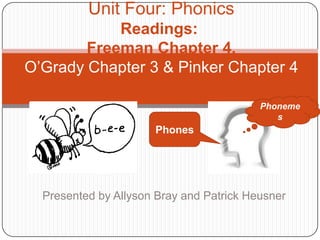
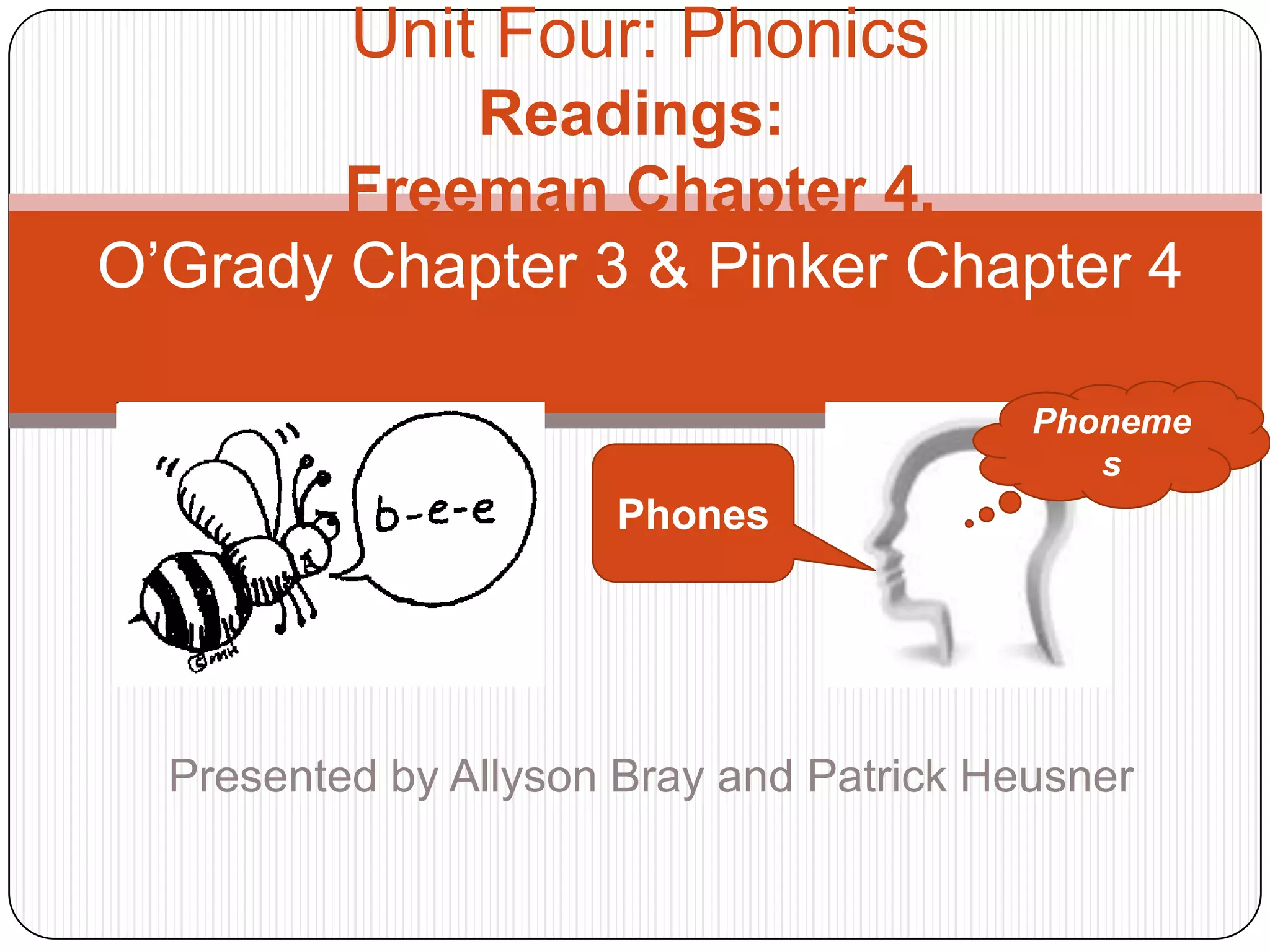
Unit Four: PhonicsReadings::Freeman Chapter 4, O’Grady Chapter 3 & Pinker Chapter 4PhonemesPhonesPresented by Allyson Bray and Patrick Heusner
O’Grady et al. CHAPTER 3: PHONOLOGYPhonology: the component of grammar that determines the selection of speech sounds and that governs both the sound patterns and the systematic phonetic variation found in language (59). “How are sound and meaning connected?”3 Major Phonological Units: 		1. Feature   2. Segment    3. SyllableFeatures are the smallest building blocks (ex., voicing)Segments are what we typically refer to as a 	sound (ex., “s”)Syllables  are a combination of syllabic element 	segments (vowels) and associated preceding or 	following segments (we’ll get to that in more detail 	later…)Changing the sound can change the meaning, too.ONE syllable, TWO segments.
O’Grady et al. CHAPTER 3: PHONOLOGYMinimal Pairs: Two forms with different meanings  that differ by one segment in the same position (ex., “jet” and “net”). Minimal pairs are used to figure out what segments contrast in a language.  Contrasting  segments belong to separate phonemes. (in this example, ‘j’ & ‘n’). ‘Phones’ are what come out of our mouth, ‘phonemes’ are what are in our head.Sounds that contrast in one language may not contrast in another (For example, you know those vowel ü they have in German that we don’t have in English?  We may hear it as “u” and not identify the difference between “güt” & “gut”).  Complimentary Distribution: When two sounds always occur in different environments and never in the same environment; therefore they can be predicted based on the environment.For example, the “Canadian  rising” dialect ‘about’ (like ‘a-boot’) and the American ‘house.’  The former is found before voiceless consonants, the latter is never found there.
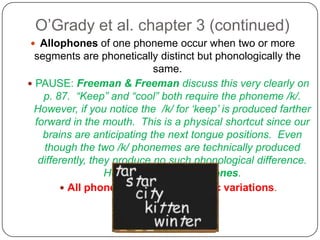
O’Grady et al. chapter 3 (continued)Allophones of one phoneme occur when two or more segments are phonetically distinct but phonologically the same.  PAUSE: Freeman & Freeman discuss this very clearly on p. 87.  “Keep” and “cool” both require the phoneme /k/.  However, if you notice the  /k/ for ‘keep’ is produced farther forward in the mouth.  This is a physical shortcut since our brains are anticipating the next tongue positions.  Even though the two /k/ phonemes are technically produced differently, they produce no such phonological difference.  Hence, they are allophones.All phonemes have allophonic variations.
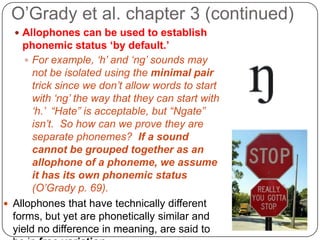
O’Grady et al. chapter 3 (continued)Allophones can be used to establish phonemic status ‘by default.’For example, ‘h’ and ‘ng’ sounds may not be isolated using the minimal pair trick since we don’t allow words to start with ‘ng’ the way that they can start with ‘h.’  “Hate” is acceptable, but “Ngate” isn’t.  So how can we prove they are separate phonemes?  If a sound cannot be grouped together as an allophone of a phoneme, we assume it has its own phonemic status (O’Grady p. 69).  Allophones that have technically different forms, but yet are phonetically similar and yield no difference in meaning, are said to be in free variation.For example, the way  the /p/ in ‘stop’ is pronounced when casually reading a stop sign versus shouting at an annoying brother to cease his behavior.
O’Grady et al. chapter 3 (continued)Allophones are one of the ways phonologists examine rules in language, but these rules are HIGHLY VARIABLE among different languages.
O’Grady et al. chapter 3 (continued)Phonemic vs. PhoneticThe phonemic transcription includes the aspects that are UNpredictable.For example, consider the word ‘late.’ The phonemic transcription is /let/ while the phonetic transcription is [lejt].  Why?  Since the sound is predictable based on its environment, phonemic transcription assumes you’ll know the rule.  For this reason it is wise to know which transcription you’re looking at: phonemic or phonetic. Phonemic forms are called ‘underlying’ forms;  phonetic forms are called ‘surface’forms.PHONETICPHONEMIC
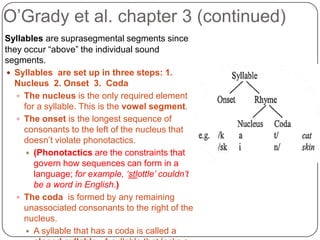
O’Grady et al. chapter 3 (continued)Syllables are suprasegmental segments since they occur “above” the individual sound segments.Syllables  are set up in three steps: 1. Nucleus  2. Onset  3.  CodaThe nucleus is the only required element for a syllable. This is the vowel segment.The onset is the longest sequence of consonants to the left of the nucleus that doesn’t violate phonotactics.(Phonotactics are the constraints that govern how sequences can form in a language; for example, ‘stlottle’ couldn’t be a word in English.)The coda  is formed by any remaining unassociated consonants to the right of the nucleus.A syllable that has a coda is called a closed syllable.  A syllable that lacks a coda is called an open syllable.
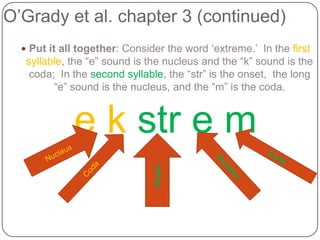
O’Grady et al. chapter 3 (continued)Put it all together: Consider the word ‘extreme.’  In the first syllable, the “e” sound is the nucleus and the “k” sound is the coda;  In the second syllable, the “str” is the onset,  the long “e” sound is the nucleus, and the “m” is the coda.e kstr e mNucleusCodaOnsetNucleusCoda
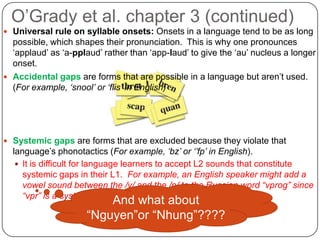
O’Grady et al. chapter 3 (continued)Universal rule on syllable onsets: Onsets in a language tend to be as long possible, which shapes their pronunciation.  This is why one pronounces ‘applaud’ as ‘a-pplaud’ rather than ‘app-laud’ to give the ‘au’ nucleus a longer onset.Accidental gapsare forms that are possible in a language but aren’t used.  (For example, ‘snool’ or ‘flis’ in English)Systemic gaps are forms that are excluded because they violate that language’s phonotactics (For example, ‘bz’ or ‘’fp’ in English).It is difficult for language learners to accept L2 sounds that constitute systemic gaps in their L1.  For example, an English speaker might add a vowel sound between the /v/ and the /p/ to the Russian word “vprog” since “vpr” is a systemic gap in English.And what about “Nguyen”or “Nhung”????
O’Grady et al. chapter 3 (continued)Features:  (Remember, features are the ‘tiniest’ building blocks of speech sounds) Currently there are 24 proposed features of a language (ex., [voice], [nasal]).Another example:  [+syllabic] sounds can act as a syllable’s nucleus (ex., vowels), whereas [-syllabic] sounds cannot.  At right: Height, Backness,			Roundedness…Further examples can be found on pp 91-97          Rules , in this context, are general statements about allophonic distribution.  Rules are written as A  B / X ___ Y , and read as “A becomes B in the environment between X and Y.”  For example, A shwa is dropped in an open syllable when it is followed by a stressed syllable, as in police (“puh-lice”) or parade (“puh-rade”)   (See O’Grady p. 100-103)
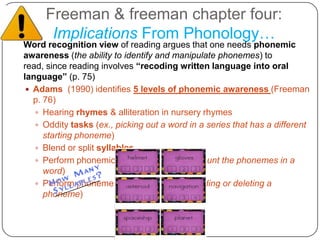
Freeman & freeman chapter four:Implications From Phonology…	Word recognition view of reading argues that one needs phonemic awareness (the ability to identify and manipulate phonemes) to read, since reading involves “recoding written language into oral language” (p. 75)Adams  (1990) identifies 5 levels of phonemic awareness (Freeman p. 76)Hearing rhymes & alliteration in nursery rhymesOddity tasks (ex., picking out a word in a series that has a different starting phoneme)Blend or split syllablesPerform phonemic segmentation (ex., count the phonemes in a word)Perform phoneme manipulation (ex., adding or deleting a phoneme)
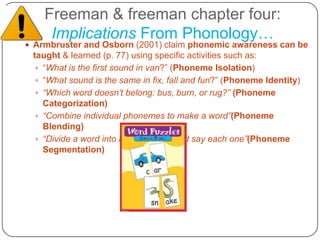
Freeman & freeman chapter four:Implications From Phonology…Armbruster and Osborn (2001) claim phonemic awareness can be taught & learned (p. 77) using specific activities such as:“What is the first sound in van?” (Phoneme Isolation)“What sound is the same in fix, fall and fun?” (Phoneme Identity)“Which word doesn’t belong: bus, burn, or rug?” (Phoneme Categorization)“Combine individual phonemes to make a word”(Phoneme Blending)“Divide a word into its phonemes and say each one”(Phoneme Segmentation) However, Freeman and Freeman add some strong food for thought in reference to this word recognition view….
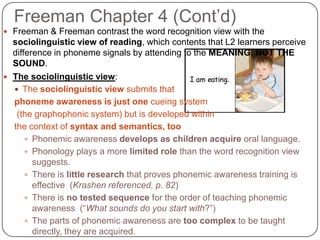
Freeman Chapter 4 (Cont’d)Freeman & Freeman contrast the word recognition view with the sociolinguistic view of reading, which contents that L2 learners perceive difference in phoneme signals by attending to the MEANING, NOT THE SOUND.The sociolinguistic view:The sociolinguistic view submits that phoneme awareness is just one cueing system (the graphophonic system) but is developed within the context of syntax and semantics, tooPhonemic awareness develops as children acquire oral language.Phonology plays a more limited role than the word recognition view suggests.There is little research that proves phonemic awareness training is effective  (Krashen referenced, p. 82)There is no tested sequence for the order of teaching phonemic awareness  (“What sounds do you start with?”)The parts of phonemic awareness are too complex to be taught directly, they are acquired.
Freeman Chapter 4 (Cont’d)Freeman & Freeman point out 3 linguistic factors that should be considered when evaluating the opposing views of phonemics (especially in cautioning the word recognition view):1. Allophones cause confusion for learners (remember the keep cool 							           example?) 2. Dialects cause confusion for learners (Is “y’all” not English? 							Is it “soda” or “pop”?)3. Language differences are problematic, too.  (What if a learner doesn’t have a particular English phoneme in her L1? How can she recognize it?)Freeman & Freeman issue another final caution: Teachers sometimes use abstract phonemic awareness exercises because they don’t have time to come up with more creative activities.
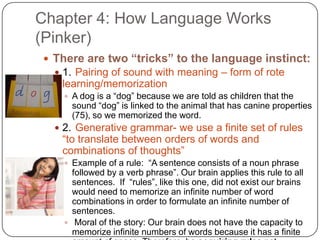
Chapter 4: How Language Works(Pinker)There are two “tricks” to the language instinct:1.	Pairing of sound with meaning – form of rote learning/memorizationA dog is a “dog” because we are told as children that the sound “dog” is linked to the animal that has canine properties (75), so we memorized the word.2.	Generative grammar- we use a finite set of rules “to translate between orders of words and combinations of thoughts”Example of a rule:  “A sentence consists of a noun phrase followed by a verb phrase”. Our brain applies this rule to all sentences.  If  “rules”, like this one, did not exist our brains would need to memorize an infinite number of word combinations in order to formulate an infinite number of sentences.  Moral of the story: Our brain does not have the capacity to memorize infinite numbers of words because it has a finite amount of space. Therefore, be acquiring rules not memorizing phrasesConclusion: Generative grammar is innate and we use it to form immeasurable numbers of phrases and sentences.
Grammar100,000,000,000,000,000,000Grammar is a “discrete combinational system”Meaning: “a finite number of words are sampled, combined and permuted to create sentences with distinct properties” (76)It is estimated that a speaker will deal with at least a hundred million trillion sentences in their lifetime.Therefore we must conclude that rote memorization is an impossibility.This is what makes artificial language devices such as computers, dolls and automated machines inadequate  they could never possibly be programmed to generate infinite combinations of sentences as real humans doThat’s a lot of words!!!
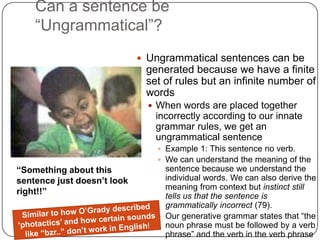
Can a sentence be “Ungrammatical”?Ungrammatical sentences can be generated because we have a finite set of rules but an infinite number of wordsWhen words are placed together incorrectly according to our innate grammar rules, we get an ungrammatical sentenceExample 1: This sentence no verb.We can understand the meaning of the sentence because we understand the individual words. We can also derive the meaning from context but instinct still tells us that the sentence is grammatically incorrect (79).Our generative grammar states that “the noun phrase must be followed by a verb phrase” and the verb in the verb phrase is missing which triggers our alarm“Something about this sentence just doesn’t look right!!”Similar to how O’Grady described ‘photactics’ and how certain sounds like “bzr..” don’t work in English!
Grammatical but NonsensicalThis is similar to O’Grady’s “Accidental Gaps” in phonemes Similarly, sentences can be grammatically correct but make no contextual sense:Chomsky: “colorless green ideas sleep furiously” (85) grammatical but essentially worthlessThis is where many word chain devices can failThey’re programmed to generate sentences that are grammatically correct but not necessarily to generate sentences that make sense As mentioned before, word chain devices and language generators, despite their sophisticated technology, are unable to account for the infinite numbers of words, word combinations and dependencies used in language (85)It was a _______ winter day so I _______ to  _______  and  ___________ .Think about all of the different words that you could insert into the blanks in this sentence.Now change the pronouns.There are an endless combination of possibilities in a simple sentence
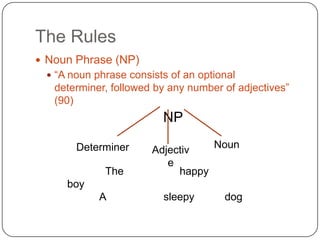
The RulesNoun Phrase (NP)“A noun phrase consists of an optional determiner, followed by any number of adjectives” (90)NPNounDeterminerAdjective             The                   happy                 boy	A 	           sleepy	          dog
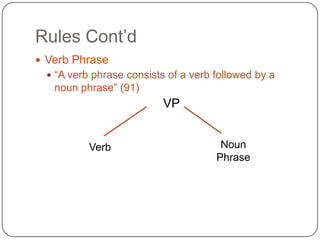
Rules Cont’dVerb Phrase“A verb phrase consists of a verb followed by a noun phrase” (91)VPNounPhraseVerb
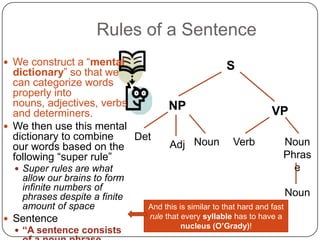
Rules of a SentenceWe construct a “mental dictionary” so that we can categorize words properly into nouns, adjectives, verbs and determiners.We then use this mental dictionary to combine our words based on the following “super rule”Super rules are what allow our brains to form infinite numbers of phrases despite a finite amount of spaceSentence“A sentence consists of a noun phrase followed by a verb phrase”SNPVPDetVerbNounPhraseNounAdjNounAnd this is similar to that hard and fast rule that every syllable has to have a nucleus (O’Grady)!
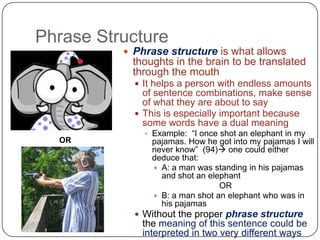
Phrase StructurePhrase structure is what allows thoughts in the brain to be translated through the mouthIt helps a person with endless amounts of sentence combinations, make sense of what they are about to sayThis is especially important because some words have a dual meaningExample:  “I once shot an elephant in my pajamas. How he got into my pajamas I will never know”  (94) one could either deduce that:A: a man was standing in his pajamas and shot an elephant 			ORB: a man shot an elephant who was in his pajamasWithout the proper phrase structure the meaning of this sentence could be interpreted in two very different ways One sentence may give the wrong impression to the listenerOR
Common Anatomy to PhrasesThere is a common anatomy in all phrases in all of the worlds languages (99).4 common principles:1.  Meaning of phrases can be derived using head words2. Phrases can refer to sets of players (not just single things or actions) that interact with one another (these are known as role players). 3.  Every phrase contains one or more modifiers Principles 2 and 3 are linked, they establish the “geometry of a phrase”, in other words if both a modifier and role player are present in a phrase the role player must be closer to the head word4.  Special positions are saved for subjects because they are usually the casual agent in a phrase, this special place is called the N-bar or V-barThe common anatomy is the same in ALL of the worlds languages. No matter how unrelated them may seem.
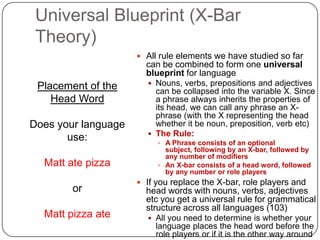
Universal Blueprint (X-Bar Theory)All rule elements we have studied so far can be combined to form one universal blueprint for languageNouns, verbs, prepositions and adjectives can be collapsed into the variable X. Since a phrase always inherits the properties of its head, we can call any phrase an X-phrase (with the X representing the head whether it be noun, preposition, verb etc)The Rule:A Phrase consists of an optional subject, following by an X-bar, followed by any number of modifiersAn X-bar consists of a head word, followed by any number or role playersIf you replace the X-bar, role players and head words with nouns, verbs, adjectives etc you get a universal rule for grammatical structure across all languages (103)All you need to determine is whether your language places the head word before the role players or if it is the other way aroundPlacement of the Head WordDoes your language use:Matt ate pizzaorMatt pizza ate
Principles and Parameters TheorySo what does this super-rule really do?Gives a guideline for what phrases must look likeHowever, Chomsky argues that this super-rule is not learned but that we are born with knowledge of this rule.  In fact, he states we are born knowing all super-rules (104).Therefore, all we have to learn is whether our language has the parameter value head first or head last.What is a parameter?A parameter is the piece of language that makes one language different from anotherChomsky states that this theory explains how children can acquire exurbanite amounts of language in a short time (remember our early readings?)
Principles and Parameters of Phrase StructureThey tell us what ingredients of a phrase can go in what order.The verb is the despot – determines which parts of the super-rule can be filledThese demands are stored with this verb in our mental dictionaryFor a sentence to have a grammatical feel, “the verbs demands must be met” (106-107)Grammar also puts tags on noun phrases and we can match these tags with the verbs in our mental dictionary (these tags are called cases). In some languages they are prefixes or suffixes on the nouns.Ex: happiness –ness is the suffix  knowledgeable –able is the suffixThe result: the brain uses this information to check for grammatical agreement between the verb and the rest of the sentence/phrase
AuxiliariesAuxiliaries = Function wordsThey are the articles, pronouns, possessive markers ‘s and meaningless prepositions like ofFunction words provide the scaffolding for a sentence, they never change and are a permanent fixture in grammar (111)They can help capture what makes one language grammatically different from another because the properties of the words change in different languagesWhich is why direct translation from one language to another sometimes results in gibberish
ConclusionGrammar is a “protocol” that connects the mouth, the ear and the mind which all operate in very different waysTherefore grammar must have a complex and abstract logic in order for it to work properly and be understoodThis proves that some grammatical awareness must be innate, otherwise children would not be able to make sense of the “noises that they hear from their parents” (118)

Mindmap2

  • 1.
    Unit Four: PhonicsReadings::FreemanChapter 4, O’Grady Chapter 3 & Pinker Chapter 4PhonemesPhonesPresented by Allyson Bray and Patrick Heusner
  • 2.
    O’Grady et al.CHAPTER 3: PHONOLOGYPhonology: the component of grammar that determines the selection of speech sounds and that governs both the sound patterns and the systematic phonetic variation found in language (59). “How are sound and meaning connected?”3 Major Phonological Units: 1. Feature 2. Segment 3. SyllableFeatures are the smallest building blocks (ex., voicing)Segments are what we typically refer to as a sound (ex., “s”)Syllables are a combination of syllabic element segments (vowels) and associated preceding or following segments (we’ll get to that in more detail later…)Changing the sound can change the meaning, too.ONE syllable, TWO segments.
  • 3.
    O’Grady et al.CHAPTER 3: PHONOLOGYMinimal Pairs: Two forms with different meanings that differ by one segment in the same position (ex., “jet” and “net”). Minimal pairs are used to figure out what segments contrast in a language. Contrasting segments belong to separate phonemes. (in this example, ‘j’ & ‘n’). ‘Phones’ are what come out of our mouth, ‘phonemes’ are what are in our head.Sounds that contrast in one language may not contrast in another (For example, you know those vowel ü they have in German that we don’t have in English? We may hear it as “u” and not identify the difference between “güt” & “gut”). Complimentary Distribution: When two sounds always occur in different environments and never in the same environment; therefore they can be predicted based on the environment.For example, the “Canadian rising” dialect ‘about’ (like ‘a-boot’) and the American ‘house.’ The former is found before voiceless consonants, the latter is never found there.
  • 4.
    O’Grady et al.chapter 3 (continued)Allophones of one phoneme occur when two or more segments are phonetically distinct but phonologically the same. PAUSE: Freeman & Freeman discuss this very clearly on p. 87. “Keep” and “cool” both require the phoneme /k/. However, if you notice the /k/ for ‘keep’ is produced farther forward in the mouth. This is a physical shortcut since our brains are anticipating the next tongue positions. Even though the two /k/ phonemes are technically produced differently, they produce no such phonological difference. Hence, they are allophones.All phonemes have allophonic variations.
  • 5.
    O’Grady et al.chapter 3 (continued)Allophones can be used to establish phonemic status ‘by default.’For example, ‘h’ and ‘ng’ sounds may not be isolated using the minimal pair trick since we don’t allow words to start with ‘ng’ the way that they can start with ‘h.’ “Hate” is acceptable, but “Ngate” isn’t. So how can we prove they are separate phonemes? If a sound cannot be grouped together as an allophone of a phoneme, we assume it has its own phonemic status (O’Grady p. 69). Allophones that have technically different forms, but yet are phonetically similar and yield no difference in meaning, are said to be in free variation.For example, the way the /p/ in ‘stop’ is pronounced when casually reading a stop sign versus shouting at an annoying brother to cease his behavior.
  • 6.
    O’Grady et al.chapter 3 (continued)Allophones are one of the ways phonologists examine rules in language, but these rules are HIGHLY VARIABLE among different languages.
  • 7.
    O’Grady et al.chapter 3 (continued)Phonemic vs. PhoneticThe phonemic transcription includes the aspects that are UNpredictable.For example, consider the word ‘late.’ The phonemic transcription is /let/ while the phonetic transcription is [lejt]. Why? Since the sound is predictable based on its environment, phonemic transcription assumes you’ll know the rule. For this reason it is wise to know which transcription you’re looking at: phonemic or phonetic. Phonemic forms are called ‘underlying’ forms; phonetic forms are called ‘surface’forms.PHONETICPHONEMIC
  • 8.
    O’Grady et al.chapter 3 (continued)Syllables are suprasegmental segments since they occur “above” the individual sound segments.Syllables are set up in three steps: 1. Nucleus 2. Onset 3. CodaThe nucleus is the only required element for a syllable. This is the vowel segment.The onset is the longest sequence of consonants to the left of the nucleus that doesn’t violate phonotactics.(Phonotactics are the constraints that govern how sequences can form in a language; for example, ‘stlottle’ couldn’t be a word in English.)The coda is formed by any remaining unassociated consonants to the right of the nucleus.A syllable that has a coda is called a closed syllable. A syllable that lacks a coda is called an open syllable.
  • 9.
    O’Grady et al.chapter 3 (continued)Put it all together: Consider the word ‘extreme.’ In the first syllable, the “e” sound is the nucleus and the “k” sound is the coda; In the second syllable, the “str” is the onset, the long “e” sound is the nucleus, and the “m” is the coda.e kstr e mNucleusCodaOnsetNucleusCoda
  • 10.
    O’Grady et al.chapter 3 (continued)Universal rule on syllable onsets: Onsets in a language tend to be as long possible, which shapes their pronunciation. This is why one pronounces ‘applaud’ as ‘a-pplaud’ rather than ‘app-laud’ to give the ‘au’ nucleus a longer onset.Accidental gapsare forms that are possible in a language but aren’t used. (For example, ‘snool’ or ‘flis’ in English)Systemic gaps are forms that are excluded because they violate that language’s phonotactics (For example, ‘bz’ or ‘’fp’ in English).It is difficult for language learners to accept L2 sounds that constitute systemic gaps in their L1. For example, an English speaker might add a vowel sound between the /v/ and the /p/ to the Russian word “vprog” since “vpr” is a systemic gap in English.And what about “Nguyen”or “Nhung”????
  • 11.
    O’Grady et al.chapter 3 (continued)Features: (Remember, features are the ‘tiniest’ building blocks of speech sounds) Currently there are 24 proposed features of a language (ex., [voice], [nasal]).Another example: [+syllabic] sounds can act as a syllable’s nucleus (ex., vowels), whereas [-syllabic] sounds cannot. At right: Height, Backness, Roundedness…Further examples can be found on pp 91-97 Rules , in this context, are general statements about allophonic distribution. Rules are written as A  B / X ___ Y , and read as “A becomes B in the environment between X and Y.” For example, A shwa is dropped in an open syllable when it is followed by a stressed syllable, as in police (“puh-lice”) or parade (“puh-rade”) (See O’Grady p. 100-103)
  • 12.
    Freeman & freemanchapter four:Implications From Phonology… Word recognition view of reading argues that one needs phonemic awareness (the ability to identify and manipulate phonemes) to read, since reading involves “recoding written language into oral language” (p. 75)Adams (1990) identifies 5 levels of phonemic awareness (Freeman p. 76)Hearing rhymes & alliteration in nursery rhymesOddity tasks (ex., picking out a word in a series that has a different starting phoneme)Blend or split syllablesPerform phonemic segmentation (ex., count the phonemes in a word)Perform phoneme manipulation (ex., adding or deleting a phoneme)
  • 13.
    Freeman & freemanchapter four:Implications From Phonology…Armbruster and Osborn (2001) claim phonemic awareness can be taught & learned (p. 77) using specific activities such as:“What is the first sound in van?” (Phoneme Isolation)“What sound is the same in fix, fall and fun?” (Phoneme Identity)“Which word doesn’t belong: bus, burn, or rug?” (Phoneme Categorization)“Combine individual phonemes to make a word”(Phoneme Blending)“Divide a word into its phonemes and say each one”(Phoneme Segmentation) However, Freeman and Freeman add some strong food for thought in reference to this word recognition view….
  • 14.
    Freeman Chapter 4(Cont’d)Freeman & Freeman contrast the word recognition view with the sociolinguistic view of reading, which contents that L2 learners perceive difference in phoneme signals by attending to the MEANING, NOT THE SOUND.The sociolinguistic view:The sociolinguistic view submits that phoneme awareness is just one cueing system (the graphophonic system) but is developed within the context of syntax and semantics, tooPhonemic awareness develops as children acquire oral language.Phonology plays a more limited role than the word recognition view suggests.There is little research that proves phonemic awareness training is effective (Krashen referenced, p. 82)There is no tested sequence for the order of teaching phonemic awareness (“What sounds do you start with?”)The parts of phonemic awareness are too complex to be taught directly, they are acquired.
  • 15.
    Freeman Chapter 4(Cont’d)Freeman & Freeman point out 3 linguistic factors that should be considered when evaluating the opposing views of phonemics (especially in cautioning the word recognition view):1. Allophones cause confusion for learners (remember the keep cool example?) 2. Dialects cause confusion for learners (Is “y’all” not English? Is it “soda” or “pop”?)3. Language differences are problematic, too. (What if a learner doesn’t have a particular English phoneme in her L1? How can she recognize it?)Freeman & Freeman issue another final caution: Teachers sometimes use abstract phonemic awareness exercises because they don’t have time to come up with more creative activities.
  • 16.
    Chapter 4: HowLanguage Works(Pinker)There are two “tricks” to the language instinct:1. Pairing of sound with meaning – form of rote learning/memorizationA dog is a “dog” because we are told as children that the sound “dog” is linked to the animal that has canine properties (75), so we memorized the word.2. Generative grammar- we use a finite set of rules “to translate between orders of words and combinations of thoughts”Example of a rule: “A sentence consists of a noun phrase followed by a verb phrase”. Our brain applies this rule to all sentences. If “rules”, like this one, did not exist our brains would need to memorize an infinite number of word combinations in order to formulate an infinite number of sentences. Moral of the story: Our brain does not have the capacity to memorize infinite numbers of words because it has a finite amount of space. Therefore, be acquiring rules not memorizing phrasesConclusion: Generative grammar is innate and we use it to form immeasurable numbers of phrases and sentences.
  • 17.
    Grammar100,000,000,000,000,000,000Grammar is a“discrete combinational system”Meaning: “a finite number of words are sampled, combined and permuted to create sentences with distinct properties” (76)It is estimated that a speaker will deal with at least a hundred million trillion sentences in their lifetime.Therefore we must conclude that rote memorization is an impossibility.This is what makes artificial language devices such as computers, dolls and automated machines inadequate  they could never possibly be programmed to generate infinite combinations of sentences as real humans doThat’s a lot of words!!!
  • 18.
    Can a sentencebe “Ungrammatical”?Ungrammatical sentences can be generated because we have a finite set of rules but an infinite number of wordsWhen words are placed together incorrectly according to our innate grammar rules, we get an ungrammatical sentenceExample 1: This sentence no verb.We can understand the meaning of the sentence because we understand the individual words. We can also derive the meaning from context but instinct still tells us that the sentence is grammatically incorrect (79).Our generative grammar states that “the noun phrase must be followed by a verb phrase” and the verb in the verb phrase is missing which triggers our alarm“Something about this sentence just doesn’t look right!!”Similar to how O’Grady described ‘photactics’ and how certain sounds like “bzr..” don’t work in English!
  • 19.
    Grammatical but NonsensicalThisis similar to O’Grady’s “Accidental Gaps” in phonemes Similarly, sentences can be grammatically correct but make no contextual sense:Chomsky: “colorless green ideas sleep furiously” (85) grammatical but essentially worthlessThis is where many word chain devices can failThey’re programmed to generate sentences that are grammatically correct but not necessarily to generate sentences that make sense As mentioned before, word chain devices and language generators, despite their sophisticated technology, are unable to account for the infinite numbers of words, word combinations and dependencies used in language (85)It was a _______ winter day so I _______ to _______ and ___________ .Think about all of the different words that you could insert into the blanks in this sentence.Now change the pronouns.There are an endless combination of possibilities in a simple sentence
  • 20.
    The RulesNoun Phrase(NP)“A noun phrase consists of an optional determiner, followed by any number of adjectives” (90)NPNounDeterminerAdjective The happy boy A sleepy dog
  • 21.
    Rules Cont’dVerb Phrase“Averb phrase consists of a verb followed by a noun phrase” (91)VPNounPhraseVerb
  • 22.
    Rules of aSentenceWe construct a “mental dictionary” so that we can categorize words properly into nouns, adjectives, verbs and determiners.We then use this mental dictionary to combine our words based on the following “super rule”Super rules are what allow our brains to form infinite numbers of phrases despite a finite amount of spaceSentence“A sentence consists of a noun phrase followed by a verb phrase”SNPVPDetVerbNounPhraseNounAdjNounAnd this is similar to that hard and fast rule that every syllable has to have a nucleus (O’Grady)!
  • 23.
    Phrase StructurePhrase structureis what allows thoughts in the brain to be translated through the mouthIt helps a person with endless amounts of sentence combinations, make sense of what they are about to sayThis is especially important because some words have a dual meaningExample: “I once shot an elephant in my pajamas. How he got into my pajamas I will never know” (94) one could either deduce that:A: a man was standing in his pajamas and shot an elephant ORB: a man shot an elephant who was in his pajamasWithout the proper phrase structure the meaning of this sentence could be interpreted in two very different ways One sentence may give the wrong impression to the listenerOR
  • 24.
    Common Anatomy toPhrasesThere is a common anatomy in all phrases in all of the worlds languages (99).4 common principles:1. Meaning of phrases can be derived using head words2. Phrases can refer to sets of players (not just single things or actions) that interact with one another (these are known as role players). 3. Every phrase contains one or more modifiers Principles 2 and 3 are linked, they establish the “geometry of a phrase”, in other words if both a modifier and role player are present in a phrase the role player must be closer to the head word4. Special positions are saved for subjects because they are usually the casual agent in a phrase, this special place is called the N-bar or V-barThe common anatomy is the same in ALL of the worlds languages. No matter how unrelated them may seem.
  • 25.
    Universal Blueprint (X-BarTheory)All rule elements we have studied so far can be combined to form one universal blueprint for languageNouns, verbs, prepositions and adjectives can be collapsed into the variable X. Since a phrase always inherits the properties of its head, we can call any phrase an X-phrase (with the X representing the head whether it be noun, preposition, verb etc)The Rule:A Phrase consists of an optional subject, following by an X-bar, followed by any number of modifiersAn X-bar consists of a head word, followed by any number or role playersIf you replace the X-bar, role players and head words with nouns, verbs, adjectives etc you get a universal rule for grammatical structure across all languages (103)All you need to determine is whether your language places the head word before the role players or if it is the other way aroundPlacement of the Head WordDoes your language use:Matt ate pizzaorMatt pizza ate
  • 26.
    Principles and ParametersTheorySo what does this super-rule really do?Gives a guideline for what phrases must look likeHowever, Chomsky argues that this super-rule is not learned but that we are born with knowledge of this rule. In fact, he states we are born knowing all super-rules (104).Therefore, all we have to learn is whether our language has the parameter value head first or head last.What is a parameter?A parameter is the piece of language that makes one language different from anotherChomsky states that this theory explains how children can acquire exurbanite amounts of language in a short time (remember our early readings?)
  • 27.
    Principles and Parametersof Phrase StructureThey tell us what ingredients of a phrase can go in what order.The verb is the despot – determines which parts of the super-rule can be filledThese demands are stored with this verb in our mental dictionaryFor a sentence to have a grammatical feel, “the verbs demands must be met” (106-107)Grammar also puts tags on noun phrases and we can match these tags with the verbs in our mental dictionary (these tags are called cases). In some languages they are prefixes or suffixes on the nouns.Ex: happiness –ness is the suffix knowledgeable –able is the suffixThe result: the brain uses this information to check for grammatical agreement between the verb and the rest of the sentence/phrase
  • 28.
    AuxiliariesAuxiliaries = FunctionwordsThey are the articles, pronouns, possessive markers ‘s and meaningless prepositions like ofFunction words provide the scaffolding for a sentence, they never change and are a permanent fixture in grammar (111)They can help capture what makes one language grammatically different from another because the properties of the words change in different languagesWhich is why direct translation from one language to another sometimes results in gibberish
  • 29.
    ConclusionGrammar is a“protocol” that connects the mouth, the ear and the mind which all operate in very different waysTherefore grammar must have a complex and abstract logic in order for it to work properly and be understoodThis proves that some grammatical awareness must be innate, otherwise children would not be able to make sense of the “noises that they hear from their parents” (118)