PHONOLOGICAL CONTRAST
10/12/2010
1
Recap
❖ Phonology: phonological rules and processes
❖ Phonological rule: a segment in the underlying form is
pronounced differently in a certain phonological environment
❖ Underlying form: the lexical entry — the stored pronunciation of
a word or sound
❖ Environment: where a segment occurs, defined by the segments
that neighbor it
❖ Some processes that change underlying forms are epenthesis,
deletion, metathesis, assimilation, dissimilation, and reduction.
2
Vowel reduction
❖ English: unstressed vowels are often pronounced as schwa [ə]
★ Canada [kǽnədə]
★ Canadian [kənéjdiən]
❖ Stressed vs. unstressed the: [i] reduces to [ə]
★ the Queen of England (the one and only) [ðij kwijn]
★ the Queen of England [ðə kwijn]
3
Rule writing
❖ When we’re confronted with data, we ask three questions:
★ Is there a pattern? Could the environment be playing a role?
★ What are the possible patterns?
★ What is the underlying form?
❖ First step: is there a pattern?
4
IS THERE A PATTERN?
5
Contrast
❖ Speakers know which segments of their language contrast and
which do not
❖ Segments are in contrast when their presence alone can change
the meaning of a word
also “distinctive”, “in opposition”
6
Contrast
❖ Examples from English:
★ [s] and [z]: sip [sɪp] and zip [zɪp]
★ [ɪ] and [ɑ]: hit [hɪt] and hot [hɑt]
❖ In these words, when we change the sound, we change the
meaning
7
Contrast
❖ When two segments contrast in an environment, there’s no rule
to predict when you get one versus the other
❖ What’s the environment that each sound occurs in?
★ [s] or [z]?
★ sip [sɪp] and zip [zɪp]
★ [ɪ] or [ɑ]?
★ hit [hɪt] and hot [hɑt]
8
Minimal pairs
❖ First step: establish which sounds are in contrast with each other in the
language
★ Different for every language
❖ Minimal pair: two words with distinct meanings that differ only by
exactly one segment found in the same position in each word
★ [sɪp] and [zɪp]
★ [hɪt] and [hɑt]
★ [lus] and [luz]
★ [fəsi] and [fəzi]
9
Minimal pairs
❖ Minimal pairs based on sound and not spelling
❖ Minimal pair test:
★ Find a minimal pair for two sounds e.g. [p] and [b]
★ If there is a minimal pair, the two sounds are contrastive in that
language
❖ Apply the minimal pair test for these pairs of sounds:
★ [p] and [b]
★ [i] and [ɪ]
10
Minimal pairs
❖ Near-minimal pair: two words with distinct meanings that
contrast segments in nearly identical environments.
★ Some languages don’t have minimal pairs for every pair of
sounds, but the sounds may still be contrastive
★ In this case, use near-minimal pairs:
★ assure [əʃʊ́ɹ] vs. azure [ǽʒɹ̩]
★ author [ɔ́θɹ̩] vs. either [íjðɹ̩]
11
Phonemes
❖ Not every segment we produce is stored in our heads
★ Since rules can predict when we get certain segments, we
don’t need to store them all
★ For example, aspiration on stops in English is predictable, so
we don’t need to store whether a stop is aspirated or not in our
lexicon
★ The rule does all the work
12
Phonemes
❖ Phonemes: distinctive sounds in a language that contrast with
other sounds in that language
❖ Phonemes are the set of sounds you store in your lexicon
❖ If two sounds are contrastive (i.e. pass the minimal pair test), they
belong to separate phonemes of that language
❖ Since we can’t write a rule to describe the distribution of the two
contrastive sounds, we say they’re both stored in the lexicon
13
Announcements
❖ HW posted Friday
★ Three phonology problems
❖ Assignment  will be returned Monday
14
Phonemes
❖ Native speakers perceive phonemes as different and distinct
sounds
★ Knowledge of phonology of your language = knowledge of
which sounds can change the meaning of a word
❖ Phones (=sounds) come out of your mouth, but phonemes are in
your head
15
Allophones
❖ Allophones are different pronunciations of a phoneme
❖ Two sounds are allophones of the same phoneme if they have the
same underlying form
★ e.g., aspirated and un-aspirated [t] in English are allophones of
the same phoneme
16
Transcription
❖ When we transcribed phones in phonetics we used square brackets
[ ]:
★ [sɪp]
★ Allophones
❖ When we transcribe phonemes, we use / /:
★ /sɪp/
❖ We use the two types of brackets to distinguish between underlying
form (phonemes) and actual pronunciation (allophones)
17
Other contrastive segments
❖ Some segments don’t have minimal pairs
❖ May never occur in same environment:
★ English [h] and [ŋ]: [h] only occurs at the beginning of
words, [ŋ] at the end of syllables
❖ Rare segments: [ʒ] is very rare in English (occurs mostly in words
borrowed from French)
★ Leash [liʃ] and leige [liʒ]
18
Other contrastive segments
❖ However, these sounds may still be contrastive
❖ The Minimal Pair Test tells us when two sounds are contrastive,
but does not tell us when two sounds are not contrastive
19
Language-specific contrasts
❖ Whether or not two sounds are contrastive is language-specific
★ Two sounds can be phonetically distinct without being
phonologically contrastive
❖ If two sounds aren’t contrastive, they are in complementary
distribution
20
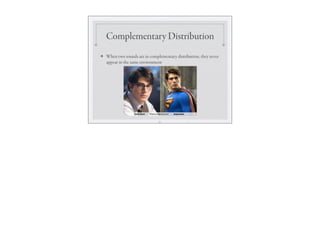
Complementary Distribution
❖ When two sounds are in complementary distribution, they never
appear in the same environment
21
Language-specific contrasts
❖ Example: English vs. Turkish [ɛ] and [æ]
English Turkish
[bɛn] ‘Ben’ [bɛn] ‘I’
[bæn] ‘ban’ [bæn] ‘I’
22
Language-specific contrasts
❖ Long and short vowels don’t contrast in English, but do in
Japanese and Finnish
Japanese
[toɽi] ‘bird’ [toɽiː] ‘shrine gate’
[kibo] ‘scale’ [kiboː] ‘hope’
23
Language-specific contrasts
Finnish
[tuli] ‘fire’ [tuːli] ‘wind’
[hætæ] ‘distress’ [hæːtæː] ‘to evict’
English
[hæt] ‘hat’ [hæːt] ‘hat’
[hit] ‘heat’ [hiːt] ‘heat’
24
Non-contrastive sounds?
❖ First step: establish which sounds are contrastive (using Minimal
Pair Test)
❖ Next, we will discover how to deal with sounds that are not
contrastive in a language
25
RULES
26
10/13/2010
Levels of representation
❖ Two levels of representation
★ Phonemes = underlying form
★ Allophones = surface form
❖ Phonemes are the contrastive sounds of a language (in our
minds)
❖ Allophones are the predictable phonetic variants of the
phonemes (what we pronounce)
27
Rules
❖ A rule has two parts:
★ A statement of the change (using an arrow)
★ A statement about the environment in which the change takes place
❖ General form:
★ Underlying form ➙ Surface form / environment
★ /X/ ➙ [Y] / A_B
★ The phoneme /X/ is pronounced as the allophone [Y] when it
occurs between an A and B
28
Example
A B
blue [blu] plow [pl̥aw]
gleam [glim] clap [kl̥æp]
slip [slɪp] clear [kl̥iɹ]
flog [flɔg] play [pl̥ej]
leaf [lif]
29
Example
❖ State the environment in terms of the natural class: [p k] = voiceless stops
❖ Example: /l/ rules in English:
★ /l/ ➙ [l̥] / after a word-initial voiceless stop
★ /l/ ➙ [l] / elsewhere
❖ We don’t need two rules for voiceless /l/:
★ /l/ ➙ [l̥] / after [p]-
★ /l/ ➙ [l̥] / after [k]
★ /l/ ➙ [l̥] / after voiceless stops
30

Phonology2

  • 1.
  • 2.
    Recap ❖ Phonology: phonologicalrules and processes ❖ Phonological rule: a segment in the underlying form is pronounced differently in a certain phonological environment ❖ Underlying form: the lexical entry — the stored pronunciation of a word or sound ❖ Environment: where a segment occurs, defined by the segments that neighbor it ❖ Some processes that change underlying forms are epenthesis, deletion, metathesis, assimilation, dissimilation, and reduction. 2
  • 3.
    Vowel reduction ❖ English:unstressed vowels are often pronounced as schwa [ə] ★ Canada [kǽnədə] ★ Canadian [kənéjdiən] ❖ Stressed vs. unstressed the: [i] reduces to [ə] ★ the Queen of England (the one and only) [ðij kwijn] ★ the Queen of England [ðə kwijn] 3
  • 4.
    Rule writing ❖ Whenwe’re confronted with data, we ask three questions: ★ Is there a pattern? Could the environment be playing a role? ★ What are the possible patterns? ★ What is the underlying form? ❖ First step: is there a pattern? 4
  • 5.
    IS THERE APATTERN? 5
  • 6.
    Contrast ❖ Speakers knowwhich segments of their language contrast and which do not ❖ Segments are in contrast when their presence alone can change the meaning of a word also “distinctive”, “in opposition” 6
  • 7.
    Contrast ❖ Examples fromEnglish: ★ [s] and [z]: sip [sɪp] and zip [zɪp] ★ [ɪ] and [ɑ]: hit [hɪt] and hot [hɑt] ❖ In these words, when we change the sound, we change the meaning 7
  • 8.
    Contrast ❖ When twosegments contrast in an environment, there’s no rule to predict when you get one versus the other ❖ What’s the environment that each sound occurs in? ★ [s] or [z]? ★ sip [sɪp] and zip [zɪp] ★ [ɪ] or [ɑ]? ★ hit [hɪt] and hot [hɑt] 8
  • 9.
    Minimal pairs ❖ Firststep: establish which sounds are in contrast with each other in the language ★ Different for every language ❖ Minimal pair: two words with distinct meanings that differ only by exactly one segment found in the same position in each word ★ [sɪp] and [zɪp] ★ [hɪt] and [hɑt] ★ [lus] and [luz] ★ [fəsi] and [fəzi] 9
  • 10.
    Minimal pairs ❖ Minimalpairs based on sound and not spelling ❖ Minimal pair test: ★ Find a minimal pair for two sounds e.g. [p] and [b] ★ If there is a minimal pair, the two sounds are contrastive in that language ❖ Apply the minimal pair test for these pairs of sounds: ★ [p] and [b] ★ [i] and [ɪ] 10
  • 11.
    Minimal pairs ❖ Near-minimalpair: two words with distinct meanings that contrast segments in nearly identical environments. ★ Some languages don’t have minimal pairs for every pair of sounds, but the sounds may still be contrastive ★ In this case, use near-minimal pairs: ★ assure [əʃʊ́ɹ] vs. azure [ǽʒɹ̩] ★ author [ɔ́θɹ̩] vs. either [íjðɹ̩] 11
  • 12.
    Phonemes ❖ Not everysegment we produce is stored in our heads ★ Since rules can predict when we get certain segments, we don’t need to store them all ★ For example, aspiration on stops in English is predictable, so we don’t need to store whether a stop is aspirated or not in our lexicon ★ The rule does all the work 12
  • 13.
    Phonemes ❖ Phonemes: distinctivesounds in a language that contrast with other sounds in that language ❖ Phonemes are the set of sounds you store in your lexicon ❖ If two sounds are contrastive (i.e. pass the minimal pair test), they belong to separate phonemes of that language ❖ Since we can’t write a rule to describe the distribution of the two contrastive sounds, we say they’re both stored in the lexicon 13
  • 14.
    Announcements ❖ HW postedFriday ★ Three phonology problems ❖ Assignment  will be returned Monday 14
  • 15.
    Phonemes ❖ Native speakersperceive phonemes as different and distinct sounds ★ Knowledge of phonology of your language = knowledge of which sounds can change the meaning of a word ❖ Phones (=sounds) come out of your mouth, but phonemes are in your head 15
  • 16.
    Allophones ❖ Allophones aredifferent pronunciations of a phoneme ❖ Two sounds are allophones of the same phoneme if they have the same underlying form ★ e.g., aspirated and un-aspirated [t] in English are allophones of the same phoneme 16
  • 17.
    Transcription ❖ When wetranscribed phones in phonetics we used square brackets [ ]: ★ [sɪp] ★ Allophones ❖ When we transcribe phonemes, we use / /: ★ /sɪp/ ❖ We use the two types of brackets to distinguish between underlying form (phonemes) and actual pronunciation (allophones) 17
  • 18.
    Other contrastive segments ❖Some segments don’t have minimal pairs ❖ May never occur in same environment: ★ English [h] and [ŋ]: [h] only occurs at the beginning of words, [ŋ] at the end of syllables ❖ Rare segments: [ʒ] is very rare in English (occurs mostly in words borrowed from French) ★ Leash [liʃ] and leige [liʒ] 18
  • 19.
    Other contrastive segments ❖However, these sounds may still be contrastive ❖ The Minimal Pair Test tells us when two sounds are contrastive, but does not tell us when two sounds are not contrastive 19
  • 20.
    Language-specific contrasts ❖ Whetheror not two sounds are contrastive is language-specific ★ Two sounds can be phonetically distinct without being phonologically contrastive ❖ If two sounds aren’t contrastive, they are in complementary distribution 20
  • 21.
    Complementary Distribution ❖ Whentwo sounds are in complementary distribution, they never appear in the same environment 21
  • 22.
    Language-specific contrasts ❖ Example:English vs. Turkish [ɛ] and [æ] English Turkish [bɛn] ‘Ben’ [bɛn] ‘I’ [bæn] ‘ban’ [bæn] ‘I’ 22
  • 23.
    Language-specific contrasts ❖ Longand short vowels don’t contrast in English, but do in Japanese and Finnish Japanese [toɽi] ‘bird’ [toɽiː] ‘shrine gate’ [kibo] ‘scale’ [kiboː] ‘hope’ 23
  • 24.
    Language-specific contrasts Finnish [tuli] ‘fire’[tuːli] ‘wind’ [hætæ] ‘distress’ [hæːtæː] ‘to evict’ English [hæt] ‘hat’ [hæːt] ‘hat’ [hit] ‘heat’ [hiːt] ‘heat’ 24
  • 25.
    Non-contrastive sounds? ❖ Firststep: establish which sounds are contrastive (using Minimal Pair Test) ❖ Next, we will discover how to deal with sounds that are not contrastive in a language 25
  • 26.
  • 27.
    Levels of representation ❖Two levels of representation ★ Phonemes = underlying form ★ Allophones = surface form ❖ Phonemes are the contrastive sounds of a language (in our minds) ❖ Allophones are the predictable phonetic variants of the phonemes (what we pronounce) 27
  • 28.
    Rules ❖ A rulehas two parts: ★ A statement of the change (using an arrow) ★ A statement about the environment in which the change takes place ❖ General form: ★ Underlying form ➙ Surface form / environment ★ /X/ ➙ [Y] / A_B ★ The phoneme /X/ is pronounced as the allophone [Y] when it occurs between an A and B 28
  • 29.
    Example A B blue [blu]plow [pl̥aw] gleam [glim] clap [kl̥æp] slip [slɪp] clear [kl̥iɹ] flog [flɔg] play [pl̥ej] leaf [lif] 29
  • 30.
    Example ❖ State theenvironment in terms of the natural class: [p k] = voiceless stops ❖ Example: /l/ rules in English: ★ /l/ ➙ [l̥] / after a word-initial voiceless stop ★ /l/ ➙ [l] / elsewhere ❖ We don’t need two rules for voiceless /l/: ★ /l/ ➙ [l̥] / after [p]- ★ /l/ ➙ [l̥] / after [k] ★ /l/ ➙ [l̥] / after voiceless stops 30