Phonetics vs Phonology
Prof. Gustavo Santamaría
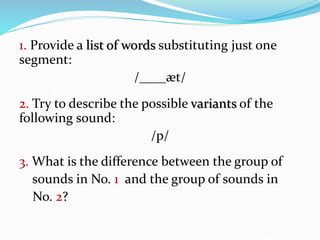
1. Provide a list of words substituting just one
segment:
/____æt/
2. Try to describe the possible variants of the
following sound:
/p/
3. What is the difference between the group of
sounds in No. 1 and the group of sounds in
No. 2?
 In group 1:
 The sounds belong to different sound
groups or classes.
 In group 2:
 The sounds belong to the same sound
group or class.
 They represent the variants of the same
sound.
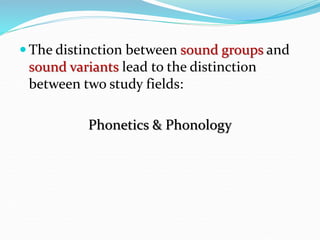
 The distinction between sound groups and
sound variants lead to the distinction
between two study fields:
Phonetics & Phonology
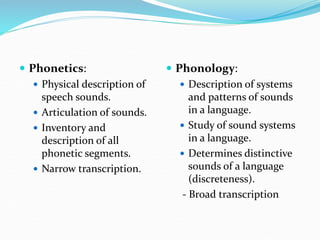
 Phonetics:
 Physical description of
speech sounds.
 Articulation of sounds.
 Inventory and
description of all
phonetic segments.
 Narrow transcription.
 Phonology:
 Description of systems
and patterns of sounds
in a language.
 Study of sound systems
in a language.
 Determines distinctive
sounds of a language
(discreteness).
- Broad transcription
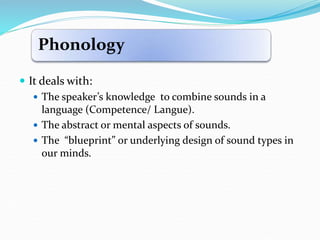
 It deals with:
 The speaker’s knowledge to combine sounds in a
language (Competence/ Langue).
 The abstract or mental aspects of sounds.
 The “blueprint” or underlying design of sound types in
our minds.
Phonology
Phonology
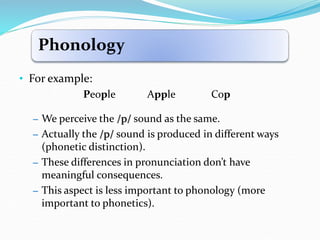
• For example:
People Apple Cop
– We perceive the /p/ sound as the same.
– Actually the /p/ sound is produced in different ways
(phonetic distinction).
– These differences in pronunciation don’t have
meaningful consequences.
– This aspect is less important to phonology (more
important to phonetics).
Phonology
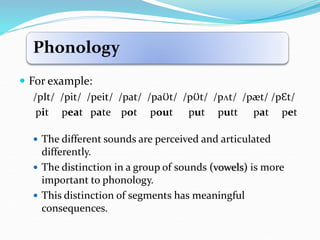
 For example:
/pIt/ /pit/ /peit/ /pat/ /paƱt/ /pƱt/ /pʌt/ /pæt/ /pƐt/
pit peat pate pot pout put putt pat pet
 The different sounds are perceived and articulated
differently.
 The distinction in a group of sounds (vowels) is more
important to phonology.
 This distinction of segments has meaningful
consequences.
Phonology
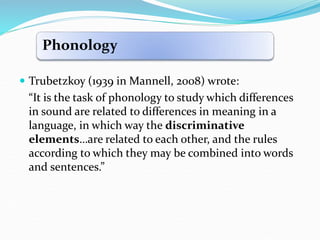
 Trubetzkoy (1939 in Mannell, 2008) wrote:
“It is the task of phonology to study which differences
in sound are related to differences in meaning in a
language, in which way the discriminative
elements…are related to each other, and the rules
according to which they may be combined into words
and sentences.”
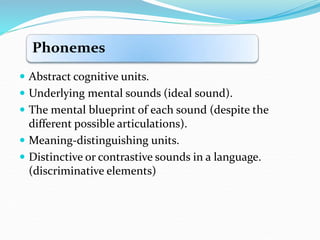
Phonemes
 Abstract cognitive units.
 Underlying mental sounds (ideal sound).
 The mental blueprint of each sound (despite the
different possible articulations).
 Meaning-distinguishing units.
 Distinctive or contrastive sounds in a language.
(discriminative elements)
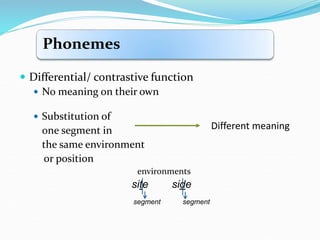
Phonemes
 Differential/ contrastive function
 No meaning on their own
 Substitution of
one segment in
the same environment
or position
environments
site side
segment segment
Different meaning
Phonemes & Phones
 Phonemes /p/ are physically articulated through
speech using phones [p]:
 Phones are:
 Concrete units
 Different versions (articulations) of a sound type (a
phoneme)
 The actual realization of phonemes
 Phonetic units
 In [ ] (Yule, 1996)
Phones & Allophones
 [p ] = aspirated – pool
 [p] = unaspirated – spoon
 [p°] = unreleased – loop
 The set of phones that refer to one phoneme are:
Allophones of that phoneme
-Sound class /p/
-No distinction
in meaning
h
Allophones
 Allophones are: Page 36 reading material
 Phonetic units [ ]
 Versions of one phoneme
 Different pronunciations/ articulations of one phoneme
 Don’t have a contrastive/ differential function
 So… If we substitute:
One phoneme for another change in meaning
One allophone for another change pronunciation
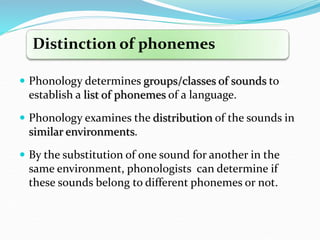
Distinction of phonemes
 Phonology determines groups/classes of sounds to
establish a list of phonemes of a language.
 Phonology examines the distribution of the sounds in
similar environments.
 By the substitution of one sound for another in the
same environment, phonologists can determine if
these sounds belong to different phonemes or not.
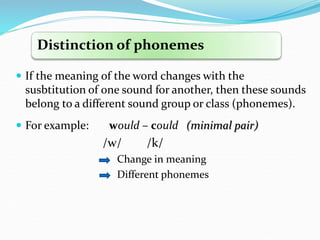
 If the meaning of the word changes with the
susbtitution of one sound for another, then these sounds
belong to a different sound group or class (phonemes).
 For example: would – could (minimal pair)
/w/ /k/
Change in meaning
Different phonemes
Distinction of phonemes
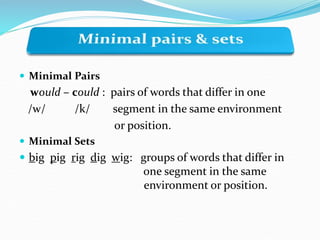
 Minimal Pairs
would – could : pairs of words that differ in one
/w/ /k/ segment in the same environment
or position.
 Minimal Sets
 big pig rig dig wig: groups of words that differ in
one segment in the same
environment or position.
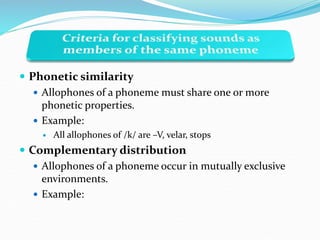
 Phonetic similarity
 Allophones of a phoneme must share one or more
phonetic properties.
 Example:
 All allophones of /k/ are –V, velar, stops
 Complementary distribution
 Allophones of a phoneme occur in mutually exclusive
environments.
 Example:
Allophones of /k/
[k ] Aspirated: 1) in initial possition (class)
2) when a stressed vowel follows (acquire)
3) final position after ‘s’ (ask)
[k] Unaspirated: 1) after initial ‘s’ (scare)
2) middle possition after a stressed
syllable (income)
[k ] Unreleased: 1) final position (look)
h
°
 Free variation
 2 allophones can occur in the same environment
 Example:
[k ] and [k ] are in free variation in final position.
*Important: pages 33 & 36 reading material!
h
°
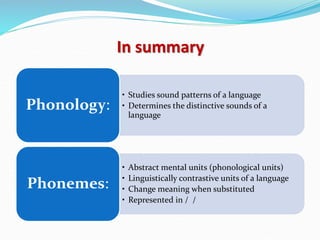
In summary
• Studies sound patterns of a language
• Determines the distinctive sounds of a
language
Phonology:
• Abstract mental units (phonological units)
• Linguistically contrastive units of a language
• Change meaning when substituted
• Represented in / /
Phonemes:
In summary
• Phonetic units
• Actual realizations of a speech sound
• Represented in [ ]
Phones:
• Versions (set of phones) of a phoneme
• No constrastive function
• Change pronunciation, not meaning,
when substituted
• Also represented in [ ]
Allophones:
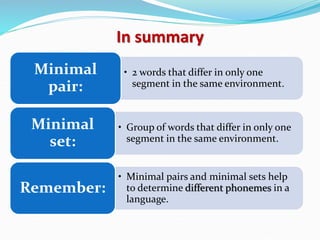
In summary
• 2 words that differ in only one
segment in the same environment.
Minimal
pair:
• Group of words that differ in only one
segment in the same environment.
Minimal
set:
• Minimal pairs and minimal sets help
to determine different phonemes in a
language.
Remember:
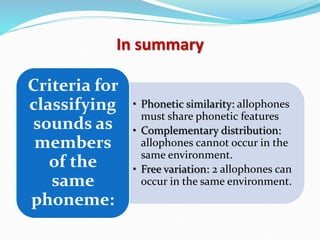
In summary
• Phonetic similarity: allophones
must share phonetic features
• Complementary distribution:
allophones cannot occur in the
same environment.
• Free variation: 2 allophones can
occur in the same environment.
Criteria for
classifying
sounds as
members
of the
same
phoneme:

Phonology Intro

  • 1.
    Phonetics vs Phonology Prof.Gustavo Santamaría
  • 2.
    1. Provide alist of words substituting just one segment: /____æt/ 2. Try to describe the possible variants of the following sound: /p/ 3. What is the difference between the group of sounds in No. 1 and the group of sounds in No. 2?
  • 3.
     In group1:  The sounds belong to different sound groups or classes.  In group 2:  The sounds belong to the same sound group or class.  They represent the variants of the same sound.
  • 4.
     The distinctionbetween sound groups and sound variants lead to the distinction between two study fields: Phonetics & Phonology
  • 5.
     Phonetics:  Physicaldescription of speech sounds.  Articulation of sounds.  Inventory and description of all phonetic segments.  Narrow transcription.  Phonology:  Description of systems and patterns of sounds in a language.  Study of sound systems in a language.  Determines distinctive sounds of a language (discreteness). - Broad transcription
  • 6.
     It dealswith:  The speaker’s knowledge to combine sounds in a language (Competence/ Langue).  The abstract or mental aspects of sounds.  The “blueprint” or underlying design of sound types in our minds. Phonology
  • 7.
    Phonology • For example: PeopleApple Cop – We perceive the /p/ sound as the same. – Actually the /p/ sound is produced in different ways (phonetic distinction). – These differences in pronunciation don’t have meaningful consequences. – This aspect is less important to phonology (more important to phonetics).
  • 8.
    Phonology  For example: /pIt//pit/ /peit/ /pat/ /paƱt/ /pƱt/ /pʌt/ /pæt/ /pƐt/ pit peat pate pot pout put putt pat pet  The different sounds are perceived and articulated differently.  The distinction in a group of sounds (vowels) is more important to phonology.  This distinction of segments has meaningful consequences.
  • 9.
    Phonology  Trubetzkoy (1939in Mannell, 2008) wrote: “It is the task of phonology to study which differences in sound are related to differences in meaning in a language, in which way the discriminative elements…are related to each other, and the rules according to which they may be combined into words and sentences.”
  • 10.
    Phonemes  Abstract cognitiveunits.  Underlying mental sounds (ideal sound).  The mental blueprint of each sound (despite the different possible articulations).  Meaning-distinguishing units.  Distinctive or contrastive sounds in a language. (discriminative elements)
  • 11.
    Phonemes  Differential/ contrastivefunction  No meaning on their own  Substitution of one segment in the same environment or position environments site side segment segment Different meaning
  • 12.
    Phonemes & Phones Phonemes /p/ are physically articulated through speech using phones [p]:  Phones are:  Concrete units  Different versions (articulations) of a sound type (a phoneme)  The actual realization of phonemes  Phonetic units  In [ ] (Yule, 1996)
  • 13.
    Phones & Allophones [p ] = aspirated – pool  [p] = unaspirated – spoon  [p°] = unreleased – loop  The set of phones that refer to one phoneme are: Allophones of that phoneme -Sound class /p/ -No distinction in meaning h
  • 14.
    Allophones  Allophones are:Page 36 reading material  Phonetic units [ ]  Versions of one phoneme  Different pronunciations/ articulations of one phoneme  Don’t have a contrastive/ differential function  So… If we substitute: One phoneme for another change in meaning One allophone for another change pronunciation
  • 15.
    Distinction of phonemes Phonology determines groups/classes of sounds to establish a list of phonemes of a language.  Phonology examines the distribution of the sounds in similar environments.  By the substitution of one sound for another in the same environment, phonologists can determine if these sounds belong to different phonemes or not.
  • 16.
     If themeaning of the word changes with the susbtitution of one sound for another, then these sounds belong to a different sound group or class (phonemes).  For example: would – could (minimal pair) /w/ /k/ Change in meaning Different phonemes Distinction of phonemes
  • 17.
     Minimal Pairs would– could : pairs of words that differ in one /w/ /k/ segment in the same environment or position.  Minimal Sets  big pig rig dig wig: groups of words that differ in one segment in the same environment or position.
  • 18.
     Phonetic similarity Allophones of a phoneme must share one or more phonetic properties.  Example:  All allophones of /k/ are –V, velar, stops  Complementary distribution  Allophones of a phoneme occur in mutually exclusive environments.  Example:
  • 19.
    Allophones of /k/ [k] Aspirated: 1) in initial possition (class) 2) when a stressed vowel follows (acquire) 3) final position after ‘s’ (ask) [k] Unaspirated: 1) after initial ‘s’ (scare) 2) middle possition after a stressed syllable (income) [k ] Unreleased: 1) final position (look) h °
  • 20.
     Free variation 2 allophones can occur in the same environment  Example: [k ] and [k ] are in free variation in final position. *Important: pages 33 & 36 reading material! h °
  • 21.
    In summary • Studiessound patterns of a language • Determines the distinctive sounds of a language Phonology: • Abstract mental units (phonological units) • Linguistically contrastive units of a language • Change meaning when substituted • Represented in / / Phonemes:
  • 22.
    In summary • Phoneticunits • Actual realizations of a speech sound • Represented in [ ] Phones: • Versions (set of phones) of a phoneme • No constrastive function • Change pronunciation, not meaning, when substituted • Also represented in [ ] Allophones:
  • 23.
    In summary • 2words that differ in only one segment in the same environment. Minimal pair: • Group of words that differ in only one segment in the same environment. Minimal set: • Minimal pairs and minimal sets help to determine different phonemes in a language. Remember:
  • 24.
    In summary • Phoneticsimilarity: allophones must share phonetic features • Complementary distribution: allophones cannot occur in the same environment. • Free variation: 2 allophones can occur in the same environment. Criteria for classifying sounds as members of the same phoneme: