Introduction
Recognizing Allophones and Phonemes
Syllable Structure
Phonological Analysis
LING 100 2013W: Tutorial T02/T04
Meagan Louie
2013-10-11
Meagan Louie Phonological Analysis
Introduction
Recognizing Allophones and Phonemes
Syllable Structure
Basic Concepts
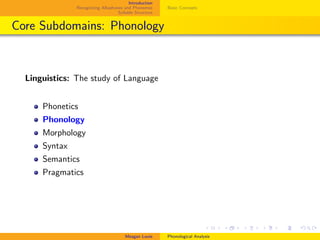
Core Subdomains: Phonology
Linguistics: The study of Language
Phonetics
Phonology
Morphology
Syntax
Semantics
Pragmatics
Meagan Louie Phonological Analysis
Introduction
Recognizing Allophones and Phonemes
Syllable Structure
Basic Concepts
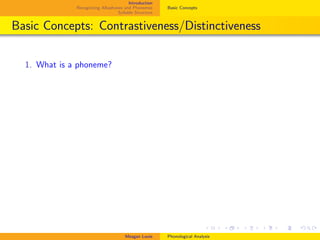
Basic Concepts: Contrastiveness/Distinctiveness
1. What is a phoneme?
Meagan Louie Phonological Analysis
Introduction
Recognizing Allophones and Phonemes
Syllable Structure
Basic Concepts
Basic Concepts: Contrastiveness/Distinctiveness
1. What is a phoneme?
A: The smallest unit of sound that is capable of distinguishing meaning
Meagan Louie Phonological Analysis
Introduction
Recognizing Allophones and Phonemes
Syllable Structure
Basic Concepts
Basic Concepts: Contrastiveness/Distinctiveness
1. What is a phoneme?
A: The smallest unit of sound that is capable of distinguishing meaning
2. What is a minimal pair/set?
Meagan Louie Phonological Analysis
Introduction
Recognizing Allophones and Phonemes
Syllable Structure
Basic Concepts
Basic Concepts: Contrastiveness/Distinctiveness
1. What is a phoneme?
A: The smallest unit of sound that is capable of distinguishing meaning
2. What is a minimal pair/set?
A: A pair/set of morphemes, which
. (i) only differ in one sound segment (eg., [sit] and [fit] ), and
. (i) differ in meaning (eg., ’seat’ = ’feet’)
Meagan Louie Phonological Analysis
Introduction
Recognizing Allophones and Phonemes
Syllable Structure
Basic Concepts
Basic Concepts: Contrastiveness/Distinctiveness
1. What is a phoneme?
A: The smallest unit of sound that is capable of distinguishing meaning
2. What is a minimal pair/set?
A: A pair/set of morphemes, which
. (i) only differ in one sound segment (eg., [sit] and [fit] ), and
. (i) differ in meaning (eg., ’seat’ = ’feet’)
3. What is a an allophone? A phonetic variant?
Meagan Louie Phonological Analysis
Introduction
Recognizing Allophones and Phonemes
Syllable Structure
Basic Concepts
Basic Concepts: Contrastiveness/Distinctiveness
1. What is a phoneme?
A: The smallest unit of sound that is capable of distinguishing meaning
2. What is a minimal pair/set?
A: A pair/set of morphemes, which
. (i) only differ in one sound segment (eg., [sit] and [fit] ), and
. (i) differ in meaning (eg., ’seat’ = ’feet’)
3. What is a an allophone? A phonetic variant?
A: The phonetic variants of a phoneme are the various ways of actually
pronouncing phonemes; allophones are phonetic variants of a phoneme
that pattern in complementary distribution.
Meagan Louie Phonological Analysis
Introduction
Recognizing Allophones and Phonemes
Syllable Structure
Basic Concepts
Basic Concepts: Contrastiveness/Distinctiveness
1. What is a phoneme?
A: The smallest unit of sound that is capable of distinguishing meaning
2. What is a minimal pair/set?
A: A pair/set of morphemes, which
. (i) only differ in one sound segment (eg., [sit] and [fit] ), and
. (i) differ in meaning (eg., ’seat’ = ’feet’)
3. What is a an allophone? A phonetic variant?
A: The phonetic variants of a phoneme are the various ways of actually
pronouncing phonemes; allophones are phonetic variants of a phoneme
that pattern in complementary distribution.
4. Examples?
Meagan Louie Phonological Analysis
Introduction
Recognizing Allophones and Phonemes
Syllable Structure
Basic Concepts
More Concepts: Contrastiveness/Distinctiveness
Meagan Louie Phonological Analysis
Introduction
Recognizing Allophones and Phonemes
Syllable Structure
Basic Concepts
More Concepts: Contrastiveness/Distinctiveness
1. What is a ’distinctive feature’?
Meagan Louie Phonological Analysis
Introduction
Recognizing Allophones and Phonemes
Syllable Structure
Basic Concepts
More Concepts: Contrastiveness/Distinctiveness
1. What is a ’distinctive feature’?
A: An articulatory/acoustic parameter that (eg., voicing, nasality,
aspiration, etc.,), where the parameter settings correlate with different
phonemes.
Meagan Louie Phonological Analysis
Introduction
Recognizing Allophones and Phonemes
Syllable Structure
Basic Concepts
More Concepts: Contrastiveness/Distinctiveness
1. What is a ’distinctive feature’?
A: An articulatory/acoustic parameter that (eg., voicing, nasality,
aspiration, etc.,), where the parameter settings correlate with different
phonemes.
2. What is a phonemic inventory? How is it different from a phonetic
inventory?
Meagan Louie Phonological Analysis
Introduction
Recognizing Allophones and Phonemes
Syllable Structure
Basic Concepts
More Concepts: Contrastiveness/Distinctiveness
1. What is a ’distinctive feature’?
A: An articulatory/acoustic parameter that (eg., voicing, nasality,
aspiration, etc.,), where the parameter settings correlate with different
phonemes.
2. What is a phonemic inventory? How is it different from a phonetic
inventory?
A: A phonemic inventory is the set of phonemes a language has. A
phonetic inventory is the set of phones a language has (i.e., a set that
contains each allophonic variation of each phoneme in the language)
Meagan Louie Phonological Analysis
Introduction
Recognizing Allophones and Phonemes
Syllable Structure
Case Study: Japanese
Case Study: Canadian English
Recognizing Allophones and Phonemes
Meagan Louie Phonological Analysis
Introduction
Recognizing Allophones and Phonemes
Syllable Structure
Case Study: Japanese
Case Study: Canadian English
Recognizing Allophones and Phonemes
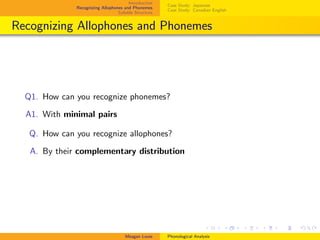
Q1. How can you recognize phonemes?
Meagan Louie Phonological Analysis
Introduction
Recognizing Allophones and Phonemes
Syllable Structure
Case Study: Japanese
Case Study: Canadian English
Recognizing Allophones and Phonemes
Q1. How can you recognize phonemes?
A1. With minimal pairs
Meagan Louie Phonological Analysis
Introduction
Recognizing Allophones and Phonemes
Syllable Structure
Case Study: Japanese
Case Study: Canadian English
Recognizing Allophones and Phonemes
Q1. How can you recognize phonemes?
A1. With minimal pairs
Q. How can you recognize allophones?
Meagan Louie Phonological Analysis
Introduction
Recognizing Allophones and Phonemes
Syllable Structure
Case Study: Japanese
Case Study: Canadian English
Recognizing Allophones and Phonemes
Q1. How can you recognize phonemes?
A1. With minimal pairs
Q. How can you recognize allophones?
A. By their complementary distribution
Meagan Louie Phonological Analysis
Introduction
Recognizing Allophones and Phonemes
Syllable Structure
Case Study: Japanese
Case Study: Canadian English
Phonological Analysis
How to Approach the Question: Phonemes or Allophones?
QUESTION:
Are [X] and [Y] (distinct) phonemes, or allophones of the same phoneme?
1. Look for minimal pairs
2. Found some? Good. Then say something like:
ANSWER
”[X] and [Y] are distinct phonemes. This can be illustrated with the
following minimal pair: [Xat] ’water oxen’ and [Yat] ’radio’ differ only in
that one begins with [X] and the other begins with [Y], yet they have
distinct meanings.
Meagan Louie Phonological Analysis
Introduction
Recognizing Allophones and Phonemes
Syllable Structure
Case Study: Japanese
Case Study: Canadian English
Distinct Phonemes: Cantonese Example
1. [g2w3] ”enough”
2. [gaw3] ”teach”
3. [tS2w3] ”stinky”
4. [tSaw2] ”stir-fried”
5. [maj5] ”buy”
6. [m2j5] ”rice (uncooked)”
7. [saj3] ”excessive”
8. [s2j3] ”small”
[Q:] Are [aw] and [2w] separate phonemes, or allophones?
[Q:] Are [aj] and [2j] separate phonemes, or allophones?
(FYI: The numbers indicate tones, 1=high level, 2=high rising, 3=mid
level, 4=low falling, 5=low rising, 6=low level)
Meagan Louie Phonological Analysis
Introduction
Recognizing Allophones and Phonemes
Syllable Structure
Case Study: Japanese
Case Study: Canadian English
Distinct Phonemes: Cantonese Example
1. [g2w3] ”enough”
2. [gaw3] ”teach”
3. [tS2w3] ”stinky”
4. [tSaw2] ”stir-fried”
5. [maj5] ”buy”
6. [m2j5] ”rice (uncooked)”
7. [saj3] ”excessive”
8. [s2j3] ”small”
[Q:] Are [aw] and [2w] separate phonemes, or allophones?
[Q:] Are [aj] and [2j] separate phonemes, or allophones?
(FYI: The numbers indicate tones, 1=high level, 2=high rising, 3=mid
level, 4=low falling, 5=low rising, 6=low level)
Meagan Louie Phonological Analysis
Introduction
Recognizing Allophones and Phonemes
Syllable Structure
Case Study: Japanese
Case Study: Canadian English
Distinct Phonemes: Cantonese Example
1. [g2w3] ”enough”
2. [gaw3] ”teach”
3. [tS2w3] ”stinky”
4. [tSaw2] ”stir-fried”
5. [maj5] ”buy”
6. [m2j5] ”rice (uncooked)”
7. [saj3] ”excessive”
8. [s2j3] ”small”
[Q:] Are [aw] and [2w] separate phonemes, or allophones?
[Q:] Are [aj] and [2j] separate phonemes, or allophones?
(FYI: The numbers indicate tones, 1=high level, 2=high rising, 3=mid
level, 4=low falling, 5=low rising, 6=low level)
Meagan Louie Phonological Analysis
Introduction
Recognizing Allophones and Phonemes
Syllable Structure
Case Study: Japanese
Case Study: Canadian English
Distinct Phonemes: Cantonese Example
1. [g2w3] ”enough”
2. [gaw3] ”teach”
3. [tS2w3] ”stinky”
4. [tSaw2] ”stir-fried”
5. [maj5] ”buy”
6. [m2j5] ”rice (uncooked)”
7. [saj3] ”excessive”
8. [s2j3] ”small”
[Q:] Are [aw] and [2w] separate phonemes, or allophones?
[Q:] Are [aj] and [2j] separate phonemes, or allophones?
→Minimal pairs, ∴ can conclude these are distinct phonemes.
Meagan Louie Phonological Analysis
Introduction
Recognizing Allophones and Phonemes
Syllable Structure
Case Study: Japanese
Case Study: Canadian English
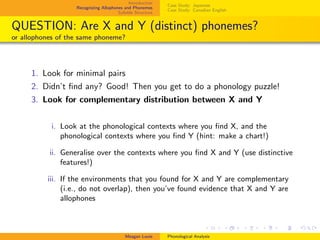
QUESTION: Are X and Y (distinct) phonemes?
or allophones of the same phoneme?
1. Look for minimal pairs
2. Didn’t find any? Good! Then you get to do a phonology puzzle!
3. Look for complementary distribution between X and Y
i. Look at the phonological contexts where you find X, and the
phonological contexts where you find Y (hint: make a chart!)
ii. Generalise over the contexts where you find X and Y (use distinctive
features!)
iii. If the environments that you found for X and Y are complementary
(i.e., do not overlap), then you’ve found evidence that X and Y are
allophones
Meagan Louie Phonological Analysis
Introduction
Recognizing Allophones and Phonemes
Syllable Structure
Case Study: Japanese
Case Study: Canadian English
Case Study: Japanese
[Q:] Are [s] and [S] separate phonemes, or allophones?
1. [sakana] ”fish”
2. [aSita] ”tomorrow”
3. [sukoSi] ”little bit”
4. [senaka] ”back”
5. [soko] ”there”
6. [asa] ”morning”
7. [Sigoto] ”work”
8. [tesuto] ”test”
9. [Siawase] ”happy”
10. [soSite] ”then”
Meagan Louie Phonological Analysis
Introduction
Recognizing Allophones and Phonemes
Syllable Structure
Case Study: Japanese
Case Study: Canadian English
How to Approach This Type of Problem
[Q:] Are [s] and [S] separate phonemes, or allophones?
1. [sakana] ”fish”
2. [aSita] ”tomorrow”
3. [sukoSi] ”little bit”
4. [senaka] ”back”
5. [soko] ”there”
6. [asa] ”morning”
7. [Sigoto] ”work”
8. [tesuto] ”test”
9. [Siawase] ”happy”
10. [soSite] ”then”
Step 1: Look for minimal pairs (evidence of phonemes)
- none in this data set.
Step 2: Try to establish complementary distribution (evidence of allophony)
Meagan Louie Phonological Analysis
Introduction
Recognizing Allophones and Phonemes
Syllable Structure
Case Study: Japanese
Case Study: Canadian English
Determining Allophony
Finding Complementary Distribution
Step 2: Try to establish complementary distribution
Meagan Louie Phonological Analysis
Introduction
Recognizing Allophones and Phonemes
Syllable Structure
Case Study: Japanese
Case Study: Canadian English
Determining Allophony
Finding Complementary Distribution
Step 2: Try to establish complementary distribution
2a: Make a chart of where [s] occurs vs where [S] occurs
Meagan Louie Phonological Analysis
Introduction
Recognizing Allophones and Phonemes
Syllable Structure
Case Study: Japanese
Case Study: Canadian English
Determining Allophony
Finding Complementary Distribution
Step 2: Try to establish complementary distribution
2a: Make a chart of where [s] occurs vs where [S] occurs
2b: Try to generalize over the environments for each sound
Environments where [s] occurs Environments where [S] occurs
# akana a ita
# ukoSi suko i
# enaka suko i
# oko # iawase
a a so ite
te uto # igoto
Siawa e
# oSite
Meagan Louie Phonological Analysis
Introduction
Recognizing Allophones and Phonemes
Syllable Structure
Case Study: Japanese
Case Study: Canadian English
Determining Allophony
Finding Complementary Distribution
Step 2: Try to establish complementary distribution
2a: Make a chart of where [s] occurs vs where [S] occurs
2b:Try to generalize over the environments for each sound
Environments where [s] occurs Environments where [S] occurs
# akana a ita
# ukoSi suko i
# enaka suko i
# oko # iawase
a a so ite
te uto # igoto
Siawa e
# oSite
Meagan Louie Phonological Analysis
Introduction
Recognizing Allophones and Phonemes
Syllable Structure
Case Study: Japanese
Case Study: Canadian English
Determining Allophony
Finding Complementary Distribution
Step 2: Try to establish complementary distribution
2a: Make a chart of where [s] occurs vs where [S] occurs
2b:Try to generalize over the environments for each sound
Environments where [s] occurs Environments where [S] occurs
# akana a ita
# ukoSi suko i
# enaka suko i
# oko # iawase
a a so ite
te uto # igoto
Siawa e
# oSite a, u, e, o i
Meagan Louie Phonological Analysis
Introduction
Recognizing Allophones and Phonemes
Syllable Structure
Case Study: Japanese
Case Study: Canadian English
Determining Allophony
Finding Complementary Distribution
Environments where [s] occurs Environments where [S] occurs
# akana a ita
# ukoSi suko i
# enaka suko i
# oko # iawase
a a so ite
te uto # igoto
Siawa e
# oSite a, u, e, o i
Generalization: [S] occurs when preceding [i], [s] occurs otherwise
Meagan Louie Phonological Analysis
Introduction
Recognizing Allophones and Phonemes
Syllable Structure
Case Study: Japanese
Case Study: Canadian English
Determining Allophony
Finding Complementary Distribution
Environments where [s] occurs Environments where [S] occurs
# akana a ita
# ukoSi suko i
# enaka suko i
# oko # iawase
a a so ite
te uto # igoto
Siawa e
# oSite a, u, e, o i
Generalization: [S] occurs when preceding [i], [s] occurs otherwise
This suggests that [s] and [S] are allophones of the same phoneme
Meagan Louie Phonological Analysis
Introduction
Recognizing Allophones and Phonemes
Syllable Structure
Case Study: Japanese
Case Study: Canadian English
Determining Allophony
Finding Complementary Distribution
Environments where [s] occurs Environments where [S] occurs
# akana a ita
# ukoSi suko i
# enaka suko i
# oko # iawase
a a so ite
te uto # igoto
Siawa e
# oSite a, u, e, o i
Generalization: [S] occurs when preceding [i], [s] occurs otherwise
This suggests that [s] and [S] are allophones of the same phoneme
s → S / i (s becomes s when preceding [i])
Meagan Louie Phonological Analysis
Introduction
Recognizing Allophones and Phonemes
Syllable Structure
Case Study: Japanese
Case Study: Canadian English
Case Study: Canadian English I
1. [k2wtS] ”couch”
2. [tawn] ”town”
3. [bôaw] ”brow”
4. [2wt] ”out”
5. [@lawz] ”allows”
6. [lawd] ”loud”
7. [p2wt] ”pout”
8. [@ôawnd] ”around”
9. [h2ws] ”houseN”
10. [m2wT] ”mouthN”
[Q:] Are [aw] and [2w] separate phonemes, or allophones?
Meagan Louie Phonological Analysis
Introduction
Recognizing Allophones and Phonemes
Syllable Structure
Case Study: Japanese
Case Study: Canadian English
Case Study: Canadian English II
1. [k2jt] ”kite”
2. [tajm] ”time”
3. [baj] ”buy”
4. [b2jt] ”bite”
5. [lajz] ”lies”
6. [lajd] ”lied”
7. [p2jp] ”pipe”
8. [ôajnd] ”rind”
9. [m2js] ”mice”
10. [m2jT] ”might”
[Q:] Are [aj] and [2j] separate phonemes, or allophones?
Meagan Louie Phonological Analysis
Introduction
Recognizing Allophones and Phonemes
Syllable Structure
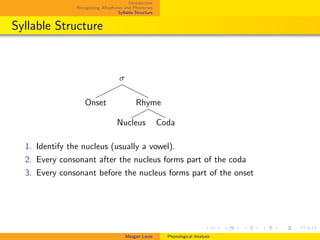
Syllable Structure
σ
Onset Rhyme
Nucleus Coda
1. Identify the nucleus (usually a vowel).
2. Every consonant after the nucleus forms part of the coda
3. Every consonant before the nucleus forms part of the onset
Meagan Louie Phonological Analysis

LING 100 - Review on Phonological Analysis

  • 1.
    Introduction Recognizing Allophones andPhonemes Syllable Structure Phonological Analysis LING 100 2013W: Tutorial T02/T04 Meagan Louie 2013-10-11 Meagan Louie Phonological Analysis
  • 2.
    Introduction Recognizing Allophones andPhonemes Syllable Structure Basic Concepts Core Subdomains: Phonology Linguistics: The study of Language Phonetics Phonology Morphology Syntax Semantics Pragmatics Meagan Louie Phonological Analysis
  • 3.
    Introduction Recognizing Allophones andPhonemes Syllable Structure Basic Concepts Basic Concepts: Contrastiveness/Distinctiveness 1. What is a phoneme? Meagan Louie Phonological Analysis
  • 4.
    Introduction Recognizing Allophones andPhonemes Syllable Structure Basic Concepts Basic Concepts: Contrastiveness/Distinctiveness 1. What is a phoneme? A: The smallest unit of sound that is capable of distinguishing meaning Meagan Louie Phonological Analysis
  • 5.
    Introduction Recognizing Allophones andPhonemes Syllable Structure Basic Concepts Basic Concepts: Contrastiveness/Distinctiveness 1. What is a phoneme? A: The smallest unit of sound that is capable of distinguishing meaning 2. What is a minimal pair/set? Meagan Louie Phonological Analysis
  • 6.
    Introduction Recognizing Allophones andPhonemes Syllable Structure Basic Concepts Basic Concepts: Contrastiveness/Distinctiveness 1. What is a phoneme? A: The smallest unit of sound that is capable of distinguishing meaning 2. What is a minimal pair/set? A: A pair/set of morphemes, which . (i) only differ in one sound segment (eg., [sit] and [fit] ), and . (i) differ in meaning (eg., ’seat’ = ’feet’) Meagan Louie Phonological Analysis
  • 7.
    Introduction Recognizing Allophones andPhonemes Syllable Structure Basic Concepts Basic Concepts: Contrastiveness/Distinctiveness 1. What is a phoneme? A: The smallest unit of sound that is capable of distinguishing meaning 2. What is a minimal pair/set? A: A pair/set of morphemes, which . (i) only differ in one sound segment (eg., [sit] and [fit] ), and . (i) differ in meaning (eg., ’seat’ = ’feet’) 3. What is a an allophone? A phonetic variant? Meagan Louie Phonological Analysis
  • 8.
    Introduction Recognizing Allophones andPhonemes Syllable Structure Basic Concepts Basic Concepts: Contrastiveness/Distinctiveness 1. What is a phoneme? A: The smallest unit of sound that is capable of distinguishing meaning 2. What is a minimal pair/set? A: A pair/set of morphemes, which . (i) only differ in one sound segment (eg., [sit] and [fit] ), and . (i) differ in meaning (eg., ’seat’ = ’feet’) 3. What is a an allophone? A phonetic variant? A: The phonetic variants of a phoneme are the various ways of actually pronouncing phonemes; allophones are phonetic variants of a phoneme that pattern in complementary distribution. Meagan Louie Phonological Analysis
  • 9.
    Introduction Recognizing Allophones andPhonemes Syllable Structure Basic Concepts Basic Concepts: Contrastiveness/Distinctiveness 1. What is a phoneme? A: The smallest unit of sound that is capable of distinguishing meaning 2. What is a minimal pair/set? A: A pair/set of morphemes, which . (i) only differ in one sound segment (eg., [sit] and [fit] ), and . (i) differ in meaning (eg., ’seat’ = ’feet’) 3. What is a an allophone? A phonetic variant? A: The phonetic variants of a phoneme are the various ways of actually pronouncing phonemes; allophones are phonetic variants of a phoneme that pattern in complementary distribution. 4. Examples? Meagan Louie Phonological Analysis
  • 10.
    Introduction Recognizing Allophones andPhonemes Syllable Structure Basic Concepts More Concepts: Contrastiveness/Distinctiveness Meagan Louie Phonological Analysis
  • 11.
    Introduction Recognizing Allophones andPhonemes Syllable Structure Basic Concepts More Concepts: Contrastiveness/Distinctiveness 1. What is a ’distinctive feature’? Meagan Louie Phonological Analysis
  • 12.
    Introduction Recognizing Allophones andPhonemes Syllable Structure Basic Concepts More Concepts: Contrastiveness/Distinctiveness 1. What is a ’distinctive feature’? A: An articulatory/acoustic parameter that (eg., voicing, nasality, aspiration, etc.,), where the parameter settings correlate with different phonemes. Meagan Louie Phonological Analysis
  • 13.
    Introduction Recognizing Allophones andPhonemes Syllable Structure Basic Concepts More Concepts: Contrastiveness/Distinctiveness 1. What is a ’distinctive feature’? A: An articulatory/acoustic parameter that (eg., voicing, nasality, aspiration, etc.,), where the parameter settings correlate with different phonemes. 2. What is a phonemic inventory? How is it different from a phonetic inventory? Meagan Louie Phonological Analysis
  • 14.
    Introduction Recognizing Allophones andPhonemes Syllable Structure Basic Concepts More Concepts: Contrastiveness/Distinctiveness 1. What is a ’distinctive feature’? A: An articulatory/acoustic parameter that (eg., voicing, nasality, aspiration, etc.,), where the parameter settings correlate with different phonemes. 2. What is a phonemic inventory? How is it different from a phonetic inventory? A: A phonemic inventory is the set of phonemes a language has. A phonetic inventory is the set of phones a language has (i.e., a set that contains each allophonic variation of each phoneme in the language) Meagan Louie Phonological Analysis
  • 15.
    Introduction Recognizing Allophones andPhonemes Syllable Structure Case Study: Japanese Case Study: Canadian English Recognizing Allophones and Phonemes Meagan Louie Phonological Analysis
  • 16.
    Introduction Recognizing Allophones andPhonemes Syllable Structure Case Study: Japanese Case Study: Canadian English Recognizing Allophones and Phonemes Q1. How can you recognize phonemes? Meagan Louie Phonological Analysis
  • 17.
    Introduction Recognizing Allophones andPhonemes Syllable Structure Case Study: Japanese Case Study: Canadian English Recognizing Allophones and Phonemes Q1. How can you recognize phonemes? A1. With minimal pairs Meagan Louie Phonological Analysis
  • 18.
    Introduction Recognizing Allophones andPhonemes Syllable Structure Case Study: Japanese Case Study: Canadian English Recognizing Allophones and Phonemes Q1. How can you recognize phonemes? A1. With minimal pairs Q. How can you recognize allophones? Meagan Louie Phonological Analysis
  • 19.
    Introduction Recognizing Allophones andPhonemes Syllable Structure Case Study: Japanese Case Study: Canadian English Recognizing Allophones and Phonemes Q1. How can you recognize phonemes? A1. With minimal pairs Q. How can you recognize allophones? A. By their complementary distribution Meagan Louie Phonological Analysis
  • 20.
    Introduction Recognizing Allophones andPhonemes Syllable Structure Case Study: Japanese Case Study: Canadian English Phonological Analysis How to Approach the Question: Phonemes or Allophones? QUESTION: Are [X] and [Y] (distinct) phonemes, or allophones of the same phoneme? 1. Look for minimal pairs 2. Found some? Good. Then say something like: ANSWER ”[X] and [Y] are distinct phonemes. This can be illustrated with the following minimal pair: [Xat] ’water oxen’ and [Yat] ’radio’ differ only in that one begins with [X] and the other begins with [Y], yet they have distinct meanings. Meagan Louie Phonological Analysis
  • 21.
    Introduction Recognizing Allophones andPhonemes Syllable Structure Case Study: Japanese Case Study: Canadian English Distinct Phonemes: Cantonese Example 1. [g2w3] ”enough” 2. [gaw3] ”teach” 3. [tS2w3] ”stinky” 4. [tSaw2] ”stir-fried” 5. [maj5] ”buy” 6. [m2j5] ”rice (uncooked)” 7. [saj3] ”excessive” 8. [s2j3] ”small” [Q:] Are [aw] and [2w] separate phonemes, or allophones? [Q:] Are [aj] and [2j] separate phonemes, or allophones? (FYI: The numbers indicate tones, 1=high level, 2=high rising, 3=mid level, 4=low falling, 5=low rising, 6=low level) Meagan Louie Phonological Analysis
  • 22.
    Introduction Recognizing Allophones andPhonemes Syllable Structure Case Study: Japanese Case Study: Canadian English Distinct Phonemes: Cantonese Example 1. [g2w3] ”enough” 2. [gaw3] ”teach” 3. [tS2w3] ”stinky” 4. [tSaw2] ”stir-fried” 5. [maj5] ”buy” 6. [m2j5] ”rice (uncooked)” 7. [saj3] ”excessive” 8. [s2j3] ”small” [Q:] Are [aw] and [2w] separate phonemes, or allophones? [Q:] Are [aj] and [2j] separate phonemes, or allophones? (FYI: The numbers indicate tones, 1=high level, 2=high rising, 3=mid level, 4=low falling, 5=low rising, 6=low level) Meagan Louie Phonological Analysis
  • 23.
    Introduction Recognizing Allophones andPhonemes Syllable Structure Case Study: Japanese Case Study: Canadian English Distinct Phonemes: Cantonese Example 1. [g2w3] ”enough” 2. [gaw3] ”teach” 3. [tS2w3] ”stinky” 4. [tSaw2] ”stir-fried” 5. [maj5] ”buy” 6. [m2j5] ”rice (uncooked)” 7. [saj3] ”excessive” 8. [s2j3] ”small” [Q:] Are [aw] and [2w] separate phonemes, or allophones? [Q:] Are [aj] and [2j] separate phonemes, or allophones? (FYI: The numbers indicate tones, 1=high level, 2=high rising, 3=mid level, 4=low falling, 5=low rising, 6=low level) Meagan Louie Phonological Analysis
  • 24.
    Introduction Recognizing Allophones andPhonemes Syllable Structure Case Study: Japanese Case Study: Canadian English Distinct Phonemes: Cantonese Example 1. [g2w3] ”enough” 2. [gaw3] ”teach” 3. [tS2w3] ”stinky” 4. [tSaw2] ”stir-fried” 5. [maj5] ”buy” 6. [m2j5] ”rice (uncooked)” 7. [saj3] ”excessive” 8. [s2j3] ”small” [Q:] Are [aw] and [2w] separate phonemes, or allophones? [Q:] Are [aj] and [2j] separate phonemes, or allophones? →Minimal pairs, ∴ can conclude these are distinct phonemes. Meagan Louie Phonological Analysis
  • 25.
    Introduction Recognizing Allophones andPhonemes Syllable Structure Case Study: Japanese Case Study: Canadian English QUESTION: Are X and Y (distinct) phonemes? or allophones of the same phoneme? 1. Look for minimal pairs 2. Didn’t find any? Good! Then you get to do a phonology puzzle! 3. Look for complementary distribution between X and Y i. Look at the phonological contexts where you find X, and the phonological contexts where you find Y (hint: make a chart!) ii. Generalise over the contexts where you find X and Y (use distinctive features!) iii. If the environments that you found for X and Y are complementary (i.e., do not overlap), then you’ve found evidence that X and Y are allophones Meagan Louie Phonological Analysis
  • 26.
    Introduction Recognizing Allophones andPhonemes Syllable Structure Case Study: Japanese Case Study: Canadian English Case Study: Japanese [Q:] Are [s] and [S] separate phonemes, or allophones? 1. [sakana] ”fish” 2. [aSita] ”tomorrow” 3. [sukoSi] ”little bit” 4. [senaka] ”back” 5. [soko] ”there” 6. [asa] ”morning” 7. [Sigoto] ”work” 8. [tesuto] ”test” 9. [Siawase] ”happy” 10. [soSite] ”then” Meagan Louie Phonological Analysis
  • 27.
    Introduction Recognizing Allophones andPhonemes Syllable Structure Case Study: Japanese Case Study: Canadian English How to Approach This Type of Problem [Q:] Are [s] and [S] separate phonemes, or allophones? 1. [sakana] ”fish” 2. [aSita] ”tomorrow” 3. [sukoSi] ”little bit” 4. [senaka] ”back” 5. [soko] ”there” 6. [asa] ”morning” 7. [Sigoto] ”work” 8. [tesuto] ”test” 9. [Siawase] ”happy” 10. [soSite] ”then” Step 1: Look for minimal pairs (evidence of phonemes) - none in this data set. Step 2: Try to establish complementary distribution (evidence of allophony) Meagan Louie Phonological Analysis
  • 28.
    Introduction Recognizing Allophones andPhonemes Syllable Structure Case Study: Japanese Case Study: Canadian English Determining Allophony Finding Complementary Distribution Step 2: Try to establish complementary distribution Meagan Louie Phonological Analysis
  • 29.
    Introduction Recognizing Allophones andPhonemes Syllable Structure Case Study: Japanese Case Study: Canadian English Determining Allophony Finding Complementary Distribution Step 2: Try to establish complementary distribution 2a: Make a chart of where [s] occurs vs where [S] occurs Meagan Louie Phonological Analysis
  • 30.
    Introduction Recognizing Allophones andPhonemes Syllable Structure Case Study: Japanese Case Study: Canadian English Determining Allophony Finding Complementary Distribution Step 2: Try to establish complementary distribution 2a: Make a chart of where [s] occurs vs where [S] occurs 2b: Try to generalize over the environments for each sound Environments where [s] occurs Environments where [S] occurs # akana a ita # ukoSi suko i # enaka suko i # oko # iawase a a so ite te uto # igoto Siawa e # oSite Meagan Louie Phonological Analysis
  • 31.
    Introduction Recognizing Allophones andPhonemes Syllable Structure Case Study: Japanese Case Study: Canadian English Determining Allophony Finding Complementary Distribution Step 2: Try to establish complementary distribution 2a: Make a chart of where [s] occurs vs where [S] occurs 2b:Try to generalize over the environments for each sound Environments where [s] occurs Environments where [S] occurs # akana a ita # ukoSi suko i # enaka suko i # oko # iawase a a so ite te uto # igoto Siawa e # oSite Meagan Louie Phonological Analysis
  • 32.
    Introduction Recognizing Allophones andPhonemes Syllable Structure Case Study: Japanese Case Study: Canadian English Determining Allophony Finding Complementary Distribution Step 2: Try to establish complementary distribution 2a: Make a chart of where [s] occurs vs where [S] occurs 2b:Try to generalize over the environments for each sound Environments where [s] occurs Environments where [S] occurs # akana a ita # ukoSi suko i # enaka suko i # oko # iawase a a so ite te uto # igoto Siawa e # oSite a, u, e, o i Meagan Louie Phonological Analysis
  • 33.
    Introduction Recognizing Allophones andPhonemes Syllable Structure Case Study: Japanese Case Study: Canadian English Determining Allophony Finding Complementary Distribution Environments where [s] occurs Environments where [S] occurs # akana a ita # ukoSi suko i # enaka suko i # oko # iawase a a so ite te uto # igoto Siawa e # oSite a, u, e, o i Generalization: [S] occurs when preceding [i], [s] occurs otherwise Meagan Louie Phonological Analysis
  • 34.
    Introduction Recognizing Allophones andPhonemes Syllable Structure Case Study: Japanese Case Study: Canadian English Determining Allophony Finding Complementary Distribution Environments where [s] occurs Environments where [S] occurs # akana a ita # ukoSi suko i # enaka suko i # oko # iawase a a so ite te uto # igoto Siawa e # oSite a, u, e, o i Generalization: [S] occurs when preceding [i], [s] occurs otherwise This suggests that [s] and [S] are allophones of the same phoneme Meagan Louie Phonological Analysis
  • 35.
    Introduction Recognizing Allophones andPhonemes Syllable Structure Case Study: Japanese Case Study: Canadian English Determining Allophony Finding Complementary Distribution Environments where [s] occurs Environments where [S] occurs # akana a ita # ukoSi suko i # enaka suko i # oko # iawase a a so ite te uto # igoto Siawa e # oSite a, u, e, o i Generalization: [S] occurs when preceding [i], [s] occurs otherwise This suggests that [s] and [S] are allophones of the same phoneme s → S / i (s becomes s when preceding [i]) Meagan Louie Phonological Analysis
  • 36.
    Introduction Recognizing Allophones andPhonemes Syllable Structure Case Study: Japanese Case Study: Canadian English Case Study: Canadian English I 1. [k2wtS] ”couch” 2. [tawn] ”town” 3. [bôaw] ”brow” 4. [2wt] ”out” 5. [@lawz] ”allows” 6. [lawd] ”loud” 7. [p2wt] ”pout” 8. [@ôawnd] ”around” 9. [h2ws] ”houseN” 10. [m2wT] ”mouthN” [Q:] Are [aw] and [2w] separate phonemes, or allophones? Meagan Louie Phonological Analysis
  • 37.
    Introduction Recognizing Allophones andPhonemes Syllable Structure Case Study: Japanese Case Study: Canadian English Case Study: Canadian English II 1. [k2jt] ”kite” 2. [tajm] ”time” 3. [baj] ”buy” 4. [b2jt] ”bite” 5. [lajz] ”lies” 6. [lajd] ”lied” 7. [p2jp] ”pipe” 8. [ôajnd] ”rind” 9. [m2js] ”mice” 10. [m2jT] ”might” [Q:] Are [aj] and [2j] separate phonemes, or allophones? Meagan Louie Phonological Analysis
  • 38.
    Introduction Recognizing Allophones andPhonemes Syllable Structure Syllable Structure σ Onset Rhyme Nucleus Coda 1. Identify the nucleus (usually a vowel). 2. Every consonant after the nucleus forms part of the coda 3. Every consonant before the nucleus forms part of the onset Meagan Louie Phonological Analysis