
PHONETICS AND
PHONOLOGY
Minimal Pairs
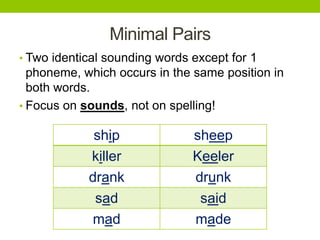
• Two identical sounding words except for 1
phoneme, which occurs in the same position in
both words.
• Focus on sounds, not on spelling!
ship sheep
killer Keeler
drank drunk
sad said
mad made
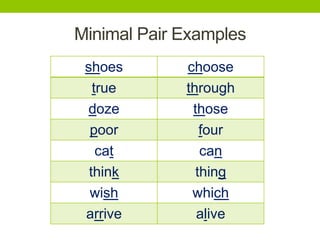
Minimal Pair Examples
shoes choose
true through
doze those
poor four
cat can
think thing
wish which
arrive alive
Not all sounds appear in all languages.
•Korean ㄹ (L/R)
• Korean speakers have difficulty articulating
English words with the letters L and R
Minimal Pair:
lice / rice
Not all sounds appear in all languages.
•Arabic /b/
• Arabic does not have a /p/ sound, and Arabic
speakers will often pronounce people as [bibl]
Dog bark or dog park?
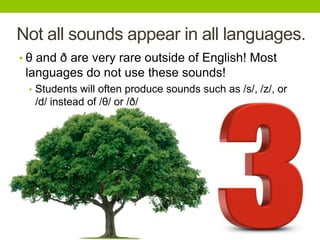
• θ and ð are very rare outside of English! Most
languages do not use these sounds!
• Students will often produce sounds such as /s/, /z/, or
/d/ instead of /θ/ or /ð/
Not all sounds appear in all languages.
• In Spanish, words do not begin with S followed by
a consonant: school, special, start
• Spanish speakers will often pronounce these words as
/ɛskul/, /ɛspɛʃl/ and /ɛstaɹt/
• Spanish speakers do not have trouble with words that
begin with S and are followed by a vowel, such as sand.
Not all sounds appear in all languages.
Even though stand and
sand are not a true
minimal pair, they’re
good for practicing this!
Aspiration
• The release of air after certain stops
• In English, the following symbols represent
aspirated sounds: /pʰ/, / tʰ/, and /kʰ/
• /pʰ/ pit, pan, apart
• /tʰ/ tick, tock, attire
• /kʰ/ keep, cat, recur
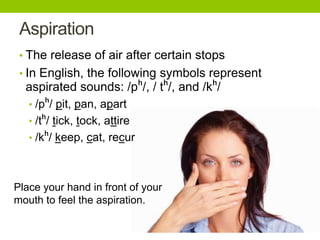
Place your hand in front of your
mouth to feel the aspiration.
Aspiration
• In English, aspiration typically occurs when the
sound is present at the beginning of the first
syllable (pit, cat); however, it can occur later in
the word if the sound is stressed and followed by
a vowel (apart, attire)
• In English, aspirations do not come at the end of
a word
• Most languages do not have aspriations
Allophones
• A group of several phones (sounds) that
represent versions of the same phoneme
• There are a group of phones (sounds) that represent
the /t/ in English
• tar [tʰ a ɹ]
• cat [k æ t]
• water [w a ɾ ə ɹ]
Phonemes vs. Allophones
• Changing phonemes changes a word’s meaning
and pronunciation
• /t/ and /p/ are phonemes, which differentiate the words
ten and pen
• Changing allophones only changes pronunciation
• An American might say [w a ɾ ə ɹ], while
a Brit might say [w a t ə r] or even
[w a t ə] – the meaning does not change.
Phonotactics
• The constraints on the sequence or position of
phonemes in a language
• Certain sound combinations just don’t exist in English!
• Phonotactics are different for each language
• In English: knight, knife, knew
[n aj t], [n aj f], [n u]
• In Russian the word for book is
книга (kniga), and it is pronounced
[k n i g ə]
Phonotactics
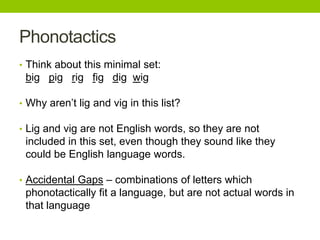
• Think about this minimal set:
big pig rig fig dig wig
• Why aren’t lig and vig in this list?
• Lig and vig are not English words, so they are not
included in this set, even though they sound like they
could be English language words.
• Accidental Gaps – combinations of letters which
phonotactically fit a language, but are not actual words in
that language
Co-articulation Effects
How would you say this sentence:
Did you see that movie last night?
Would you say
[d I d] [j u] [s i] [ð æ t] [m u v i] [l æ s t] [n aj t]
or
[d I dʒ u] [s i] [ð æ] [m u v i] [l æ s] [n aj t]
Co-articulation Effects
• Assimilation – When one sound becomes more like
another nearby sound in terms of its phonetic
characteristics
• “did you” is often pronounced [d I dʒ u] when the [d] and [j]
phones undergo assimilation
• Elision – When a sound segment that might be
pronounced when speaking carefully is left out of a
word during casual speech
• The [t] sound at the end of words in the middle of a sentence is
frequently dropped: [ð æ] [m u v i] [l æ s] [n aj t]
• The [d] sound is frequently dropped from friendship: [f ɹ ɛ n ʃ I
p]
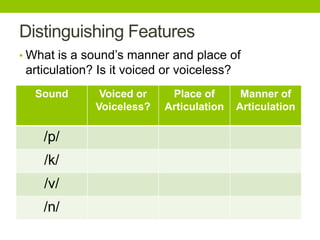
Distinguishing Features
• What is a sound’s manner and place of
articulation? Is it voiced or voiceless?
Sound Voiced or
Voiceless?
Place of
Articulation
Manner of
Articulation
/p/
/k/
/v/
/n/

Phonetics and Phonology

  • 1.
  • 2.
    Minimal Pairs • Twoidentical sounding words except for 1 phoneme, which occurs in the same position in both words. • Focus on sounds, not on spelling! ship sheep killer Keeler drank drunk sad said mad made
  • 3.
    Minimal Pair Examples shoeschoose true through doze those poor four cat can think thing wish which arrive alive
  • 4.
    Not all soundsappear in all languages. •Korean ㄹ (L/R) • Korean speakers have difficulty articulating English words with the letters L and R Minimal Pair: lice / rice
  • 5.
    Not all soundsappear in all languages. •Arabic /b/ • Arabic does not have a /p/ sound, and Arabic speakers will often pronounce people as [bibl] Dog bark or dog park?
  • 6.
    • θ andð are very rare outside of English! Most languages do not use these sounds! • Students will often produce sounds such as /s/, /z/, or /d/ instead of /θ/ or /ð/ Not all sounds appear in all languages.
  • 7.
    • In Spanish,words do not begin with S followed by a consonant: school, special, start • Spanish speakers will often pronounce these words as /ɛskul/, /ɛspɛʃl/ and /ɛstaɹt/ • Spanish speakers do not have trouble with words that begin with S and are followed by a vowel, such as sand. Not all sounds appear in all languages. Even though stand and sand are not a true minimal pair, they’re good for practicing this!
  • 8.
    Aspiration • The releaseof air after certain stops • In English, the following symbols represent aspirated sounds: /pʰ/, / tʰ/, and /kʰ/ • /pʰ/ pit, pan, apart • /tʰ/ tick, tock, attire • /kʰ/ keep, cat, recur Place your hand in front of your mouth to feel the aspiration.
  • 9.
    Aspiration • In English,aspiration typically occurs when the sound is present at the beginning of the first syllable (pit, cat); however, it can occur later in the word if the sound is stressed and followed by a vowel (apart, attire) • In English, aspirations do not come at the end of a word • Most languages do not have aspriations
  • 10.
    Allophones • A groupof several phones (sounds) that represent versions of the same phoneme • There are a group of phones (sounds) that represent the /t/ in English • tar [tʰ a ɹ] • cat [k æ t] • water [w a ɾ ə ɹ]
  • 11.
    Phonemes vs. Allophones •Changing phonemes changes a word’s meaning and pronunciation • /t/ and /p/ are phonemes, which differentiate the words ten and pen • Changing allophones only changes pronunciation • An American might say [w a ɾ ə ɹ], while a Brit might say [w a t ə r] or even [w a t ə] – the meaning does not change.
  • 12.
    Phonotactics • The constraintson the sequence or position of phonemes in a language • Certain sound combinations just don’t exist in English! • Phonotactics are different for each language • In English: knight, knife, knew [n aj t], [n aj f], [n u] • In Russian the word for book is книга (kniga), and it is pronounced [k n i g ə]
  • 13.
    Phonotactics • Think aboutthis minimal set: big pig rig fig dig wig • Why aren’t lig and vig in this list? • Lig and vig are not English words, so they are not included in this set, even though they sound like they could be English language words. • Accidental Gaps – combinations of letters which phonotactically fit a language, but are not actual words in that language
  • 14.
    Co-articulation Effects How wouldyou say this sentence: Did you see that movie last night? Would you say [d I d] [j u] [s i] [ð æ t] [m u v i] [l æ s t] [n aj t] or [d I dʒ u] [s i] [ð æ] [m u v i] [l æ s] [n aj t]
  • 15.
    Co-articulation Effects • Assimilation– When one sound becomes more like another nearby sound in terms of its phonetic characteristics • “did you” is often pronounced [d I dʒ u] when the [d] and [j] phones undergo assimilation • Elision – When a sound segment that might be pronounced when speaking carefully is left out of a word during casual speech • The [t] sound at the end of words in the middle of a sentence is frequently dropped: [ð æ] [m u v i] [l æ s] [n aj t] • The [d] sound is frequently dropped from friendship: [f ɹ ɛ n ʃ I p]
  • 16.
    Distinguishing Features • Whatis a sound’s manner and place of articulation? Is it voiced or voiceless? Sound Voiced or Voiceless? Place of Articulation Manner of Articulation /p/ /k/ /v/ /n/