Madrid Young Learners
Context  High re-enrolment  rate Supplants English  studied in school Enrolled whole  academic year Study English 3  hours per week 4,500 students Ages range from  5 – 18 +
Learner support Learners supported  traditionally through  f2f counselling Tendency to view as  ‘grammar clinics’ for  ‘ailing’ students Counselling groups  contain variety  of needs. Difficult to support  large numbers. Parents value,  but problems
Research into learner profiles Students on support and levels of motivation – bespoke questionnaire Student ‘multiple intelligence’ profiling – Berman (2002) after Gardner (1983)
Multiple intelligence scores Sample sizes: Juniors (10 – 12 years) c. 135 responses Seniors (13 – 18 years) c. 300 responses
Multiple intelligences and EFL course books Palmberg (2000)  “ Catering for multiple intelligences in EFL Course books” Found that in typical EFL coursebook: “ 97% of the 300 exercises catered for verbal linguistic learners,  76% for intrapersonal learners , 25% for interpersonal learners, 8% for mathematical logical learners, 5% for bodily-kinesthetic learners, 3% for naturalist learners, and 2% for musical-rhythmic learners.”
Social/educational software Shirky (2003)  “Social Software and the Politics of Groups” Social software ‘supports group communications’.  Anderson (2005)  “ Distance learning – Social software’s killer ap?” “… a new genre of networked-based learning tools known as educational software…”  “… where normal software links people to the inner workings of a computer or network, social software links people to the inner workings of each other’s thoughts, feelings and opinions.”
Which educational software?
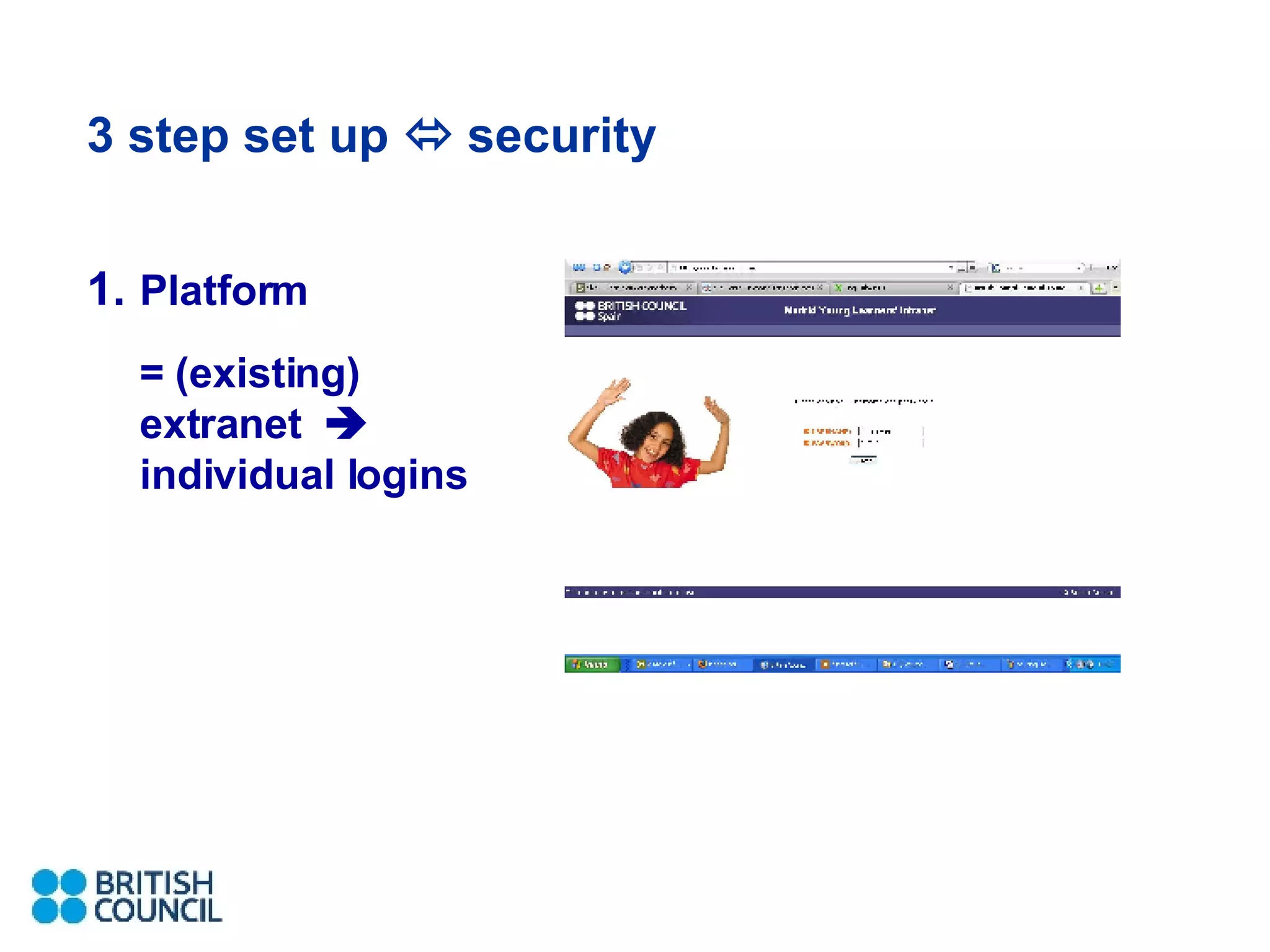
3 step set up    security Platform  = (existing) extranet     individual logins
3 step set up    security 2.  Google Apps   = personal email and document storage     3000 (free) educational licences with individual logins
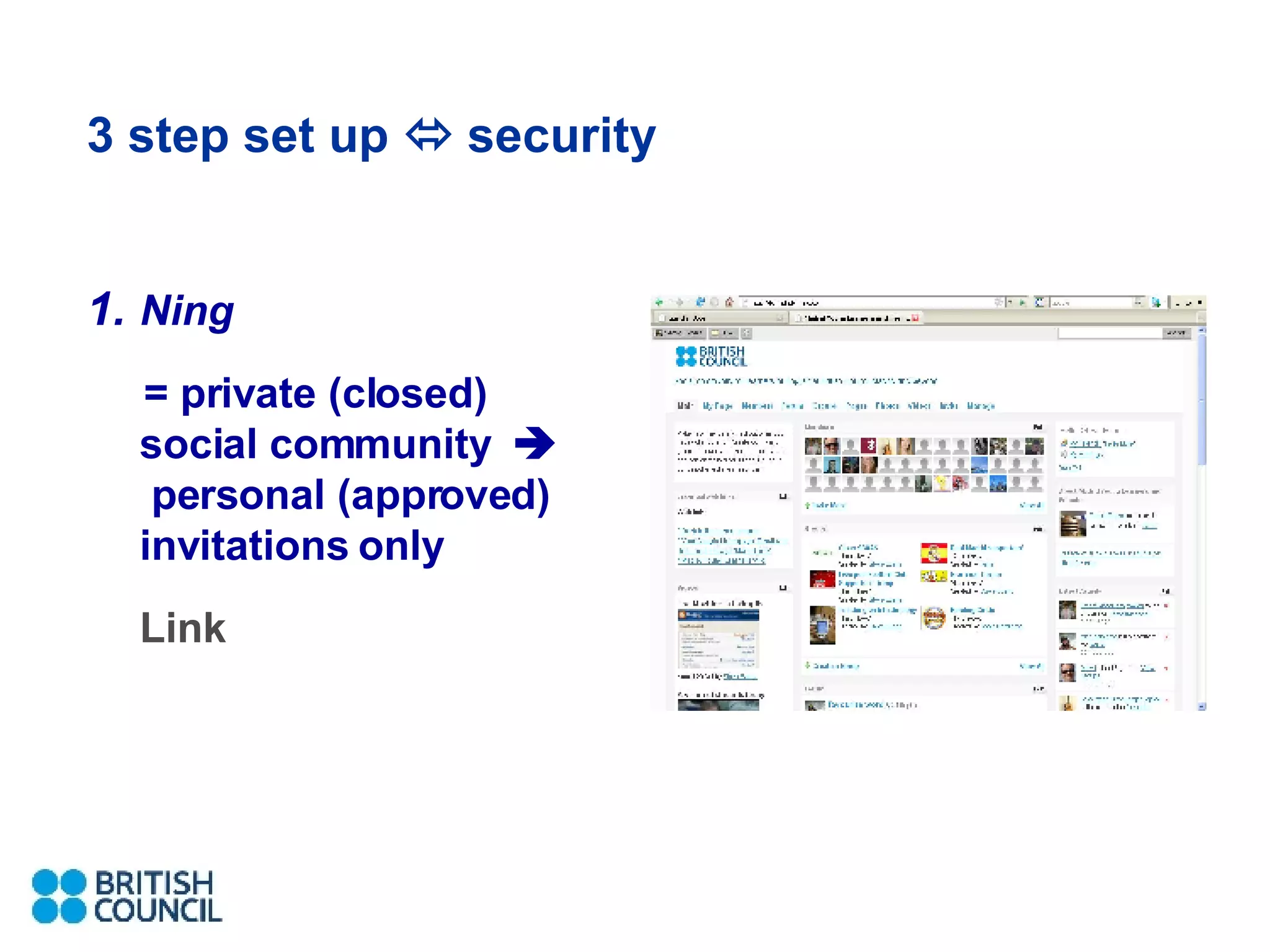
3 step set up    security Ning = private (closed) social community     personal (approved) invitations only Link
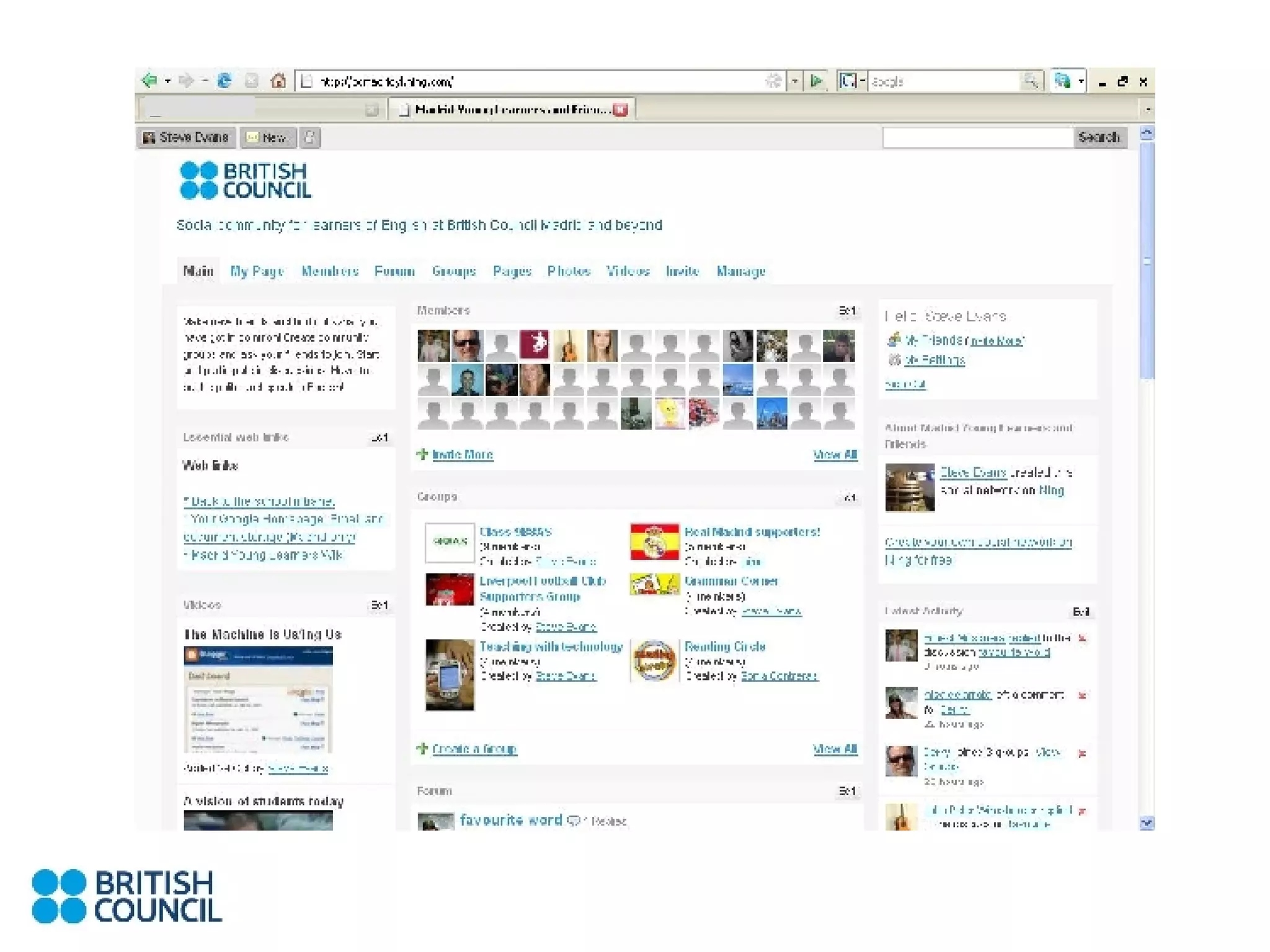
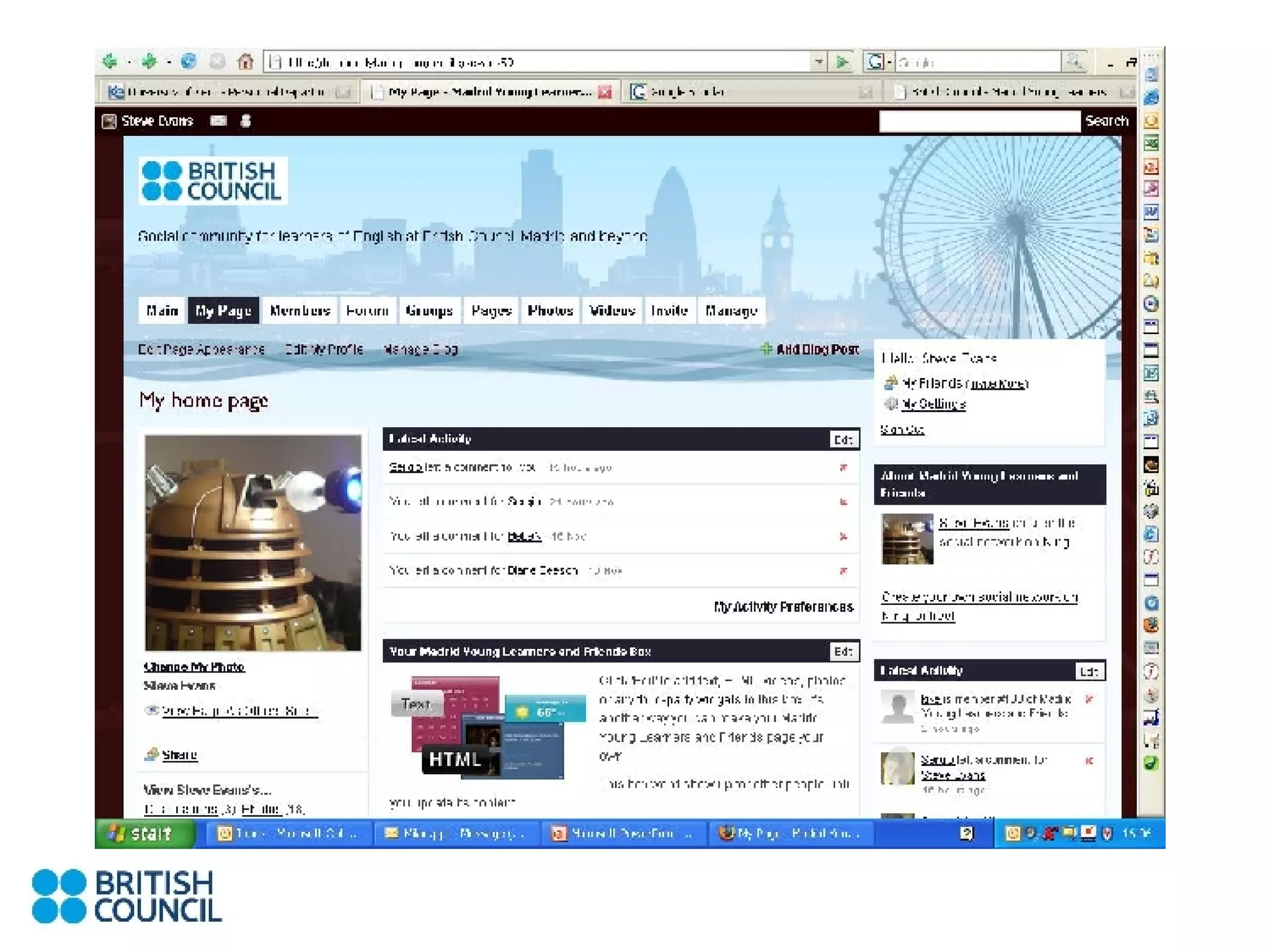
Features of the social community Students’ personal home page and profile Internal email (private) and comments (public) Community groups (public or private) – embedded media / links Discussion forums (public) Blogs (public / shared / private) comments optional Video (embedded / uploaded) comments / discussions  * Photos (linked / uploaded) comments / discussions  * *  Cannot be submitted without approval


The story so far Approaching 200 members – including several from Poland Over 12,000 views 21 activity groups formed (20 by teachers, 1 by a student) Students responding to discussions, embedded media objects Some students taking care over profiles – revisiting and building Minimal inappropriate use – some content rejected (e.g. Spanish used, partisan political, alcohol reference – minimal and of little importance)
What next? Currently approaching 10% of (senior) student body registered – aim to reach around 50 % by end academic year. Workshops and user guide to encourage greater teacher uptake. Publicity and competition prizes to encourage greater student participation Anticipate greater participation from other centres Aim to reach ‘take off’ point to make community self-sustaining
References Anderson, T. (2005)   Distance learning – social software’s killer ap. http://www.unisa.edu.au/odlaaconference/PPDF2s/13%20odlaa%20-%20Anderson.pdf   Shirky, C. (2003)   Social software and the politics of groups http://shirky.com/writings/group_politics.html   Palmberg, R. (2000)   Catering for multiple intelligences in EFL Course books http://www.hltmag.co.uk/jan02/sart6.htm   More at:  http://scholar.google.com/   >  Search for ‘Educational software’

Milan

  • 1.
  • 2.
    Context Highre-enrolment rate Supplants English studied in school Enrolled whole academic year Study English 3 hours per week 4,500 students Ages range from 5 – 18 +
  • 3.
    Learner support Learnerssupported traditionally through f2f counselling Tendency to view as ‘grammar clinics’ for ‘ailing’ students Counselling groups contain variety of needs. Difficult to support large numbers. Parents value, but problems
  • 4.
    Research into learnerprofiles Students on support and levels of motivation – bespoke questionnaire Student ‘multiple intelligence’ profiling – Berman (2002) after Gardner (1983)
  • 5.
    Multiple intelligence scoresSample sizes: Juniors (10 – 12 years) c. 135 responses Seniors (13 – 18 years) c. 300 responses
  • 6.
    Multiple intelligences andEFL course books Palmberg (2000) “ Catering for multiple intelligences in EFL Course books” Found that in typical EFL coursebook: “ 97% of the 300 exercises catered for verbal linguistic learners, 76% for intrapersonal learners , 25% for interpersonal learners, 8% for mathematical logical learners, 5% for bodily-kinesthetic learners, 3% for naturalist learners, and 2% for musical-rhythmic learners.”
  • 7.
    Social/educational software Shirky(2003) “Social Software and the Politics of Groups” Social software ‘supports group communications’. Anderson (2005) “ Distance learning – Social software’s killer ap?” “… a new genre of networked-based learning tools known as educational software…” “… where normal software links people to the inner workings of a computer or network, social software links people to the inner workings of each other’s thoughts, feelings and opinions.”
  • 8.
  • 9.
    3 step setup  security Platform = (existing) extranet  individual logins
  • 10.
    3 step setup  security 2. Google Apps = personal email and document storage  3000 (free) educational licences with individual logins
  • 11.
    3 step setup  security Ning = private (closed) social community  personal (approved) invitations only Link
  • 12.
    Features of thesocial community Students’ personal home page and profile Internal email (private) and comments (public) Community groups (public or private) – embedded media / links Discussion forums (public) Blogs (public / shared / private) comments optional Video (embedded / uploaded) comments / discussions * Photos (linked / uploaded) comments / discussions * * Cannot be submitted without approval
  • 13.
  • 14.
  • 15.
  • 16.
  • 17.
    The story sofar Approaching 200 members – including several from Poland Over 12,000 views 21 activity groups formed (20 by teachers, 1 by a student) Students responding to discussions, embedded media objects Some students taking care over profiles – revisiting and building Minimal inappropriate use – some content rejected (e.g. Spanish used, partisan political, alcohol reference – minimal and of little importance)
  • 18.
    What next? Currentlyapproaching 10% of (senior) student body registered – aim to reach around 50 % by end academic year. Workshops and user guide to encourage greater teacher uptake. Publicity and competition prizes to encourage greater student participation Anticipate greater participation from other centres Aim to reach ‘take off’ point to make community self-sustaining
  • 19.
    References Anderson, T.(2005) Distance learning – social software’s killer ap. http://www.unisa.edu.au/odlaaconference/PPDF2s/13%20odlaa%20-%20Anderson.pdf Shirky, C. (2003) Social software and the politics of groups http://shirky.com/writings/group_politics.html Palmberg, R. (2000) Catering for multiple intelligences in EFL Course books http://www.hltmag.co.uk/jan02/sart6.htm More at: http://scholar.google.com/ > Search for ‘Educational software’