Webquests   Steve Evans What are they and why use them?
Origins In 1995 Prof. Bernie Dodge began developing the WebQuest strategy at San Diego State University to help teachers integrate the power of the Web with student learning.  As a result, criteria were developed for creating WebQuests and there are now many examples available on the Web.
Definition “ A webquest is an inquiry-oriented activity in which some or all of the information that learners interact with comes from resources on the Internet…”  (Dodge, 1997)  “ There are at least two levels of webquest that should be distinguished from one another…”
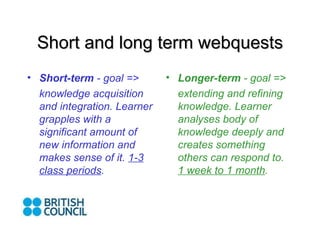
Short and long term webquests Short-term  - goal =>  knowledge acquisition and integration. Learner grapples with a significant amount of new information and makes sense of it.  1-3 class periods . Longer-term  - goal =>  extending and refining knowledge. Learner analyses body of knowledge deeply and creates something others can respond to.  1 week to 1 month .
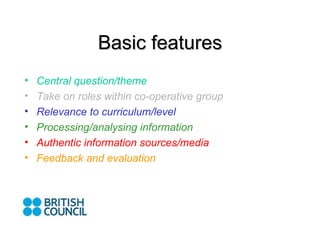
Basic features Central question/theme Take on roles within co-operative group Relevance to curriculum/level Processing/analysing information Authentic information sources/media Feedback and evaluation
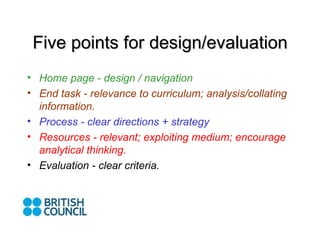
Five points for design/evaluation Home page - design / navigation End task - relevance to curriculum; analysis/collating information. Process - clear directions + strategy Resources - relevant; exploiting medium; encourage analytical thinking. Evaluation - clear criteria.
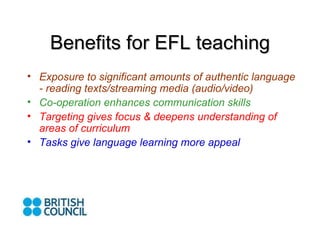
Benefits for EFL teaching Exposure to significant amounts of authentic language - reading texts/streaming media (audio/video) Co-operation enhances communication skills Targeting gives focus & deepens understanding of areas of curriculum Tasks give language learning more appeal
Some examples Primary Upper-intermediate

WebQuests - what are they and do we need them?

  • 1.
    Webquests Steve Evans What are they and why use them?
  • 2.
    Origins In 1995Prof. Bernie Dodge began developing the WebQuest strategy at San Diego State University to help teachers integrate the power of the Web with student learning. As a result, criteria were developed for creating WebQuests and there are now many examples available on the Web.
  • 3.
    Definition “ Awebquest is an inquiry-oriented activity in which some or all of the information that learners interact with comes from resources on the Internet…” (Dodge, 1997) “ There are at least two levels of webquest that should be distinguished from one another…”
  • 4.
    Short and longterm webquests Short-term - goal => knowledge acquisition and integration. Learner grapples with a significant amount of new information and makes sense of it. 1-3 class periods . Longer-term - goal => extending and refining knowledge. Learner analyses body of knowledge deeply and creates something others can respond to. 1 week to 1 month .
  • 5.
    Basic features Centralquestion/theme Take on roles within co-operative group Relevance to curriculum/level Processing/analysing information Authentic information sources/media Feedback and evaluation
  • 6.
    Five points fordesign/evaluation Home page - design / navigation End task - relevance to curriculum; analysis/collating information. Process - clear directions + strategy Resources - relevant; exploiting medium; encourage analytical thinking. Evaluation - clear criteria.
  • 7.
    Benefits for EFLteaching Exposure to significant amounts of authentic language - reading texts/streaming media (audio/video) Co-operation enhances communication skills Targeting gives focus & deepens understanding of areas of curriculum Tasks give language learning more appeal
  • 8.
    Some examples PrimaryUpper-intermediate