Open Educational
Resources and Learning
Spaces

Josie Taylor, Professor of Learning Technology,
   Director, Institute of Educational Technology
                             The Open University
The Open University, UK
• Higher education needs to prepare itself to exist in a
  more open future by embracing openness and the
  implications for change that it entails
• These changes are likely to be profound
• However, we don’t yet fully understand what they are,
  or what the impact on organisations or students is likely
  to be
OpenLearn at The Open University
• 2006 – William and Flora Hewlett foundation provided
  us with funds to investigate sharing educational
  resources and more open approaches
• Our definition of OER:
   “The open provision of educational resources, enabled
     by information and communication technologies, for
     consultation, use and adaptation by a community of
     users for non-commercial purposes.”

                             http://openlearn.open.ac.uk
OpenLearn
• Designed on a model analogous to the open source
  software movement
• >11million unique visitors have used OpenLearn since
  2006
• Gradual build of user base
Studies by OLNet
• Patrick McAndrew and the OLNet team at the OU
• Analysis of user behaviour, targeting those who used
  the site more heavily, supported by follow-up interviews
  and monitoring of activities taking place with the open
  content
• The results from one of these studies (n = 2,011)
  highlighted two distinct clusters of learners: "volunteer"
  students and "social" learners.
Volunteer students
The volunteer students sought the content they wanted to
 learn from, and they expected to work through it. These
 learners were most interested in:
       – more content
       – tools for self-assessment
       – ways to reflect on their individual learning.
Social Learners
The social learners were less motivated to work through
 the content. Rather, they seem to see learning as a
 way to meet people with shared interests. This cluster
 of learners ranked communication tools more highly
 and were more interested in advanced features on the
 website.
What are these learners trying to
do?

• How might they frame those tasks?
• How will they know when they have succeeded? i.e.
  what ‘counts’ as success?
• What will be the quality of the experience?
• How can we best support them?
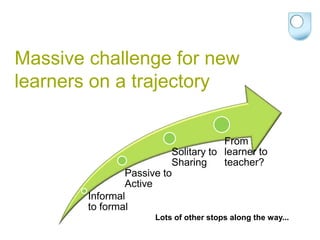
Massive challenge for new
learners on a trajectory

                                      From
                          Solitary to learner to
                          Sharing     teacher?
                Passive to
                Active
        Informal
        to formal
                      Lots of other stops along the way...
What is this process?
• It is not just a process of skill acquisition
• These are profound developmental stages for the
  individual
• There are equally profound issues for the academy –
  what is a university for?
• In a completely open world, who determines what is
  (or should be) of value?
• Who holds the power to say ‘this is worthy’? Will that be
  determined by the employment market?
Digital Literacies
(Mary Lea & Sylvia Jones 2011)
• Learners bring a wealth of experience to bear – some
  appropriate, some not
• Learners are engaged in meaning-making
• Recognition of the central role of texts in construction of
  knowledge and practice of learning
• Potential shifts of power between learners, communities
  and institutions
• Role of the institution is critically important
• Boundaries of ‘texts’ are more fluid and unstable than in
  previous times
Improving our understanding of
student behaviour?
• ‘Rich accounts in the literature of students’ use of
  technology’
• ‘No detailed or in depth examination of what students
  actually do in contexts when using different
  applications, or how meanings are being made from,
  and through, engagement with digital technology’
• ‘Recognition of the central nature of texts both in the
  construction of knowledge and the practice of learning’
                                      Lea and Jones (2011)
Building on 25 years of previous
studies
• Learning programming:
     • Taylor, J., PROLOG project 1983-88
• Learning from multimedia:
     • Laurillard, D., Plowman, L., Taylor, J., Stratfold, M.,
       The MENO project: Multimedia, Education and
       Narrative Organisation (1996 – 2000)
• Mobile Learning:
     • Sharples, M., Taylor, J., McAndrew, P., Vavoula, G.,
       MOBIlearn (2004 – 2008) Mobile Learning
Also building on ...
• Dewey, J. (1916). Democracy and Education.New York: Free Press.
• Vygotsky, L. S. (1978). Mind in society: the development of higher
  psychological processes.Cambridge: Harvard University Press.
• Engeström, Y. (1987). Learning by expanding: An activity-theoretical
  approach to developmental research.Helsinki: Orienta-Konsultit.
• Engeström, Y. (1996). Perspectives on activity theory.Cambridge:
  Cambridge University Press.
• Bruner, J. (1996). The Culture of Education. Harvard University
  Press, Cambridge MA
Summary of studies learning
from digital resources
• Less experienced learners benefit from explicit
  narrative support to assist in process of narrative
  construction, which can be effected through interface
  design
• Leaving (even quite experienced) learners to drive their
  own learning resulted in incomplete coverage of all the
  necessary material
• Need to explicitly support the development of this
  literacy
Support ‘Volunteer’ students
• Structure interfaces to optimise narrative construction
  by learners
• Have experts providing services, offering narrative
  guidance
• Provide some explicit pathways through materials, with
  options to branch and return
• Provide implicit support embedded in the interface that
  influence learners implicitly
Pask: Conversation Theory (1975)
o Conversation is the converse of control.
o Concepts are exchanged in a conversation and often
  some public concept is shared …
o ‘But may just as well lead to enrichment by divergence
  (of our personal concepts) as to convergence...'
  (1987)
o Cybernetic view of conversation: participant might be a
  computer or a person (or anything else)
Sharples, Taylor, McAndrew, Vavoula

• ‘The analysis of learning as a conversational system
  might imply that a teacher has no ontologically privileged
  position, but is simply another participant in a continual
  conversation ...Traditional education needs to be
  explored in relation to the new world of global knowledge
  and mobile technology. It is not sufficient to assert that
  authoritative knowledge is always located in the specialist
  professions and disciplines...’
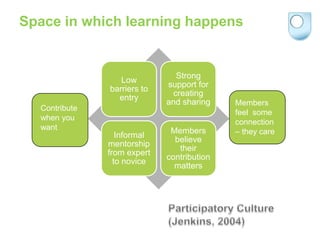
Space in which learning happens


                               Strong
                  Low
                             support for
               barriers to
                              creating
                 entry
                             and sharing    Members
  Contribute
                                            feel some
  when you
                                            connection
  want
                  Informal
                              Members       – they care
                               believe
               mentorship
                                their
               from expert
                             contribution
                 to novice
                               matters
Ecological approach (Jenkins 2004)
• interrelationship among all the different communication
  technologies and
   – the cultural communities that grow up around them
   – the activities they support.

• Interactivity is a property of the technology, while
  participation is a property of culture.
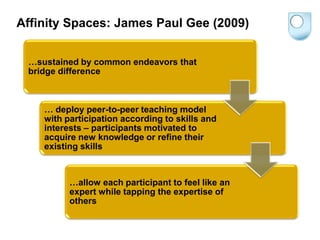
Affinity Spaces: James Paul Gee (2009)


 …sustained by common endeavors that
 bridge difference


    … deploy peer-to-peer teaching model
    with participation according to skills and
    interests – participants motivated to
    acquire new knowledge or refine their
    existing skills


          …allow each participant to feel like an
          expert while tapping the expertise of
          others
Gee’s distinctions
Formal education system             Informal affinity space
• Conservative                      • Experimental
• Static                            • Innovative
• Structures to sustain are         • Structures to sustain are
  institutional                       provisional
• Remain little changed over long   • Can respond to short-term
  periods of time                     needs and temporary interests
• Communities are bureaucratic      • Communities are ad hoc and
  and often national                  localised
• Does not allow for easy           • Allows for easy moves in and
  movement in and out                 out of informal learning
                                      communities
Support Social Learners
• Provide ‘affinity spaces’ for learning
• Ensure it is populated with a rich mix of people (look at
  the ecology of the community to make it sustainable)
• Optimise conversations between peers
• Optimise conversations between learners and experts
• Allow people to come and go easily
TECHNOLOGY/MEDIA


TRUST
          PEDAGOGY


                      IDEAS

          COMMUNITY
SocialLearn

• This work is at the heart of our SocialLearn project, an
  affinity space optimised for learning
• Pilot running from November 10 – Mar 11 with staff in
  the area of professional development (~ 11k staff
  potentially)
Research questions
 – What is required to establish a successful distributed
   community of learners?
 – What is required to ensure sustainability of learning
   communities, and to support their growth?
 – How can the community determine and agree ‘what
   counts’ as learning and how it should be ‘counted’ and
   ‘accounted’ for?
 – How are leaders identified, and supported in these
   communities?
Role of organisation is critical
• Establish control where needed (i.e. to maintain quality)
• Release control where it is not (i.e. restricting learners’
  choices and activities)
• What is the role of the academy, and how is it
  supported by the organisation?
     • Are we ‘just’ selling courses?
     • Are we developing capacity in the knowledge
       economy?
     • Are we developing capacity in our organisation?
     • Are we ethics-led or market-led? Can you be both?

Open Educational Resources and Learning Spaces

  • 1.
    Open Educational Resources andLearning Spaces Josie Taylor, Professor of Learning Technology, Director, Institute of Educational Technology The Open University
  • 2.
    The Open University,UK • Higher education needs to prepare itself to exist in a more open future by embracing openness and the implications for change that it entails • These changes are likely to be profound • However, we don’t yet fully understand what they are, or what the impact on organisations or students is likely to be
  • 3.
    OpenLearn at TheOpen University • 2006 – William and Flora Hewlett foundation provided us with funds to investigate sharing educational resources and more open approaches • Our definition of OER: “The open provision of educational resources, enabled by information and communication technologies, for consultation, use and adaptation by a community of users for non-commercial purposes.” http://openlearn.open.ac.uk
  • 4.
    OpenLearn • Designed ona model analogous to the open source software movement • >11million unique visitors have used OpenLearn since 2006 • Gradual build of user base
  • 5.
    Studies by OLNet •Patrick McAndrew and the OLNet team at the OU • Analysis of user behaviour, targeting those who used the site more heavily, supported by follow-up interviews and monitoring of activities taking place with the open content • The results from one of these studies (n = 2,011) highlighted two distinct clusters of learners: "volunteer" students and "social" learners.
  • 6.
    Volunteer students The volunteerstudents sought the content they wanted to learn from, and they expected to work through it. These learners were most interested in: – more content – tools for self-assessment – ways to reflect on their individual learning.
  • 7.
    Social Learners The sociallearners were less motivated to work through the content. Rather, they seem to see learning as a way to meet people with shared interests. This cluster of learners ranked communication tools more highly and were more interested in advanced features on the website.
  • 8.
    What are theselearners trying to do? • How might they frame those tasks? • How will they know when they have succeeded? i.e. what ‘counts’ as success? • What will be the quality of the experience? • How can we best support them?
  • 9.
    Massive challenge fornew learners on a trajectory From Solitary to learner to Sharing teacher? Passive to Active Informal to formal Lots of other stops along the way...
  • 10.
    What is thisprocess? • It is not just a process of skill acquisition • These are profound developmental stages for the individual • There are equally profound issues for the academy – what is a university for? • In a completely open world, who determines what is (or should be) of value? • Who holds the power to say ‘this is worthy’? Will that be determined by the employment market?
  • 11.
    Digital Literacies (Mary Lea& Sylvia Jones 2011) • Learners bring a wealth of experience to bear – some appropriate, some not • Learners are engaged in meaning-making • Recognition of the central role of texts in construction of knowledge and practice of learning • Potential shifts of power between learners, communities and institutions • Role of the institution is critically important • Boundaries of ‘texts’ are more fluid and unstable than in previous times
  • 12.
    Improving our understandingof student behaviour? • ‘Rich accounts in the literature of students’ use of technology’ • ‘No detailed or in depth examination of what students actually do in contexts when using different applications, or how meanings are being made from, and through, engagement with digital technology’ • ‘Recognition of the central nature of texts both in the construction of knowledge and the practice of learning’ Lea and Jones (2011)
  • 13.
    Building on 25years of previous studies • Learning programming: • Taylor, J., PROLOG project 1983-88 • Learning from multimedia: • Laurillard, D., Plowman, L., Taylor, J., Stratfold, M., The MENO project: Multimedia, Education and Narrative Organisation (1996 – 2000) • Mobile Learning: • Sharples, M., Taylor, J., McAndrew, P., Vavoula, G., MOBIlearn (2004 – 2008) Mobile Learning
  • 14.
    Also building on... • Dewey, J. (1916). Democracy and Education.New York: Free Press. • Vygotsky, L. S. (1978). Mind in society: the development of higher psychological processes.Cambridge: Harvard University Press. • Engeström, Y. (1987). Learning by expanding: An activity-theoretical approach to developmental research.Helsinki: Orienta-Konsultit. • Engeström, Y. (1996). Perspectives on activity theory.Cambridge: Cambridge University Press. • Bruner, J. (1996). The Culture of Education. Harvard University Press, Cambridge MA
  • 15.
    Summary of studieslearning from digital resources • Less experienced learners benefit from explicit narrative support to assist in process of narrative construction, which can be effected through interface design • Leaving (even quite experienced) learners to drive their own learning resulted in incomplete coverage of all the necessary material • Need to explicitly support the development of this literacy
  • 16.
    Support ‘Volunteer’ students •Structure interfaces to optimise narrative construction by learners • Have experts providing services, offering narrative guidance • Provide some explicit pathways through materials, with options to branch and return • Provide implicit support embedded in the interface that influence learners implicitly
  • 17.
    Pask: Conversation Theory(1975) o Conversation is the converse of control. o Concepts are exchanged in a conversation and often some public concept is shared … o ‘But may just as well lead to enrichment by divergence (of our personal concepts) as to convergence...' (1987) o Cybernetic view of conversation: participant might be a computer or a person (or anything else)
  • 18.
    Sharples, Taylor, McAndrew,Vavoula • ‘The analysis of learning as a conversational system might imply that a teacher has no ontologically privileged position, but is simply another participant in a continual conversation ...Traditional education needs to be explored in relation to the new world of global knowledge and mobile technology. It is not sufficient to assert that authoritative knowledge is always located in the specialist professions and disciplines...’
  • 19.
    Space in whichlearning happens Strong Low support for barriers to creating entry and sharing Members Contribute feel some when you connection want Informal Members – they care believe mentorship their from expert contribution to novice matters
  • 20.
    Ecological approach (Jenkins2004) • interrelationship among all the different communication technologies and – the cultural communities that grow up around them – the activities they support. • Interactivity is a property of the technology, while participation is a property of culture.
  • 21.
    Affinity Spaces: JamesPaul Gee (2009) …sustained by common endeavors that bridge difference … deploy peer-to-peer teaching model with participation according to skills and interests – participants motivated to acquire new knowledge or refine their existing skills …allow each participant to feel like an expert while tapping the expertise of others
  • 22.
    Gee’s distinctions Formal educationsystem Informal affinity space • Conservative • Experimental • Static • Innovative • Structures to sustain are • Structures to sustain are institutional provisional • Remain little changed over long • Can respond to short-term periods of time needs and temporary interests • Communities are bureaucratic • Communities are ad hoc and and often national localised • Does not allow for easy • Allows for easy moves in and movement in and out out of informal learning communities
  • 23.
    Support Social Learners •Provide ‘affinity spaces’ for learning • Ensure it is populated with a rich mix of people (look at the ecology of the community to make it sustainable) • Optimise conversations between peers • Optimise conversations between learners and experts • Allow people to come and go easily
  • 24.
    TECHNOLOGY/MEDIA TRUST PEDAGOGY IDEAS COMMUNITY
  • 25.
    SocialLearn • This workis at the heart of our SocialLearn project, an affinity space optimised for learning • Pilot running from November 10 – Mar 11 with staff in the area of professional development (~ 11k staff potentially)
  • 26.
    Research questions –What is required to establish a successful distributed community of learners? – What is required to ensure sustainability of learning communities, and to support their growth? – How can the community determine and agree ‘what counts’ as learning and how it should be ‘counted’ and ‘accounted’ for? – How are leaders identified, and supported in these communities?
  • 27.
    Role of organisationis critical • Establish control where needed (i.e. to maintain quality) • Release control where it is not (i.e. restricting learners’ choices and activities) • What is the role of the academy, and how is it supported by the organisation? • Are we ‘just’ selling courses? • Are we developing capacity in the knowledge economy? • Are we developing capacity in our organisation? • Are we ethics-led or market-led? Can you be both?

Editor's Notes

  • #10 From informal to formal learning – or not!From passive consumption to active participationFrom taking what you’re given to personalising, editing, modifying and creatingFrom closed to open learningFrom solitary working to sharingFrom being a learner to being a teacher
  • #21 This work is very helpful – we have already taken the ecological approach to media use – we have been looking at the cultural communities that grow around them, and observing the activities they support. We have done this extensively for OpenLearn, we are doing it now for ITunesU and UTube
  • #25 We are committed to understanding and exploring the relations between people, technology/media and learning. But we are also interested in the emergent second order concepts – we are looking at communities that cohere around different platforms/mediaQuality community depends on trust – trust is particularly important in distance educationAnd trust supports open sharing which is also very importantThe confidence to participate depends on all this