Pisces: Locomotion and Migration
Locomotion in Fishes
Locomotion of fishes means movement of
fishes for their survival .
It provides a number of interesting
information to the Ichthyologists.
The knowledge of the different methods of
locomotion is yet not fully understood because
fishes in aquaria or somewhere else other than
their natural inhabitation tend to behave in a
manner somewhat different from the normal.
There are three primary methods employed by
fishes to produce forward movement in
aquatic environment:
 Body movement due to alternate expansion
and contraction of the myomeres (myosomes).
Movement of the appendages (fins) and
Movements caused by the action of jets of water
expelled from the gill openings during the process
of respiration.
Types of Locomotion in Fishes
Locomotion in fishes has been
classified into three types:
 Anguilliform or eel like.
 Ostraciform or trunk-fish like.
Carangiform or jack-like.
Anguilliform type of locomotion is serpentine
or purely undulatory in nature and is found in
eels. It is brought about by sequential,
alternate contraction of the myotomes on each
side of the body. In this most of the body
participates
Anguilliform
Ostraciform
It is a wig-wag motion, seen especially in
the sculling action of the tail and found in
trunkfishes. It is induced by simple
alternate contraction of all the muscle
segments on one side of the body and then
on the other. The alternating contractions
cause the tail to switch back and forth like a
paddle behind the relatively rigid trunk of
the fish. The body moves in a series of short
cross arcs in the water as the fish progresses
forward. We can say simply that it is due to
 Oscillation of caudal fin
 Assisted with pectoral fins
intermediate type between Ist
Herrings, Sardines). In this
Posterior body flexes
and IInd types (e.g.
Carangiform
Carangiform is the most common type of locomotion.
In this type, the fish drives itself forward by side-by-
side sweeps of the tail region. It is actually an
Anterior ½ or 2/3 body inflexible
Migration of Fishes
Migration means movement for specific purpose
and specific period of time.
Few species travel long distance moving from
place to place in search or food or for breeding . This
movement of a large number of fishes for the
purpose of feeding or spawning is known as
Migration.
Migration behaviour is of course one of the
phenomena in the life histories of the fish directed
toward reproductive success
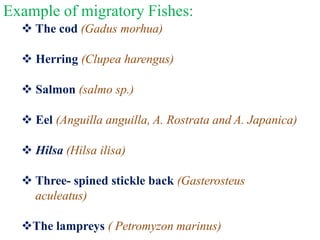
Example of migratory Fishes:
 The cod (Gadus morhua)
 Herring (Clupea harengus)
 Salmon (salmo sp.)
 Eel (Anguilla anguilla, A. Rostrata and A. Japanica)
 Hilsa (Hilsa ilisa)
 Three- spined stickle back (Gasterosteus
aculeatus)
The lampreys ( Petromyzon marinus)
PURPOSE OF MIGRATION
Migration may be for the following reasons
ALIMENTORY MIGRATION: This is in
search of food and water.
GAMETIC MIGRATION: For reproduction.
CLIMATIC MIGRATION: To secure
more suitable climatic conditions.
OSMOREGULATORY MIGRATION.
To maintain physiological activity of body.
FORMS OF MIGRATION:
The pattern of migration differs between species, as well as
within a species , Myers (1949) has used the following
terms to describe fish migration
1. DIADROMOUS FISHES
 Anadromous (salmon and hilsa)
 Catadromous ( anguilla)
Amphidromous
2. POTAMODROMOUS FISHES
3. OCEANODROMOUS FISHES
1. DIADROMOUS (Dia: through, Dromous: running)
FISHES: Truly migratory fishes which migrate between the sea
and fresh water and are three types:
A. Anadromous (Ana: Up):
 Diadromous fishes which spend a major part of there lifes
in the sea but migrate to fresh water during breeding
period for spawning (Process of laying eggs).
Thus, many marine fishes like the Salmon shad Lampray and
Hilsa, travel long distances in te sea and run up the river to
spawn in fresh water .
Salmon and Hilsa have been found to travel several thousand
km in the sea, then several hundred km in land to reach the
spawning ground , after egg laying , the spend fishes return to
feeding places in the sea.
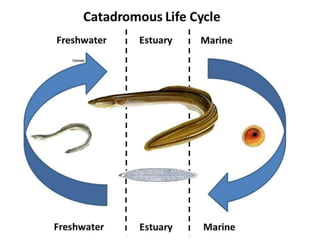
B. Catadromous (Kata; Down):
This group including didromous fishes which spend a major of
their lives in fresh water but migrate to the sea for breeding
purpose.
Thus the fresh, water eel Anguilla travels several thousand km
starting from the rivers and reaching the spawning grounds in the
sea.
After egg laying, the river die and the young larvae drift and
swim back towards the fresh water , taking three years in
reaching the rivers.
Here ,they become adult , and on reaching maturity start
their seaward migration again.
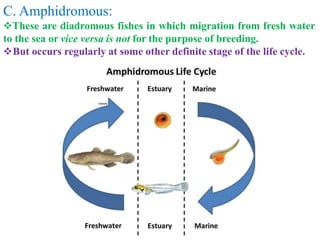
C. Amphidromous:
These are diadromous fishes in which migration from fresh water
to the sea or vice versa is not for the purpose of breeding.
But occurs regularly at some other definite stage of the life cycle.
2. POTAMODROMOUS FISHES:
Truly migratory fishes whose migration remain confined to fresh
water , e.g. the carps and the trout travels long distance in large rivers
in search of spawning grounds.
After egg laying at suitable places they return to the feeding area.
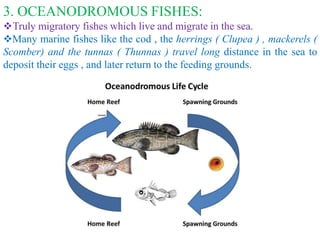
3. OCEANODROMOUS FISHES:
Truly migratory fishes which live and migrate in the sea.
Many marine fishes like the cod , the herrings ( Clupea ) , mackerels (
Scomber) and the tunnas ( Thunnas ) travel long distance in the sea to
deposit their eggs , and later return to the feeding grounds.
Influencing Factors Of Migration:
Migration are influenced by several
be physical, chemical and biological.
Physical:
factors which may
 Bottom materials
Depth of water
 temperature
 light intensity
Photoperiod
Current turbidity
Chemical
 salinity
 pH
 Smell and taste of water.
Biological :
Migration are the sexual maturity
 Blood pressure
Food
Memory
Physiological clock
The endocrine glands
Presence or absence of the predators and competitors
may also be considered as the biological factors governing
migration of fishes.
REASON OF MIGRATION-:
1) To optimize feeding
2) To avoid unfavorable condition,
3) To enhance reproductive success , and
4) Possibly to promote colonization.
the strategy of fish is to exploit rich food source,
to enhance food intake which is necessary for
increased growth rate , fecundity and survival.
ADVANTAGES:
Migration is an adaptation towards abundance.
It would be an advantage to have separate
spawning , nursery and feeding grounds.
A species whose adults return to spawn in an
area where
similar to
the environmental condition were
those under which they themselves
survived when
young.
Thus a better egg and larvae survival would lead
to a greater number of spawners on a particular
ground.
References:
1. http://www.fishfarmingtechniques.com/fishes/locomotion/locomotion-in-fishes-general-
principles-types-and-modes-fisheries/13452
2. https://slideplayer.com/slide/13435965/
3. https://www.slideshare.net/BalwantSingh16/migration-of-fishes
4. https://www.slideshare.net/40024/fish-migration-and-fish-passes-62529744