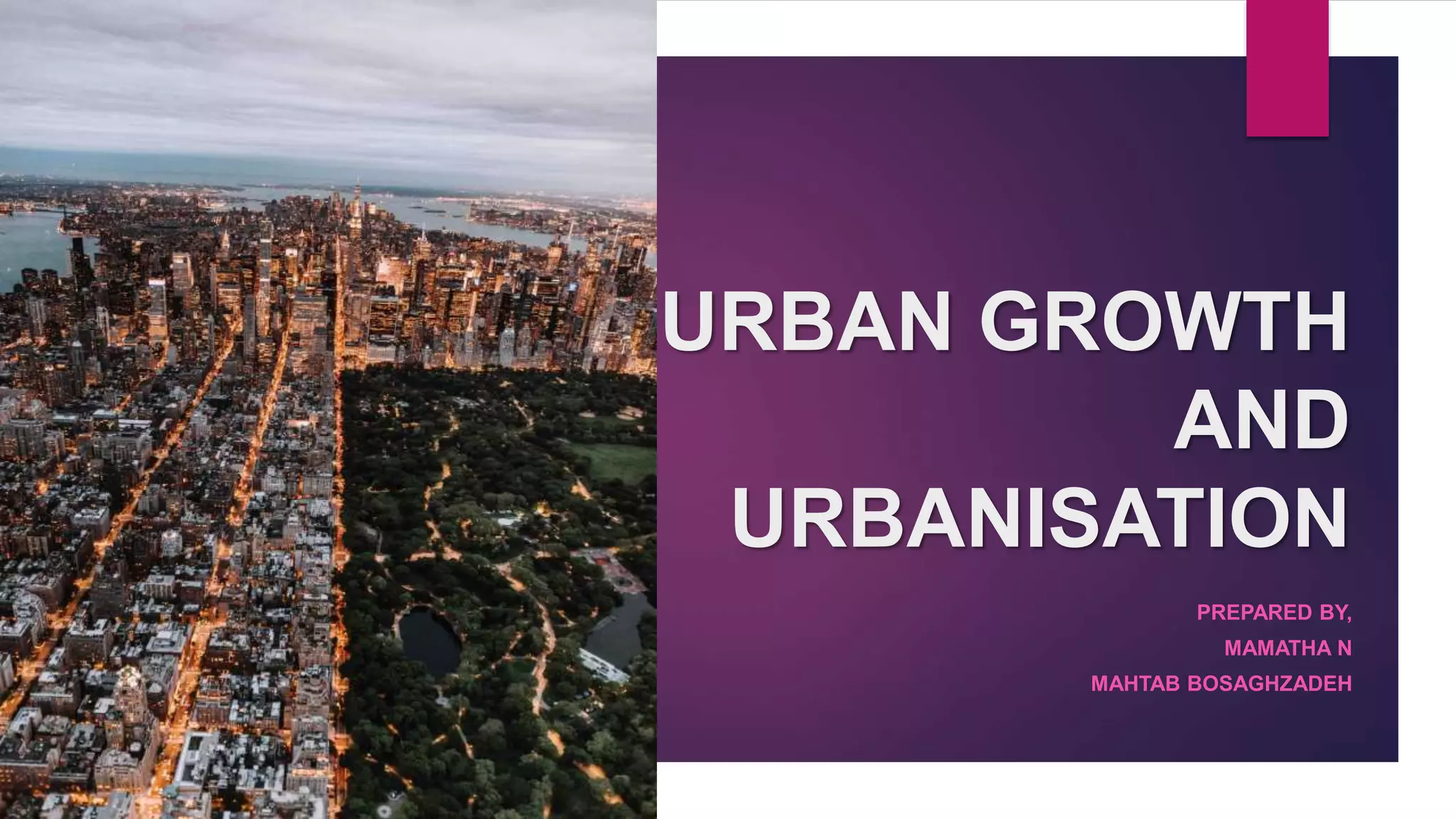
URBAN GROWTH
AND
URBANISATION
PREPARED BY,
MAMATHA N
MAHTAB BOSAGHZADEH
CONTENTS
 Definition of Urban Growth and Urbanization
 Causes of Urban Growth and Urbanization
 Urbanization in India
 Classification of Urban Centers
 Benefits of Urbanization
 Effects of Urbanization
 Facts about Urbanization in India
 Conclusion
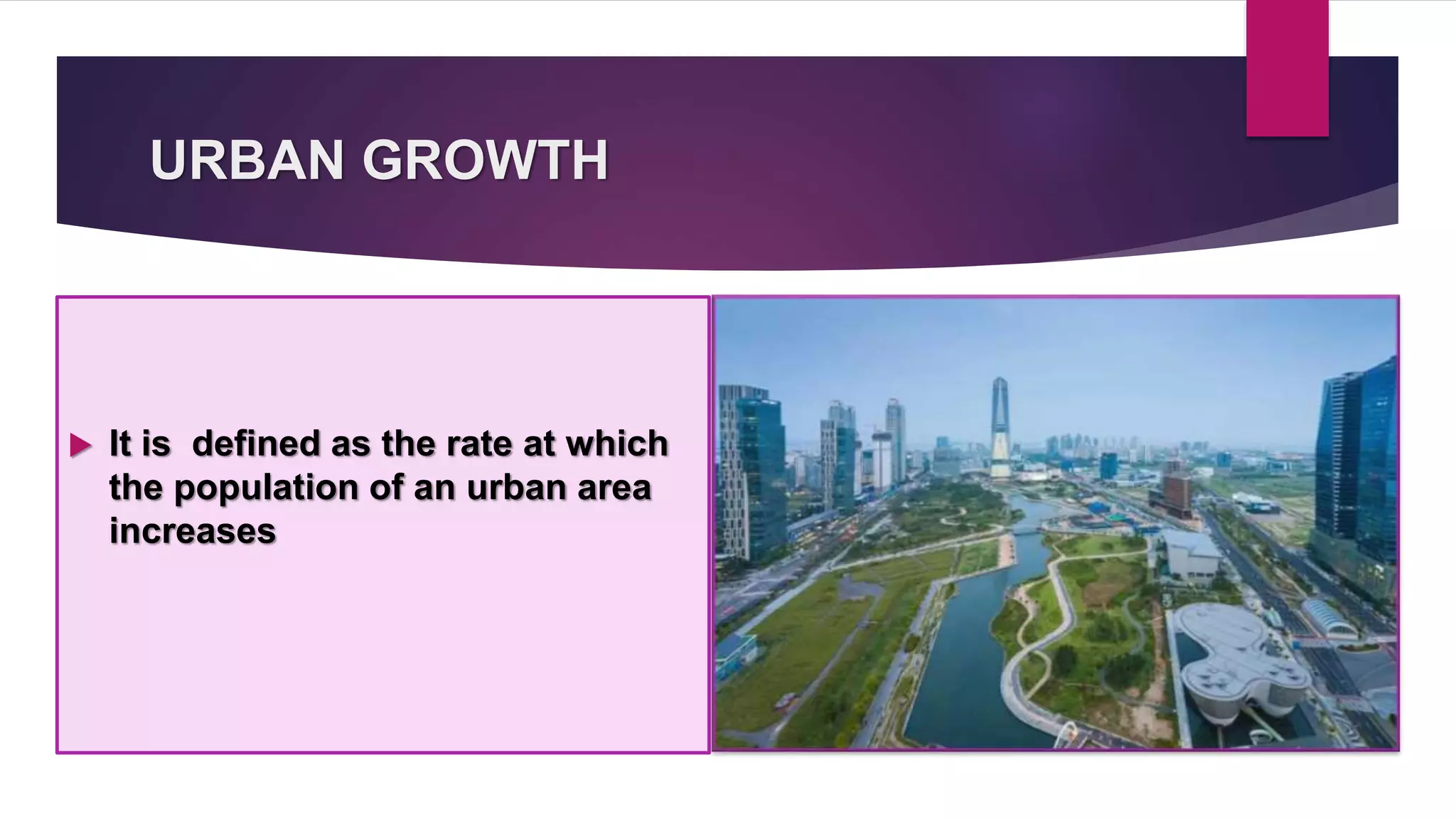
URBAN GROWTH
 It is defined as the rate at which
the population of an urban area
increases
URBANISATION
 Urbanization is the process by
which there is an increase in the
proportion of people living in
urban area.
CAUSES OF URBAN GROWTH AND
URBANZATION
INDUSTRILIZATION
EMPLOYMENT OPPURTUNITIES
COMMERCIALIZATION
SOCIAL BENEFITS AND SERVICES
MODERISATION AND CHANGES IN THE MODE OF
LIVING
RURAL URBAN TRANSFORMATION
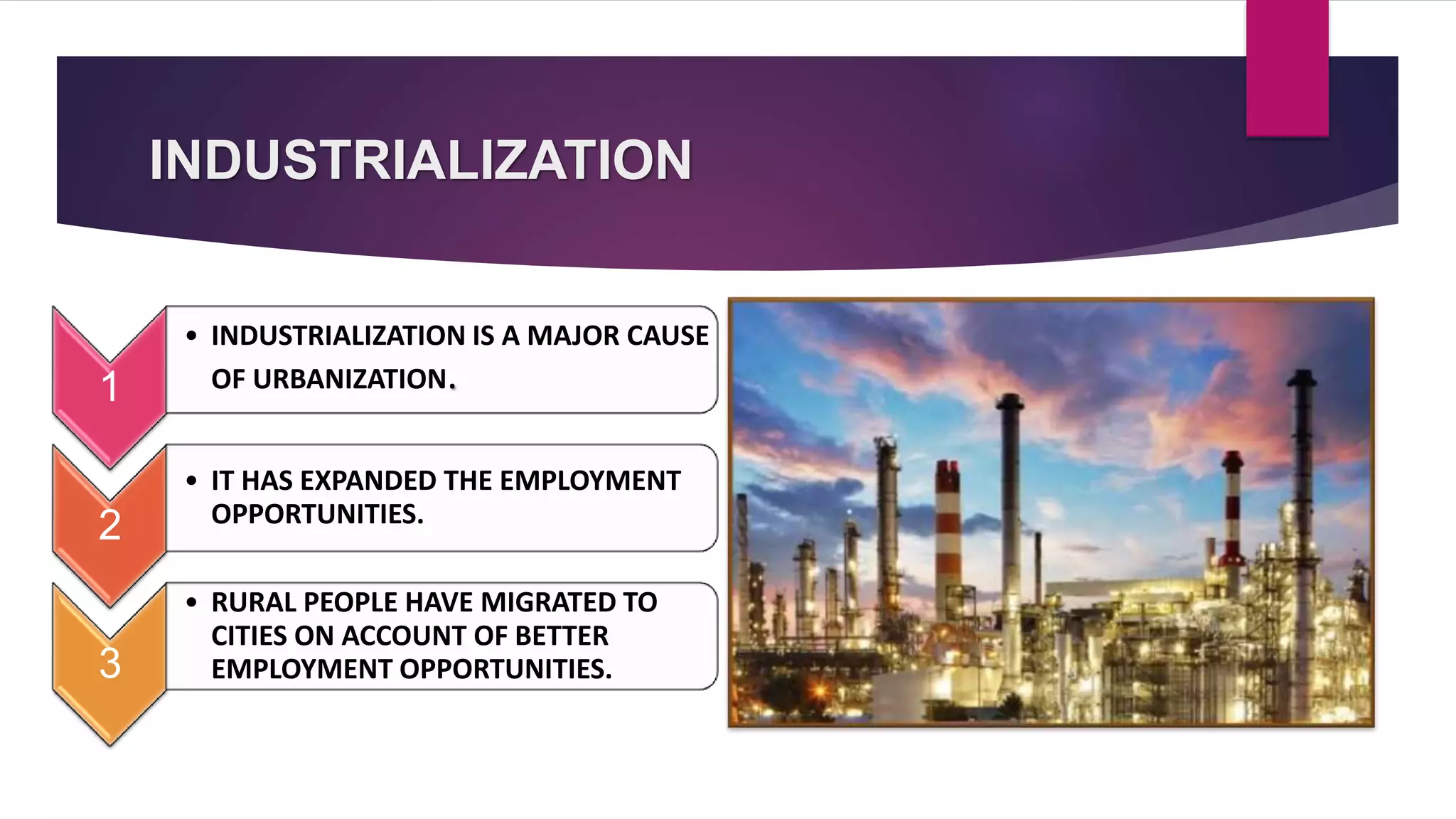
INDUSTRIALIZATION
1
• INDUSTRIALIZATION IS A MAJOR CAUSE
OF URBANIZATION.
2
• IT HAS EXPANDED THE EMPLOYMENT
OPPORTUNITIES.
3
• RURAL PEOPLE HAVE MIGRATED TO
CITIES ON ACCOUNT OF BETTER
EMPLOYMENT OPPORTUNITIES.
EMPLOYMENT OPPURTUNITIES
IN RURAL SECTOR PEOPLE HAVE TO
DEPEND MAINLY ON AGRICULTURE FOR
THEIR LIVELIHOOD.
URBANIZATION INFLUENCES THE
PEOPLE FROM RURAL TO URBAN
AREAS
IT IS A NATURAL CONSEQUENCE OF
ECONOMIC CHANGE THAT TAKES
PLACE
SOCIAL FACTORS
MANY SOCIAL FACTORS SUCH AS
 ATTRACTION OF CITIES
 BETTER STANDARD OF LIVING
 BETTER EDUCATIONAL
FACILITIES
 NEED FOR STATUS
ALSO INDUCE PEOPLE TO
MIGRATE TO CITIES.
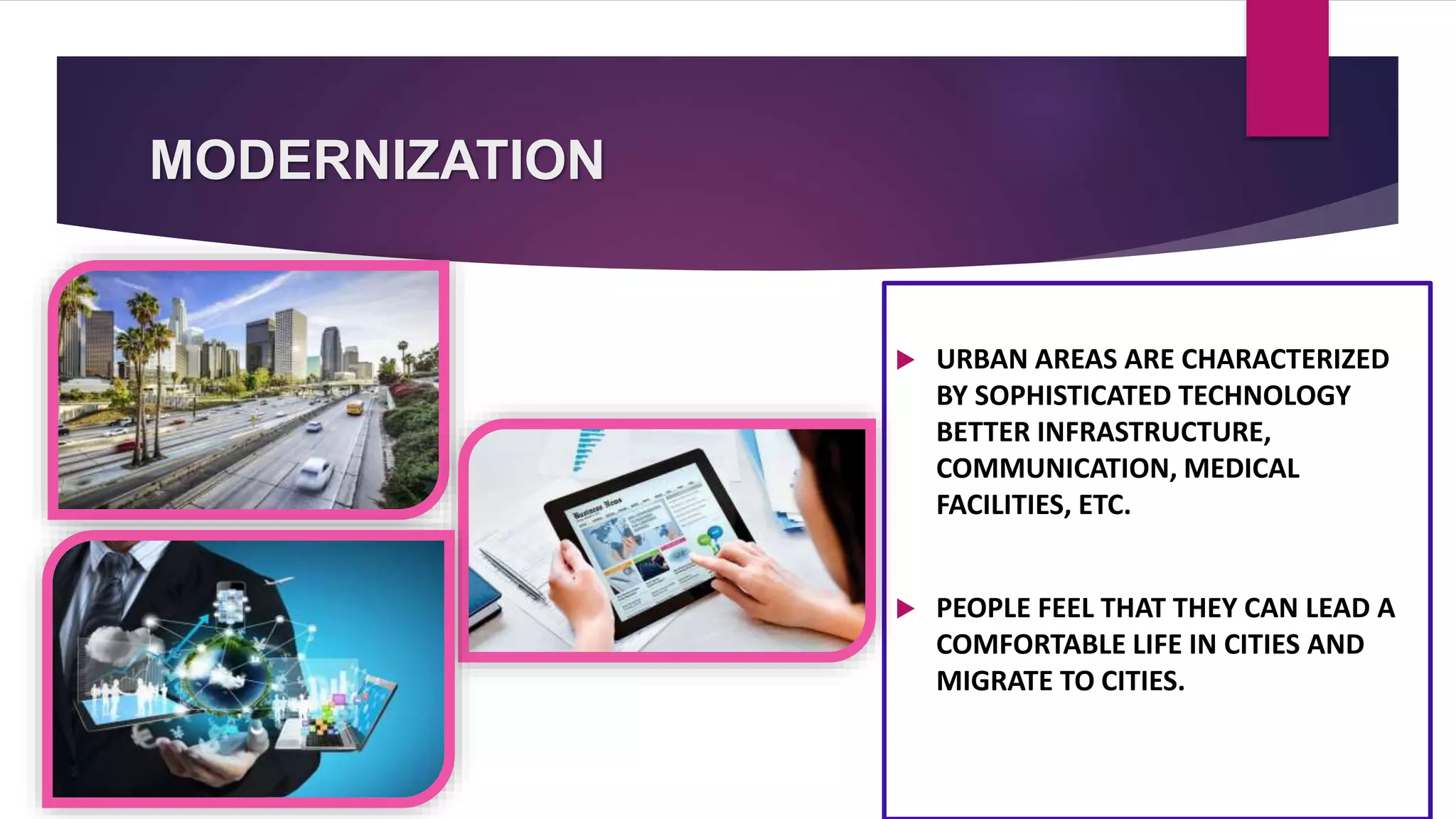
MODERNIZATION
 URBAN AREAS ARE CHARACTERIZED
BY SOPHISTICATED TECHNOLOGY
BETTER INFRASTRUCTURE,
COMMUNICATION, MEDICAL
FACILITIES, ETC.
 PEOPLE FEEL THAT THEY CAN LEAD A
COMFORTABLE LIFE IN CITIES AND
MIGRATE TO CITIES.
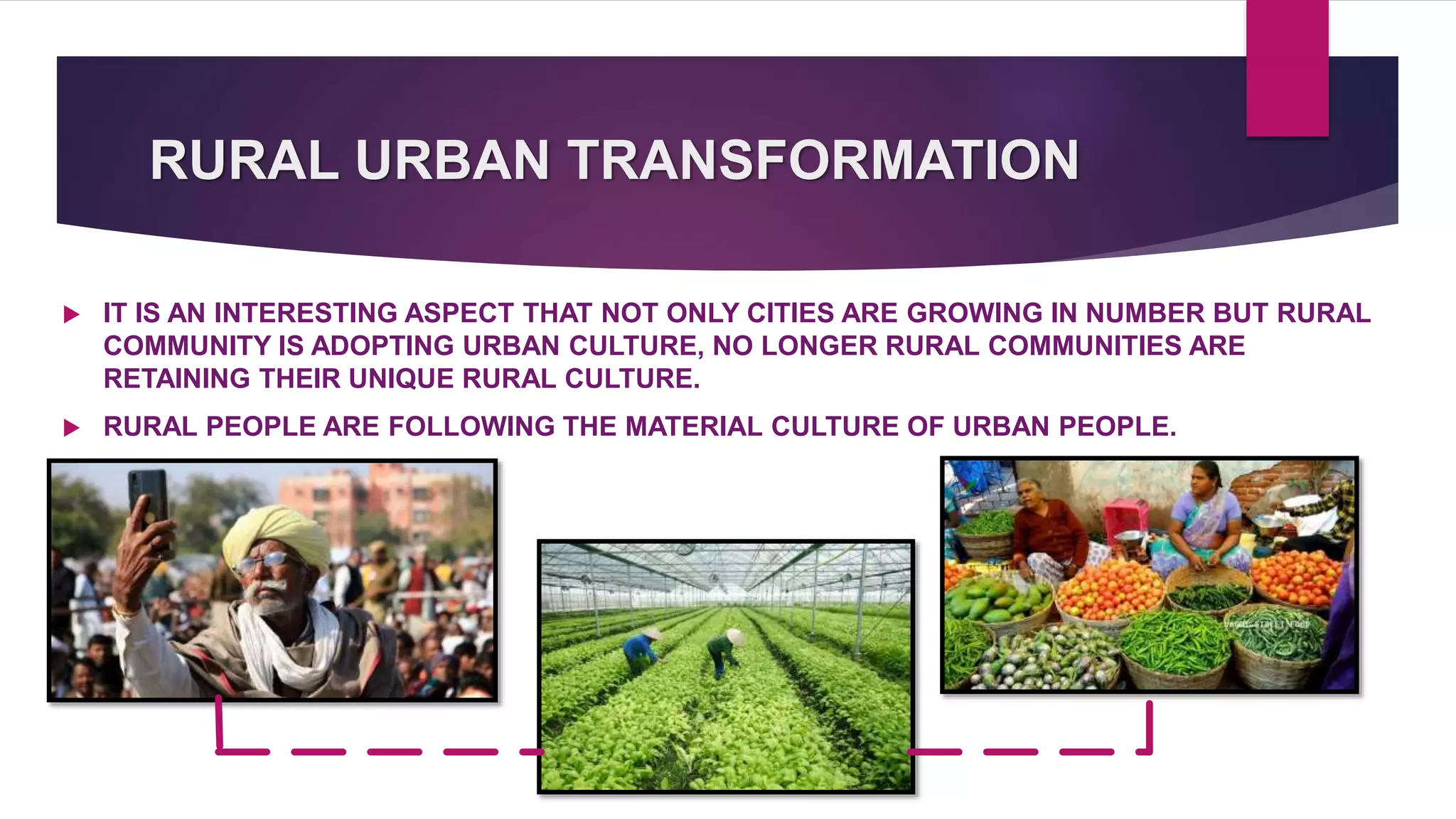
RURAL URBAN TRANSFORMATION
 IT IS AN INTERESTING ASPECT THAT NOT ONLY CITIES ARE GROWING IN NUMBER BUT RURAL
COMMUNITY IS ADOPTING URBAN CULTURE, NO LONGER RURAL COMMUNITIES ARE
RETAINING THEIR UNIQUE RURAL CULTURE.
 RURAL PEOPLE ARE FOLLOWING THE MATERIAL CULTURE OF URBAN PEOPLE.
URBANIZATION
IN INDIA
INTRODUCTION:
India is one of the fastest growing economy in the
world next to China.
India is poised to become the fifth-largest economy,
overtaking the United Kingdom by 2019 as per the IMF
projection. The country ranks third when GDP is
compared in terms of purchasing power parity at $10.51
trillion.
India was the 19th-largest in merchandise and 6th
largest services exporter in the world in 2013.
GDP (sector wise)
1. SERVICE SECTOR – 53.66%
2. INDUSTRY – 23.34%
3. AGRICULTURE – 23%
(As per
https://en.wikipedia.org/wiki/economy_of_india )
URBANIZATION IN INDIA
 URBANIZATION IS TAKING PLACE AT A FASTER RATE IN INDIA.
 Urbanization in India was mainly started after independence, due to adoption of mixed
economy by the country which gave rise to the development of private sector.
Year of Census Population
Percentage
1901 11.4
2001 28.53
2011 31.16
Total population percentage in urban areas
Rate of urbanization: 2.4% (2010-15 est.)
Source: censes 2011( Govt. of India)
Total population percentage in Rural - urban areas
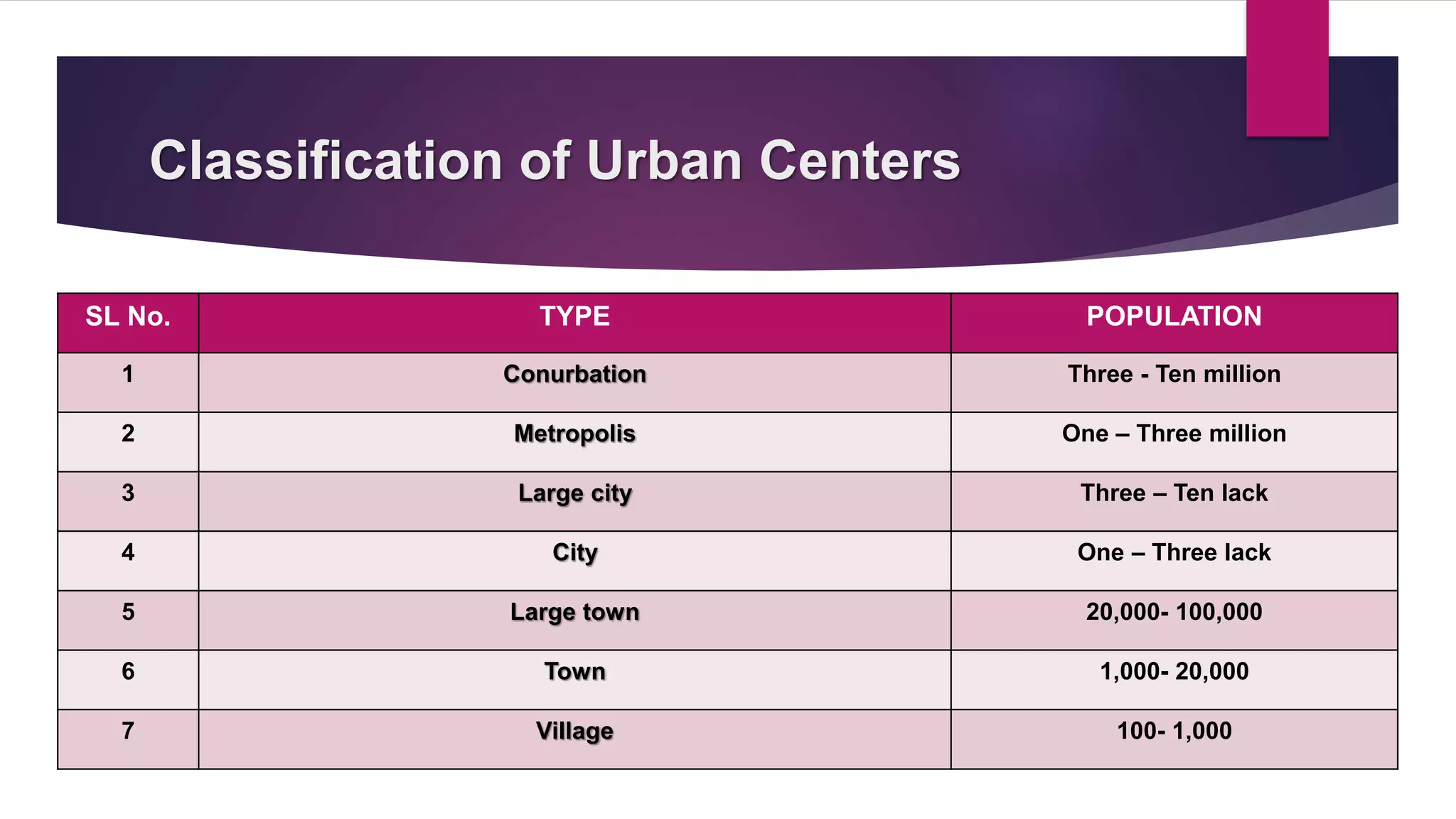
Classification of Urban Centers
SL No. TYPE POPULATION
1 Conurbation Three - Ten million
2 Metropolis One – Three million
3 Large city Three – Ten lack
4 City One – Three lack
5 Large town 20,000- 100,000
6 Town 1,000- 20,000
7 Village 100- 1,000
 Improvement in economy
 Growth of commercial activities
 Social & cultural integration
 Efficient services
 Resources of utilization
BENEFITS OF URBANISATION
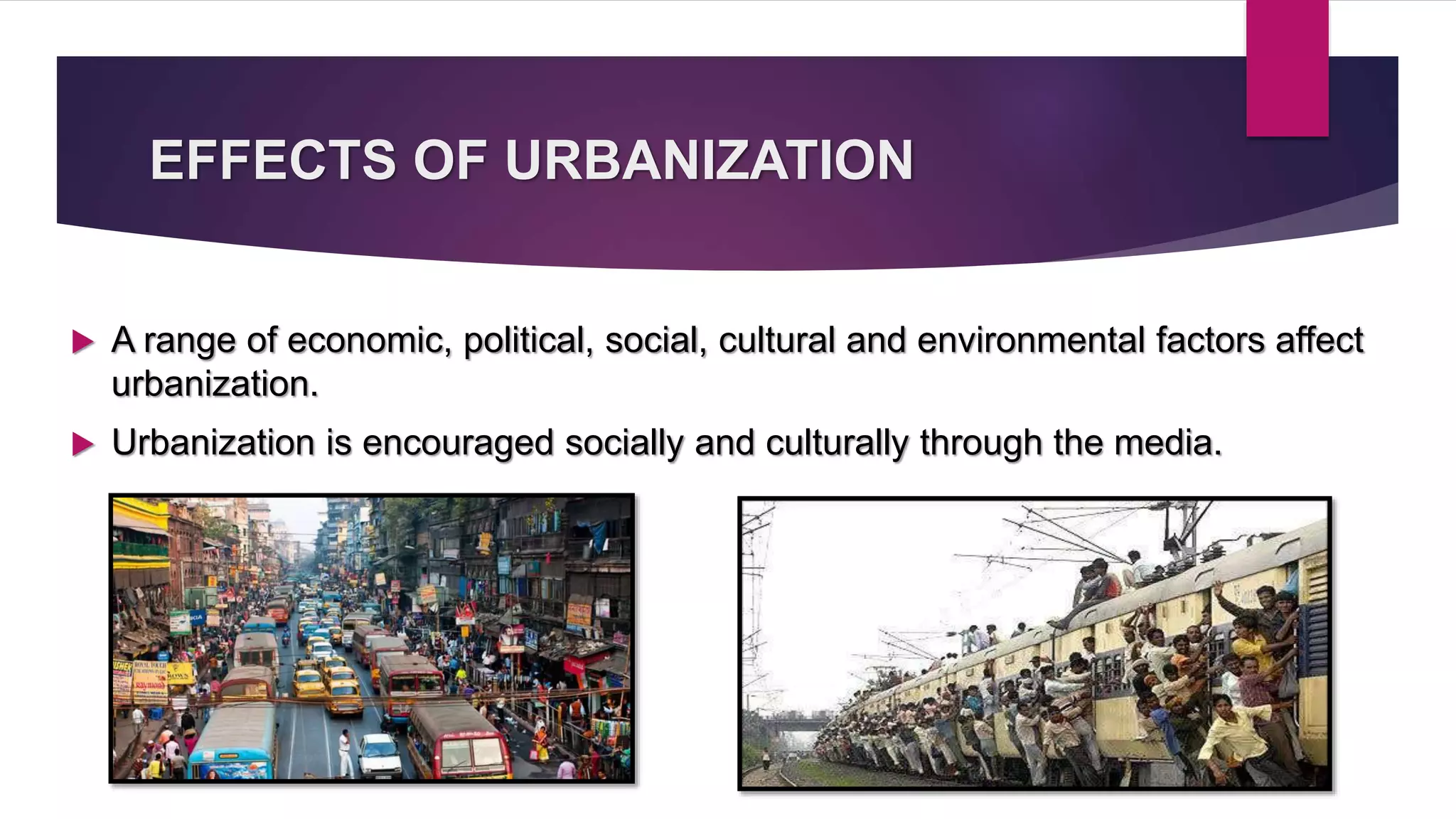
EFFECTS OF URBANIZATION
 A range of economic, political, social, cultural and environmental factors affect
urbanization.
 Urbanization is encouraged socially and culturally through the media.
SOCIO-CULTURAL IMPACTS
 Cities have a strong socio-cultural impacts on their
surrounding rural areas.
 The mass media depicts city life as superior to rural
life, the “STANDARD” language is deemed that of
the national capital, and better services are received
in the city due to its wealth.
 The fertility rate in cities is often lower than in rural
areas due to the absence of agriculture, the cost of
children, food and living space in cities, and family
planning.
 As a city grows, the cost of housing and infrastructure also grows, since there are less water, land
and building material available, and greater congestion problems.
 As a city decays in this way, governments often do not meet the service needs of residents and
urban development is dominated by private capital.
 Unemployment grows, as do drug abuse, crime and homelessness.
SOCIO-ECONOMIC IMPACTS
 Waste are a major problem in large cities.
 Air pollution results from overdependence
on motorized transport and from burning
of coal to supply energy.
 Water pollution results from poor sewage
facilities and disposal of industrial heavy
metals into waterways.
 Vast quantities of solid waste are
produced in industries.
 Traffic congestion and noise pollution are
major environmental impacts of large
cities.
ENVIRONMENTAL IMPACTS
POSITIVE EFFECTS OF URBANIZATION
 MIGRATION OF RURAL PEOPLE TO URBAN AREAS.
 EMPLOYMENT OPPORTUNITIES IN URBAN CENTERS.
 TRANSPORT AND COMMUNICATION FACILITIES.
 EDUCATIONAL FACILITIES.
 INCREASE IN THE STANDARD OF LIVING.
ADVERSE EFFECTS OF
URBANIZATION
There is increasing competition for facilities due to the high standard of living in urban areas,
which has triggered several negative effects:-
 Slums and its consequences of overcrowding.
 Lack of sanitation
 Poverty
 Illiteracy
 Unemployment and
 Crime is the worst impact of urbanization.
 Global warming, air ,pollution, water scarcity and pollution and loss of forest cover,
agricultural land and depletion of wildlife as a result of urban sprawl, pose serious threats
to the environment.
Facts about Urbanization in India
 Mckinsey global institute estimated that nearly 70% new jobs will be created by 2030.
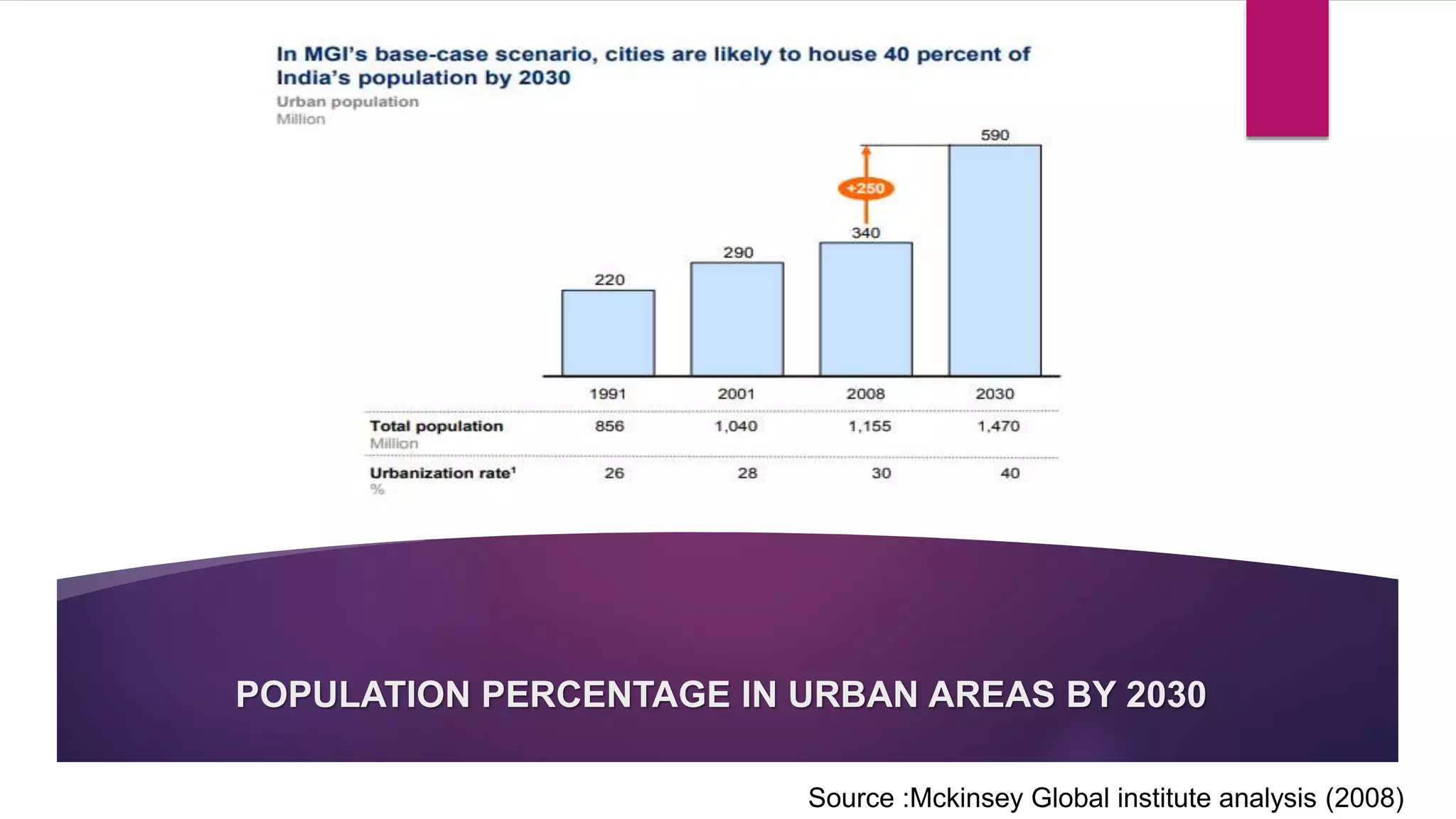
 Estimated that the urban population increase from 340 million(2008) to 590 million by 2030.
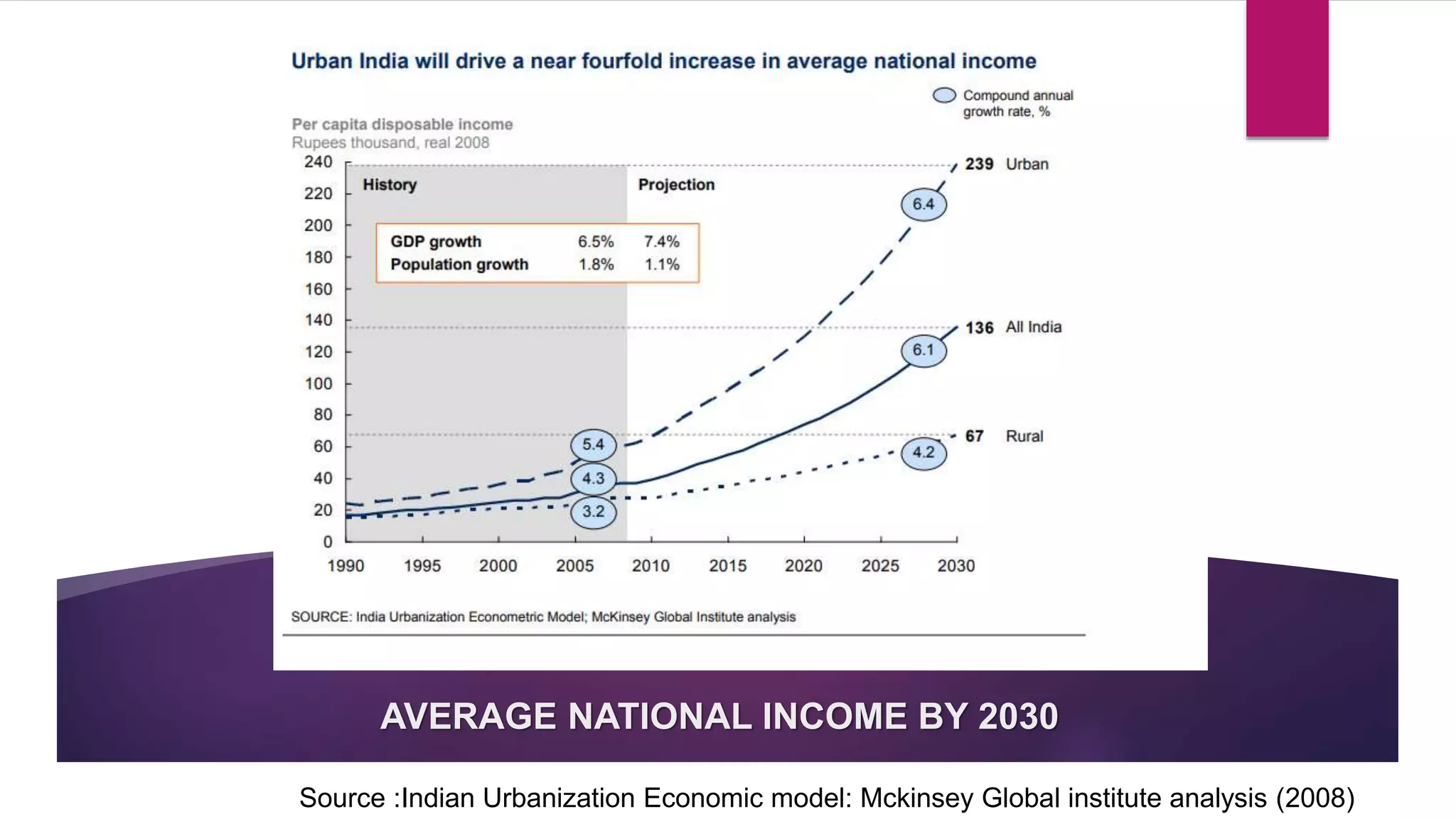
 Urbanization leads fourfold increase in per capita income by 2030.
 Urban economy provides 85% of total tax revenue.
 200 million rural population are directly benefited from urbanization.
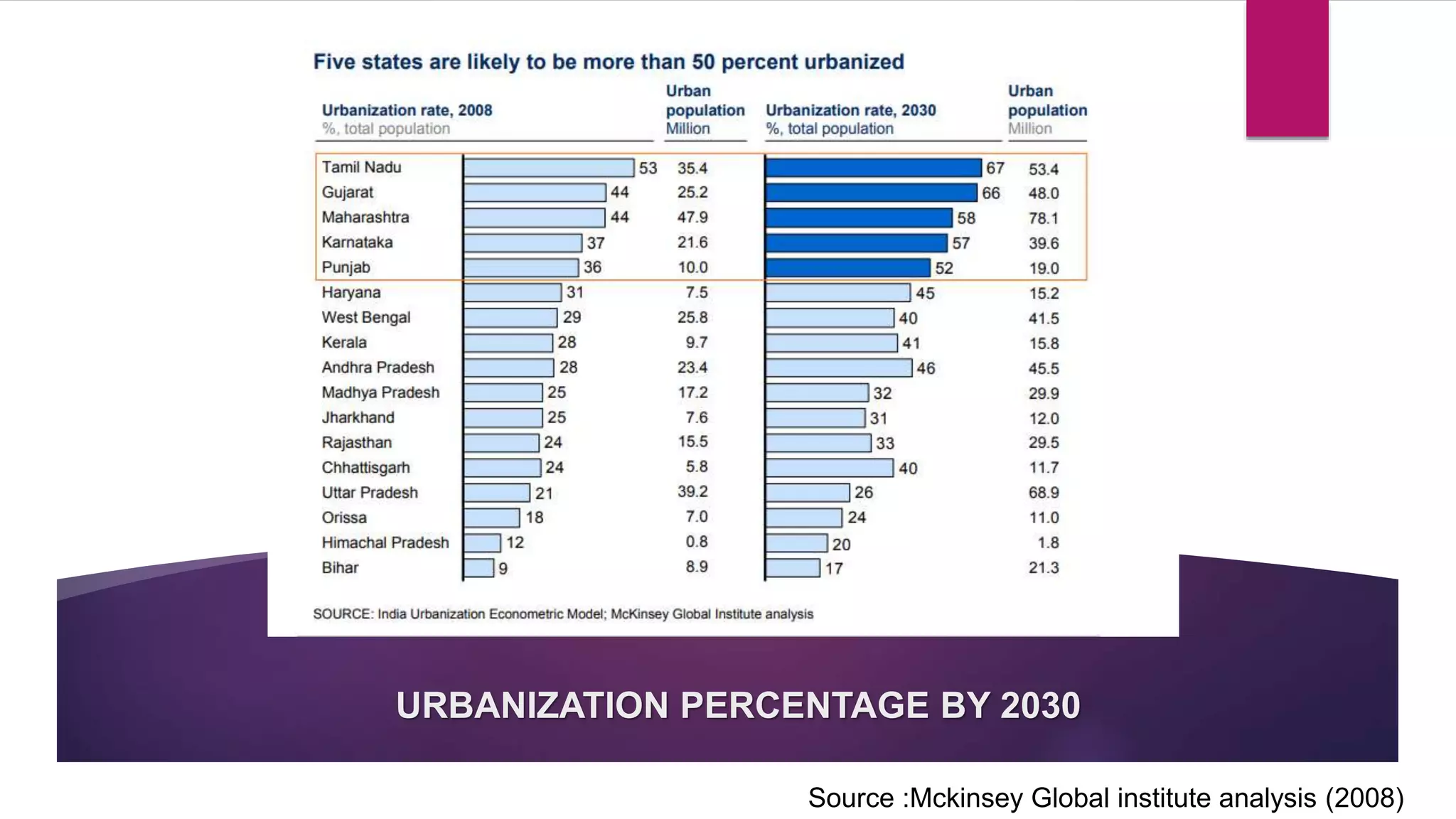
 Tamil Nadu, Gujarat, Maharashtra, Karnataka and Punjab have more population living in
urban areas.
POPULATION PERCENTAGE IN URBAN AREAS BY 2030
Source :Mckinsey Global institute analysis (2008)
URBANIZATION PERCENTAGE BY 2030
Source :Mckinsey Global institute analysis (2008)
AVERAGE NATIONAL INCOME BY 2030
Source :Indian Urbanization Economic model: Mckinsey Global institute analysis (2008)
CONCLUSION
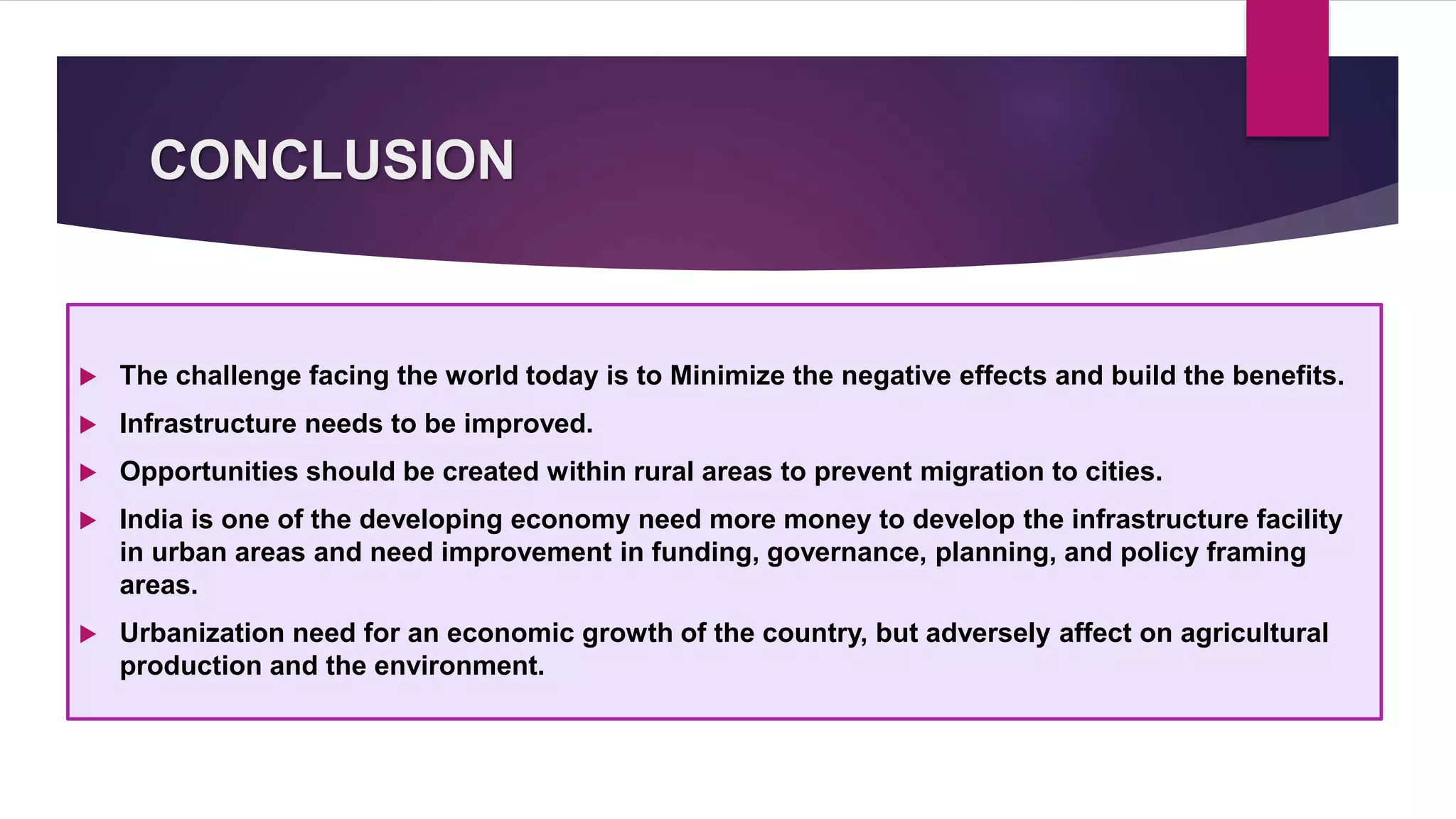
 The challenge facing the world today is to Minimize the negative effects and build the benefits.
 Infrastructure needs to be improved.
 Opportunities should be created within rural areas to prevent migration to cities.
 India is one of the developing economy need more money to develop the infrastructure facility
in urban areas and need improvement in funding, governance, planning, and policy framing
areas.
 Urbanization need for an economic growth of the country, but adversely affect on agricultural
production and the environment.
REFERENCE
 https://planningtank.com/urbanisation
 https://en.wikipedia.org/wiki/Urbanization
 https://en.wikipedia.org/wiki/Urbanisation_in_India
 www.slideshare.net
 GOOGLE
“
”

Urban growth and urbanization

  • 1.
  • 2.
    CONTENTS  Definition ofUrban Growth and Urbanization  Causes of Urban Growth and Urbanization  Urbanization in India  Classification of Urban Centers  Benefits of Urbanization  Effects of Urbanization  Facts about Urbanization in India  Conclusion
  • 3.
    URBAN GROWTH  Itis defined as the rate at which the population of an urban area increases
  • 4.
    URBANISATION  Urbanization isthe process by which there is an increase in the proportion of people living in urban area.
  • 5.
    CAUSES OF URBANGROWTH AND URBANZATION INDUSTRILIZATION EMPLOYMENT OPPURTUNITIES COMMERCIALIZATION SOCIAL BENEFITS AND SERVICES MODERISATION AND CHANGES IN THE MODE OF LIVING RURAL URBAN TRANSFORMATION
  • 6.
    INDUSTRIALIZATION 1 • INDUSTRIALIZATION ISA MAJOR CAUSE OF URBANIZATION. 2 • IT HAS EXPANDED THE EMPLOYMENT OPPORTUNITIES. 3 • RURAL PEOPLE HAVE MIGRATED TO CITIES ON ACCOUNT OF BETTER EMPLOYMENT OPPORTUNITIES.
  • 7.
    EMPLOYMENT OPPURTUNITIES IN RURALSECTOR PEOPLE HAVE TO DEPEND MAINLY ON AGRICULTURE FOR THEIR LIVELIHOOD. URBANIZATION INFLUENCES THE PEOPLE FROM RURAL TO URBAN AREAS IT IS A NATURAL CONSEQUENCE OF ECONOMIC CHANGE THAT TAKES PLACE
  • 8.
    SOCIAL FACTORS MANY SOCIALFACTORS SUCH AS  ATTRACTION OF CITIES  BETTER STANDARD OF LIVING  BETTER EDUCATIONAL FACILITIES  NEED FOR STATUS ALSO INDUCE PEOPLE TO MIGRATE TO CITIES.
  • 9.
    MODERNIZATION  URBAN AREASARE CHARACTERIZED BY SOPHISTICATED TECHNOLOGY BETTER INFRASTRUCTURE, COMMUNICATION, MEDICAL FACILITIES, ETC.  PEOPLE FEEL THAT THEY CAN LEAD A COMFORTABLE LIFE IN CITIES AND MIGRATE TO CITIES.
  • 10.
    RURAL URBAN TRANSFORMATION IT IS AN INTERESTING ASPECT THAT NOT ONLY CITIES ARE GROWING IN NUMBER BUT RURAL COMMUNITY IS ADOPTING URBAN CULTURE, NO LONGER RURAL COMMUNITIES ARE RETAINING THEIR UNIQUE RURAL CULTURE.  RURAL PEOPLE ARE FOLLOWING THE MATERIAL CULTURE OF URBAN PEOPLE.
  • 11.
    URBANIZATION IN INDIA INTRODUCTION: India isone of the fastest growing economy in the world next to China. India is poised to become the fifth-largest economy, overtaking the United Kingdom by 2019 as per the IMF projection. The country ranks third when GDP is compared in terms of purchasing power parity at $10.51 trillion. India was the 19th-largest in merchandise and 6th largest services exporter in the world in 2013. GDP (sector wise) 1. SERVICE SECTOR – 53.66% 2. INDUSTRY – 23.34% 3. AGRICULTURE – 23% (As per https://en.wikipedia.org/wiki/economy_of_india )
  • 12.
    URBANIZATION IN INDIA URBANIZATION IS TAKING PLACE AT A FASTER RATE IN INDIA.  Urbanization in India was mainly started after independence, due to adoption of mixed economy by the country which gave rise to the development of private sector. Year of Census Population Percentage 1901 11.4 2001 28.53 2011 31.16 Total population percentage in urban areas Rate of urbanization: 2.4% (2010-15 est.) Source: censes 2011( Govt. of India) Total population percentage in Rural - urban areas
  • 13.
    Classification of UrbanCenters SL No. TYPE POPULATION 1 Conurbation Three - Ten million 2 Metropolis One – Three million 3 Large city Three – Ten lack 4 City One – Three lack 5 Large town 20,000- 100,000 6 Town 1,000- 20,000 7 Village 100- 1,000
  • 14.
     Improvement ineconomy  Growth of commercial activities  Social & cultural integration  Efficient services  Resources of utilization BENEFITS OF URBANISATION
  • 15.
    EFFECTS OF URBANIZATION A range of economic, political, social, cultural and environmental factors affect urbanization.  Urbanization is encouraged socially and culturally through the media.
  • 16.
    SOCIO-CULTURAL IMPACTS  Citieshave a strong socio-cultural impacts on their surrounding rural areas.  The mass media depicts city life as superior to rural life, the “STANDARD” language is deemed that of the national capital, and better services are received in the city due to its wealth.  The fertility rate in cities is often lower than in rural areas due to the absence of agriculture, the cost of children, food and living space in cities, and family planning.
  • 17.
     As acity grows, the cost of housing and infrastructure also grows, since there are less water, land and building material available, and greater congestion problems.  As a city decays in this way, governments often do not meet the service needs of residents and urban development is dominated by private capital.  Unemployment grows, as do drug abuse, crime and homelessness. SOCIO-ECONOMIC IMPACTS
  • 18.
     Waste area major problem in large cities.  Air pollution results from overdependence on motorized transport and from burning of coal to supply energy.  Water pollution results from poor sewage facilities and disposal of industrial heavy metals into waterways.  Vast quantities of solid waste are produced in industries.  Traffic congestion and noise pollution are major environmental impacts of large cities. ENVIRONMENTAL IMPACTS
  • 19.
    POSITIVE EFFECTS OFURBANIZATION  MIGRATION OF RURAL PEOPLE TO URBAN AREAS.  EMPLOYMENT OPPORTUNITIES IN URBAN CENTERS.  TRANSPORT AND COMMUNICATION FACILITIES.  EDUCATIONAL FACILITIES.  INCREASE IN THE STANDARD OF LIVING.
  • 20.
    ADVERSE EFFECTS OF URBANIZATION Thereis increasing competition for facilities due to the high standard of living in urban areas, which has triggered several negative effects:-  Slums and its consequences of overcrowding.  Lack of sanitation  Poverty  Illiteracy  Unemployment and  Crime is the worst impact of urbanization.  Global warming, air ,pollution, water scarcity and pollution and loss of forest cover, agricultural land and depletion of wildlife as a result of urban sprawl, pose serious threats to the environment.
  • 21.
    Facts about Urbanizationin India  Mckinsey global institute estimated that nearly 70% new jobs will be created by 2030.  Estimated that the urban population increase from 340 million(2008) to 590 million by 2030.  Urbanization leads fourfold increase in per capita income by 2030.  Urban economy provides 85% of total tax revenue.  200 million rural population are directly benefited from urbanization.  Tamil Nadu, Gujarat, Maharashtra, Karnataka and Punjab have more population living in urban areas.
  • 22.
    POPULATION PERCENTAGE INURBAN AREAS BY 2030 Source :Mckinsey Global institute analysis (2008)
  • 23.
    URBANIZATION PERCENTAGE BY2030 Source :Mckinsey Global institute analysis (2008)
  • 24.
    AVERAGE NATIONAL INCOMEBY 2030 Source :Indian Urbanization Economic model: Mckinsey Global institute analysis (2008)
  • 25.
    CONCLUSION  The challengefacing the world today is to Minimize the negative effects and build the benefits.  Infrastructure needs to be improved.  Opportunities should be created within rural areas to prevent migration to cities.  India is one of the developing economy need more money to develop the infrastructure facility in urban areas and need improvement in funding, governance, planning, and policy framing areas.  Urbanization need for an economic growth of the country, but adversely affect on agricultural production and the environment.
  • 26.
    REFERENCE  https://planningtank.com/urbanisation  https://en.wikipedia.org/wiki/Urbanization https://en.wikipedia.org/wiki/Urbanisation_in_India  www.slideshare.net  GOOGLE
  • 27.