
SAFETY ASPECTS OF
PACKAGING MATERIALS
Presented By :-Sourabh S. Kale
M.Tech. Scholar,
SMC College of Dairy Science,
AAU, Anand
CONTENT
Introduction
Food packaging as food contaminant
source
Migration of additives
Factors controlling the migration
Testing of the packaging materials for
migration
Expression of Results and Recommended
limits
Conclusion
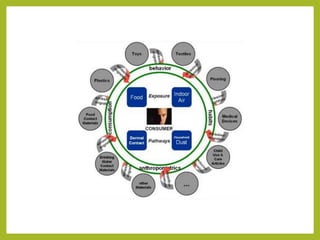
food contact materials are an underestimated source of chemical
food contamination.
FPMs have the potential to release and subsequent transfer of
components into the food.
The extent to which migration occurs depends on
physicochemical properties of the migrant, of the packaging
material, and the food composition (e.g. fat content)
Introduction
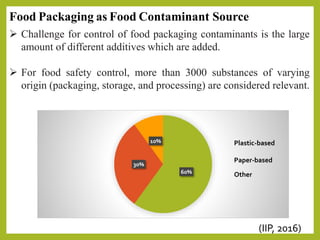
Food Packaging as Food Contaminant Source
 Challenge for control of food packaging contaminants is the large
amount of different additives which are added.
 For food safety control, more than 3000 substances of varying
origin (packaging, storage, and processing) are considered relevant.
60%
30%
10% Plastic-based
Paper-based
Other
(IIP, 2016)
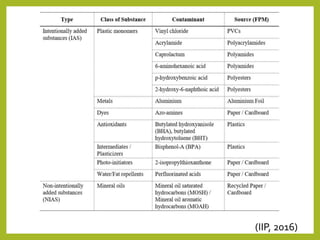
Plastic FPMs
• The additives like plasticizers, antioxidants, UV stabilizers, colors,
printing inks, etc. can migrate into the packaged food.
• Furthermore, the residues of mono and oligomers of the starting
material(s) as well as additives required for the polymerization
may also be migrated into the food.
Timber, Paper and paper board
• Printing inks and chemicals used in the pulp and paper production
may migrate through paper board into foods.
• Chlorophenols formed during the bleaching of wood pulp for paper
manufacture can be responsible for taints.
(IIP, 2016)
 Iron-based metal bodies
•Usually these are coated inside with polymers to avoid direct
contact with the food.
•Corrosion by high-salt or acidic food items is a major issue.
• Aluminum cans have to be covered with polymers as well since
aluminum also is a quite corrosion-prone metal.
(IIP, 2016)
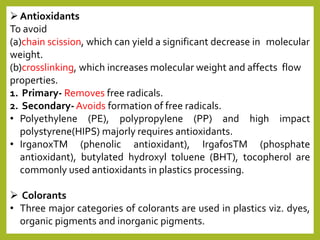
Antioxidants
To avoid
(a)chain scission, which can yield a significant decrease in molecular
weight.
(b)crosslinking, which increases molecular weight and affects flow
properties.
1. Primary- Removes free radicals.
2. Secondary- Avoids formation of free radicals.
• Polyethylene (PE), polypropylene (PP) and high impact
polystyrene(HIPS) majorly requires antioxidants.
• IrganoxTM (phenolic antioxidant), IrgafosTM (phosphate
antioxidant), butylated hydroxyl toluene (BHT), tocopherol are
commonly used antioxidants in plastics processing.
 Colorants
• Three major categories of colorants are used in plastics viz. dyes,
organic pigments and inorganic pigments.
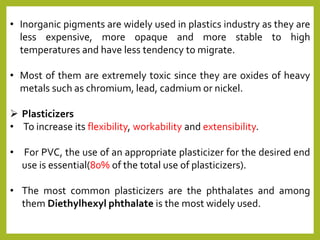
• Inorganic pigments are widely used in plastics industry as they are
less expensive, more opaque and more stable to high
temperatures and have less tendency to migrate.
• Most of them are extremely toxic since they are oxides of heavy
metals such as chromium, lead, cadmium or nickel.
 Plasticizers
• To increase its flexibility, workability and extensibility.
• For PVC, the use of an appropriate plasticizer for the desired end
use is essential(80% of the total use of plasticizers).
• The most common plasticizers are the phthalates and among
them Diethylhexyl phthalate is the most widely used.
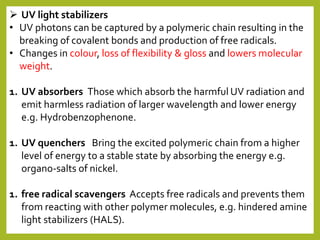
 UV light stabilizers
• UV photons can be captured by a polymeric chain resulting in the
breaking of covalent bonds and production of free radicals.
• Changes in colour, loss of flexibility & gloss and lowers molecular
weight.
1. UV absorbers Those which absorb the harmful UV radiation and
emit harmless radiation of larger wavelength and lower energy
e.g. Hydrobenzophenone.
1. UV quenchers Bring the excited polymeric chain from a higher
level of energy to a stable state by absorbing the energy e.g.
organo-salts of nickel.
1. free radical scavengers Accepts free radicals and prevents them
from reacting with other polymer molecules, e.g. hindered amine
light stabilizers (HALS).
Migration of additives from Packaging
material to food
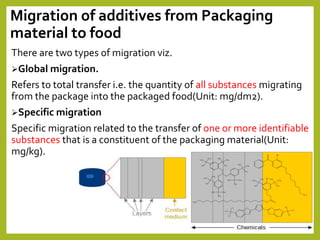
There are two types of migration viz.
Global migration.
Refers to total transfer i.e. the quantity of all substances migrating
from the package into the packaged food(Unit: mg/dm2).
Specific migration
Specific migration related to the transfer of one or more identifiable
substances that is a constituent of the packaging material(Unit:
mg/kg).
Factors that control the migration
Diffusion process of migrants.
Composition of packaging material.
The nature and extent of contact.
Nature of the food.
Temperature of contact surface.
The duration of contact.
M= t1/2.
(IIP, 2016)
Testing of the packaging
materials for migration
Conventional direct migration measurements
sample is placed in contact with a food or simulant in a manner
representing the contact conditions of actual conditions in use.
Alternative semidirect migration test approaches
where a sample is kept in contact with an appropriate simulant in
such a manner that a strong interaction between simulant and
plastic takes place (more severe test conditions) shorter contact
times are applied.
(European Commission, 2002).
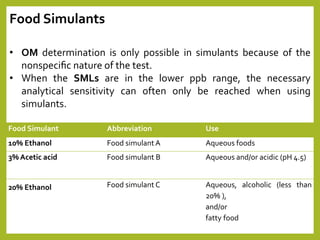
• OM determination is only possible in simulants because of the
nonspecific nature of the test.
• When the SMLs are in the lower ppb range, the necessary
analytical sensitivity can often only be reached when using
simulants.
Food Simulant Abbreviation Use
10% Ethanol Food simulant A Aqueous foods
3% Acetic acid Food simulant B Aqueous and/or acidic (pH 4.5)
20% Ethanol Food simulant C Aqueous, alcoholic (less than
20% ),
and/or
fatty food
Food Simulants
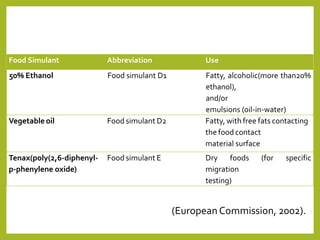
Food Simulant Abbreviation Use
50% Ethanol Food simulant D1 Fatty, alcoholic(more than20%
ethanol),
and/or
emulsions (oil-in-water)
Vegetable oil Food simulant D2 Fatty, with free fats contacting
the food contact
material surface
Tenax(poly(2,6-diphenyl-
p-phenylene oxide)
Food simulant E Dry foods (for specific
migration
testing)
(European Commission, 2002).
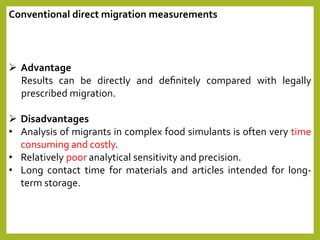
 Advantage
Results can be directly and definitely compared with legally
prescribed migration.
 Disadvantages
• Analysis of migrants in complex food simulants is often very time
consuming and costly.
• Relatively poor analytical sensitivity and precision.
• Long contact time for materials and articles intended for long-
term storage.
Conventional direct migration measurements
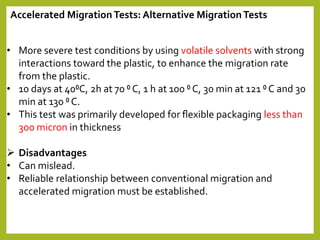
Accelerated MigrationTests: Alternative MigrationTests
• More severe test conditions by using volatile solvents with strong
interactions toward the plastic, to enhance the migration rate
from the plastic.
• 10 days at 40⁰C, 2h at 70 ⁰ C, 1 h at 100 ⁰ C, 30 min at 121 ⁰ C and 30
min at 130 ⁰ C.
• This test was primarily developed for flexible packaging less than
300 micron in thickness
 Disadvantages
• Can mislead.
• Reliable relationship between conventional migration and
accelerated migration must be established.
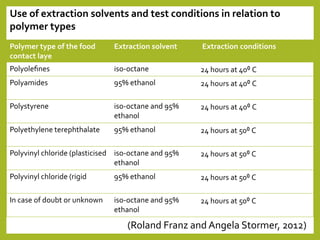
Polymer type of the food
contact laye
Extraction solvent Extraction conditions
Polyolefines iso-octane 24 hours at 40⁰ C
Polyamides 95% ethanol 24 hours at 40⁰ C
Polystyrene iso-octane and 95%
ethanol
24 hours at 40⁰ C
Polyethylene terephthalate 95% ethanol 24 hours at 50⁰ C
Polyvinyl chloride (plasticised iso-octane and 95%
ethanol
24 hours at 50⁰ C
Polyvinyl chloride (rigid 95% ethanol 24 hours at 50⁰ C
In case of doubt or unknown iso-octane and 95%
ethanol
24 hours at 50⁰ C
Use of extraction solvents and test conditions in relation to
polymer types
(Roland Franz and Angela Stormer, 2012)
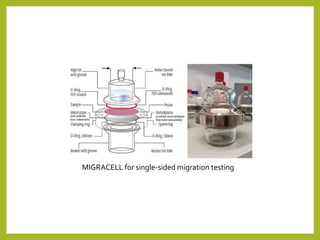
MIGRACELL for single-sided migration testing
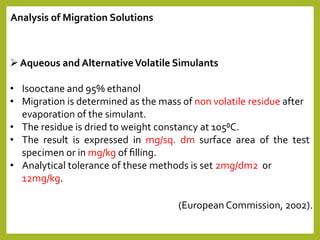
Analysis of Migration Solutions
Aqueous and AlternativeVolatile Simulants
• Isooctane and 95% ethanol
• Migration is determined as the mass of non volatile residue after
evaporation of the simulant.
• The residue is dried to weight constancy at 105⁰C.
• The result is expressed in mg/sq. dm surface area of the test
specimen or in mg/kg of filling.
• Analytical tolerance of these methods is set 2mg/dm2 or
12mg/kg.
(European Commission, 2002).
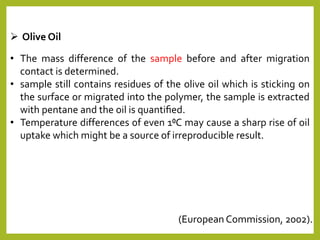
 Olive Oil
• The mass difference of the sample before and after migration
contact is determined.
• sample still contains residues of the olive oil which is sticking on
the surface or migrated into the polymer, the sample is extracted
with pentane and the oil is quantified.
• Temperature differences of even 1⁰C may cause a sharp rise of oil
uptake which might be a source of irreproducible result.
(European Commission, 2002).
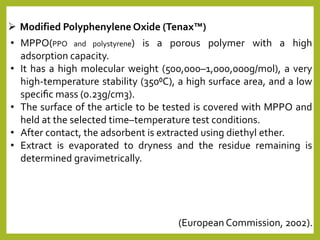
 Modified Polyphenylene Oxide (Tenax™)
• MPPO(PPO and polystyrene) is a porous polymer with a high
adsorption capacity.
• It has a high molecular weight (500,000–1,000,000g/mol), a very
high-temperature stability (350⁰C), a high surface area, and a low
specific mass (0.23g/cm3).
• The surface of the article to be tested is covered with MPPO and
held at the selected time–temperature test conditions.
• After contact, the adsorbent is extracted using diethyl ether.
• Extract is evaporated to dryness and the residue remaining is
determined gravimetrically.
(European Commission, 2002).
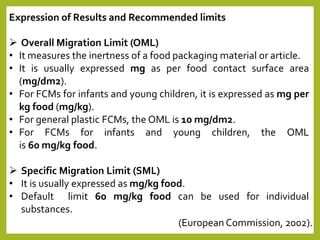
Expression of Results and Recommended limits
 Overall Migration Limit (OML)
• It measures the inertness of a food packaging material or article.
• It is usually expressed mg as per food contact surface area
(mg/dm2).
• For FCMs for infants and young children, it is expressed as mg per
kg food (mg/kg).
• For general plastic FCMs, the OML is 10 mg/dm2.
• For FCMs for infants and young children, the OML
is 60 mg/kg food.
 Specific Migration Limit (SML)
• It is usually expressed as mg/kg food.
• Default limit 60 mg/kg food can be used for individual
substances.
(European Commission, 2002).
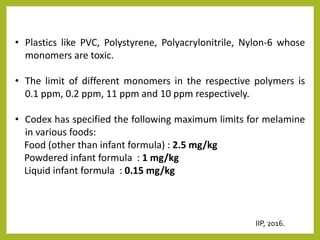
• Plastics like PVC, Polystyrene, Polyacrylonitrile, Nylon-6 whose
monomers are toxic.
• The limit of different monomers in the respective polymers is
0.1 ppm, 0.2 ppm, 11 ppm and 10 ppm respectively.
• Codex has specified the following maximum limits for melamine
in various foods:
Food (other than infant formula) : 2.5 mg/kg
Powdered infant formula : 1 mg/kg
Liquid infant formula : 0.15 mg/kg
IIP, 2016.
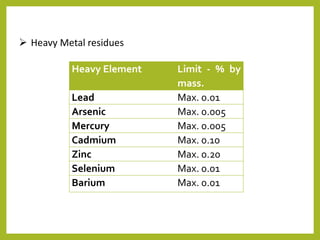
 Heavy Metal residues
Heavy Element Limit - % by
mass.
Lead Max. 0.01
Arsenic Max. 0.005
Mercury Max. 0.005
Cadmium Max. 0.10
Zinc Max. 0.20
Selenium Max. 0.01
Barium Max. 0.01
Conclusion
• A major role of FPMs is the avoidance of risks related to microbial
or chemical contamination of the food, i.e. unwanted events,
which may imply serious health risks.
• Food contact materials are an underestimated source of chemical
food contamination.
• Chemical properties of the migrant, of the packaging material,
and the food (e.g. fat content); temperature; storage time; and
size of the packaging in proportion to the foodstuff volume
(smaller size packaging has a larger surface to volume ratio)
decides the rate of migration.
• food packaging materials are also a source of heavy metals.
• It is not always possible to analyze actual food for nature and
quantity of migrants from the plastics so simulants or extractants
are used as substitute.
• Either conventional or accelerated migration tests are carried out
to determine SML orOML
Safety aspects of packaging materials

Safety aspects of packaging materials

  • 1.
    SAFETY ASPECTS OF PACKAGINGMATERIALS Presented By :-Sourabh S. Kale M.Tech. Scholar, SMC College of Dairy Science, AAU, Anand
  • 2.
    CONTENT Introduction Food packaging asfood contaminant source Migration of additives Factors controlling the migration Testing of the packaging materials for migration Expression of Results and Recommended limits Conclusion
  • 3.
    food contact materialsare an underestimated source of chemical food contamination. FPMs have the potential to release and subsequent transfer of components into the food. The extent to which migration occurs depends on physicochemical properties of the migrant, of the packaging material, and the food composition (e.g. fat content) Introduction
  • 5.
    Food Packaging asFood Contaminant Source  Challenge for control of food packaging contaminants is the large amount of different additives which are added.  For food safety control, more than 3000 substances of varying origin (packaging, storage, and processing) are considered relevant. 60% 30% 10% Plastic-based Paper-based Other (IIP, 2016)
  • 6.
    Plastic FPMs • Theadditives like plasticizers, antioxidants, UV stabilizers, colors, printing inks, etc. can migrate into the packaged food. • Furthermore, the residues of mono and oligomers of the starting material(s) as well as additives required for the polymerization may also be migrated into the food. Timber, Paper and paper board • Printing inks and chemicals used in the pulp and paper production may migrate through paper board into foods. • Chlorophenols formed during the bleaching of wood pulp for paper manufacture can be responsible for taints. (IIP, 2016)
  • 7.
     Iron-based metalbodies •Usually these are coated inside with polymers to avoid direct contact with the food. •Corrosion by high-salt or acidic food items is a major issue. • Aluminum cans have to be covered with polymers as well since aluminum also is a quite corrosion-prone metal.
  • 8.
  • 9.
    Antioxidants To avoid (a)chain scission,which can yield a significant decrease in molecular weight. (b)crosslinking, which increases molecular weight and affects flow properties. 1. Primary- Removes free radicals. 2. Secondary- Avoids formation of free radicals. • Polyethylene (PE), polypropylene (PP) and high impact polystyrene(HIPS) majorly requires antioxidants. • IrganoxTM (phenolic antioxidant), IrgafosTM (phosphate antioxidant), butylated hydroxyl toluene (BHT), tocopherol are commonly used antioxidants in plastics processing.  Colorants • Three major categories of colorants are used in plastics viz. dyes, organic pigments and inorganic pigments.
  • 10.
    • Inorganic pigmentsare widely used in plastics industry as they are less expensive, more opaque and more stable to high temperatures and have less tendency to migrate. • Most of them are extremely toxic since they are oxides of heavy metals such as chromium, lead, cadmium or nickel.  Plasticizers • To increase its flexibility, workability and extensibility. • For PVC, the use of an appropriate plasticizer for the desired end use is essential(80% of the total use of plasticizers). • The most common plasticizers are the phthalates and among them Diethylhexyl phthalate is the most widely used.
  • 11.
     UV lightstabilizers • UV photons can be captured by a polymeric chain resulting in the breaking of covalent bonds and production of free radicals. • Changes in colour, loss of flexibility & gloss and lowers molecular weight. 1. UV absorbers Those which absorb the harmful UV radiation and emit harmless radiation of larger wavelength and lower energy e.g. Hydrobenzophenone. 1. UV quenchers Bring the excited polymeric chain from a higher level of energy to a stable state by absorbing the energy e.g. organo-salts of nickel. 1. free radical scavengers Accepts free radicals and prevents them from reacting with other polymer molecules, e.g. hindered amine light stabilizers (HALS).
  • 12.
    Migration of additivesfrom Packaging material to food There are two types of migration viz. Global migration. Refers to total transfer i.e. the quantity of all substances migrating from the package into the packaged food(Unit: mg/dm2). Specific migration Specific migration related to the transfer of one or more identifiable substances that is a constituent of the packaging material(Unit: mg/kg).
  • 13.
    Factors that controlthe migration Diffusion process of migrants. Composition of packaging material. The nature and extent of contact. Nature of the food. Temperature of contact surface. The duration of contact. M= t1/2. (IIP, 2016)
  • 14.
    Testing of thepackaging materials for migration
  • 15.
    Conventional direct migrationmeasurements sample is placed in contact with a food or simulant in a manner representing the contact conditions of actual conditions in use. Alternative semidirect migration test approaches where a sample is kept in contact with an appropriate simulant in such a manner that a strong interaction between simulant and plastic takes place (more severe test conditions) shorter contact times are applied. (European Commission, 2002).
  • 16.
    • OM determinationis only possible in simulants because of the nonspecific nature of the test. • When the SMLs are in the lower ppb range, the necessary analytical sensitivity can often only be reached when using simulants. Food Simulant Abbreviation Use 10% Ethanol Food simulant A Aqueous foods 3% Acetic acid Food simulant B Aqueous and/or acidic (pH 4.5) 20% Ethanol Food simulant C Aqueous, alcoholic (less than 20% ), and/or fatty food Food Simulants
  • 17.
    Food Simulant AbbreviationUse 50% Ethanol Food simulant D1 Fatty, alcoholic(more than20% ethanol), and/or emulsions (oil-in-water) Vegetable oil Food simulant D2 Fatty, with free fats contacting the food contact material surface Tenax(poly(2,6-diphenyl- p-phenylene oxide) Food simulant E Dry foods (for specific migration testing) (European Commission, 2002).
  • 18.
     Advantage Results canbe directly and definitely compared with legally prescribed migration.  Disadvantages • Analysis of migrants in complex food simulants is often very time consuming and costly. • Relatively poor analytical sensitivity and precision. • Long contact time for materials and articles intended for long- term storage. Conventional direct migration measurements
  • 19.
    Accelerated MigrationTests: AlternativeMigrationTests • More severe test conditions by using volatile solvents with strong interactions toward the plastic, to enhance the migration rate from the plastic. • 10 days at 40⁰C, 2h at 70 ⁰ C, 1 h at 100 ⁰ C, 30 min at 121 ⁰ C and 30 min at 130 ⁰ C. • This test was primarily developed for flexible packaging less than 300 micron in thickness  Disadvantages • Can mislead. • Reliable relationship between conventional migration and accelerated migration must be established.
  • 20.
    Polymer type ofthe food contact laye Extraction solvent Extraction conditions Polyolefines iso-octane 24 hours at 40⁰ C Polyamides 95% ethanol 24 hours at 40⁰ C Polystyrene iso-octane and 95% ethanol 24 hours at 40⁰ C Polyethylene terephthalate 95% ethanol 24 hours at 50⁰ C Polyvinyl chloride (plasticised iso-octane and 95% ethanol 24 hours at 50⁰ C Polyvinyl chloride (rigid 95% ethanol 24 hours at 50⁰ C In case of doubt or unknown iso-octane and 95% ethanol 24 hours at 50⁰ C Use of extraction solvents and test conditions in relation to polymer types (Roland Franz and Angela Stormer, 2012)
  • 21.
    MIGRACELL for single-sidedmigration testing
  • 22.
    Analysis of MigrationSolutions Aqueous and AlternativeVolatile Simulants • Isooctane and 95% ethanol • Migration is determined as the mass of non volatile residue after evaporation of the simulant. • The residue is dried to weight constancy at 105⁰C. • The result is expressed in mg/sq. dm surface area of the test specimen or in mg/kg of filling. • Analytical tolerance of these methods is set 2mg/dm2 or 12mg/kg. (European Commission, 2002).
  • 23.
     Olive Oil •The mass difference of the sample before and after migration contact is determined. • sample still contains residues of the olive oil which is sticking on the surface or migrated into the polymer, the sample is extracted with pentane and the oil is quantified. • Temperature differences of even 1⁰C may cause a sharp rise of oil uptake which might be a source of irreproducible result. (European Commission, 2002).
  • 24.
     Modified PolyphenyleneOxide (Tenax™) • MPPO(PPO and polystyrene) is a porous polymer with a high adsorption capacity. • It has a high molecular weight (500,000–1,000,000g/mol), a very high-temperature stability (350⁰C), a high surface area, and a low specific mass (0.23g/cm3). • The surface of the article to be tested is covered with MPPO and held at the selected time–temperature test conditions. • After contact, the adsorbent is extracted using diethyl ether. • Extract is evaporated to dryness and the residue remaining is determined gravimetrically. (European Commission, 2002).
  • 25.
    Expression of Resultsand Recommended limits  Overall Migration Limit (OML) • It measures the inertness of a food packaging material or article. • It is usually expressed mg as per food contact surface area (mg/dm2). • For FCMs for infants and young children, it is expressed as mg per kg food (mg/kg). • For general plastic FCMs, the OML is 10 mg/dm2. • For FCMs for infants and young children, the OML is 60 mg/kg food.  Specific Migration Limit (SML) • It is usually expressed as mg/kg food. • Default limit 60 mg/kg food can be used for individual substances. (European Commission, 2002).
  • 26.
    • Plastics likePVC, Polystyrene, Polyacrylonitrile, Nylon-6 whose monomers are toxic. • The limit of different monomers in the respective polymers is 0.1 ppm, 0.2 ppm, 11 ppm and 10 ppm respectively. • Codex has specified the following maximum limits for melamine in various foods: Food (other than infant formula) : 2.5 mg/kg Powdered infant formula : 1 mg/kg Liquid infant formula : 0.15 mg/kg IIP, 2016.
  • 27.
     Heavy Metalresidues Heavy Element Limit - % by mass. Lead Max. 0.01 Arsenic Max. 0.005 Mercury Max. 0.005 Cadmium Max. 0.10 Zinc Max. 0.20 Selenium Max. 0.01 Barium Max. 0.01
  • 28.
    Conclusion • A majorrole of FPMs is the avoidance of risks related to microbial or chemical contamination of the food, i.e. unwanted events, which may imply serious health risks. • Food contact materials are an underestimated source of chemical food contamination. • Chemical properties of the migrant, of the packaging material, and the food (e.g. fat content); temperature; storage time; and size of the packaging in proportion to the foodstuff volume (smaller size packaging has a larger surface to volume ratio) decides the rate of migration.
  • 29.
    • food packagingmaterials are also a source of heavy metals. • It is not always possible to analyze actual food for nature and quantity of migrants from the plastics so simulants or extractants are used as substitute. • Either conventional or accelerated migration tests are carried out to determine SML orOML