Migrating to
Spark at Netflix
Ryan Blue
Spark Summit 2019
Spark at Netflix
● ETL was mostly written in Pig, with some in Hive
● Pipelines required data engineering
● Data engineers had to understand the processing engine
Long ago . . .
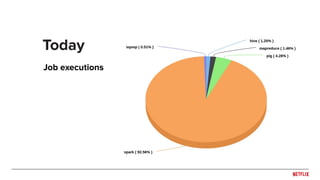
Today
Job executions
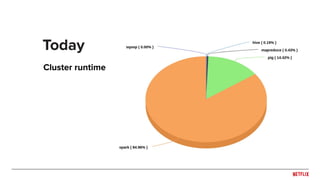
Today
Cluster runtime
Today
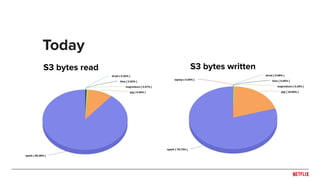
S3 bytes read S3 bytes written
● Spark is > 90% of job executions – high tens-of-thousands daily
● Data platform is easier to use and more efficient
● Customers from all parts of the business
Today
How did we get there?
● High-profile Spark features: DataFrames, codegen, etc.
● S3 optimizations and committers
● Parquet filtering, tuning, and compression
● Notebook environment
Not included
Spark deployments
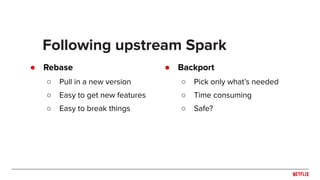
● Rebase
○ Pull in a new version
○ Easy to get new features
○ Easy to break things
Following upstream Spark
● Backport
○ Pick only what’s needed
○ Time consuming
○ Safe?
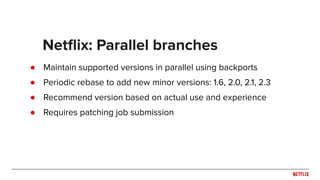
● Maintain supported versions in parallel using backports
● Periodic rebase to add new minor versions: 1.6, 2.0, 2.1, 2.3
● Recommend version based on actual use and experience
● Requires patching job submission
Netflix: Parallel branches
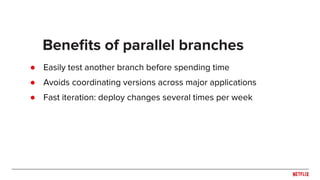
● Easily test another branch before spending time
● Avoids coordinating versions across major applications
● Fast iteration: deploy changes several times per week
Benefits of parallel branches
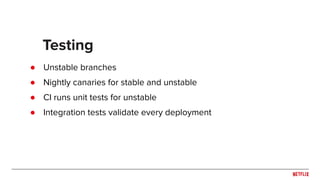
● Unstable branches
● Nightly canaries for stable and unstable
● CI runs unit tests for unstable
● Integration tests validate every deployment
Testing
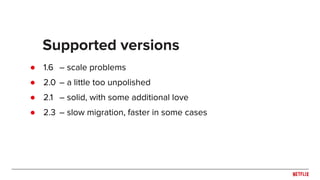
● 1.6 – scale problems
● 2.0 – a little too unpolished
● 2.1 – solid, with some additional love
● 2.3 – slow migration, faster in some cases
Supported versions
Challenges
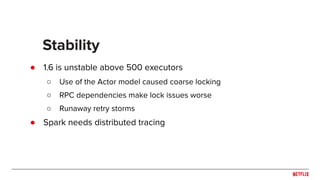
● 1.6 is unstable above 500 executors
○ Use of the Actor model caused coarse locking
○ RPC dependencies make lock issues worse
○ Runaway retry storms
● Spark needs distributed tracing
Stability
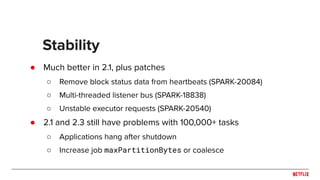
● Much better in 2.1, plus patches
○ Remove block status data from heartbeats (SPARK-20084)
○ Multi-threaded listener bus (SPARK-18838)
○ Unstable executor requests (SPARK-20540)
● 2.1 and 2.3 still have problems with 100,000+ tasks
○ Applications hang after shutdown
○ Increase job maxPartitionBytes or coalesce
Stability
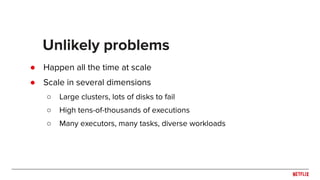
● Happen all the time at scale
● Scale in several dimensions
○ Large clusters, lots of disks to fail
○ High tens-of-thousands of executions
○ Many executors, many tasks, diverse workloads
Unlikely problems
● Fix CommitCoordinator and OutputCommitter problems
● Turn off YARN preemption in production
● Use cgroups to contain greedy apps
● Use general-purpose features
○ Blacklisting to avoid cascading failure
○ Speculative execution to tolerate slow nodes
○ Adaptive execution reduces risk
Unlikely problems
● Fix persistent OOM causes
○ Use less driver memory for broadcast joins (SPARK-22170)
○ Add PySpark memory region and limits (SPARK-25004)
○ Base stats on row count, not size on disk
Memory management
● Educate users about memory regions
○ Spark memory vs JVM memory vs overhead
○ Know what region fixes your problem (e.g., spilling)
○ Never set spark.executor.memory without
also setting spark.memory.fraction
Memory management
Best practices
● Avoid RDDs
○ Kryo problems plagued 1.6 apps
○ Let the optimizer improve jobs over time
● Aggressively broadcast
○ Remove the broadcast timeout
○ Set broadcast threshold much higher
Basics
● 3 rules:
○ Don’t copy configuration
○ If you don’t know what it does, don’t change it
○ Never change timeouts
● Document defaults and recommendations
Configuration
● Know how to control parallelism
○ spark.sql.shuffle.partitions,
spark.sql.files.maxPartitionBytes
○ repartition vs coalesce
● Use the least-intrusive option
○ Set shuffle parallelism high and use adaptive execution
○ Allow Spark to improve
Parallelism
● Keep tasks in low tens-of-thousands
○ Too many tasks and the driver can’t handle heartbeats
○ Jobs hang for 10+ minutes after shutdown
● Reduce pressure on shuffle service
○ map tasks * reduce tasks = shuffle shards
Avoid wide stages
● Fixed --num-executors accidents (SPARK-13723)
● Use materialize instead of caching
○ Materialize: convert to RDD, back to DF, and count
○ Stores cache data in shuffle servers
○ Also avoids over-optimization
Dynamic Allocation
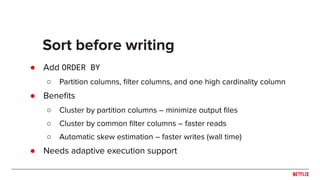
● Add ORDER BY
○ Partition columns, filter columns, and one high cardinality column
● Benefits
○ Cluster by partition columns – minimize output files
○ Cluster by common filter columns – faster reads
○ Automatic skew estimation – faster writes (wall time)
● Needs adaptive execution support
Sort before writing
Current problems
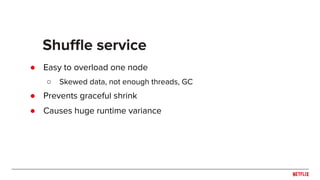
● Easy to overload one node
○ Skewed data, not enough threads, GC
● Prevents graceful shrink
● Causes huge runtime variance
Shuffle service
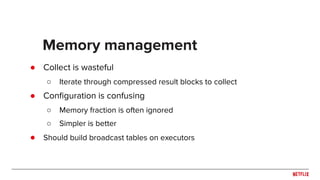
● Collect is wasteful
○ Iterate through compressed result blocks to collect
● Configuration is confusing
○ Memory fraction is often ignored
○ Simpler is better
● Should build broadcast tables on executors
Memory management
● Forked the write path for 2.x releases
○ Consistent rules across “datasource” and Hive tables
○ Remove unsafe operations, like implicit unsafe casts
○ Dynamic partition overwrites and Netflix “batch” pattern
● Fix upstream behavior and consistency with DSv2
● Fix table usability with Iceberg
○ Schema evolution and partitioning
DataSourceV2
Thank you!
Questions?

Migrating to Apache Spark at Netflix

  • 1.
    Migrating to Spark atNetflix Ryan Blue Spark Summit 2019
  • 2.
  • 3.
    ● ETL wasmostly written in Pig, with some in Hive ● Pipelines required data engineering ● Data engineers had to understand the processing engine Long ago . . .
  • 4.
  • 5.
  • 6.
    Today S3 bytes readS3 bytes written
  • 7.
    ● Spark is> 90% of job executions – high tens-of-thousands daily ● Data platform is easier to use and more efficient ● Customers from all parts of the business Today
  • 8.
    How did weget there?
  • 9.
    ● High-profile Sparkfeatures: DataFrames, codegen, etc. ● S3 optimizations and committers ● Parquet filtering, tuning, and compression ● Notebook environment Not included
  • 10.
  • 11.
    ● Rebase ○ Pullin a new version ○ Easy to get new features ○ Easy to break things Following upstream Spark ● Backport ○ Pick only what’s needed ○ Time consuming ○ Safe?
  • 12.
    ● Maintain supportedversions in parallel using backports ● Periodic rebase to add new minor versions: 1.6, 2.0, 2.1, 2.3 ● Recommend version based on actual use and experience ● Requires patching job submission Netflix: Parallel branches
  • 13.
    ● Easily testanother branch before spending time ● Avoids coordinating versions across major applications ● Fast iteration: deploy changes several times per week Benefits of parallel branches
  • 14.
    ● Unstable branches ●Nightly canaries for stable and unstable ● CI runs unit tests for unstable ● Integration tests validate every deployment Testing
  • 15.
    ● 1.6 –scale problems ● 2.0 – a little too unpolished ● 2.1 – solid, with some additional love ● 2.3 – slow migration, faster in some cases Supported versions
  • 16.
  • 17.
    ● 1.6 isunstable above 500 executors ○ Use of the Actor model caused coarse locking ○ RPC dependencies make lock issues worse ○ Runaway retry storms ● Spark needs distributed tracing Stability
  • 18.
    ● Much betterin 2.1, plus patches ○ Remove block status data from heartbeats (SPARK-20084) ○ Multi-threaded listener bus (SPARK-18838) ○ Unstable executor requests (SPARK-20540) ● 2.1 and 2.3 still have problems with 100,000+ tasks ○ Applications hang after shutdown ○ Increase job maxPartitionBytes or coalesce Stability
  • 19.
    ● Happen allthe time at scale ● Scale in several dimensions ○ Large clusters, lots of disks to fail ○ High tens-of-thousands of executions ○ Many executors, many tasks, diverse workloads Unlikely problems
  • 20.
    ● Fix CommitCoordinatorand OutputCommitter problems ● Turn off YARN preemption in production ● Use cgroups to contain greedy apps ● Use general-purpose features ○ Blacklisting to avoid cascading failure ○ Speculative execution to tolerate slow nodes ○ Adaptive execution reduces risk Unlikely problems
  • 21.
    ● Fix persistentOOM causes ○ Use less driver memory for broadcast joins (SPARK-22170) ○ Add PySpark memory region and limits (SPARK-25004) ○ Base stats on row count, not size on disk Memory management
  • 22.
    ● Educate usersabout memory regions ○ Spark memory vs JVM memory vs overhead ○ Know what region fixes your problem (e.g., spilling) ○ Never set spark.executor.memory without also setting spark.memory.fraction Memory management
  • 23.
  • 24.
    ● Avoid RDDs ○Kryo problems plagued 1.6 apps ○ Let the optimizer improve jobs over time ● Aggressively broadcast ○ Remove the broadcast timeout ○ Set broadcast threshold much higher Basics
  • 25.
    ● 3 rules: ○Don’t copy configuration ○ If you don’t know what it does, don’t change it ○ Never change timeouts ● Document defaults and recommendations Configuration
  • 26.
    ● Know howto control parallelism ○ spark.sql.shuffle.partitions, spark.sql.files.maxPartitionBytes ○ repartition vs coalesce ● Use the least-intrusive option ○ Set shuffle parallelism high and use adaptive execution ○ Allow Spark to improve Parallelism
  • 27.
    ● Keep tasksin low tens-of-thousands ○ Too many tasks and the driver can’t handle heartbeats ○ Jobs hang for 10+ minutes after shutdown ● Reduce pressure on shuffle service ○ map tasks * reduce tasks = shuffle shards Avoid wide stages
  • 28.
    ● Fixed --num-executorsaccidents (SPARK-13723) ● Use materialize instead of caching ○ Materialize: convert to RDD, back to DF, and count ○ Stores cache data in shuffle servers ○ Also avoids over-optimization Dynamic Allocation
  • 29.
    ● Add ORDERBY ○ Partition columns, filter columns, and one high cardinality column ● Benefits ○ Cluster by partition columns – minimize output files ○ Cluster by common filter columns – faster reads ○ Automatic skew estimation – faster writes (wall time) ● Needs adaptive execution support Sort before writing
  • 30.
  • 31.
    ● Easy tooverload one node ○ Skewed data, not enough threads, GC ● Prevents graceful shrink ● Causes huge runtime variance Shuffle service
  • 32.
    ● Collect iswasteful ○ Iterate through compressed result blocks to collect ● Configuration is confusing ○ Memory fraction is often ignored ○ Simpler is better ● Should build broadcast tables on executors Memory management
  • 33.
    ● Forked thewrite path for 2.x releases ○ Consistent rules across “datasource” and Hive tables ○ Remove unsafe operations, like implicit unsafe casts ○ Dynamic partition overwrites and Netflix “batch” pattern ● Fix upstream behavior and consistency with DSv2 ● Fix table usability with Iceberg ○ Schema evolution and partitioning DataSourceV2
  • 34.