Big Data in 200KM/h
Omid Vahdaty, Big Data Ninja
Disclaimer
● I am not the best, I simply love
what I do VERY much.
● You are more than welcome to
challenge me or anything I have
to say as I could be wrong.
● This Lecture has evolves over
time, this is the 4th iteration.
● Feel Free to send me comments
A little bit about Me
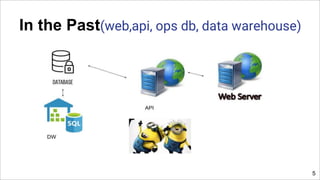
In the Past(web,api, ops db, data warehouse)
5
Then came Big Data...
6
Then came the cloud...
7
Then came the invoice ...
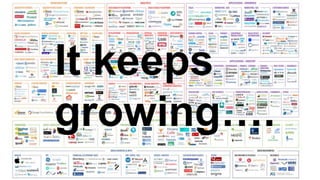
It keeps
growing….
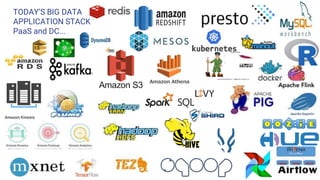
TODAY’S BIG DATA
APPLICATION STACK
PaaS and DC...
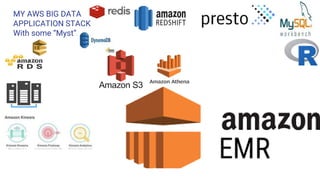
MY AWS BIG DATA
APPLICATION STACK
With some “Myst”...
Jargon
Big data?
Architecture?
Considerations?
Challenges?
How to get started?
Big Jargon & Basics concepts u should know
https://amazon-aws-big-data-demystified.ninja/2019/02/18/big-data-jargon-faqs-
and-everything-you-wanted-to-know-and-didnt-ask-about-big-data/
● What is Big Data?
● scale out / up ?
● structured/semi structured/unstructured data ?
● ACID?
● OLAP VS OLTP? == Analytics VS operational
● DIY = Do it Yourself
● PaaS = Platform as a service
Big Data =
When your data outgrows
your infrastructure ability to process
● Volume (x TB processing per day)
● Velocity ( x GB/s)
● Variety (JSON, CSV, events etc)
● Veracity (how much of the data is accurate?)
Challenges creating big data architecture?
● What is the business use case ? How fast do u need the insights?
○ 15 min - 24 hours delay and above → use batch
○ Less than 15 min?
■ Might be batch - depends data source is files or events?.
■ Streaming?
● Sub seconds delay?
● Sub minute delay?
■ Streaming with in flight analytics ?
○ How complex is the compute jobs? Aggregations? joins?
Challenges creating big data architecture?
● What is the Velocity?
○ Under 100K events per second? Not a problem
○ Over 1M events per second? Costly. But doable.
○ Over 1B events per seconds? Not trivial at all.
● Volume ?
○ ~1TB a day ? Not a problem
○ Over ? it depends.
○ Over a petabyte? Well…. It depends.
● Veracity (how are you going to handle different data sources?)
○ Structured (CSV)
○ Semi structured (JSON,XML)
○ Unstructured (pictures, movies etc)
Challenges creating big data architecture?
● Performance targets?
● Costs targets?
● Security restrictions?
● Regulation restriction? privacy?
● Which technology to choose?
● Datacenter or cloud?
● Latency?
● Throughput?
● Concurrency?
● Security Access patterns?
● Pass? Max 7 technologies
● Iaas? Max 4 technologies
Cloud Architecture rules of thumb...
● Decoupling
● Rule of thumb: max 3 technologies in dc, 7 tech max in cloud
○ Do use more b/c: maintenance
○ Training time
○ complexity/simplicity
How to get started on big data architecture?
Get answers to the below:
1. What is the business use case?
a. Volume? velocity? Variety? vercity/
b. Did you map all of data sources?
2. Where should we build a data platform?
a. What is the product? → requirements.
b. Cloud? datacenter?
3. Architecture?
a. DIY? Paas? , Pay as you go? Or fixed? Decoupled?
b. Fast? Cheap? simple?
4. Did you Communicate you plans?
5. Did you map all known challenges?
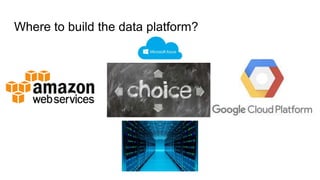
Where to build the data platform?
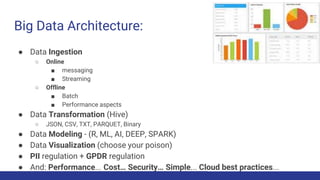
Big Data Architecture:
● Data Ingestion
○ Online
■ messaging
■ Streaming
○ Offline
■ Batch
■ Performance aspects
● Data Transformation (Hive)
○ JSON, CSV, TXT, PARQUET, Binary
● Data Modeling - (R, ML, AI, DEEP, SPARK)
● Data Visualization (choose your poison)
● PII regulation + GPDR regulation
● And: Performance... Cost… Security… Simple... Cloud best practices...
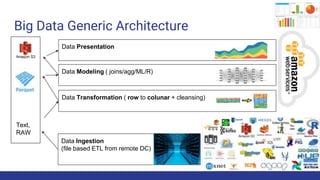
Big Data Generic Architecture
Data Ingestion
(file based ETL from remote DC)
Data Transformation ( row to colunar + cleansing)
Data Modeling ( joins/agg/ML/R)
Data Presentation
Text,
RAW
Data Ingestion
A layer in your big data architecture
designed to do one thing : ingest
data via Batch or Streaming, I.e
move (only) data from point A to
point B. from source data to the
next layer in the architecture
(decoupled).
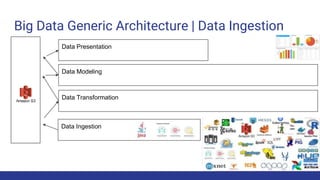
Big Data Generic Architecture | Data Ingestion
Data Ingestion
Data Transformation
Data Modeling
Data Presentation
S3 Considerations
● Security
○ at rest: server side S3-Managed Keys (SSE-S3)
○ at transit: SSL / VPN
○ Hardening: user, IP ACL, write permission only.
● Upload
○ AWS s3 cli
○ Multi part upload
○ Aborting Incomplete Multipart Uploads Using a
Bucket Lifecycle Policy
○ Consider S3 CLI Sync command instead of CP
Sqoop - ETL
● Open source , part of EMR
● HDFS to RDMS and back. Via JDBC.
● E.g BiDirectional ETL from RDS to HDFS
● Unlikely use case: ETL from customer source operational DB.
Flume & Kafka
● Opens source project for streaming & messaging
● Popular
● Generic
● Good practice for many use cases. (a meetup by it self)
● Highly durable, scalable, extension etc.
● Downside : DIY, Non trivial to get started
Data Transfer Options
● Direct Connect (4GB/s?)
● For all other use case
○ S3 multipart upload
○ Compression
○ Security
■ Data at motion
■ Data at rest
Kinesis family of products
● Kinesis Stream - collect@source and near real time processing
○ Near real time
○ High throughput
○ Low cost
○ Easy administration - set desired level of capacity
○ Delivery to : s3,redshift, Dynamo, ...
○ Ingress 1mb, egress 2mbs. Upto 1000 Transaction per second.
○ Not managed!
● Kinesis Analytics - in flight analytics.
● Kin. Firehose - Park you data @ destination.
Kinesis Firehose - for Data parking
● Not for fast lane - no in flight analytics
● Ingest , transform and load to:
○ Kinesis
○ S3
○ Redshift
○ elastic search
● Managed Service
Comparison of Kinesis products
● Streams
○ Sub 1 sec processing latency
○ Choice of stream processor (generic)
○ For smaller events
● Firehose
○ Zero admin
○ 4 targets built in (redshift, s3, search, etc)
○ Buffering 60 sec minimum.
○ For larger “events”
Data
Transformation
A layer in your big data architecture
designed to : Transform and
Cleanse data (row data to columnar
data and convert data types, Fix
bugs in data)
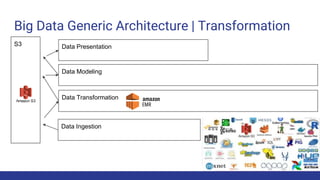
Big Data Generic Architecture | Transformation
Data Ingestion
S3
Data Transformation
Data Modeling
Data Presentation
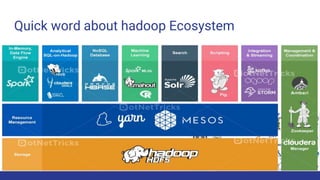
Quick word about hadoop Ecosystem
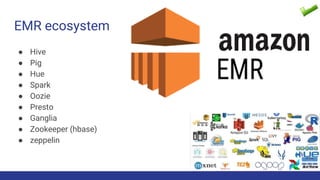
EMR ecosystem
● Hive
● Pig
● Hue
● Spark
● Oozie
● Presto
● Ganglia
● Zookeeper (hbase)
● zeppelin
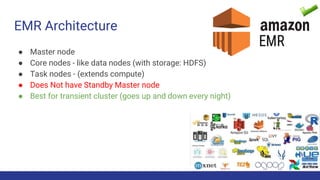
EMR Architecture
● Master node
● Core nodes - like data nodes (with storage: HDFS)
● Task nodes - (extends compute)
● Does Not have Standby Master node
● Best for transient cluster (goes up and down every night)
EMR lesson learned...
● Bigger instance type is good architecture
● Use spot instances - for the tasks only.
● Don't always use TEZ (MR? Spark?)
● Make sure your choose instance with network optimized
● Resize cluster is not recommended
● Bootstrap to automate cluster upon provisioning
● Use Steps to automate steps on running cluster
● Use Glue to share Hive MetaStore
● Good Cost reduction article on EMR
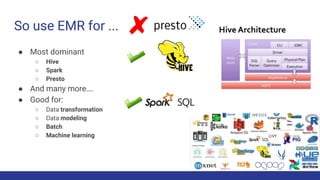
So use EMR for ...
● Most dominant
○ Hive
○ Spark
○ Presto
● And many more….
● Good for:
○ Data transformation
○ Data modeling
○ Batch
○ Machine learning
Hive
● SQL over hadoop.
● Engine: spark, tez, MR
● JDBC / ODBC
● Not good when need to shuffle.
● Not peta scale.
● SerDe json, parquet,regex,text etc.
● Dynamic partitions
● Insert overwrite
● Data Transformation
● Convert to Columnar
Presto
● SQL over hadoop
● Not good always for join on 2 large tables.
● Limited by memory
● Not fault tolerant like hive.
● Optimized for ad hoc queries
● No insert overwrite
● No dynamic partitions.
● Has some connectors : redshift and more
● https://amazon-aws-big-data-
demystified.ninja/2018/07/02/aws-emr-
presto-demystified-everything-you-
wanted-to-know-about-presto/
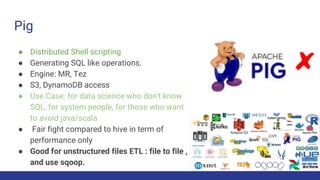
Pig
● Distributed Shell scripting
● Generating SQL like operations.
● Engine: MR, Tez
● S3, DynamoDB access
● Use Case: for data science who don't know
SQL, for system people, for those who want
to avoid java/scala
● Fair fight compared to hive in term of
performance only
● Good for unstructured files ETL : file to file ,
and use sqoop.
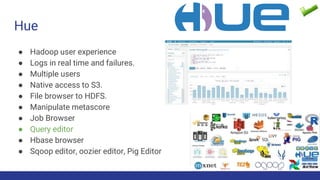
Hue
● Hadoop user experience
● Logs in real time and failures.
● Multiple users
● Native access to S3.
● File browser to HDFS.
● Manipulate metascore
● Job Browser
● Query editor
● Hbase browser
● Sqoop editor, oozier editor, Pig Editor
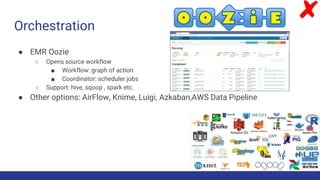
Orchestration
● EMR Oozie
○ Opens source workflow
■ Workflow: graph of action
■ Coordinator: scheduler jobs
○ Support: hive, sqoop , spark etc.
● Other options: AirFlow, Knime, Luigi, Azkaban,AWS Data Pipeline
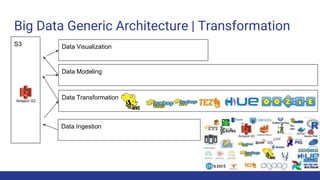
Big Data Generic Architecture | Transformation
Data Ingestion
S3
Data Transformation
Data Modeling
Data Visualization
Data Modeling
A layer in your big data architecture
designed to Model data: Joins,
Aggregations, nightly jobs, Machine
learning
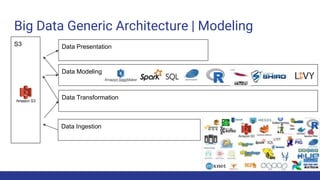
Big Data Generic Architecture | Modeling
Data Ingestion
S3
Data Transformation
Data Modeling
Data Presentation
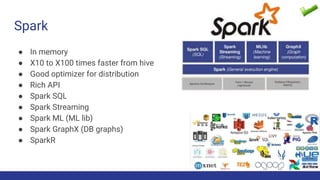
Spark
● In memory
● X10 to X100 times faster from hive
● Good optimizer for distribution
● Rich API
● Spark SQL
● Spark Streaming
● Spark ML (ML lib)
● Spark GraphX (DB graphs)
● SparkR
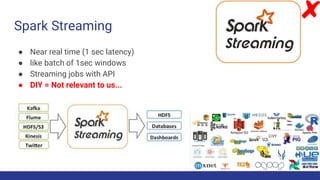
Spark Streaming
● Near real time (1 sec latency)
● like batch of 1sec windows
● Streaming jobs with API
● DIY = Not relevant to us...
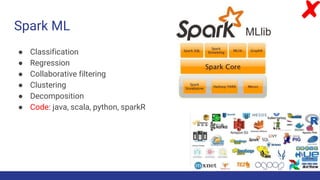
Spark ML
● Classification
● Regression
● Collaborative filtering
● Clustering
● Decomposition
● Code: java, scala, python, sparkR
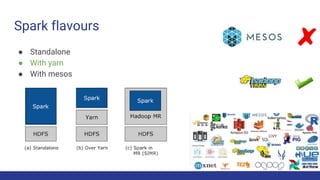
Spark flavours
● Standalone
● With yarn
● With mesos
Spark SQL
● Same syntax as hive
● Optional JDBC via thrift
● Non trivial learning curve
● Upto X10 faster than hive.
● Works well with Zeppelin (out of the box)
● Does not replaces Hive
● Spark not always faster than hive
● insert overwrite -
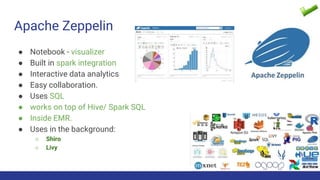
Apache Zeppelin
● Notebook - visualizer
● Built in spark integration
● Interactive data analytics
● Easy collaboration.
● Uses SQL
● works on top of Hive/ Spark SQL
● Inside EMR.
● Uses in the background:
○ Shiro
○ Livy
Redshift
● OLAP, not OLTP→ analytics , not transaction
● Fully SQL
● Fully ACID
● No indexing
● Fully managed
● Petabyte Scale
● MPP
● Can create slow queue for queries
○ which are long lasting.
● DO NOT USE FOR transformation.
● Good for : DW, Complex Joins.
EMR vs Redshift
● How much data loaded and unloaded?
● Which operations need to performed?
● Recycling data? → EMR
● History to be analyzed again and again ? → emr
● What the data needs to end up? BI?
● Use spectrum in some use cases. (aggregations)?
● Raw data? S3.
● When to use emr and when redshift?
Hive VS. Redshift
● Amount of concurrency ? low → hive, high → redshift
● Access to customers? Redshift? athena?
● Transformation, Unstructured , batch, ETL → hive.
● Peta scale ? redshift
● Complex joins → Redshift
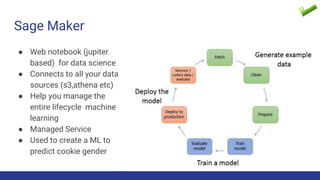
Sage Maker
● Web notebook (jupiter
based) for data science
● Connects to all your data
sources (s3,athena etc)
● Help you manage the
entire lifecycle machine
learning
● Managed Service
● Used to create a ML to
predict cookie gender
AWS Glue
Shared meta store
Helps with some data transformation (managed service)
Automatic Schema discovery
AWD RDS (aurora, postgres, mysql)
● We used RDS aurora as Operational DB
● We did not use it for big data analytics although it supports upto 64Tb
● It is row based.
● The syntax is missing analytical functions
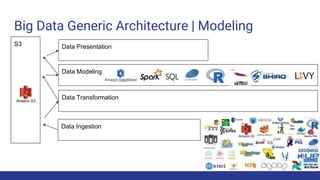
Big Data Generic Architecture | Modeling
Data Ingestion
S3
Data Transformation
Data Modeling
Data Presentation
Data
Presentation Used ONLY for presenting data for
operational applications or BI, Use
managed service to ensure HA.
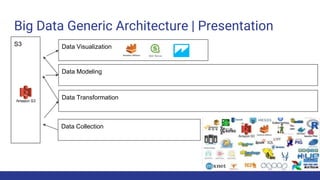
Big Data Generic Architecture | Presentation
Data Collection
S3
Data Transformation
Data Modeling
Data Visualization
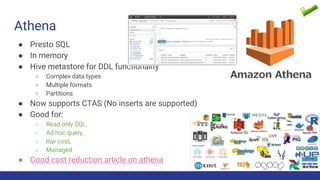
Athena
● Presto SQL
● In memory
● Hive metastore for DDL functionality
○ Complex data types
○ Multiple formats
○ Partitions
● Now supports CTAS (No inserts are supported)
● Good for:
○ Read only SQL,
○ Ad hoc query,
○ low cost,
○ Managed
● Good cost reduction article on athena
Summery Take Away Message &
Action Items
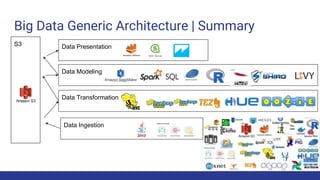
Big Data Generic Architecture | Summary
Data Ingestion
S3
Data Transformation
Data Modeling
Data Presentation
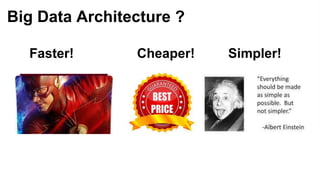
Big Data Architecture ?
Faster! Cheaper! Simpler!
How to get started | Call for Action
Lectures: AWS Big Data Demystified lectures #1 until #4
AWS Big Data Demystified Meetup Big Data Demystified meetup
Stay in touch...
● Omid Vahdaty
● +972-54-2384178
● https://big-data-demystified.ninja/
● Join our meetups subscribe to youtube channels
○ https://www.meetup.com/AWS-Big-Data-Demystified/
○ https://www.meetup.com/Big-Data-Demystified/
○ Big Data Demystified YouTube
○ AWS Big Data Demystified YouTube

Big Data in 200 km/h | AWS Big Data Demystified #1.3

  • 1.
    Big Data in200KM/h Omid Vahdaty, Big Data Ninja
  • 2.
    Disclaimer ● I amnot the best, I simply love what I do VERY much. ● You are more than welcome to challenge me or anything I have to say as I could be wrong. ● This Lecture has evolves over time, this is the 4th iteration. ● Feel Free to send me comments
  • 3.
    A little bitabout Me
  • 5.
    In the Past(web,api,ops db, data warehouse) 5
  • 6.
    Then came BigData... 6
  • 7.
    Then came thecloud... 7
  • 8.
    Then came theinvoice ...
  • 9.
  • 10.
    TODAY’S BIG DATA APPLICATIONSTACK PaaS and DC...
  • 11.
    MY AWS BIGDATA APPLICATION STACK With some “Myst”...
  • 12.
  • 13.
    Big Jargon &Basics concepts u should know https://amazon-aws-big-data-demystified.ninja/2019/02/18/big-data-jargon-faqs- and-everything-you-wanted-to-know-and-didnt-ask-about-big-data/ ● What is Big Data? ● scale out / up ? ● structured/semi structured/unstructured data ? ● ACID? ● OLAP VS OLTP? == Analytics VS operational ● DIY = Do it Yourself ● PaaS = Platform as a service
  • 14.
    Big Data = Whenyour data outgrows your infrastructure ability to process ● Volume (x TB processing per day) ● Velocity ( x GB/s) ● Variety (JSON, CSV, events etc) ● Veracity (how much of the data is accurate?)
  • 15.
    Challenges creating bigdata architecture? ● What is the business use case ? How fast do u need the insights? ○ 15 min - 24 hours delay and above → use batch ○ Less than 15 min? ■ Might be batch - depends data source is files or events?. ■ Streaming? ● Sub seconds delay? ● Sub minute delay? ■ Streaming with in flight analytics ? ○ How complex is the compute jobs? Aggregations? joins?
  • 16.
    Challenges creating bigdata architecture? ● What is the Velocity? ○ Under 100K events per second? Not a problem ○ Over 1M events per second? Costly. But doable. ○ Over 1B events per seconds? Not trivial at all. ● Volume ? ○ ~1TB a day ? Not a problem ○ Over ? it depends. ○ Over a petabyte? Well…. It depends. ● Veracity (how are you going to handle different data sources?) ○ Structured (CSV) ○ Semi structured (JSON,XML) ○ Unstructured (pictures, movies etc)
  • 17.
    Challenges creating bigdata architecture? ● Performance targets? ● Costs targets? ● Security restrictions? ● Regulation restriction? privacy? ● Which technology to choose? ● Datacenter or cloud? ● Latency? ● Throughput? ● Concurrency? ● Security Access patterns? ● Pass? Max 7 technologies ● Iaas? Max 4 technologies
  • 18.
    Cloud Architecture rulesof thumb... ● Decoupling ● Rule of thumb: max 3 technologies in dc, 7 tech max in cloud ○ Do use more b/c: maintenance ○ Training time ○ complexity/simplicity
  • 19.
    How to getstarted on big data architecture? Get answers to the below: 1. What is the business use case? a. Volume? velocity? Variety? vercity/ b. Did you map all of data sources? 2. Where should we build a data platform? a. What is the product? → requirements. b. Cloud? datacenter? 3. Architecture? a. DIY? Paas? , Pay as you go? Or fixed? Decoupled? b. Fast? Cheap? simple? 4. Did you Communicate you plans? 5. Did you map all known challenges?
  • 20.
    Where to buildthe data platform?
  • 21.
    Big Data Architecture: ●Data Ingestion ○ Online ■ messaging ■ Streaming ○ Offline ■ Batch ■ Performance aspects ● Data Transformation (Hive) ○ JSON, CSV, TXT, PARQUET, Binary ● Data Modeling - (R, ML, AI, DEEP, SPARK) ● Data Visualization (choose your poison) ● PII regulation + GPDR regulation ● And: Performance... Cost… Security… Simple... Cloud best practices...
  • 22.
    Big Data GenericArchitecture Data Ingestion (file based ETL from remote DC) Data Transformation ( row to colunar + cleansing) Data Modeling ( joins/agg/ML/R) Data Presentation Text, RAW
  • 23.
    Data Ingestion A layerin your big data architecture designed to do one thing : ingest data via Batch or Streaming, I.e move (only) data from point A to point B. from source data to the next layer in the architecture (decoupled).
  • 24.
    Big Data GenericArchitecture | Data Ingestion Data Ingestion Data Transformation Data Modeling Data Presentation
  • 25.
    S3 Considerations ● Security ○at rest: server side S3-Managed Keys (SSE-S3) ○ at transit: SSL / VPN ○ Hardening: user, IP ACL, write permission only. ● Upload ○ AWS s3 cli ○ Multi part upload ○ Aborting Incomplete Multipart Uploads Using a Bucket Lifecycle Policy ○ Consider S3 CLI Sync command instead of CP
  • 26.
    Sqoop - ETL ●Open source , part of EMR ● HDFS to RDMS and back. Via JDBC. ● E.g BiDirectional ETL from RDS to HDFS ● Unlikely use case: ETL from customer source operational DB.
  • 27.
    Flume & Kafka ●Opens source project for streaming & messaging ● Popular ● Generic ● Good practice for many use cases. (a meetup by it self) ● Highly durable, scalable, extension etc. ● Downside : DIY, Non trivial to get started
  • 28.
    Data Transfer Options ●Direct Connect (4GB/s?) ● For all other use case ○ S3 multipart upload ○ Compression ○ Security ■ Data at motion ■ Data at rest
  • 29.
    Kinesis family ofproducts ● Kinesis Stream - collect@source and near real time processing ○ Near real time ○ High throughput ○ Low cost ○ Easy administration - set desired level of capacity ○ Delivery to : s3,redshift, Dynamo, ... ○ Ingress 1mb, egress 2mbs. Upto 1000 Transaction per second. ○ Not managed! ● Kinesis Analytics - in flight analytics. ● Kin. Firehose - Park you data @ destination.
  • 30.
    Kinesis Firehose -for Data parking ● Not for fast lane - no in flight analytics ● Ingest , transform and load to: ○ Kinesis ○ S3 ○ Redshift ○ elastic search ● Managed Service
  • 31.
    Comparison of Kinesisproducts ● Streams ○ Sub 1 sec processing latency ○ Choice of stream processor (generic) ○ For smaller events ● Firehose ○ Zero admin ○ 4 targets built in (redshift, s3, search, etc) ○ Buffering 60 sec minimum. ○ For larger “events”
  • 32.
    Data Transformation A layer inyour big data architecture designed to : Transform and Cleanse data (row data to columnar data and convert data types, Fix bugs in data)
  • 33.
    Big Data GenericArchitecture | Transformation Data Ingestion S3 Data Transformation Data Modeling Data Presentation
  • 34.
    Quick word abouthadoop Ecosystem
  • 35.
    EMR ecosystem ● Hive ●Pig ● Hue ● Spark ● Oozie ● Presto ● Ganglia ● Zookeeper (hbase) ● zeppelin
  • 36.
    EMR Architecture ● Masternode ● Core nodes - like data nodes (with storage: HDFS) ● Task nodes - (extends compute) ● Does Not have Standby Master node ● Best for transient cluster (goes up and down every night)
  • 37.
    EMR lesson learned... ●Bigger instance type is good architecture ● Use spot instances - for the tasks only. ● Don't always use TEZ (MR? Spark?) ● Make sure your choose instance with network optimized ● Resize cluster is not recommended ● Bootstrap to automate cluster upon provisioning ● Use Steps to automate steps on running cluster ● Use Glue to share Hive MetaStore ● Good Cost reduction article on EMR
  • 38.
    So use EMRfor ... ● Most dominant ○ Hive ○ Spark ○ Presto ● And many more…. ● Good for: ○ Data transformation ○ Data modeling ○ Batch ○ Machine learning
  • 39.
    Hive ● SQL overhadoop. ● Engine: spark, tez, MR ● JDBC / ODBC ● Not good when need to shuffle. ● Not peta scale. ● SerDe json, parquet,regex,text etc. ● Dynamic partitions ● Insert overwrite ● Data Transformation ● Convert to Columnar
  • 40.
    Presto ● SQL overhadoop ● Not good always for join on 2 large tables. ● Limited by memory ● Not fault tolerant like hive. ● Optimized for ad hoc queries ● No insert overwrite ● No dynamic partitions. ● Has some connectors : redshift and more ● https://amazon-aws-big-data- demystified.ninja/2018/07/02/aws-emr- presto-demystified-everything-you- wanted-to-know-about-presto/
  • 41.
    Pig ● Distributed Shellscripting ● Generating SQL like operations. ● Engine: MR, Tez ● S3, DynamoDB access ● Use Case: for data science who don't know SQL, for system people, for those who want to avoid java/scala ● Fair fight compared to hive in term of performance only ● Good for unstructured files ETL : file to file , and use sqoop.
  • 42.
    Hue ● Hadoop userexperience ● Logs in real time and failures. ● Multiple users ● Native access to S3. ● File browser to HDFS. ● Manipulate metascore ● Job Browser ● Query editor ● Hbase browser ● Sqoop editor, oozier editor, Pig Editor
  • 43.
    Orchestration ● EMR Oozie ○Opens source workflow ■ Workflow: graph of action ■ Coordinator: scheduler jobs ○ Support: hive, sqoop , spark etc. ● Other options: AirFlow, Knime, Luigi, Azkaban,AWS Data Pipeline
  • 44.
    Big Data GenericArchitecture | Transformation Data Ingestion S3 Data Transformation Data Modeling Data Visualization
  • 45.
    Data Modeling A layerin your big data architecture designed to Model data: Joins, Aggregations, nightly jobs, Machine learning
  • 46.
    Big Data GenericArchitecture | Modeling Data Ingestion S3 Data Transformation Data Modeling Data Presentation
  • 47.
    Spark ● In memory ●X10 to X100 times faster from hive ● Good optimizer for distribution ● Rich API ● Spark SQL ● Spark Streaming ● Spark ML (ML lib) ● Spark GraphX (DB graphs) ● SparkR
  • 48.
    Spark Streaming ● Nearreal time (1 sec latency) ● like batch of 1sec windows ● Streaming jobs with API ● DIY = Not relevant to us...
  • 49.
    Spark ML ● Classification ●Regression ● Collaborative filtering ● Clustering ● Decomposition ● Code: java, scala, python, sparkR
  • 50.
    Spark flavours ● Standalone ●With yarn ● With mesos
  • 51.
    Spark SQL ● Samesyntax as hive ● Optional JDBC via thrift ● Non trivial learning curve ● Upto X10 faster than hive. ● Works well with Zeppelin (out of the box) ● Does not replaces Hive ● Spark not always faster than hive ● insert overwrite -
  • 52.
    Apache Zeppelin ● Notebook- visualizer ● Built in spark integration ● Interactive data analytics ● Easy collaboration. ● Uses SQL ● works on top of Hive/ Spark SQL ● Inside EMR. ● Uses in the background: ○ Shiro ○ Livy
  • 53.
    Redshift ● OLAP, notOLTP→ analytics , not transaction ● Fully SQL ● Fully ACID ● No indexing ● Fully managed ● Petabyte Scale ● MPP ● Can create slow queue for queries ○ which are long lasting. ● DO NOT USE FOR transformation. ● Good for : DW, Complex Joins.
  • 54.
    EMR vs Redshift ●How much data loaded and unloaded? ● Which operations need to performed? ● Recycling data? → EMR ● History to be analyzed again and again ? → emr ● What the data needs to end up? BI? ● Use spectrum in some use cases. (aggregations)? ● Raw data? S3. ● When to use emr and when redshift?
  • 55.
    Hive VS. Redshift ●Amount of concurrency ? low → hive, high → redshift ● Access to customers? Redshift? athena? ● Transformation, Unstructured , batch, ETL → hive. ● Peta scale ? redshift ● Complex joins → Redshift
  • 56.
    Sage Maker ● Webnotebook (jupiter based) for data science ● Connects to all your data sources (s3,athena etc) ● Help you manage the entire lifecycle machine learning ● Managed Service ● Used to create a ML to predict cookie gender
  • 57.
    AWS Glue Shared metastore Helps with some data transformation (managed service) Automatic Schema discovery
  • 58.
    AWD RDS (aurora,postgres, mysql) ● We used RDS aurora as Operational DB ● We did not use it for big data analytics although it supports upto 64Tb ● It is row based. ● The syntax is missing analytical functions
  • 59.
    Big Data GenericArchitecture | Modeling Data Ingestion S3 Data Transformation Data Modeling Data Presentation
  • 60.
    Data Presentation Used ONLYfor presenting data for operational applications or BI, Use managed service to ensure HA.
  • 61.
    Big Data GenericArchitecture | Presentation Data Collection S3 Data Transformation Data Modeling Data Visualization
  • 62.
    Athena ● Presto SQL ●In memory ● Hive metastore for DDL functionality ○ Complex data types ○ Multiple formats ○ Partitions ● Now supports CTAS (No inserts are supported) ● Good for: ○ Read only SQL, ○ Ad hoc query, ○ low cost, ○ Managed ● Good cost reduction article on athena
  • 63.
    Summery Take AwayMessage & Action Items
  • 64.
    Big Data GenericArchitecture | Summary Data Ingestion S3 Data Transformation Data Modeling Data Presentation
  • 65.
    Big Data Architecture? Faster! Cheaper! Simpler!
  • 66.
    How to getstarted | Call for Action Lectures: AWS Big Data Demystified lectures #1 until #4 AWS Big Data Demystified Meetup Big Data Demystified meetup
  • 67.
    Stay in touch... ●Omid Vahdaty ● +972-54-2384178 ● https://big-data-demystified.ninja/ ● Join our meetups subscribe to youtube channels ○ https://www.meetup.com/AWS-Big-Data-Demystified/ ○ https://www.meetup.com/Big-Data-Demystified/ ○ Big Data Demystified YouTube ○ AWS Big Data Demystified YouTube