Tagging and Processing Data in
Real Time
Hari Shreedharan
Cloudera
Siddhartha Jain
Salesforce.com
Features
● Process and normalize log streams in near real time
○ regex matching
● Scale from 100k events per second to a million
○ More producers could get added in real time
○ Must scale to increasing data volumes
● Horizontal scalability and fault tolerance
○ Throwing more hardware at the app should not break the app
○ Machines/Tiers can fail and come back
● Ability to plug in existing frameworks
○ Kafka, HDFS, Elastic Search, Spark….
Goals
● Search/Analysis
○ Investigations and casual exploration
● Compute
○ Data Science, correlation and alerting
● Enrich
○ For integrating external threat feeds and internally generated profiles
Expectations
● Stream processing delay tolerance
○ Worst case < 5 minutes
● Volume of messages
○ Anywhere between 100k/sec to 1 million/sec
● Maintain common data dictionary across ingest, store and compute
pipelines
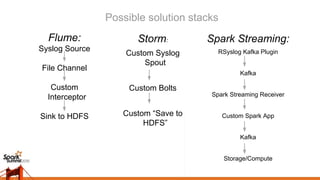
Possible solution stacks
Flume:
Syslog Source
File Channel
Custom
Interceptor
Sink to HDFS
Storm:
Custom Syslog
Spout
Custom Bolts
Custom “Save to
HDFS”
Spark Streaming:
RSyslog Kafka Plugin
Kafka
Spark Streaming Receiver
Custom Spark App
Kafka
Storage/Compute
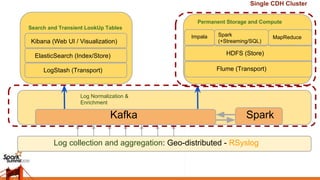
Log collection and aggregation: Geo-distributed - RSyslog
Log Normalization &
Enrichment
Kafka Spark
LogStash (Transport)
ElasticSearch (Index/Store)
Kibana (Web UI / Visualization)
Search and Transient LookUp Tables
Flume (Transport)
HDFS (Store)
Impala Spark
(+Streaming/SQL)
MapReduce
Permanent Storage and Compute
Single CDH Cluster
<86>May 15 20:29:59 rh6-x64-test-template sshd[32632]: Accepted publickey for jdoe from 10.3.1.1 port 62902
ssh2
RSyslog
<86>May 15 20:29:59 rh6-x64-test-template sshd[32632]: Accepted publickey for jdoe from 10.3.1.1 port 62902
ssh2
Kafka (topic=rawUnStructured)
Spark (Apply Regex match/extract, map to JSON)
topic=NormalizedStructured
JSON = {
"srcIP": "10.3.1.1",
"srcPort": "62902",
"serviceType": "authentication",
"regexMatch":
"sshdAcceptedSessionsLinux",
"user": "jdoe",
"product": "Linux",
"@version": "1",
"@timestamp": "2015-05-15T20:30:53.714Z"
}
Kafka
topic=sshdAcceptedSessionsLinux
JSON = {
"srcIP": "10.3.9.1",
"srcPort": "62902",
"serviceType": "authentication",
"regexMatch": "sshdAcceptedSessionsLinux",
"user": "jdoe",
"product": "Linux",
"@version": "1",
"@timestamp": "2015-05-15T20:30:53.714Z"
}
topic=srcIP
1.1.1.1
2.2.2.2
4.4.4.4
topic=User
joe
jane
doe
john …..
topic=dstIP
10.1.1.1
10.2.2.2
7.2.2.2
3.3.3.3
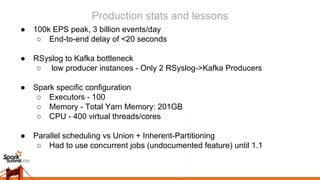
Production stats and lessons
● 100k EPS peak, 3 billion events/day
○ End-to-end delay of <20 seconds
● RSyslog to Kafka bottleneck
○ low producer instances - Only 2 RSyslog->Kafka Producers
● Spark specific configuration
○ Executors - 100
○ Memory - Total Yarn Memory: 201GB
○ CPU - 400 virtual threads/cores
● Parallel scheduling vs Union + Inherent-Partitioning
○ Had to use concurrent jobs (undocumented feature) until 1.1
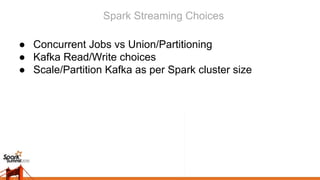
Spark Streaming Choices
● Concurrent Jobs vs Union/Partitioning
● Kafka Read/Write choices
● Scale/Partition Kafka as per Spark cluster size
Issues
● None of the issues were because of Spark Streaming!
● Going from Spark 0.9 to 1.3
● YARN logAggregation
○ too verbose, crashing the executor nodes
● Yarn Client vs Cluster mode
○ failed at first attempt
● Too many config options, switches/knobs
○ hard to test/identify bottlenecks/bugs
More Issues
● Can’t debug issues in an IDE
● Can’t debug or identify bottlenecks with test data easily or test flows
● If something gets fixed eventually in Spark, don’t bother trying to find root
cause of why it didn’t work earlier
○ You probably won’t be able to figure out in a reasonable amount of time
(100s of commits per release!)
What it’s not
● All open source, no proprietary data stores or compute frameworks
● It is a platform, adaptable to any big data problem, no silver bullet or magic
sauce
● Uses scalable data stores, no massive monolithic databases
● Mostly plumbing/integration work, no massive code to maintain
● Runs on commodity hardware, no custom hardware

Tagging and Processing Data in Real Time-(Hari Shreedharan and Siddhartha Jain, Cloudera and Salesforce)

  • 1.
    Tagging and ProcessingData in Real Time Hari Shreedharan Cloudera Siddhartha Jain Salesforce.com
  • 2.
    Features ● Process andnormalize log streams in near real time ○ regex matching ● Scale from 100k events per second to a million ○ More producers could get added in real time ○ Must scale to increasing data volumes ● Horizontal scalability and fault tolerance ○ Throwing more hardware at the app should not break the app ○ Machines/Tiers can fail and come back ● Ability to plug in existing frameworks ○ Kafka, HDFS, Elastic Search, Spark….
  • 3.
    Goals ● Search/Analysis ○ Investigationsand casual exploration ● Compute ○ Data Science, correlation and alerting ● Enrich ○ For integrating external threat feeds and internally generated profiles
  • 4.
    Expectations ● Stream processingdelay tolerance ○ Worst case < 5 minutes ● Volume of messages ○ Anywhere between 100k/sec to 1 million/sec ● Maintain common data dictionary across ingest, store and compute pipelines
  • 5.
    Possible solution stacks Flume: SyslogSource File Channel Custom Interceptor Sink to HDFS Storm: Custom Syslog Spout Custom Bolts Custom “Save to HDFS” Spark Streaming: RSyslog Kafka Plugin Kafka Spark Streaming Receiver Custom Spark App Kafka Storage/Compute
  • 6.
    Log collection andaggregation: Geo-distributed - RSyslog Log Normalization & Enrichment Kafka Spark LogStash (Transport) ElasticSearch (Index/Store) Kibana (Web UI / Visualization) Search and Transient LookUp Tables Flume (Transport) HDFS (Store) Impala Spark (+Streaming/SQL) MapReduce Permanent Storage and Compute Single CDH Cluster
  • 7.
    <86>May 15 20:29:59rh6-x64-test-template sshd[32632]: Accepted publickey for jdoe from 10.3.1.1 port 62902 ssh2 RSyslog <86>May 15 20:29:59 rh6-x64-test-template sshd[32632]: Accepted publickey for jdoe from 10.3.1.1 port 62902 ssh2 Kafka (topic=rawUnStructured) Spark (Apply Regex match/extract, map to JSON) topic=NormalizedStructured JSON = { "srcIP": "10.3.1.1", "srcPort": "62902", "serviceType": "authentication", "regexMatch": "sshdAcceptedSessionsLinux", "user": "jdoe", "product": "Linux", "@version": "1", "@timestamp": "2015-05-15T20:30:53.714Z" } Kafka topic=sshdAcceptedSessionsLinux JSON = { "srcIP": "10.3.9.1", "srcPort": "62902", "serviceType": "authentication", "regexMatch": "sshdAcceptedSessionsLinux", "user": "jdoe", "product": "Linux", "@version": "1", "@timestamp": "2015-05-15T20:30:53.714Z" } topic=srcIP 1.1.1.1 2.2.2.2 4.4.4.4 topic=User joe jane doe john ….. topic=dstIP 10.1.1.1 10.2.2.2 7.2.2.2 3.3.3.3
  • 8.
    Production stats andlessons ● 100k EPS peak, 3 billion events/day ○ End-to-end delay of <20 seconds ● RSyslog to Kafka bottleneck ○ low producer instances - Only 2 RSyslog->Kafka Producers ● Spark specific configuration ○ Executors - 100 ○ Memory - Total Yarn Memory: 201GB ○ CPU - 400 virtual threads/cores ● Parallel scheduling vs Union + Inherent-Partitioning ○ Had to use concurrent jobs (undocumented feature) until 1.1
  • 9.
    Spark Streaming Choices ●Concurrent Jobs vs Union/Partitioning ● Kafka Read/Write choices ● Scale/Partition Kafka as per Spark cluster size
  • 10.
    Issues ● None ofthe issues were because of Spark Streaming! ● Going from Spark 0.9 to 1.3 ● YARN logAggregation ○ too verbose, crashing the executor nodes ● Yarn Client vs Cluster mode ○ failed at first attempt ● Too many config options, switches/knobs ○ hard to test/identify bottlenecks/bugs
  • 11.
    More Issues ● Can’tdebug issues in an IDE ● Can’t debug or identify bottlenecks with test data easily or test flows ● If something gets fixed eventually in Spark, don’t bother trying to find root cause of why it didn’t work earlier ○ You probably won’t be able to figure out in a reasonable amount of time (100s of commits per release!)
  • 12.
    What it’s not ●All open source, no proprietary data stores or compute frameworks ● It is a platform, adaptable to any big data problem, no silver bullet or magic sauce ● Uses scalable data stores, no massive monolithic databases ● Mostly plumbing/integration work, no massive code to maintain ● Runs on commodity hardware, no custom hardware