Postmodernism
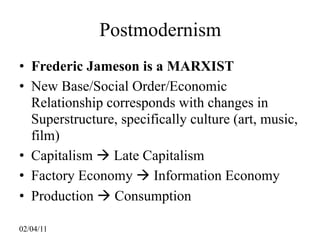
• Fredric Jameson is a MARXIST
• New Base/Social Order/Economic
  Relationship corresponds with changes in
  Superstructure, specifically culture (art, music,
  film)
• Capitalism  Late Capitalism
• Factory Economy  Information Economy
• Production  Consumption

02/04/11
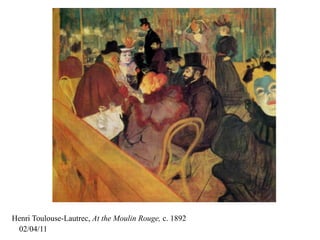
Henri Toulouse-Lautrec, At the Moulin Rouge, c. 1892
 02/04/11
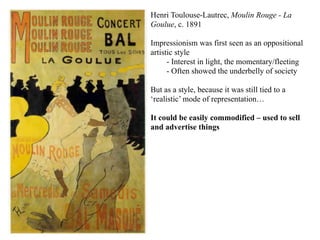
Henri Toulouse-Lautrec, Moulin Rouge - La
           Goulue, c. 1891

           Impressionism was first seen as an oppositional
           artistic style
                 - Interest in light, the momentary/fleeting
                 - Often showed the underbelly of society

           But as a style, because it was still tied to a
           ‘realistic’ mode of representation…

           It could be easily commodified – used to sell
           and advertise things


02/04/11
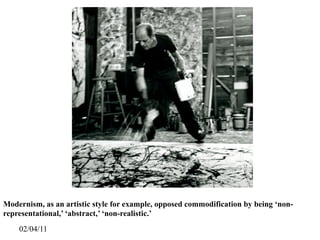
Modernism, as an artistic style for example, opposed commodification by being ‘non-
representational,’ ‘abstract,’ ‘non-realistic.’
    02/04/11
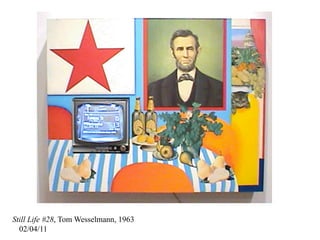
Still Life #28, Tom Wesselmann, 1963
  02/04/11
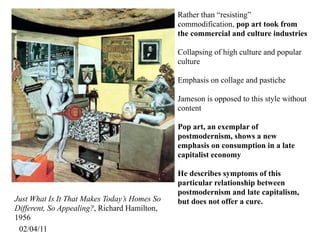
Rather than “resisting”
                                              commodification, pop art took from
                                              the commercial and culture industries

                                              Collapsing of high culture and popular
                                              culture

                                              Emphasis on collage and pastiche

                                              Jameson is opposed to this style without
                                              content

                                              Pop art, an exemplar of
                                              postmodernism, shows a new
                                              emphasis on consumption in a late
                                              capitalist economy

                                              He describes symptoms of this
                                              particular relationship between
                                              postmodernism and late capitalism,
Just What Is It That Makes Today’s Homes So   but does not offer a cure.
Different, So Appealing?, Richard Hamilton,
1956
 02/04/11
Postmodernism
• Frederic Jameson is a MARXIST
• New Base/Social Order/Economic
  Relationship corresponds with changes in
  Superstructure, specifically culture (art, music,
  film)
• Capitalism  Late Capitalism
• Factory Economy  Information Economy
• Production  Consumption

02/04/11
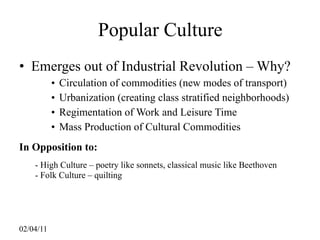
Popular Culture
• Emerges out of Industrial Revolution – Why?
           •   Circulation of commodities (new modes of transport)
           •   Urbanization (creating class stratified neighborhoods)
           •   Regimentation of Work and Leisure Time
           •   Mass Production of Cultural Commodities
In Opposition to:
    - High Culture – poetry like sonnets, classical music like Beethoven
    - Folk Culture – quilting


02/04/11
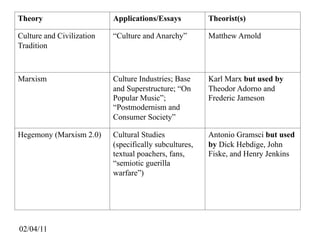
Theory                     Applications/Essays          Theorist(s)

Culture and Civilization   “Culture and Anarchy”        Matthew Arnold
Tradition


Marxism                    Culture Industries; Base     Karl Marx but used by
                           and Superstructure; “On      Theodor Adorno and
                           Popular Music”;              Frederic Jameson
                           “Postmodernism and
                           Consumer Society”

Hegemony (Marxism 2.0)     Cultural Studies             Antonio Gramsci but used
                           (specifically subcultures,   by Dick Hebdige, John
                           textual poachers, fans,      Fiske, and Henry Jenkins
                           “semiotic guerilla
                           warfare”)


02/04/11
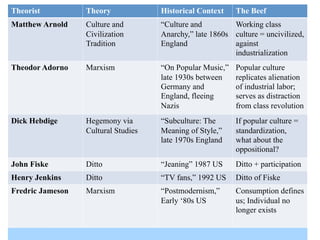
Theorist          Theory             Historical Context    The Beef
Matthew Arnold    Culture and        “Culture and         Working class
                  Civilization       Anarchy,” late 1860s culture = uncivilized,
                  Tradition          England              against
                                                          industrialization
Theodor Adorno    Marxism            “On Popular Music,”   Popular culture
                                     late 1930s between    replicates alienation
                                     Germany and           of industrial labor;
                                     England, fleeing      serves as distraction
                                     Nazis                 from class revolution
Dick Hebdige      Hegemony via       “Subculture: The      If popular culture =
                  Cultural Studies   Meaning of Style,”    standardization,
                                     late 1970s England    what about the
                                                           oppositional?
John Fiske        Ditto              “Jeaning” 1987 US     Ditto + participation
Henry Jenkins     Ditto              “TV fans,” 1992 US    Ditto of Fiske
Fredric Jameson   Marxism            “Postmodernism,”      Consumption defines
                                     Early ‘80s US         us; Individual no
                                                           longer exists

  02/04/11
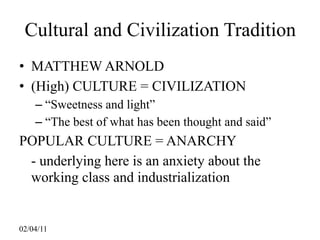
Cultural and Civilization Tradition
• MATTHEW ARNOLD
• (High) CULTURE = CIVILIZATION
    – “Sweetness and light”
    – “The best of what has been thought and said”
POPULAR CULTURE = ANARCHY
 - underlying here is an anxiety about the
 working class and industrialization


02/04/11
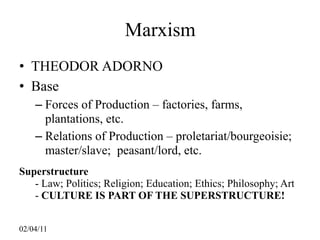
Marxism
• THEODOR ADORNO
• Base
    – Forces of Production – factories, farms,
      plantations, etc.
    – Relations of Production – proletariat/bourgeoisie;
      master/slave; peasant/lord, etc.
Superstructure
   - Law; Politics; Religion; Education; Ethics; Philosophy; Art
   - CULTURE IS PART OF THE SUPERSTRUCTURE!


02/04/11
Marxism
• Base  Superstructure = Economic Determinism;
  VULGAR MARXISM
• Base  Superstructure = Cultural Determinism
• Base  Superstructure = This is what we want!
    – The base shapes and conditions the superstructure: it
      establishes the terrain on which culture is lived and
      experienced
    – The superstructure sustains the base: a society’s
      culture, law, politics, and religion legitimize its forces
      and relations of production

02/04/11
MARXISM : The Culture Industry
• MARXIST CRITIQUE by THEODOR ADORNO
• Base = Mass production
• Superstructure = Mass-produced popular culture,
  standardized ideas, conformity, obedience
• Specifically:
    – Standardization (The Sitcom)
    – Pseudo-individualization (The Office UK vs. US)
    – Social Cement (Prime Time TV  end-goal of
      obedience)

02/04/11
Hegemony
• Marxism 2.0
• ANTONIO GRAMSCI
    – Wrote this theory in prison in Fascist Italy, early 1930s
    – Given the oppressive nature of capitalism’s class
      relations, why does the proletariat not rise up in
      revolution?
    – Frames people NOT as docile bodies complicit in their
      subjugation


02/04/11
So what is it?
• Hegemony is the process by which the ruling
  class actively works to secure the proletariat’s
  consent for its moral, cultural, intellectual, and
  political leadership.
• Series of negotiations between dominant and
  subordinate groups
• As a theory recognizes that people (the
  proletariat) have agency. They are NOT
  docile/obedient/passive masses.

02/04/11
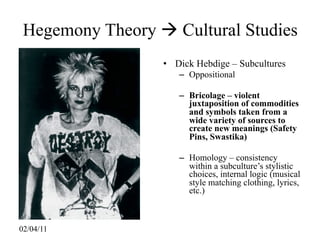
Hegemony Theory  Cultural Studies
                  • Dick Hebdige – Subcultures
                     – Oppositional

                     – Bricolage – violent
                       juxtaposition of commodities
                       and symbols taken from a
                       wide variety of sources to
                       create new meanings (Safety
                       Pins, Swastika)

                     – Homology – consistency
                       within a subculture’s stylistic
                       choices, internal logic (musical
                       style matching clothing, lyrics,
                       etc.)


02/04/11
Culture Studies Continued
• TEXTUAL POACHING, Henry Jenkins
           • Practice by which fans as active readers assert their
             mastery and control over mass-produced texts
           • But more than fans, we all poach. We create meaning
             through the process of reading.
           • We contest the author’s authority and right to determine
             what a text means.


02/04/11
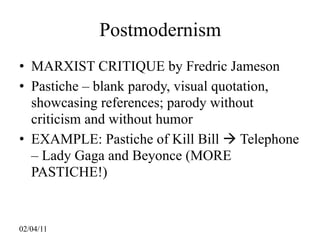
Postmodernism
• MARXIST CRITIQUE by Fredric Jameson
• Pastiche – blank parody, visual quotation,
  showcasing references; parody without
  criticism and without humor
• EXAMPLE: Pastiche of Kill Bill  Telephone
  – Lady Gaga and Beyonce (MORE
  PASTICHE!)


02/04/11
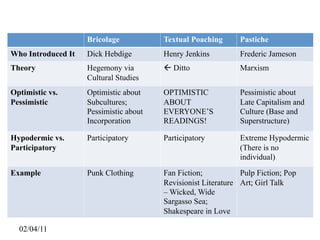
Bricolage           Textual Poaching       Pastiche
Who Introduced It   Dick Hebdige        Henry Jenkins          Frederic Jameson
Theory              Hegemony via         Ditto                Marxism
                    Cultural Studies
Optimistic vs.      Optimistic about    OPTIMISTIC             Pessimistic about
Pessimistic         Subcultures;        ABOUT                  Late Capitalism and
                    Pessimistic about   EVERYONE’S             Culture (Base and
                    Incorporation       READINGS!              Superstructure)

Hypodermic vs.      Participatory       Participatory          Extreme Hypodermic
Participatory                                                  (There is no
                                                               individual)
Example             Punk Clothing       Fan Fiction;           Pulp Fiction; Pop
                                        Revisionist Literature Art; Girl Talk
                                        – Wicked, Wide
                                        Sargasso Sea;
                                        Shakespeare in Love

  02/04/11
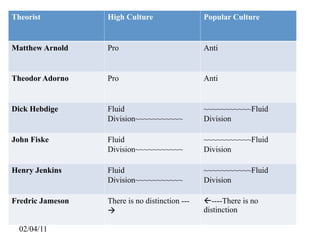
Theorist          High Culture                  Popular Culture


Matthew Arnold    Pro                           Anti


Theodor Adorno    Pro                           Anti


Dick Hebdige      Fluid                         ~~~~~~~~~~~Fluid
                  Division~~~~~~~~~~~           Division

John Fiske        Fluid                         ~~~~~~~~~~~Fluid
                  Division~~~~~~~~~~~           Division

Henry Jenkins     Fluid                         ~~~~~~~~~~~Fluid
                  Division~~~~~~~~~~~           Division

Fredric Jameson   There is no distinction ---   ----There is no
                                               distinction

  02/04/11

Midterm review

  • 1.
    Postmodernism • Fredric Jamesonis a MARXIST • New Base/Social Order/Economic Relationship corresponds with changes in Superstructure, specifically culture (art, music, film) • Capitalism  Late Capitalism • Factory Economy  Information Economy • Production  Consumption 02/04/11
  • 2.
    Henri Toulouse-Lautrec, Atthe Moulin Rouge, c. 1892 02/04/11
  • 3.
    Henri Toulouse-Lautrec, MoulinRouge - La Goulue, c. 1891 Impressionism was first seen as an oppositional artistic style - Interest in light, the momentary/fleeting - Often showed the underbelly of society But as a style, because it was still tied to a ‘realistic’ mode of representation… It could be easily commodified – used to sell and advertise things 02/04/11
  • 4.
    Modernism, as anartistic style for example, opposed commodification by being ‘non- representational,’ ‘abstract,’ ‘non-realistic.’ 02/04/11
  • 5.
    Still Life #28,Tom Wesselmann, 1963 02/04/11
  • 6.
    Rather than “resisting” commodification, pop art took from the commercial and culture industries Collapsing of high culture and popular culture Emphasis on collage and pastiche Jameson is opposed to this style without content Pop art, an exemplar of postmodernism, shows a new emphasis on consumption in a late capitalist economy He describes symptoms of this particular relationship between postmodernism and late capitalism, Just What Is It That Makes Today’s Homes So but does not offer a cure. Different, So Appealing?, Richard Hamilton, 1956 02/04/11
  • 7.
    Postmodernism • Frederic Jamesonis a MARXIST • New Base/Social Order/Economic Relationship corresponds with changes in Superstructure, specifically culture (art, music, film) • Capitalism  Late Capitalism • Factory Economy  Information Economy • Production  Consumption 02/04/11
  • 8.
    Popular Culture • Emergesout of Industrial Revolution – Why? • Circulation of commodities (new modes of transport) • Urbanization (creating class stratified neighborhoods) • Regimentation of Work and Leisure Time • Mass Production of Cultural Commodities In Opposition to: - High Culture – poetry like sonnets, classical music like Beethoven - Folk Culture – quilting 02/04/11
  • 9.
    Theory Applications/Essays Theorist(s) Culture and Civilization “Culture and Anarchy” Matthew Arnold Tradition Marxism Culture Industries; Base Karl Marx but used by and Superstructure; “On Theodor Adorno and Popular Music”; Frederic Jameson “Postmodernism and Consumer Society” Hegemony (Marxism 2.0) Cultural Studies Antonio Gramsci but used (specifically subcultures, by Dick Hebdige, John textual poachers, fans, Fiske, and Henry Jenkins “semiotic guerilla warfare”) 02/04/11
  • 10.
    Theorist Theory Historical Context The Beef Matthew Arnold Culture and “Culture and Working class Civilization Anarchy,” late 1860s culture = uncivilized, Tradition England against industrialization Theodor Adorno Marxism “On Popular Music,” Popular culture late 1930s between replicates alienation Germany and of industrial labor; England, fleeing serves as distraction Nazis from class revolution Dick Hebdige Hegemony via “Subculture: The If popular culture = Cultural Studies Meaning of Style,” standardization, late 1970s England what about the oppositional? John Fiske Ditto “Jeaning” 1987 US Ditto + participation Henry Jenkins Ditto “TV fans,” 1992 US Ditto of Fiske Fredric Jameson Marxism “Postmodernism,” Consumption defines Early ‘80s US us; Individual no longer exists 02/04/11
  • 11.
    Cultural and CivilizationTradition • MATTHEW ARNOLD • (High) CULTURE = CIVILIZATION – “Sweetness and light” – “The best of what has been thought and said” POPULAR CULTURE = ANARCHY - underlying here is an anxiety about the working class and industrialization 02/04/11
  • 12.
    Marxism • THEODOR ADORNO •Base – Forces of Production – factories, farms, plantations, etc. – Relations of Production – proletariat/bourgeoisie; master/slave; peasant/lord, etc. Superstructure - Law; Politics; Religion; Education; Ethics; Philosophy; Art - CULTURE IS PART OF THE SUPERSTRUCTURE! 02/04/11
  • 13.
    Marxism • Base Superstructure = Economic Determinism; VULGAR MARXISM • Base  Superstructure = Cultural Determinism • Base  Superstructure = This is what we want! – The base shapes and conditions the superstructure: it establishes the terrain on which culture is lived and experienced – The superstructure sustains the base: a society’s culture, law, politics, and religion legitimize its forces and relations of production 02/04/11
  • 14.
    MARXISM : TheCulture Industry • MARXIST CRITIQUE by THEODOR ADORNO • Base = Mass production • Superstructure = Mass-produced popular culture, standardized ideas, conformity, obedience • Specifically: – Standardization (The Sitcom) – Pseudo-individualization (The Office UK vs. US) – Social Cement (Prime Time TV  end-goal of obedience) 02/04/11
  • 15.
    Hegemony • Marxism 2.0 •ANTONIO GRAMSCI – Wrote this theory in prison in Fascist Italy, early 1930s – Given the oppressive nature of capitalism’s class relations, why does the proletariat not rise up in revolution? – Frames people NOT as docile bodies complicit in their subjugation 02/04/11
  • 16.
    So what isit? • Hegemony is the process by which the ruling class actively works to secure the proletariat’s consent for its moral, cultural, intellectual, and political leadership. • Series of negotiations between dominant and subordinate groups • As a theory recognizes that people (the proletariat) have agency. They are NOT docile/obedient/passive masses. 02/04/11
  • 17.
    Hegemony Theory Cultural Studies • Dick Hebdige – Subcultures – Oppositional – Bricolage – violent juxtaposition of commodities and symbols taken from a wide variety of sources to create new meanings (Safety Pins, Swastika) – Homology – consistency within a subculture’s stylistic choices, internal logic (musical style matching clothing, lyrics, etc.) 02/04/11
  • 18.
    Culture Studies Continued •TEXTUAL POACHING, Henry Jenkins • Practice by which fans as active readers assert their mastery and control over mass-produced texts • But more than fans, we all poach. We create meaning through the process of reading. • We contest the author’s authority and right to determine what a text means. 02/04/11
  • 19.
    Postmodernism • MARXIST CRITIQUEby Fredric Jameson • Pastiche – blank parody, visual quotation, showcasing references; parody without criticism and without humor • EXAMPLE: Pastiche of Kill Bill  Telephone – Lady Gaga and Beyonce (MORE PASTICHE!) 02/04/11
  • 20.
    Bricolage Textual Poaching Pastiche Who Introduced It Dick Hebdige Henry Jenkins Frederic Jameson Theory Hegemony via  Ditto Marxism Cultural Studies Optimistic vs. Optimistic about OPTIMISTIC Pessimistic about Pessimistic Subcultures; ABOUT Late Capitalism and Pessimistic about EVERYONE’S Culture (Base and Incorporation READINGS! Superstructure) Hypodermic vs. Participatory Participatory Extreme Hypodermic Participatory (There is no individual) Example Punk Clothing Fan Fiction; Pulp Fiction; Pop Revisionist Literature Art; Girl Talk – Wicked, Wide Sargasso Sea; Shakespeare in Love 02/04/11
  • 21.
    Theorist High Culture Popular Culture Matthew Arnold Pro Anti Theodor Adorno Pro Anti Dick Hebdige Fluid ~~~~~~~~~~~Fluid Division~~~~~~~~~~~ Division John Fiske Fluid ~~~~~~~~~~~Fluid Division~~~~~~~~~~~ Division Henry Jenkins Fluid ~~~~~~~~~~~Fluid Division~~~~~~~~~~~ Division Fredric Jameson There is no distinction --- ----There is no  distinction 02/04/11