
Marxism & Liberal Pluralism
Marxist & Liberal Pluralist Theory and the Media
KEYWORDS;
• Economic base
• Superstructure
• Proletariat
• Bourgeoisie
• Ideological State Apparatus
• Repressive State Apparatus
• False Consciousness
KEY THEORISTS
• Karl Marx
• Stuart Hall
• Chomksy & Herman
• Antonio Gramsci
KEYWORDS;
• Liberalist
• Pluralist
KEY THEORISTS
• Michael Gurevitch
What is Marxism?
 At the heart of Marxism is the belief that all capitalist societies function on the same
principles.
 Society is formed of the ‘economic base’ and the ‘superstructure’.
 A capitalist society can only work if the people within society accept that they need ‘things’.
It is through the economic base that production of these ‘things’ occur. This is consumerism.
 In order to make people think they want and need certain things you need the
‘superstructure’ – social and cultural institutions such as The Army, Police, Legal System,
Political System, Education, Religion, the notion of family and of course the Media. These
institutions control our cultural and social beliefs in a way that keep consumerism and
capitalism going.
 Within this you have the bourgeoisie and the proletariat. These are the people themselves –
the bourgeoisie are the rich, powerful people who are in control. They want everything to
stay the same because if it does they continue to have power, control and money. The
proletariat are the workers, the people who form they economic base. They help the cycle of
consumerism by producing and consuming these ‘things’ or ideas and beliefs.
The Economic Base & Superstructure
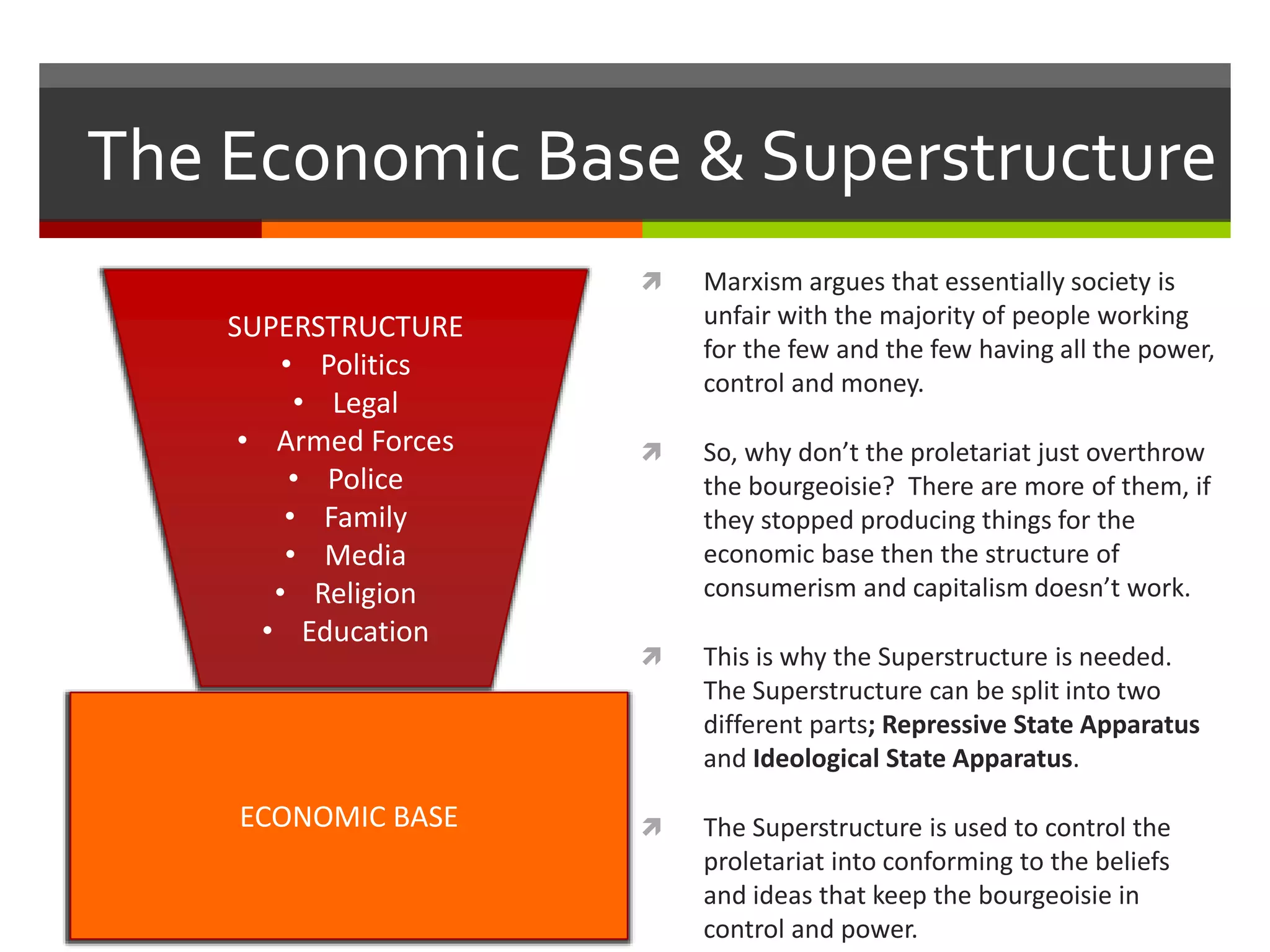
 Marxism argues that essentially society is
unfair with the majority of people working
for the few and the few having all the power,
control and money.
 So, why don’t the proletariat just overthrow
the bourgeoisie? There are more of them, if
they stopped producing things for the
economic base then the structure of
consumerism and capitalism doesn’t work.
 This is why the Superstructure is needed.
The Superstructure can be split into two
different parts; Repressive State Apparatus
and Ideological State Apparatus.
 The Superstructure is used to control the
proletariat into conforming to the beliefs
and ideas that keep the bourgeoisie in
control and power.
SUPERSTRUCTURE
• Politics
• Legal
• Armed Forces
• Police
• Family
• Media
• Religion
• Education
ECONOMIC BASE
RSA & ISA
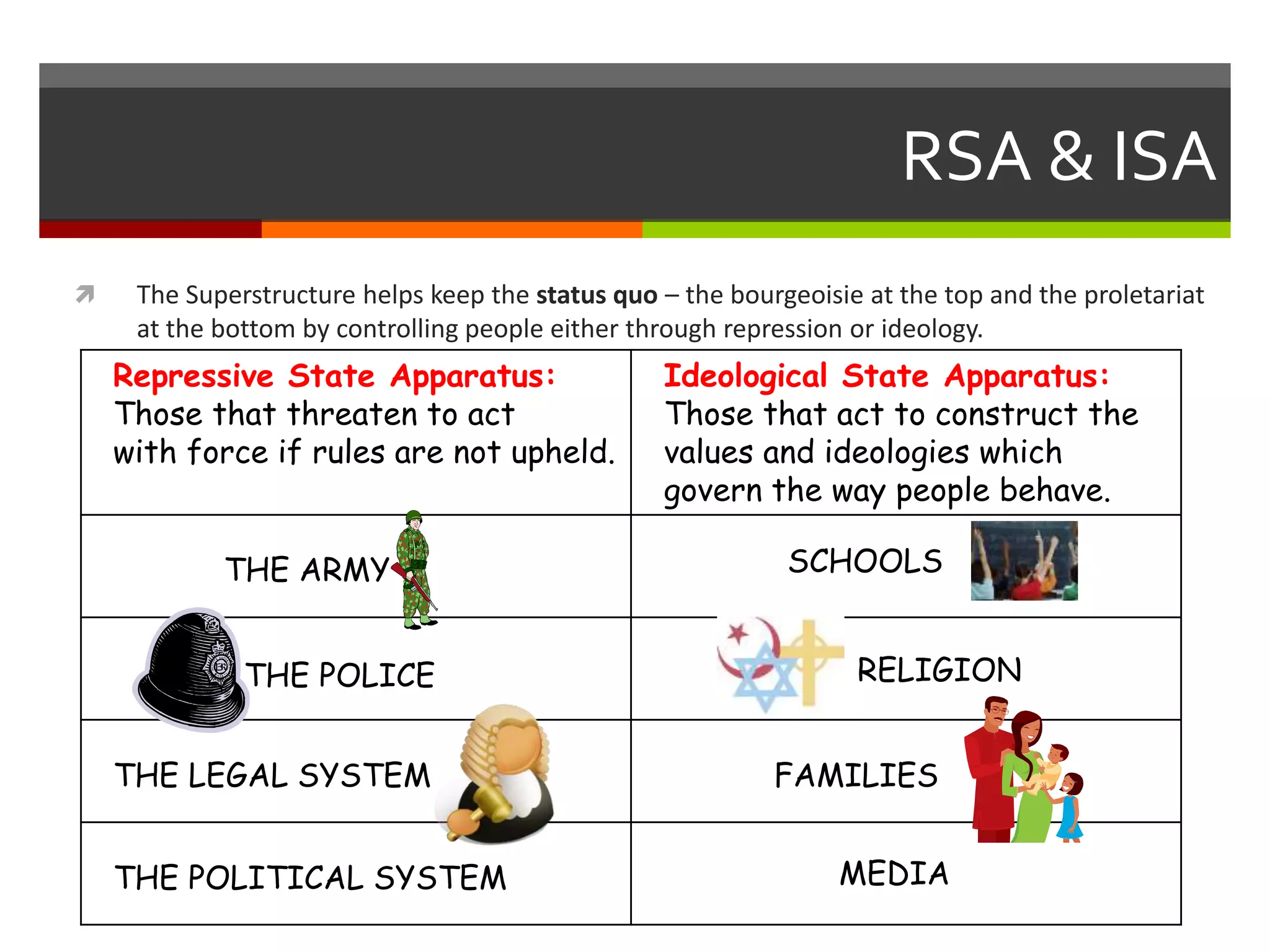
 The Superstructure helps keep the status quo – the bourgeoisie at the top and the proletariat
at the bottom by controlling people either through repression or ideology.
THE ARMY
THE POLICE
THE LEGAL SYSTEM
Repressive State Apparatus:
Those that threaten to act
with force if rules are not upheld.
Ideological State Apparatus:
Those that act to construct the
values and ideologies which
govern the way people behave.
SCHOOLS
RELIGION
FAMILIES
THE POLITICAL SYSTEM MEDIA
RSA, ISA & False Consciousness
 In modern society the Media is at the heart of the Superstructure because
it constantly reinforces the dominant ideologies that support the
bourgeoisie.
 This is called the status quo or false consciousness – because the
ideologies that the proletariat see and hear all the time (through the
media) mostly support the norm or the status quo they simply accept that
this is the way is supposed to be.
 False Consciousness = the belief in ideas and values as truths when in fact
they are constructed ideologies which support the power base and keep
the system the way it is.
Marxism & the Media
 According to Marxist theory - As part of the modern superstructure, the
media plays a pivotal role in the function of maintaining the power and
influence held by the bourgeoisie.
 Media institutions are ruled and controlled by members of the bourgeoisie
they want to stay in control and power. Therefore the viewpoints,
messages and ideologies of the media products they produce try to
legitimize, perpetuate and promote the ideologies that will continue this
control and power.
 Any opposite ideologies are either not allowed to be heard or they are
presented in such as way as to convince the proletariat that they are
wrong.
 Chomsky & Herman (!988) are theorists who supported this idea of the
media. They believed that the media manipulates populations to prevent
them from rebelling against those in power.
Examples
 Repressive State Apparatus – The Army, The Legal System, The
Political System and the Police – they have laws to ensure that
their ideologies are supported and accepted by society
HOWEVER the media also play an important role in promoting
these.
 It was illegal in many states in American for people of black and
white races to marry (up until 1950s). This was supported in
law but also in the representations on TV and in film. As society
started to change so did representations and then law.
Examples
 Ideological State Apparatus – Media, family, education and
religion – these systems control through ideas rather than law.
They present ideologies to people, mainly through the media, in
order to get people to accept them as normal.
 Consider how the representation of women has changed over
the years – from wife and mother to career woman and super
mother. Consider how women who had careers might have
been viewed in previous generations compared to now. Who’s
interest would it have been in to keep women ‘in doors’? Why
might it support a Marxist view of society?
Criticisms of Marxism
 Karl Marx was writing 150 years ago during industrialisation, when society was very different.
Back then most businesses were controlled by one person or a family whereas now most big
businesses or institutions are controlled by shareholders – can we still use Marxism when
there is a less obvious divide between the bourgeoisie and the proletariat?
 Technology has changed so radically now, although the mainstream media is still an
ideological state apparatus what about e-media. The fact that I can ignore mainstream media
and its ideologies and go off and find my own? Does this mean that Marxism no longer
happens at all? Is it still relevant?
 The other big problem with Marxism is that it assumes the audience is passive – that the
people seeing and hearing these dominant ideologies through the media are going to simply
accept them and not think for themselves. Stuart Hall argued in the 1980s that the dominant
ideologies can be called the ‘preferred readings’ of texts but that the readers can ignore
these and chose to adopt alternative readings instead. Hall suggested they could have a
‘negotiated’ reading or an ‘oppositional’ reading instead. If this is the case then the
argument for Marxism is diminished massively since the superstructure has less control.
Case Study:The Apprentice
(2005-present: BBC)
 The Apprentice is a prolonged job interview where
contestants compete against each other to be chosen
for a job working for the entrepreneur Lord Alan Sugar.
 The fact that Sugar has all the power reinforces the
‘superior’ position of the capitalist elite.
 He has power as he has used the system to create
wealth and he is shown using this power to provide a
livelihood for the winner of the competition.
Case Study:The Apprentice
(2005-present: BBC)
 All of the contestants are dependent
on him for their survival in the show
(and implicitly, beyond).
• The prize for the winner is a well-paid job and the winner will
need to display the qualities that identify him / her as a
potentially successful businessperson.
Case Study:The Apprentice
(2005-present: BBC)
Through the tasks and the judgements offered afterwards some clear values
are identified:
Successful people need to be outgoing but not too extrovert. They must be
adventurous in business terms but not reckless; confident but not arrogant
and be both good leaders and team players.
These qualities are the ones that are rewarded by success within the show
and can be seen to be part of the construction of a false consciousness
regarding the personality types of people who are valued within the capitalist
system. The creative, individual or introvert are not seen as ‘acceptable’
neither are those who challenge authority or who work outside team
structures. People who do not conform to these norms are ‘fired’.
Case Study:The Apprentice
(2005-present: BBC)
Given the media’s position as part of the superstructure of the capitalist
system, texts can be analysed in terms of how they act to construct these
values in their representations.
Your Case Study
 Whether you are looking at Identities in the Media
or Impact of New Digital Media you can use
Marxism in your arguments.
 Write a paragraph explaining how/where you might
use Marxism (either using a specific text to argue
your point or you general argument).
What is Liberal Pluralism?
 Liberal Pluralism challenges the ideas put forward in Marxism but it is also linked to us living
in a capitalist world.
 At the heart of Liberal Pluralism is the belief that society is made up of many different groups
with competing interests whilst the media is subject to the wishes of the consumer (supply &
demand).
 Therefore the media present a range of ideologies, views and opinions and the audience
select and reject those ideologies offered to them depending on their interests.
 In Liberal Pluralism the media can sometimes be considered an agent for democracy since it
can allow a range of different ideologies to be heard by lots of people.
 Breaking down Liberal Pluralism;
 Liberalism is the belief in the importance of liberty and equal rights
 Pluralism is the acknowledgement of diversity of interests and people (plural literally means many)
Liberal Pluralism, the Media and
audiences
 Liberal Pluralists see the relationship between the audience and the media less about power
and more evenly. The relationship is entered into voluntarily since audience chose what
media to access and they can always go and looks for opposing views and ideas should they
wish.
 Since the media are about getting the biggest audiences possible in order to make as much
money as possible if their audiences dwindle they change what they do to give the audience
more of what they like. Therefore the control can be as much in the audiences hands as it is
in the medias.
 Liberal Pluralism functions on a number of assumptions or beliefs about this relationship:
 The Media provide information necessary for citizens to act upon
 The Media are independent of the power of economic and government
 The Media help to give a voice to all views and provide a forum for public debate
 The Media operate to furnish information rather than to re-construct society to a political agenda
 The Media serve as an independent institution keeping watch over the self-serving government and
excessive influence of special interest groups (eg. Religions)
Example
 YouTube – liberal pluralist institution.
 Anyone can upload their ideologies – it is cheap to access and use in
various ways (computer, smart phone etc)
 It is easy to share these ideologies through other e-media platforms
– facebook, twitter etc.
 HOWEVER – can we still consider YouTube to be liberal pluralist
given who now owns it and the restrictions/censorship on there.
 Is liberal pluralism about how the audience use a text/institution or
is it about the ownership and control?
Your Case Study
 Whether you are looking at Identities in the Media
or Impact of New Digital Media you can use Liberal
Pluralism in your arguments.
 Write a paragraph explaining how/where you might
use Liberal Pluralism (either using a specific text to
argue your point or you general argument).

Marxism & Liberal Pluralism (A2)

  • 1.
     Marxism & LiberalPluralism Marxist & Liberal Pluralist Theory and the Media KEYWORDS; • Economic base • Superstructure • Proletariat • Bourgeoisie • Ideological State Apparatus • Repressive State Apparatus • False Consciousness KEY THEORISTS • Karl Marx • Stuart Hall • Chomksy & Herman • Antonio Gramsci KEYWORDS; • Liberalist • Pluralist KEY THEORISTS • Michael Gurevitch
  • 2.
    What is Marxism? At the heart of Marxism is the belief that all capitalist societies function on the same principles.  Society is formed of the ‘economic base’ and the ‘superstructure’.  A capitalist society can only work if the people within society accept that they need ‘things’. It is through the economic base that production of these ‘things’ occur. This is consumerism.  In order to make people think they want and need certain things you need the ‘superstructure’ – social and cultural institutions such as The Army, Police, Legal System, Political System, Education, Religion, the notion of family and of course the Media. These institutions control our cultural and social beliefs in a way that keep consumerism and capitalism going.  Within this you have the bourgeoisie and the proletariat. These are the people themselves – the bourgeoisie are the rich, powerful people who are in control. They want everything to stay the same because if it does they continue to have power, control and money. The proletariat are the workers, the people who form they economic base. They help the cycle of consumerism by producing and consuming these ‘things’ or ideas and beliefs.
  • 3.
    The Economic Base& Superstructure  Marxism argues that essentially society is unfair with the majority of people working for the few and the few having all the power, control and money.  So, why don’t the proletariat just overthrow the bourgeoisie? There are more of them, if they stopped producing things for the economic base then the structure of consumerism and capitalism doesn’t work.  This is why the Superstructure is needed. The Superstructure can be split into two different parts; Repressive State Apparatus and Ideological State Apparatus.  The Superstructure is used to control the proletariat into conforming to the beliefs and ideas that keep the bourgeoisie in control and power. SUPERSTRUCTURE • Politics • Legal • Armed Forces • Police • Family • Media • Religion • Education ECONOMIC BASE
  • 4.
    RSA & ISA The Superstructure helps keep the status quo – the bourgeoisie at the top and the proletariat at the bottom by controlling people either through repression or ideology. THE ARMY THE POLICE THE LEGAL SYSTEM Repressive State Apparatus: Those that threaten to act with force if rules are not upheld. Ideological State Apparatus: Those that act to construct the values and ideologies which govern the way people behave. SCHOOLS RELIGION FAMILIES THE POLITICAL SYSTEM MEDIA
  • 5.
    RSA, ISA &False Consciousness  In modern society the Media is at the heart of the Superstructure because it constantly reinforces the dominant ideologies that support the bourgeoisie.  This is called the status quo or false consciousness – because the ideologies that the proletariat see and hear all the time (through the media) mostly support the norm or the status quo they simply accept that this is the way is supposed to be.  False Consciousness = the belief in ideas and values as truths when in fact they are constructed ideologies which support the power base and keep the system the way it is.
  • 6.
    Marxism & theMedia  According to Marxist theory - As part of the modern superstructure, the media plays a pivotal role in the function of maintaining the power and influence held by the bourgeoisie.  Media institutions are ruled and controlled by members of the bourgeoisie they want to stay in control and power. Therefore the viewpoints, messages and ideologies of the media products they produce try to legitimize, perpetuate and promote the ideologies that will continue this control and power.  Any opposite ideologies are either not allowed to be heard or they are presented in such as way as to convince the proletariat that they are wrong.  Chomsky & Herman (!988) are theorists who supported this idea of the media. They believed that the media manipulates populations to prevent them from rebelling against those in power.
  • 7.
    Examples  Repressive StateApparatus – The Army, The Legal System, The Political System and the Police – they have laws to ensure that their ideologies are supported and accepted by society HOWEVER the media also play an important role in promoting these.  It was illegal in many states in American for people of black and white races to marry (up until 1950s). This was supported in law but also in the representations on TV and in film. As society started to change so did representations and then law.
  • 8.
    Examples  Ideological StateApparatus – Media, family, education and religion – these systems control through ideas rather than law. They present ideologies to people, mainly through the media, in order to get people to accept them as normal.  Consider how the representation of women has changed over the years – from wife and mother to career woman and super mother. Consider how women who had careers might have been viewed in previous generations compared to now. Who’s interest would it have been in to keep women ‘in doors’? Why might it support a Marxist view of society?
  • 9.
    Criticisms of Marxism Karl Marx was writing 150 years ago during industrialisation, when society was very different. Back then most businesses were controlled by one person or a family whereas now most big businesses or institutions are controlled by shareholders – can we still use Marxism when there is a less obvious divide between the bourgeoisie and the proletariat?  Technology has changed so radically now, although the mainstream media is still an ideological state apparatus what about e-media. The fact that I can ignore mainstream media and its ideologies and go off and find my own? Does this mean that Marxism no longer happens at all? Is it still relevant?  The other big problem with Marxism is that it assumes the audience is passive – that the people seeing and hearing these dominant ideologies through the media are going to simply accept them and not think for themselves. Stuart Hall argued in the 1980s that the dominant ideologies can be called the ‘preferred readings’ of texts but that the readers can ignore these and chose to adopt alternative readings instead. Hall suggested they could have a ‘negotiated’ reading or an ‘oppositional’ reading instead. If this is the case then the argument for Marxism is diminished massively since the superstructure has less control.
  • 10.
    Case Study:The Apprentice (2005-present:BBC)  The Apprentice is a prolonged job interview where contestants compete against each other to be chosen for a job working for the entrepreneur Lord Alan Sugar.  The fact that Sugar has all the power reinforces the ‘superior’ position of the capitalist elite.  He has power as he has used the system to create wealth and he is shown using this power to provide a livelihood for the winner of the competition.
  • 11.
    Case Study:The Apprentice (2005-present:BBC)  All of the contestants are dependent on him for their survival in the show (and implicitly, beyond). • The prize for the winner is a well-paid job and the winner will need to display the qualities that identify him / her as a potentially successful businessperson.
  • 12.
    Case Study:The Apprentice (2005-present:BBC) Through the tasks and the judgements offered afterwards some clear values are identified: Successful people need to be outgoing but not too extrovert. They must be adventurous in business terms but not reckless; confident but not arrogant and be both good leaders and team players. These qualities are the ones that are rewarded by success within the show and can be seen to be part of the construction of a false consciousness regarding the personality types of people who are valued within the capitalist system. The creative, individual or introvert are not seen as ‘acceptable’ neither are those who challenge authority or who work outside team structures. People who do not conform to these norms are ‘fired’.
  • 13.
    Case Study:The Apprentice (2005-present:BBC) Given the media’s position as part of the superstructure of the capitalist system, texts can be analysed in terms of how they act to construct these values in their representations.
  • 14.
    Your Case Study Whether you are looking at Identities in the Media or Impact of New Digital Media you can use Marxism in your arguments.  Write a paragraph explaining how/where you might use Marxism (either using a specific text to argue your point or you general argument).
  • 15.
    What is LiberalPluralism?  Liberal Pluralism challenges the ideas put forward in Marxism but it is also linked to us living in a capitalist world.  At the heart of Liberal Pluralism is the belief that society is made up of many different groups with competing interests whilst the media is subject to the wishes of the consumer (supply & demand).  Therefore the media present a range of ideologies, views and opinions and the audience select and reject those ideologies offered to them depending on their interests.  In Liberal Pluralism the media can sometimes be considered an agent for democracy since it can allow a range of different ideologies to be heard by lots of people.  Breaking down Liberal Pluralism;  Liberalism is the belief in the importance of liberty and equal rights  Pluralism is the acknowledgement of diversity of interests and people (plural literally means many)
  • 16.
    Liberal Pluralism, theMedia and audiences  Liberal Pluralists see the relationship between the audience and the media less about power and more evenly. The relationship is entered into voluntarily since audience chose what media to access and they can always go and looks for opposing views and ideas should they wish.  Since the media are about getting the biggest audiences possible in order to make as much money as possible if their audiences dwindle they change what they do to give the audience more of what they like. Therefore the control can be as much in the audiences hands as it is in the medias.  Liberal Pluralism functions on a number of assumptions or beliefs about this relationship:  The Media provide information necessary for citizens to act upon  The Media are independent of the power of economic and government  The Media help to give a voice to all views and provide a forum for public debate  The Media operate to furnish information rather than to re-construct society to a political agenda  The Media serve as an independent institution keeping watch over the self-serving government and excessive influence of special interest groups (eg. Religions)
  • 17.
    Example  YouTube –liberal pluralist institution.  Anyone can upload their ideologies – it is cheap to access and use in various ways (computer, smart phone etc)  It is easy to share these ideologies through other e-media platforms – facebook, twitter etc.  HOWEVER – can we still consider YouTube to be liberal pluralist given who now owns it and the restrictions/censorship on there.  Is liberal pluralism about how the audience use a text/institution or is it about the ownership and control?
  • 18.
    Your Case Study Whether you are looking at Identities in the Media or Impact of New Digital Media you can use Liberal Pluralism in your arguments.  Write a paragraph explaining how/where you might use Liberal Pluralism (either using a specific text to argue your point or you general argument).

Editor's Notes

  • #3 You can think of the bourgeoisie as the ‘haves’ or the elite and you can think of the proletariat as the ‘have nots’ or the masses.
  • #17 Critical thinking – can we argue against any of these?