GROUP MEMBERS
• Usman Aslam
• Syeda Fizza Rizvi
• Syed Irtaza
• Tayyaba Faiz
• Ikhlas Ahmad
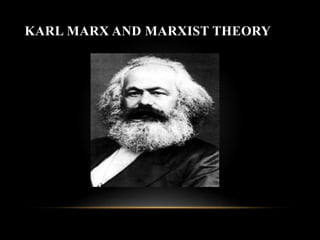
KARL MARX AND MARXIST THEORY
TABLE OF CONTENTS
• Who was Karl Marx?
• Some important key concepts and ideology
• Types of Marxism
• Criticisms of Marxist ideas
• Contributions of Karl Marx’s Theory in the modern world
system
• Conclusion
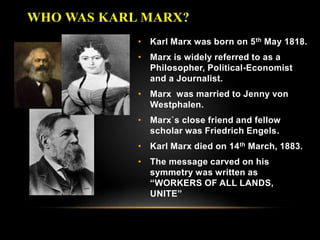
• Karl Marx was born on 5th May 1818.
• Marx is widely referred to as a
Philosopher, Political-Economist
and a Journalist.
• Marx was married to Jenny von
Westphalen.
• Marx`s close friend and fellow
scholar was Friedrich Engels.
• Karl Marx died on 14th March, 1883.
• The message carved on his
symmetry was written as
“WORKERS OF ALL LANDS,
UNITE”
WHO WAS KARL MARX?
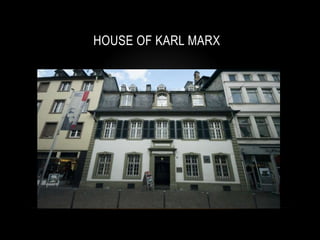
HOUSE OF KARL MARX
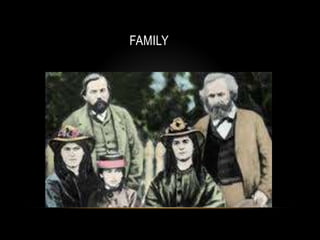
FAMILY
SOME IMPORTANT KEY CONCEPTS
• Capitalism: Marx believed that capitalism is not only an
economic system but it is also a political system.
• Class Struggles: Marx believed that conflict produces class
and inherently class produces conflict.
• Exploitation: Marx believed that Capitalism can only thrive
exploitation of the working class.
• Alienation: The workers are forced to sell their labour to the
Capitalists in order to survive.
SOME IMPORTANT KEY IDEOLOGIES
• Capitalist society is divided into two classes:
The Bourgeoisie(wealthier ones) and the Proletariat(poor ones).
• The bourgeoisie increase their wealth by exploiting the
proletariat:
The richer ones exploit and make the poor more weaker to gain
wealth and power.
• Ideological Control:
Marx argued that the ruling classes used their control of social
institutions to gain ideological dominance. Thus, the
proletariats accepted this and didn’t fight back.
• The result of the above is false class consciousness:
The end result of ideological control is false consciousness –
where the masses, or proletariat are deluded into thinking that
everything is fine and that the appalling in which they live and
work are inevitable.
TYPES OF MARXISM
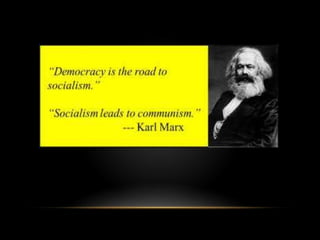
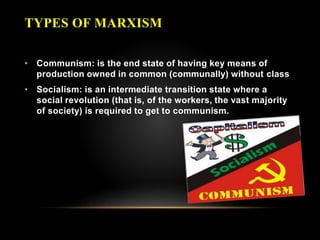
• Communism: is the end state of having key means of
production owned in common (communally) without class
• Socialism: is an intermediate transition state where a
social revolution (that is, of the workers, the vast majority
of society) is required to get to communism.
CRITICISMS OF MARXIST IDEAS
• Criticisms of Marxism have come from various political
ideologies which include ethical and economical criticisms.
• Democratic socialists and social democrats reject the idea
that socialism can be accomplished through class conflict
and a proletarian revolution.
• Some thinkers have rejected the fundamentals of Marxist
theory, such as historical materialism and the labour theory
of value, and gone on to criticise capitalism - and support
socialism - using other arguments.
• Some contemporary supporters of Marxism argue that many
aspects of Marxist thought are viable, but that the corpus is
incomplete or somewhat out-dated in regards to certain
aspects of economic, political or social theory.
CONTRIBUTIONS OF MARXISM IN THE
MODERN WORLD SYSTEM
• Elaboration of the conflict model of society, specifically his
theory of social change based on antagonisms between
classes.
• The idea that power originates primarily in economic
production.
• Concern with the social origins of alienation.
• Understanding of modern capitalism.
• Welfare State.
CONCLUSION
THANK YOU

Presentation, karl marx

  • 1.
    GROUP MEMBERS • UsmanAslam • Syeda Fizza Rizvi • Syed Irtaza • Tayyaba Faiz • Ikhlas Ahmad
  • 2.
    KARL MARX ANDMARXIST THEORY
  • 4.
    TABLE OF CONTENTS •Who was Karl Marx? • Some important key concepts and ideology • Types of Marxism • Criticisms of Marxist ideas • Contributions of Karl Marx’s Theory in the modern world system • Conclusion
  • 6.
    • Karl Marxwas born on 5th May 1818. • Marx is widely referred to as a Philosopher, Political-Economist and a Journalist. • Marx was married to Jenny von Westphalen. • Marx`s close friend and fellow scholar was Friedrich Engels. • Karl Marx died on 14th March, 1883. • The message carved on his symmetry was written as “WORKERS OF ALL LANDS, UNITE” WHO WAS KARL MARX?
  • 7.
  • 8.
  • 9.
    SOME IMPORTANT KEYCONCEPTS • Capitalism: Marx believed that capitalism is not only an economic system but it is also a political system. • Class Struggles: Marx believed that conflict produces class and inherently class produces conflict. • Exploitation: Marx believed that Capitalism can only thrive exploitation of the working class. • Alienation: The workers are forced to sell their labour to the Capitalists in order to survive.
  • 11.
    SOME IMPORTANT KEYIDEOLOGIES • Capitalist society is divided into two classes: The Bourgeoisie(wealthier ones) and the Proletariat(poor ones). • The bourgeoisie increase their wealth by exploiting the proletariat: The richer ones exploit and make the poor more weaker to gain wealth and power. • Ideological Control: Marx argued that the ruling classes used their control of social institutions to gain ideological dominance. Thus, the proletariats accepted this and didn’t fight back. • The result of the above is false class consciousness: The end result of ideological control is false consciousness – where the masses, or proletariat are deluded into thinking that everything is fine and that the appalling in which they live and work are inevitable.
  • 13.
    TYPES OF MARXISM •Communism: is the end state of having key means of production owned in common (communally) without class • Socialism: is an intermediate transition state where a social revolution (that is, of the workers, the vast majority of society) is required to get to communism.
  • 14.
    CRITICISMS OF MARXISTIDEAS • Criticisms of Marxism have come from various political ideologies which include ethical and economical criticisms. • Democratic socialists and social democrats reject the idea that socialism can be accomplished through class conflict and a proletarian revolution. • Some thinkers have rejected the fundamentals of Marxist theory, such as historical materialism and the labour theory of value, and gone on to criticise capitalism - and support socialism - using other arguments. • Some contemporary supporters of Marxism argue that many aspects of Marxist thought are viable, but that the corpus is incomplete or somewhat out-dated in regards to certain aspects of economic, political or social theory.
  • 16.
    CONTRIBUTIONS OF MARXISMIN THE MODERN WORLD SYSTEM • Elaboration of the conflict model of society, specifically his theory of social change based on antagonisms between classes. • The idea that power originates primarily in economic production. • Concern with the social origins of alienation. • Understanding of modern capitalism. • Welfare State.
  • 17.
  • 18.