Postmodernis
   A critical approach to Film
m
Postmodernism
  A critical approach to Film


      What is
      Postmodernism?
     - An Oxymoron?
     -       An overused & meaningless term?
     -       A bunch of nonsense?
     -       A “response” (or, “responses”) to modernism.
Postmodernism
  A critical approach to Film


                          What is
                          Modernism?
       Modernism, in its broadest definition, is modern thought, character, or
       practice.

       Modernism explicitly rejects the ideology or realism, and makes use of the
       works of the past, through the application of reprise, incorporation, rewriting,
       recapitulation, revision and parody in new forms.

       The term modernism encompasses the activities and output of those who felt
       the “traditional” forms of art, architecture, literature, religious faith, social
       organization and daily life were becoming outdated in the new economic,
       social, and political conditions of an emerging fully industrialized world.
Postmodernism
  A critical approach to Film


 Postmodernism is
 therefore…
Postmodernism
  A critical approach to Film


 Postmodernism is
 therefore…
                     In Film…
                     Postmodernist films upsets the mainstream
                     conventions of narrative structure and
                     characterisation and destroys the audience‟s
                     suspension of belief.
Features of postmodern
                 films
• They don‟t pretend to wholly works, and often draw
  attention to the fact they are in fact fictitious. For
  instance, characters might stop and talk directly to the
  audience.

• They often re-arrange or disrupt strict linear narratives,
  instead using circular narratives and open ended
  closures.

• They often involve characters that feel disconnected or
  alienated from their environment and distrust authorities.
Genres of Postmodern
• Pastiche: Self referential, tongue-in-cheek,
  rehashes of classic pop culture.

• Flattening of Affect: Technology, violence,
  drugs, and the media lead to detached,
  emotionless, unauthentic lives.

• Hyper reality: Technologically created
  realities are often more authentic or desirable
  than the real world.
Genres of Postmodernism
• Time Bending: Time travel provides another way
  to shape reality and play “what if” games with
  society.

• Altered states: Drugs, mental illness and
  technology provide a dark, often psychedelic,
  gateways to new internal realities.

• More Human than Human: Artificial intelligence,
  robotics and cybernetics seek to enhance, or
  replace, humanity.
Analysis of a flattening affect
                  Film
• Fight Club a synopsis: A ticking-time-bomb
  insomniac and a slippery soap salesman
  channel primal male aggression into a
  shocking new form of therapy. Their
  concept catches on, with underground
  "fight clubs" forming in every town, until an
  eccentric gets in the way and ignites an
  out-of-control spiral toward oblivion.
Fight club
                                                Analysis
•   The main protagonist‟s journey from a depressed insomniac to, to an
    unhinged violent psychopath, Is according to the postmodernism theory,
    the characterization of a protagonist who is disconnected from wider
    society, this is a key feature of a postmodern film.

•   In Fight Club the movie uses a narrator through out the film who is one
    of the main protagonist this is another postmodern concept. This type of
    cinematography disrupts the linear sequence of the narrative and
    instead creates a circular narrative in which parts of the film are cliff
    hangers where the audience does not know what‟s happening next
    mirroring the actions of the main protagonist. Broadcast media bulletins
    are used to create suspense and tension. A dark color scheme
    connotes to the audience that this film is going to be violent and scary.
    This film is a classic example of the postmodernist theory.
Taking Postmodernism
further…
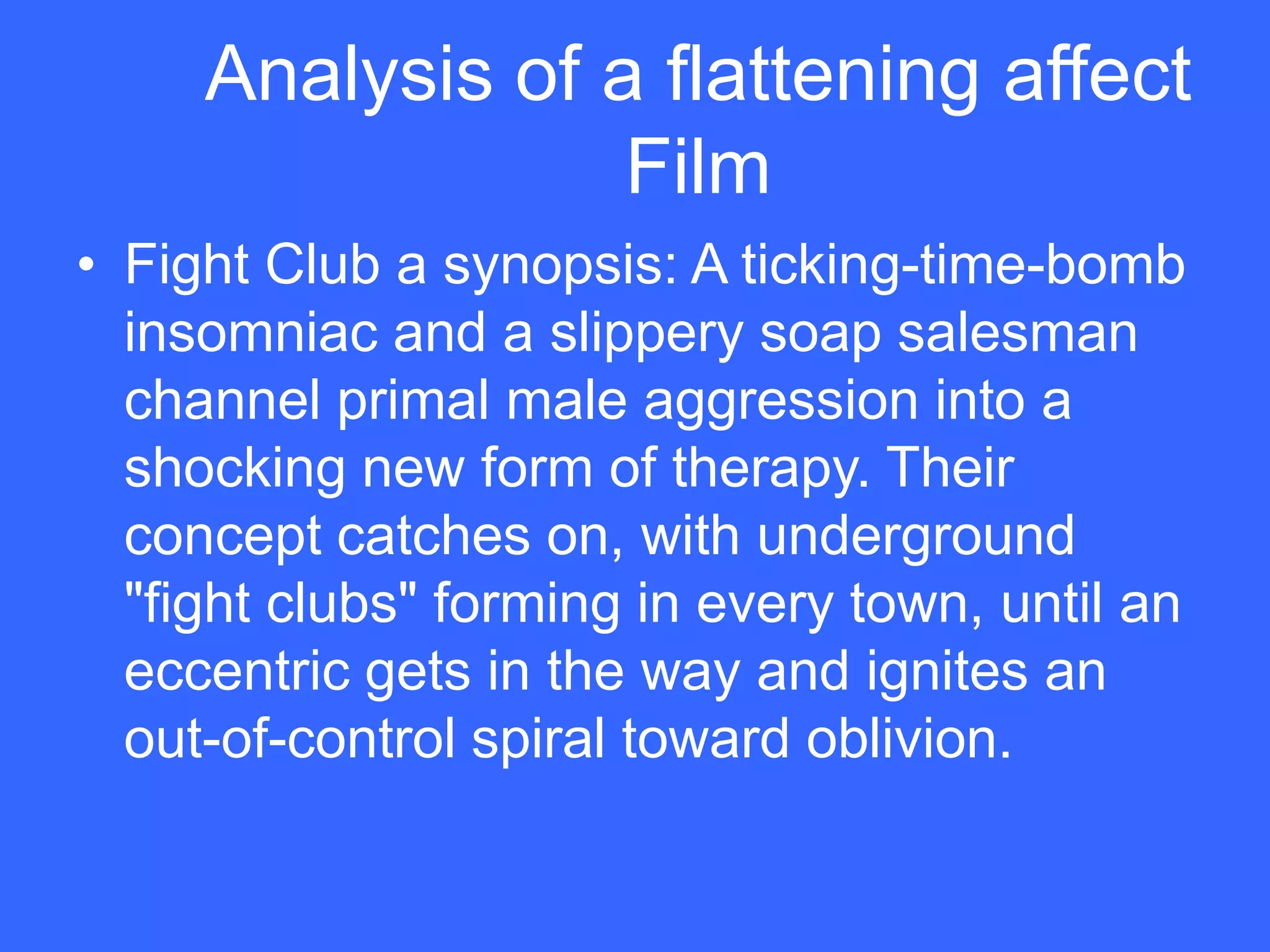
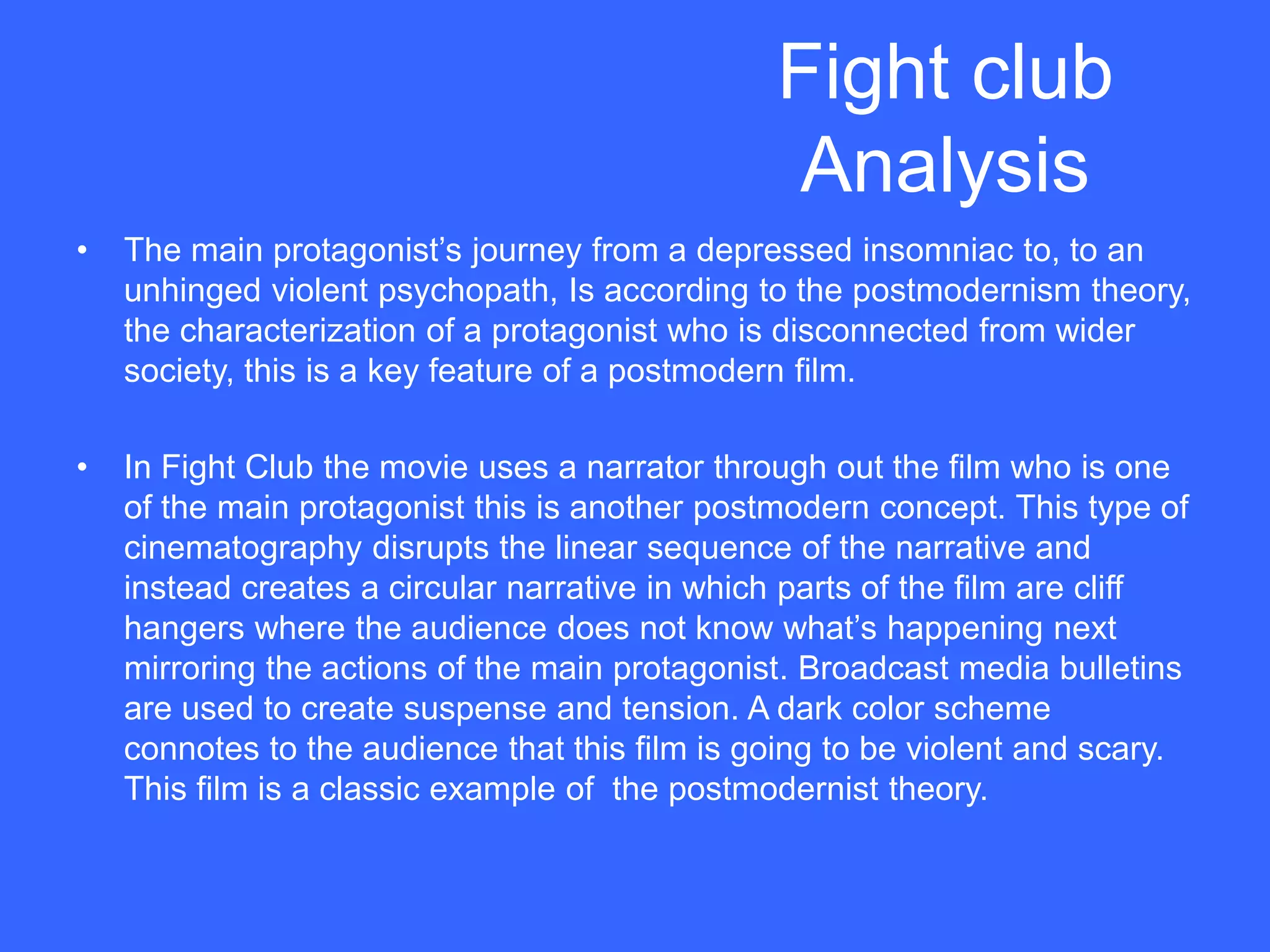
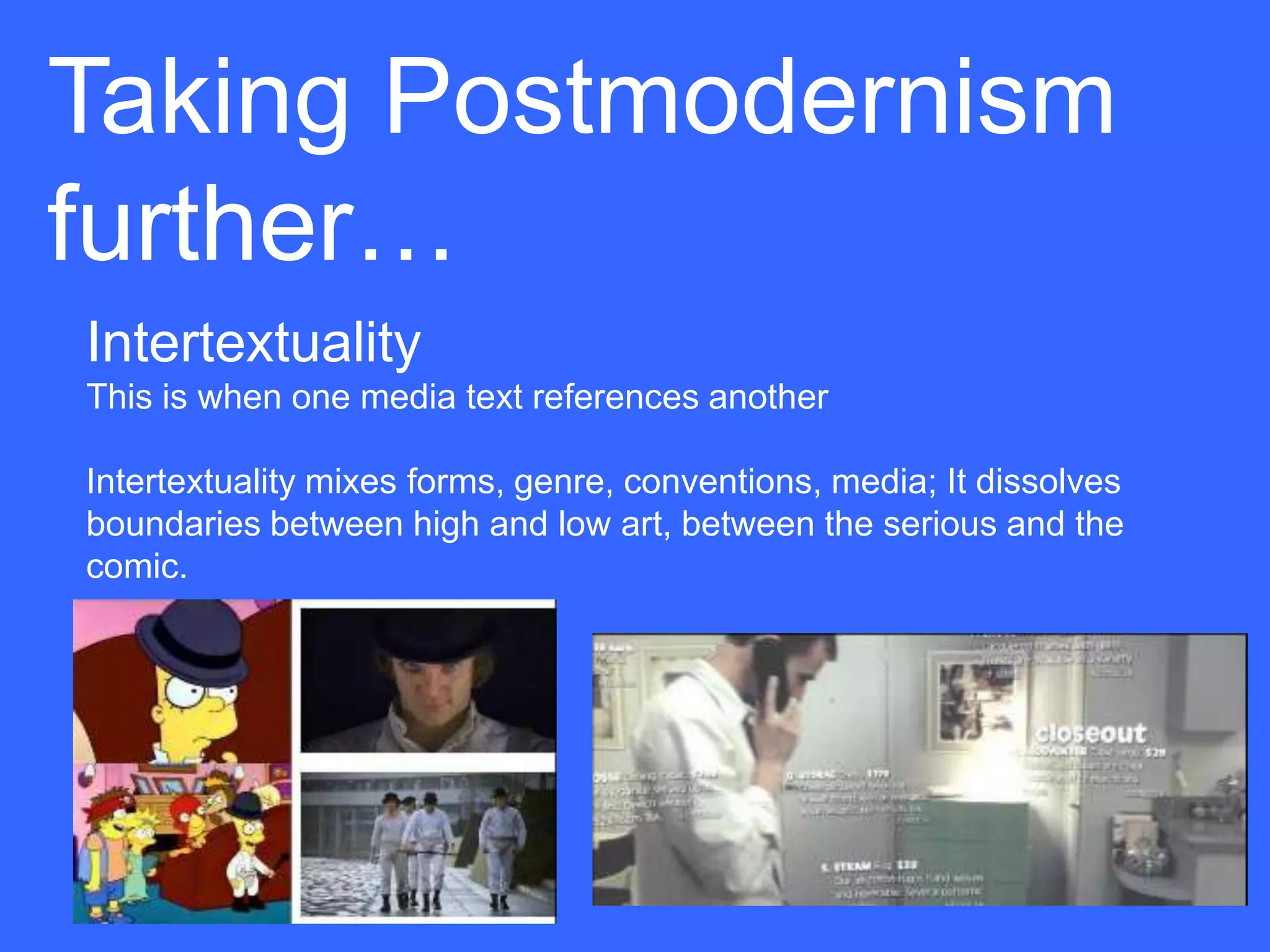
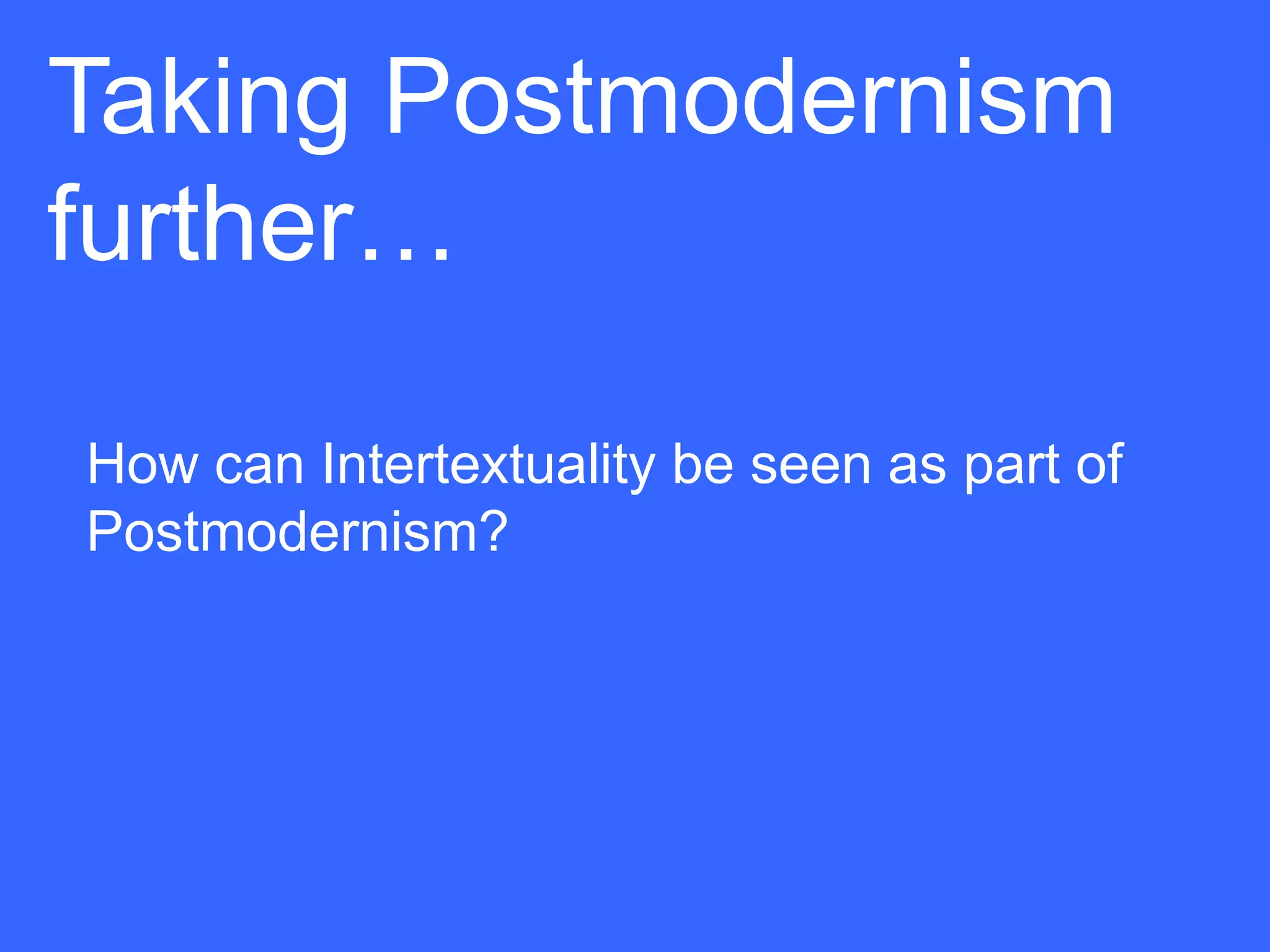
Intertextuality
This is when one media text references another

Intertextuality mixes forms, genre, conventions, media; It dissolves
boundaries between high and low art, between the serious and the
comic.
Taking Postmodernism
further…

How can Intertextuality be seen as part of
Postmodernism?
Postmodernism in
Society
 What would it look like?
 - The breakdown of the distinction between
    culture & society
 - An emphasis on style at the expense of
   substance & content.
 - The breakdown of a distinction between high
   culture (art) and popular culture
 - Confusion over time & space
 - The decline of the meta-narrative or grand
   narrative (i.e. the absolute universal and all
   embracing claims to knowledge like science or
   religion)
Postmodernism in
Society
The breakdown of the distinction
between culture & society
 - Mass culture is now so influential it is no longer „holding a
   mirror up to society‟ – it IS society.

 - The distinction between media and reality has collapsed

 - So new art/media artifacts are influenced by ones previous to
   it.

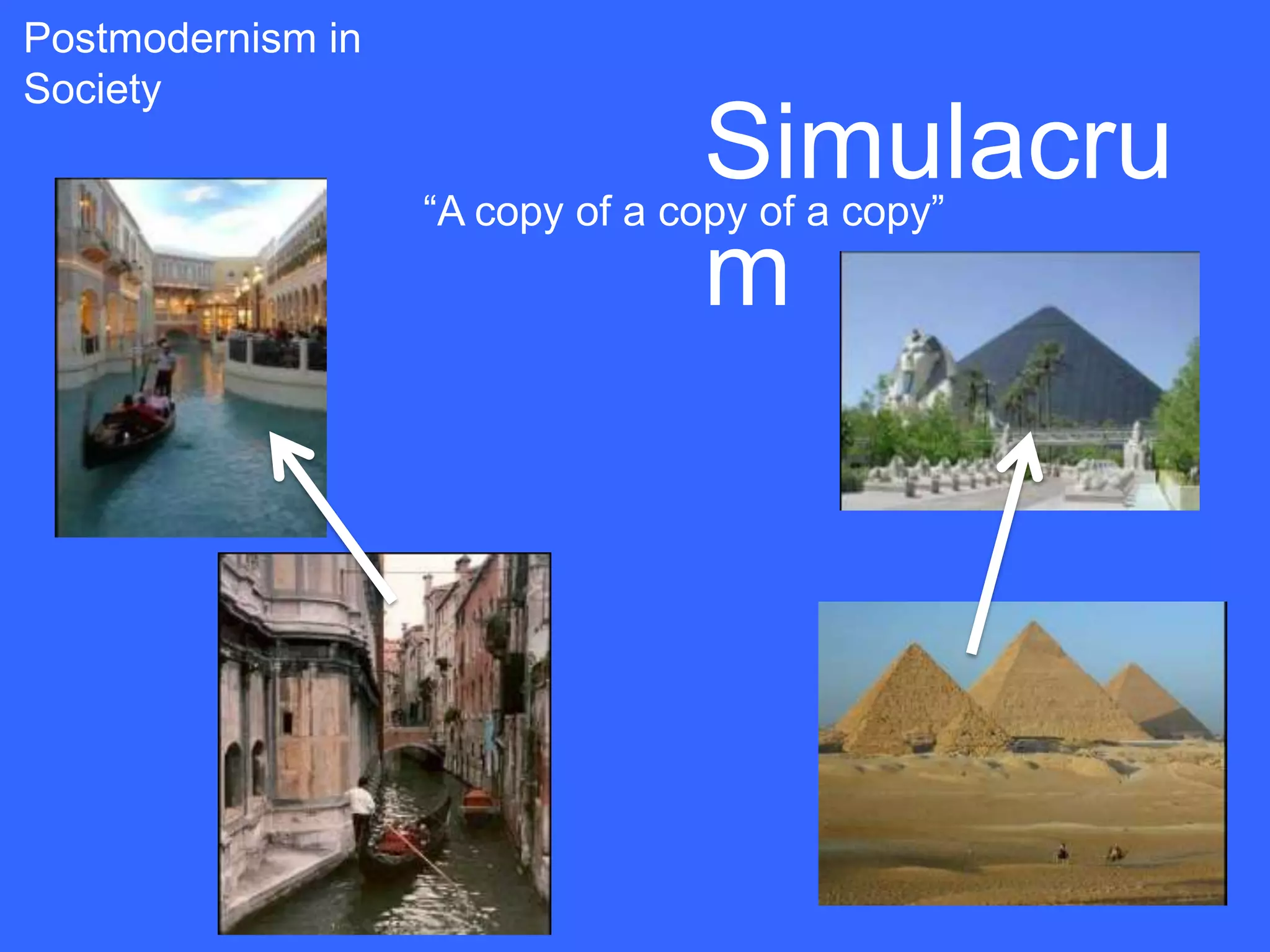
 - Simulacrum – a copy of a copy (of a copy)

 - Intertextuality – Using other texts in a „new‟ one
Postmodernism in
Society
                                        Simulacru
                      “A copy of a copy of a copy”


 “There is no such thing as originality”
                                        m
                                                     Bo
                                                     Diddley


                                                     Chuc
                                                     k
     Outkast              Mick Jagger                Berry

“The distinction between media &
reality has collapsed”
Postmodernism in
Society
                                  Simulacru
                   “A copy of a copy of a copy”
                                  m
Postmodernism in
Society
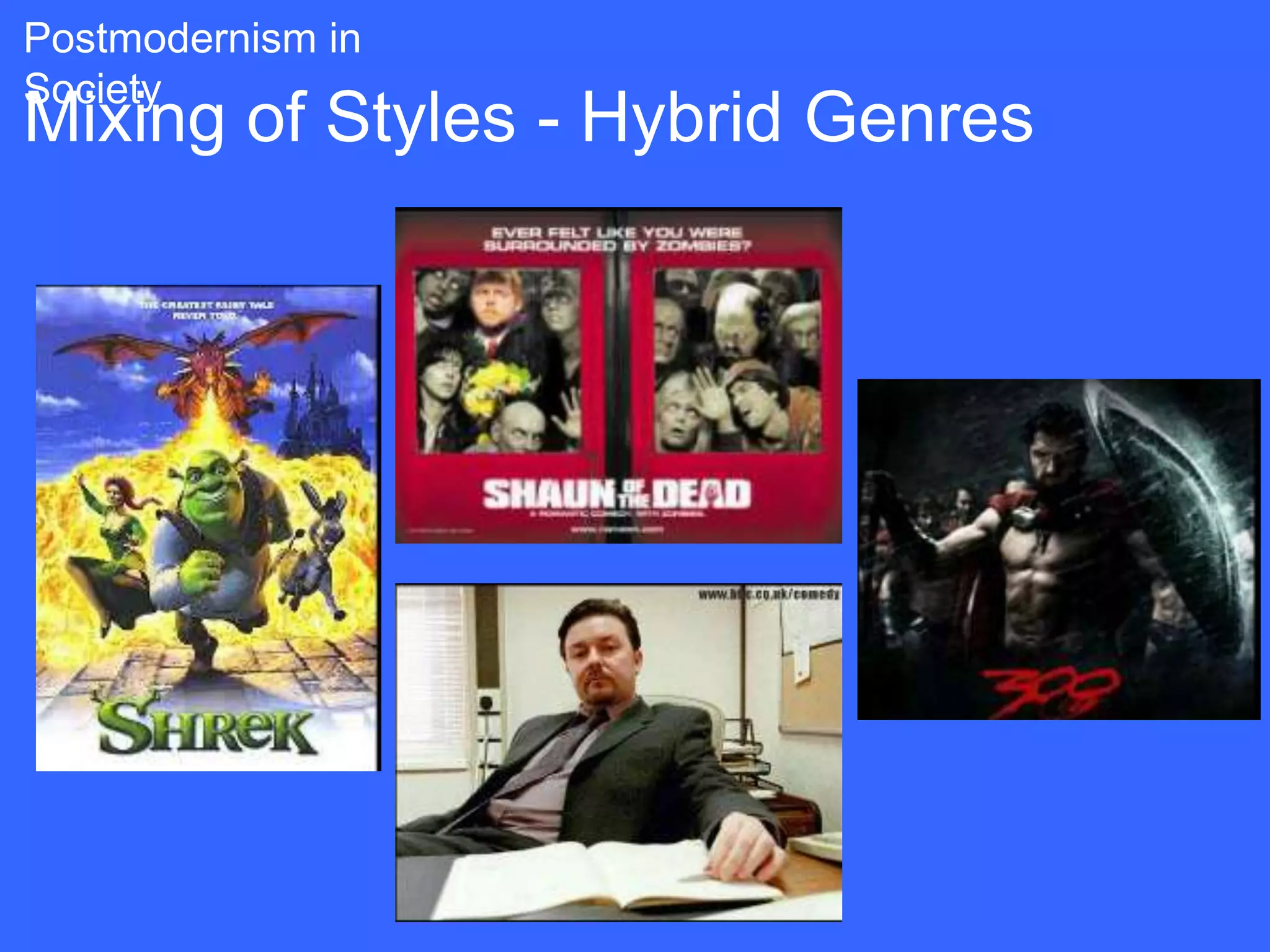
Mixing of Styles - Hybrid Genres
Postmodernism in
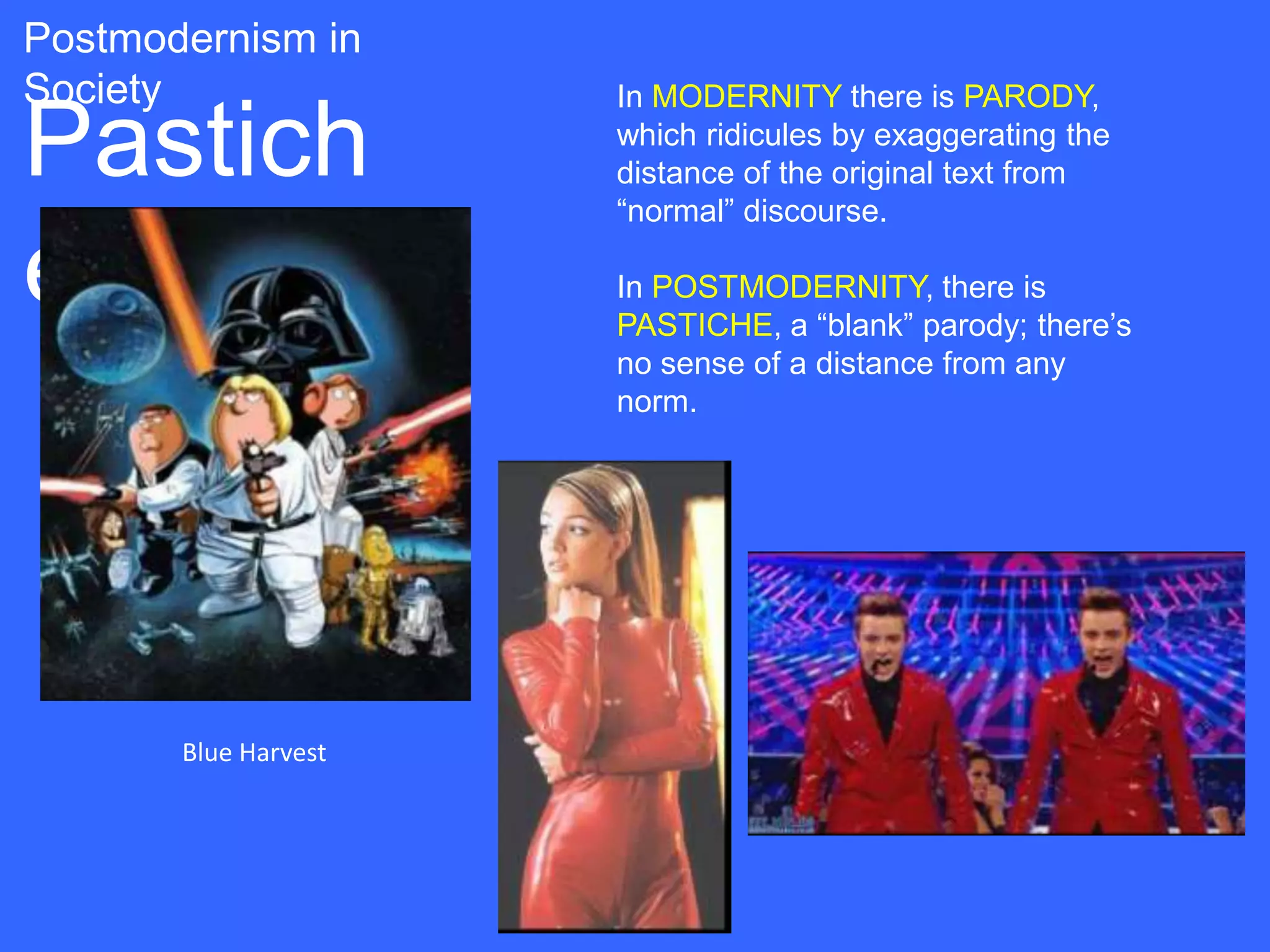
Society               In MODERNITY there is PARODY,

Pastich               which ridicules by exaggerating the
                      distance of the original text from
                      “normal” discourse.

e                     In POSTMODERNITY, there is
                      PASTICHE, a “blank” parody; there‟s
                      no sense of a distance from any
                      norm.


       Blue Harvest
Postmodernism in
Society
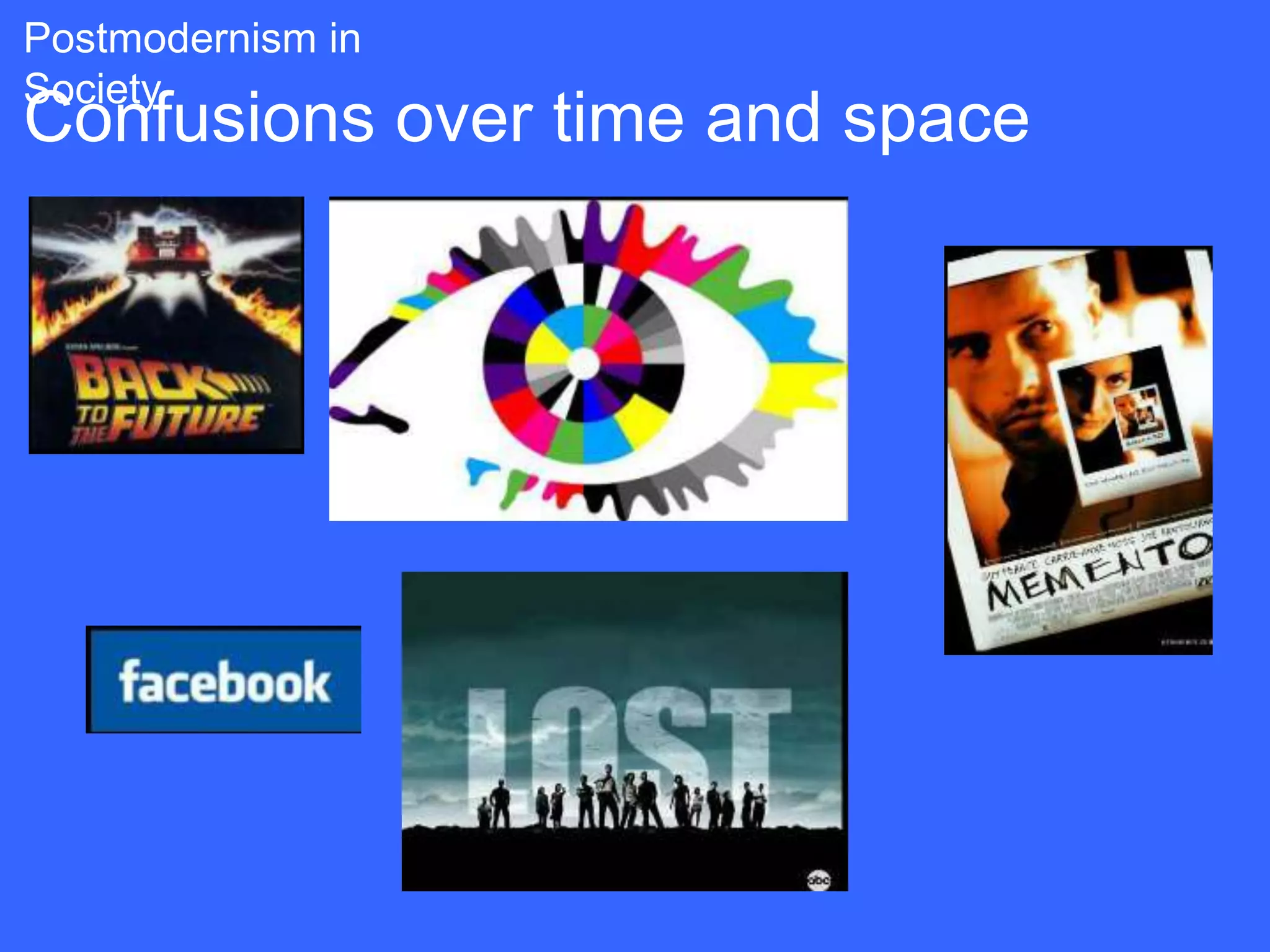
Confusions over time and space

 - Travel across the globe is swift, inexpensive and possible for
   most people

 - Most people have a fair knowledge of other cultures due to
   news/documentaries

 - The internet has broken down space and time barriers

 - 24hr cities
Postmodernism in
Society
Confusions over time and space
Postmodernism in
Society
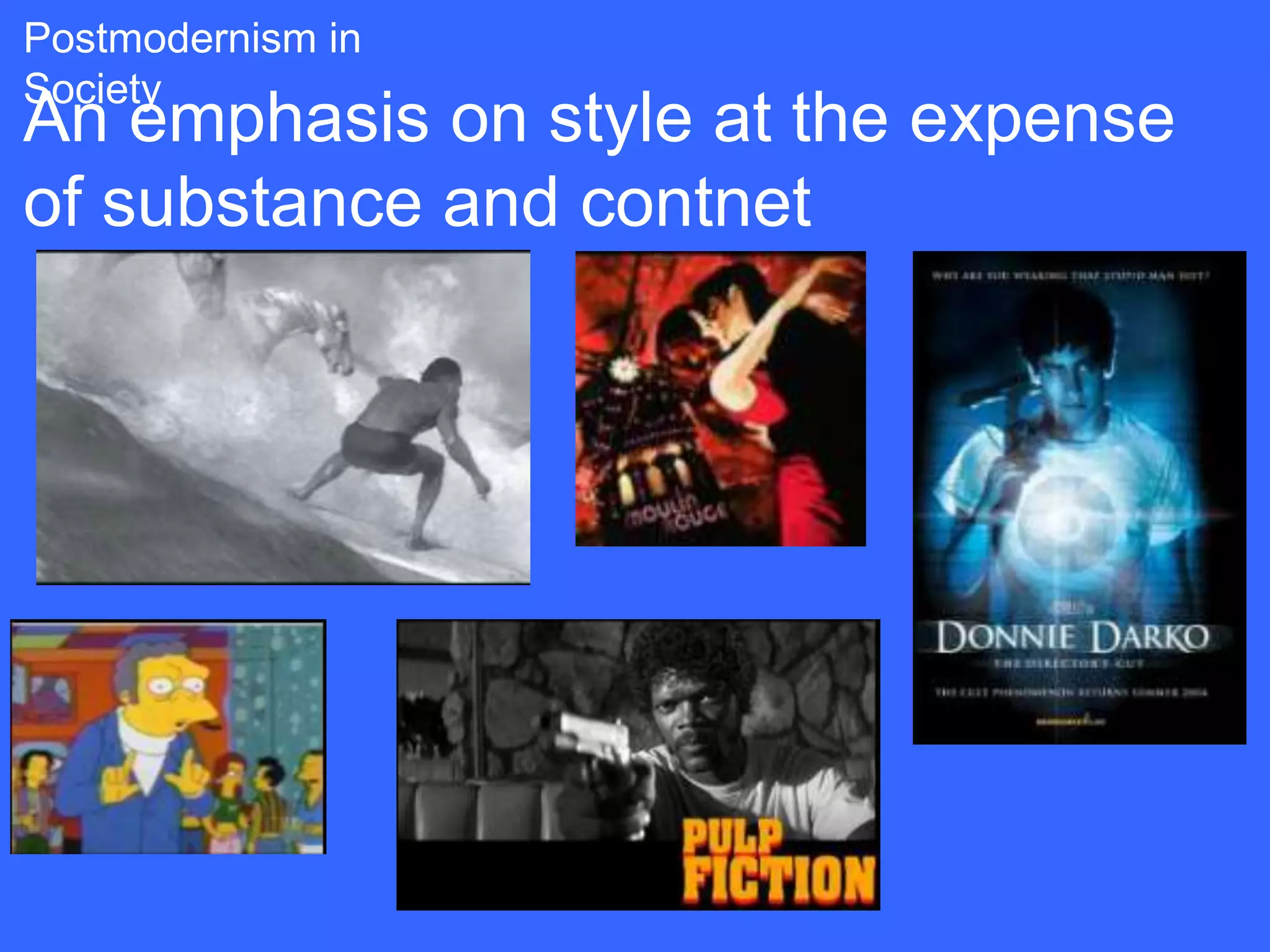
An emphasis on style at the expense
of substance and contnet
 - The visual and stylistic impact becomes more important than
   the meaning/message

 - Media texts which defy interpretation

 - Retro/Nostalgia

 - Shallow –Empty?
Postmodernism in
Society
An emphasis on style at the expense
of substance and contnet
Postmodernism in
Society
The breakdown of a distinction
between high culture (art) and pop
culture
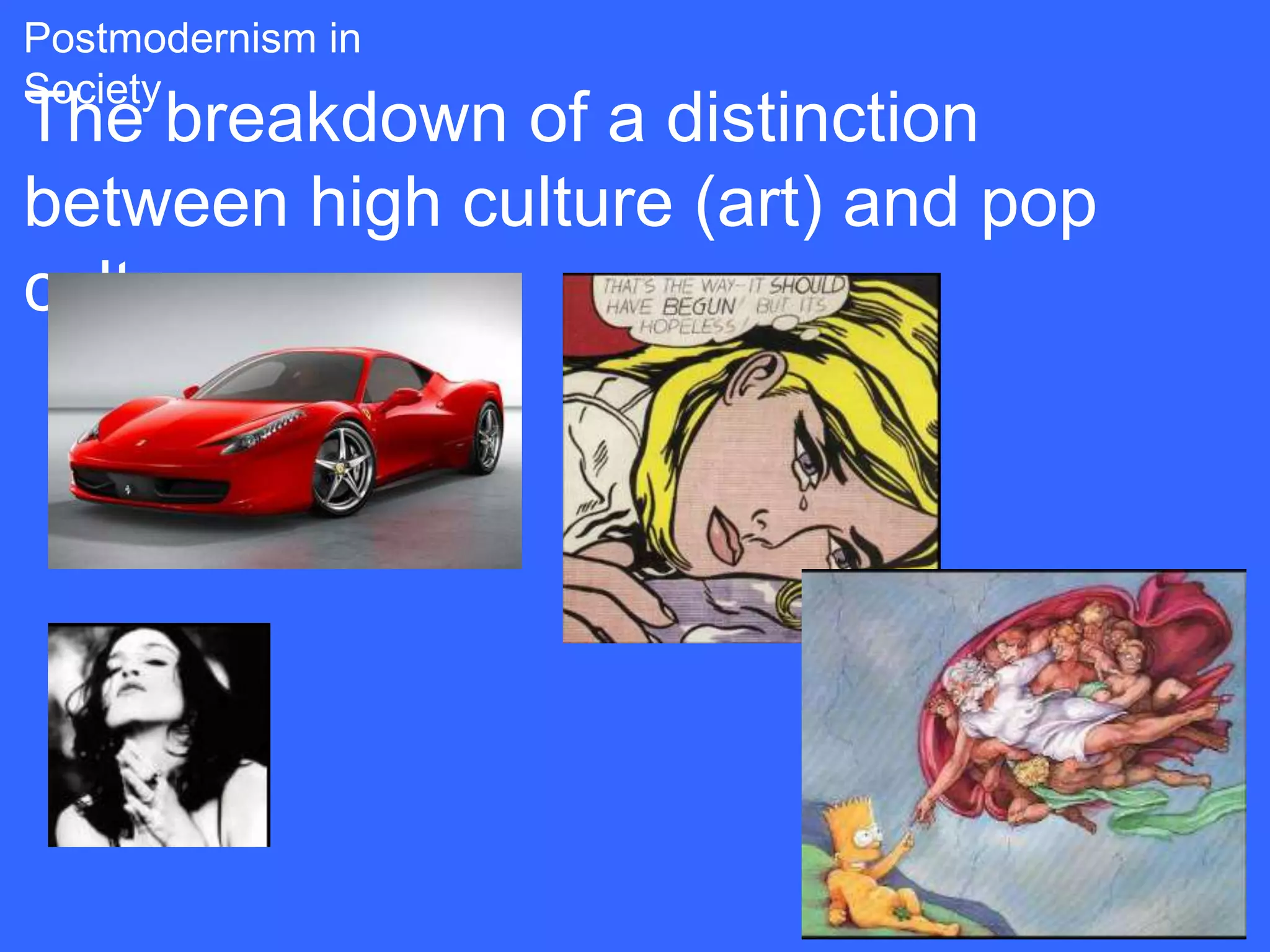
 - Postmodernists – High and low cultrue are =

 - Against the „elitism‟ of high modernism

 - Text which contain elements of high and low culture

 - Treating „low art‟ or „pop culture‟ as if they were high art
   pieces.
Postmodernism in
Society
The breakdown of a distinction
between high culture (art) and pop
culture
 HIGH ART             LOW ART

 Fine art             Advertising
 Opera                Pop Music
 Ballet               Genre Films
 Classical Music      Television
 Classic Literature   Trashy Novels
 Art Cinema           Music videos
 Sculpture
Postmodernism in
Society
The breakdown of a distinction
between high culture (art) and pop
culture
Postmodernism in
Society
The decline of the meta-narrative

 - A meta-narrative is a narrative or story which claims to
   explain something totally – ie christianity, marxism

 - Because society is so fragmented, we live by individual,
   „hand picked‟ beliefs rather than collective ones

 - Post modern texts reflect this state of being by being
   ambiguous in their meaning/message. They defy an
   „absolute truth‟.
Taking Postmodernism
further…
      The                 A Postmodern Case Study
     Matrix
      The Matrix is a 1999 science fiction-action
              film written and directed by
             Larry and Andy Wachowski
        and starring Keanu Reeves, Laurence
          Fishburne, Carrie-Anne Moss, Joe
            Pantoliano, and Hugo Weaving.

     It was first released in the USA on March 31,
          1999, and is the first entry in The Matrix
         series of films, comics, video games, and
                          animation.
Taking Postmodernism
further…
                               A Postmodern Case Study
   Box Office
      Info $171 million in the U.S. and $460 million
    • It earned
       worldwide, and later became the first DVD to sell more
                than three million copies in the U.S.

      • The Ultimate Matrix Collection was released on HD
       DVD on May 22, 2007 and on Blu-ray on October 14,
                              2008.

       • The movie is also scheduled to be released stand
        alone in a 10th anniversary edition on Blu-ray in the
        Digibook format on March 31, 2009, 10 years to the
           day after the movie was released theatrically.
Taking Postmodernism
further…
                            A Postmodern Case Study


       In Postmodern thought, interpretations of The
        Matrix often reference Baudrillard's philosophy
       to demonstrate that the movie is an allegory for
             contemporary experience in a heavily
             commercialized, media-driven society,
          especially of the developed countries. This
        influence was brought to the public's attention
         through the writings of art historians such as
          Griselda Pollock and film theorists such as
                    Heinz-Peter Schwerfel.
Taking Postmodernism
further…
                       A Postmodern Case Study


    The Wachowski Brothers were keen that all
          involved understood the thematic
      background of the movie. For example,
      the book used to conceal disks early in
      the movie, Simulacra and Simulation, a
        1981 work by the French philosopher
       Jean Baudrillard, was required reading
       for most of the principal cast and crew.
Taking Postmodernism
further…
                                  A Postmodern Case Study

       • The Matrix makes many connections to Simulacra and
        Simulation. In an early scene, Simulacra and Simulation is
        the book in which Neo hides his illicit software. In the film,
         the chapter 'On Nihilism' is in the middle, rather than the
                              end of the book.

     • Morpheus also refers to the real world outside of the Matrix
        as the "desert of the real", which was directly referenced in
       the Slavoj Žižek work, Welcome to the Desert of the Real. In
        the original script, Morpheus referenced Baudrillard's book
                                 specifically.

    • Keanu Reeves was asked by the directors to read the book,
      as well as Out of Control and Evolution Psychology, before
                          being cast as Neo.
Taking Postmodernism
further…
                             A Postmodern Case Study
    Merrin –
    „Baudrillard and the Media‟ (2005 p131)
   The Matrix has us. Our consumption of the films, the
           merchandise, and the world and myth the
       Wachowskis sell us, and our collective orgasm
       over the effects and phones, guns, shades and
     leather, represent our integration into the virtuality
        it promotes. The Matrix became a viral meme
           spreading through and being mimetically
      (mimicked i.e. copied) and absorbed into modern
              culture, extending our virtualisation.
Taking Postmodernism
further…
                              A Postmodern Case Study
Merrin cont.
       Just as the film offered the stark choice of being
          inside or outside the matrix so you were either
           inside or outside the zeitgeist (the spirit of the
         times). To paraphrase Morpheus: The Matrix is
       everywhere. As Baudrillard makes clear, however,
             its fans and public are caught in a similarly
       invisible matrix that is far greater than depicted in
            the film, and that the film itself is part of and
                               extends.
Taking Postmodernism
further…
                              A Postmodern Case Study
Other Postmodern Influences
     The film describes a future in which reality perceived by
          humans is actually the Matrix: a simulated reality
        created by sentient machines in order to pacify and
       subdue the human population while their bodies' heat
        and electrical activity are used as an energy source.
    Upon learning this, computer programmer "Neo" is drawn
      into a rebellion against the machines. The film contains
            many references to the cyberpunk and hacker
         subcultures; philosophical and religious ideas; and
       homages to Alice's Adventures in Wonderland, Hong
            Kong action cinema and Spaghetti Westerns.
Taking Postmodernism
further…
                          A Postmodern Case Study
         Challenging Film Making
               Conventions
     The film is known for popularizing the use of a visual effect known as "bullet
        time", which allows the viewer to explore a moment progressing in slow-
       motion as the camera appears to orbit around the scene at normal speed.

    One proposed technique for creating these effects involved propelling a high
      speed camera along a fixed track with a rocket to capture the action as it
       occurred. However, this was discarded as unfeasible, because not only
      was the destruction of the camera in the attempt all but inevitable, but the
          camera would also be almost impossible to control at such speeds.
       Instead, the method used was a technically expanded version of an old
       art photography technique known as time-slice photography, in which a
         large number of cameras are placed around an object and triggered
                                nearly simultaneously.
Taking Postmodernism
further…
                               A Postmodern Case Study

       • The evolution of photogrametric and image-based
        computer-generated background approaches in The
           Matrix's bullet time shots set the stage for later
           innovations unveiled in the sequels The Matrix
            Reloaded and The Matrix Revolutions. Virtual
        Cinematography (CGI-rendered characters, locations,
       and events) and the high-definition "Universal Capture"
         process completely replaced the use of still camera
       arrays, thus more closely realizing the "virtual camera".

    • This film overcame the release of Star Wars Episode I:
      The Phantom Menace by winning the Academy Award
                        for Visual Effects
Taking Postmodernism
further…


                           How is
                        Fight Club
                       postmodern
                                 ?
Taking Postmodernism
further…
                       A Postmodern Case Study

Postmodernism & fc

  • 1.
    Postmodernis A critical approach to Film m
  • 2.
    Postmodernism Acritical approach to Film What is Postmodernism? - An Oxymoron? - An overused & meaningless term? - A bunch of nonsense? - A “response” (or, “responses”) to modernism.
  • 3.
    Postmodernism Acritical approach to Film What is Modernism? Modernism, in its broadest definition, is modern thought, character, or practice. Modernism explicitly rejects the ideology or realism, and makes use of the works of the past, through the application of reprise, incorporation, rewriting, recapitulation, revision and parody in new forms. The term modernism encompasses the activities and output of those who felt the “traditional” forms of art, architecture, literature, religious faith, social organization and daily life were becoming outdated in the new economic, social, and political conditions of an emerging fully industrialized world.
  • 4.
    Postmodernism Acritical approach to Film Postmodernism is therefore…
  • 5.
    Postmodernism Acritical approach to Film Postmodernism is therefore… In Film… Postmodernist films upsets the mainstream conventions of narrative structure and characterisation and destroys the audience‟s suspension of belief.
  • 6.
    Features of postmodern films • They don‟t pretend to wholly works, and often draw attention to the fact they are in fact fictitious. For instance, characters might stop and talk directly to the audience. • They often re-arrange or disrupt strict linear narratives, instead using circular narratives and open ended closures. • They often involve characters that feel disconnected or alienated from their environment and distrust authorities.
  • 7.
    Genres of Postmodern •Pastiche: Self referential, tongue-in-cheek, rehashes of classic pop culture. • Flattening of Affect: Technology, violence, drugs, and the media lead to detached, emotionless, unauthentic lives. • Hyper reality: Technologically created realities are often more authentic or desirable than the real world.
  • 8.
    Genres of Postmodernism •Time Bending: Time travel provides another way to shape reality and play “what if” games with society. • Altered states: Drugs, mental illness and technology provide a dark, often psychedelic, gateways to new internal realities. • More Human than Human: Artificial intelligence, robotics and cybernetics seek to enhance, or replace, humanity.
  • 9.
    Analysis of aflattening affect Film • Fight Club a synopsis: A ticking-time-bomb insomniac and a slippery soap salesman channel primal male aggression into a shocking new form of therapy. Their concept catches on, with underground "fight clubs" forming in every town, until an eccentric gets in the way and ignites an out-of-control spiral toward oblivion.
  • 10.
    Fight club Analysis • The main protagonist‟s journey from a depressed insomniac to, to an unhinged violent psychopath, Is according to the postmodernism theory, the characterization of a protagonist who is disconnected from wider society, this is a key feature of a postmodern film. • In Fight Club the movie uses a narrator through out the film who is one of the main protagonist this is another postmodern concept. This type of cinematography disrupts the linear sequence of the narrative and instead creates a circular narrative in which parts of the film are cliff hangers where the audience does not know what‟s happening next mirroring the actions of the main protagonist. Broadcast media bulletins are used to create suspense and tension. A dark color scheme connotes to the audience that this film is going to be violent and scary. This film is a classic example of the postmodernist theory.
  • 11.
    Taking Postmodernism further… Intertextuality This iswhen one media text references another Intertextuality mixes forms, genre, conventions, media; It dissolves boundaries between high and low art, between the serious and the comic.
  • 12.
    Taking Postmodernism further… How canIntertextuality be seen as part of Postmodernism?
  • 13.
    Postmodernism in Society Whatwould it look like? - The breakdown of the distinction between culture & society - An emphasis on style at the expense of substance & content. - The breakdown of a distinction between high culture (art) and popular culture - Confusion over time & space - The decline of the meta-narrative or grand narrative (i.e. the absolute universal and all embracing claims to knowledge like science or religion)
  • 14.
    Postmodernism in Society The breakdownof the distinction between culture & society - Mass culture is now so influential it is no longer „holding a mirror up to society‟ – it IS society. - The distinction between media and reality has collapsed - So new art/media artifacts are influenced by ones previous to it. - Simulacrum – a copy of a copy (of a copy) - Intertextuality – Using other texts in a „new‟ one
  • 15.
    Postmodernism in Society Simulacru “A copy of a copy of a copy” “There is no such thing as originality” m Bo Diddley Chuc k Outkast Mick Jagger Berry “The distinction between media & reality has collapsed”
  • 16.
    Postmodernism in Society Simulacru “A copy of a copy of a copy” m
  • 17.
    Postmodernism in Society Mixing ofStyles - Hybrid Genres
  • 18.
    Postmodernism in Society In MODERNITY there is PARODY, Pastich which ridicules by exaggerating the distance of the original text from “normal” discourse. e In POSTMODERNITY, there is PASTICHE, a “blank” parody; there‟s no sense of a distance from any norm. Blue Harvest
  • 19.
    Postmodernism in Society Confusions overtime and space - Travel across the globe is swift, inexpensive and possible for most people - Most people have a fair knowledge of other cultures due to news/documentaries - The internet has broken down space and time barriers - 24hr cities
  • 20.
  • 21.
    Postmodernism in Society An emphasison style at the expense of substance and contnet - The visual and stylistic impact becomes more important than the meaning/message - Media texts which defy interpretation - Retro/Nostalgia - Shallow –Empty?
  • 22.
    Postmodernism in Society An emphasison style at the expense of substance and contnet
  • 23.
    Postmodernism in Society The breakdownof a distinction between high culture (art) and pop culture - Postmodernists – High and low cultrue are = - Against the „elitism‟ of high modernism - Text which contain elements of high and low culture - Treating „low art‟ or „pop culture‟ as if they were high art pieces.
  • 24.
    Postmodernism in Society The breakdownof a distinction between high culture (art) and pop culture HIGH ART LOW ART Fine art Advertising Opera Pop Music Ballet Genre Films Classical Music Television Classic Literature Trashy Novels Art Cinema Music videos Sculpture
  • 25.
    Postmodernism in Society The breakdownof a distinction between high culture (art) and pop culture
  • 26.
    Postmodernism in Society The declineof the meta-narrative - A meta-narrative is a narrative or story which claims to explain something totally – ie christianity, marxism - Because society is so fragmented, we live by individual, „hand picked‟ beliefs rather than collective ones - Post modern texts reflect this state of being by being ambiguous in their meaning/message. They defy an „absolute truth‟.
  • 27.
    Taking Postmodernism further… The A Postmodern Case Study Matrix The Matrix is a 1999 science fiction-action film written and directed by Larry and Andy Wachowski and starring Keanu Reeves, Laurence Fishburne, Carrie-Anne Moss, Joe Pantoliano, and Hugo Weaving. It was first released in the USA on March 31, 1999, and is the first entry in The Matrix series of films, comics, video games, and animation.
  • 28.
    Taking Postmodernism further… A Postmodern Case Study Box Office Info $171 million in the U.S. and $460 million • It earned worldwide, and later became the first DVD to sell more than three million copies in the U.S. • The Ultimate Matrix Collection was released on HD DVD on May 22, 2007 and on Blu-ray on October 14, 2008. • The movie is also scheduled to be released stand alone in a 10th anniversary edition on Blu-ray in the Digibook format on March 31, 2009, 10 years to the day after the movie was released theatrically.
  • 29.
    Taking Postmodernism further… A Postmodern Case Study In Postmodern thought, interpretations of The Matrix often reference Baudrillard's philosophy to demonstrate that the movie is an allegory for contemporary experience in a heavily commercialized, media-driven society, especially of the developed countries. This influence was brought to the public's attention through the writings of art historians such as Griselda Pollock and film theorists such as Heinz-Peter Schwerfel.
  • 30.
    Taking Postmodernism further… A Postmodern Case Study The Wachowski Brothers were keen that all involved understood the thematic background of the movie. For example, the book used to conceal disks early in the movie, Simulacra and Simulation, a 1981 work by the French philosopher Jean Baudrillard, was required reading for most of the principal cast and crew.
  • 31.
    Taking Postmodernism further… A Postmodern Case Study • The Matrix makes many connections to Simulacra and Simulation. In an early scene, Simulacra and Simulation is the book in which Neo hides his illicit software. In the film, the chapter 'On Nihilism' is in the middle, rather than the end of the book. • Morpheus also refers to the real world outside of the Matrix as the "desert of the real", which was directly referenced in the Slavoj Žižek work, Welcome to the Desert of the Real. In the original script, Morpheus referenced Baudrillard's book specifically. • Keanu Reeves was asked by the directors to read the book, as well as Out of Control and Evolution Psychology, before being cast as Neo.
  • 32.
    Taking Postmodernism further… A Postmodern Case Study Merrin – „Baudrillard and the Media‟ (2005 p131) The Matrix has us. Our consumption of the films, the merchandise, and the world and myth the Wachowskis sell us, and our collective orgasm over the effects and phones, guns, shades and leather, represent our integration into the virtuality it promotes. The Matrix became a viral meme spreading through and being mimetically (mimicked i.e. copied) and absorbed into modern culture, extending our virtualisation.
  • 33.
    Taking Postmodernism further… A Postmodern Case Study Merrin cont. Just as the film offered the stark choice of being inside or outside the matrix so you were either inside or outside the zeitgeist (the spirit of the times). To paraphrase Morpheus: The Matrix is everywhere. As Baudrillard makes clear, however, its fans and public are caught in a similarly invisible matrix that is far greater than depicted in the film, and that the film itself is part of and extends.
  • 34.
    Taking Postmodernism further… A Postmodern Case Study Other Postmodern Influences The film describes a future in which reality perceived by humans is actually the Matrix: a simulated reality created by sentient machines in order to pacify and subdue the human population while their bodies' heat and electrical activity are used as an energy source. Upon learning this, computer programmer "Neo" is drawn into a rebellion against the machines. The film contains many references to the cyberpunk and hacker subcultures; philosophical and religious ideas; and homages to Alice's Adventures in Wonderland, Hong Kong action cinema and Spaghetti Westerns.
  • 35.
    Taking Postmodernism further… A Postmodern Case Study Challenging Film Making Conventions The film is known for popularizing the use of a visual effect known as "bullet time", which allows the viewer to explore a moment progressing in slow- motion as the camera appears to orbit around the scene at normal speed. One proposed technique for creating these effects involved propelling a high speed camera along a fixed track with a rocket to capture the action as it occurred. However, this was discarded as unfeasible, because not only was the destruction of the camera in the attempt all but inevitable, but the camera would also be almost impossible to control at such speeds. Instead, the method used was a technically expanded version of an old art photography technique known as time-slice photography, in which a large number of cameras are placed around an object and triggered nearly simultaneously.
  • 36.
    Taking Postmodernism further… A Postmodern Case Study • The evolution of photogrametric and image-based computer-generated background approaches in The Matrix's bullet time shots set the stage for later innovations unveiled in the sequels The Matrix Reloaded and The Matrix Revolutions. Virtual Cinematography (CGI-rendered characters, locations, and events) and the high-definition "Universal Capture" process completely replaced the use of still camera arrays, thus more closely realizing the "virtual camera". • This film overcame the release of Star Wars Episode I: The Phantom Menace by winning the Academy Award for Visual Effects
  • 37.
    Taking Postmodernism further… How is Fight Club postmodern ?
  • 38.
    Taking Postmodernism further… A Postmodern Case Study