SOC 462
IDENTITY&CULTURE
Asst. Prof. Fatma ALTINBAŞ SARIGÜL
Mass Culture and Popular Culture
• The pessimistic view sees popular culture as a problem
for society, whereas optimistic view thinks popular culture
can be uses in highly creative ways.
High Culture; products that are intellectual, artistic,
difficult to understand, expensive and aimed at those with
an exclusive taste, not shared by ordinary people.
Low Culture; products that are easy to understand,
cheap, ‘throwaway’, common and so on.
‘Mass Society Thesis’
In mass society; individuals lose their sense of
community, lose their individuality and come to rely on
strong authority from above.
It suggests that popular culture prevents critical and
revolutionary thought.
This is seen as dangerous, because if the masses cannot
think for themselves, the groups who run the society can
dominate as they wish.
The Frankfurt School
• The best known and most influential version of the Marxist
interpretation of mass culture and commodification was
provided by Marcuse, Adorno and Horkheimer.
• Adorno and Horkheimer argued that advertising in capitalism
creates and manipulates false needs and desires that are
fulfilled by consumption.
• The consumption of cultural products, under a capitalist
economy creates fetishism, which is in favor of the ruling
group.
• In this respect, consumerism is ideological.
• Media as ‘cultural industry’.
The Pluralist Perspective
They argue that;
• Different people perceive the media in different
ways.
• Individuals have plural choices what to consume
and not.
• Power is distributed among many different groups
in society.
• Human beings are active, creative beings.
Postmodernity and Popular Culture
• Whereas modernity was characterized by the
manufacture of products and the use of raw materials,
postmodernity is based on consumption rather than
production.
• In postmodernity, life-style construction and the creation of
self-identity are based on the types of popular culture
products we consume, and the creative uses to which we
put these products.
• Anderson versus Baudrillard
Youth Culture and Subculture
• Youth culture is big business for ‘culture industry’.
Subculture; a group that has broken away from the
dominant culture and has its own specialist norms and
values.
Deviant Subculture; a group that reject the common
norms and rules of the society.
The Historical Development of
Subcultural Study
• Robert Merton- mid 1930s.
• The Chicago School
• Howard Becker
Popular Culture and Subcultures
• Excorporation: the cultural products, images, styles, life-
styles, behavioral patterns and so on of the dominant
culture are taken over by a subculture in order to
challenge and change the meanings the dominant culture
has given to them.
• Can subcultures change the structure of the society or by
rejecting the system, do they become more deviant in
time?
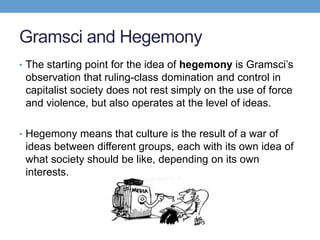
Gramsci and Hegemony
• The starting point for the idea of hegemony is Gramsci’s
observation that ruling-class domination and control in
capitalist society does not rest simply on the use of force
and violence, but also operates at the level of ideas.
• Hegemony means that culture is the result of a war of
ideas between different groups, each with its own idea of
what society should be like, depending on its own
interests.
Semiology
• Semiology is interested in signs and symbols hidden in
everyday life.
• Weinstein uses the term ‘bricolage’ from Levi-Strauss
to discuss how subcultures borrow, redefine and use
styles and symbols from cultural groups other than their
own.
• Bricolage- the mixing of symbols by reclassifying them
and actively creating new and meaningful subcultures
based on resistance to dominant values.
Soc 462, 8th class

Soc 462, 8th class

  • 1.
    SOC 462 IDENTITY&CULTURE Asst. Prof.Fatma ALTINBAŞ SARIGÜL
  • 2.
    Mass Culture andPopular Culture • The pessimistic view sees popular culture as a problem for society, whereas optimistic view thinks popular culture can be uses in highly creative ways. High Culture; products that are intellectual, artistic, difficult to understand, expensive and aimed at those with an exclusive taste, not shared by ordinary people. Low Culture; products that are easy to understand, cheap, ‘throwaway’, common and so on.
  • 3.
    ‘Mass Society Thesis’ Inmass society; individuals lose their sense of community, lose their individuality and come to rely on strong authority from above. It suggests that popular culture prevents critical and revolutionary thought. This is seen as dangerous, because if the masses cannot think for themselves, the groups who run the society can dominate as they wish.
  • 4.
    The Frankfurt School •The best known and most influential version of the Marxist interpretation of mass culture and commodification was provided by Marcuse, Adorno and Horkheimer. • Adorno and Horkheimer argued that advertising in capitalism creates and manipulates false needs and desires that are fulfilled by consumption. • The consumption of cultural products, under a capitalist economy creates fetishism, which is in favor of the ruling group. • In this respect, consumerism is ideological. • Media as ‘cultural industry’.
  • 5.
    The Pluralist Perspective Theyargue that; • Different people perceive the media in different ways. • Individuals have plural choices what to consume and not. • Power is distributed among many different groups in society. • Human beings are active, creative beings.
  • 6.
    Postmodernity and PopularCulture • Whereas modernity was characterized by the manufacture of products and the use of raw materials, postmodernity is based on consumption rather than production. • In postmodernity, life-style construction and the creation of self-identity are based on the types of popular culture products we consume, and the creative uses to which we put these products. • Anderson versus Baudrillard
  • 7.
    Youth Culture andSubculture • Youth culture is big business for ‘culture industry’. Subculture; a group that has broken away from the dominant culture and has its own specialist norms and values. Deviant Subculture; a group that reject the common norms and rules of the society.
  • 8.
    The Historical Developmentof Subcultural Study • Robert Merton- mid 1930s. • The Chicago School • Howard Becker
  • 9.
    Popular Culture andSubcultures • Excorporation: the cultural products, images, styles, life- styles, behavioral patterns and so on of the dominant culture are taken over by a subculture in order to challenge and change the meanings the dominant culture has given to them. • Can subcultures change the structure of the society or by rejecting the system, do they become more deviant in time?
  • 10.
    Gramsci and Hegemony •The starting point for the idea of hegemony is Gramsci’s observation that ruling-class domination and control in capitalist society does not rest simply on the use of force and violence, but also operates at the level of ideas. • Hegemony means that culture is the result of a war of ideas between different groups, each with its own idea of what society should be like, depending on its own interests.
  • 11.
    Semiology • Semiology isinterested in signs and symbols hidden in everyday life. • Weinstein uses the term ‘bricolage’ from Levi-Strauss to discuss how subcultures borrow, redefine and use styles and symbols from cultural groups other than their own. • Bricolage- the mixing of symbols by reclassifying them and actively creating new and meaningful subcultures based on resistance to dominant values.