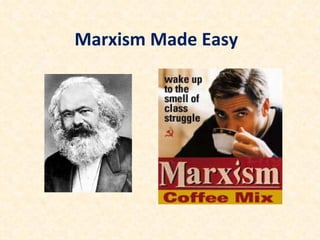
Marxism Made Easy
The following ideas
summarise the section on
Marxist Perspective in
Media Studies A2: The
Essential Introduction for
WJEC. It would be a good
idea to read the entire
section in the original, if
you want to fully get to
grips with these ideas and
ways of looking at media
texts.
Marxism derived from the
political and social ideologies
written by Karl Marx in the
1867 book Das Kapital.

It developed into a political
system that became the basis
of communism, central to the
old Soviet Union and still part
of the social fabric of China
and North Korea.
Since Marx’s death in 1883, his ideas have ben taken
and expanded by others, so modern Marxism is more
than just the work of Karl Marx.
One of Marx’s core ideas about society was that all
societies have an economic base. This is seen to be
the central core and focus of any society – what
makes the rest of it tick.

In Western cultures this economic base is
essentially capitalist – in other words, the whole
system is based on the pursuit of wealth. The
problem is that this does not benefit all – the rich
get richer and the poor poorer in this type of
system. It leads to social inequality.
A capitalist system encourages
individuals to pursue wealth and
prosperity and allows them, after
due taxes have ben paid, to keep the
profit. This is seen to motivate
economic success.

As a result capitalism has valued
individuality, competitiveness,
conspicuous consumption (as an
obvious sign of success) and
materialism. Greed is not necessarily
a vice, as it promotes the desire to
produce wealth.
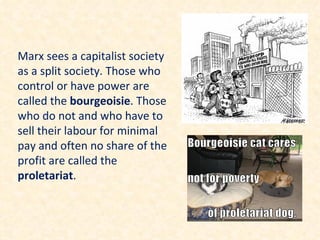
Marx sees a capitalist society
as a split society. Those who
control or have power are
called the bourgeoisie. Those
who do not and who have to
sell their labour for minimal
pay and often no share of the
profit are called the
proletariat.
Marx saw that the economic
base supported a
superstructure – the
institutions that exist in a
society such as those linked to
the law, education, politics and
the media. These are shaped
by the economic base and
exist to support, serve and
legitimise the base to society –
they partly exist to convince
people that the way the
country works is the right way.
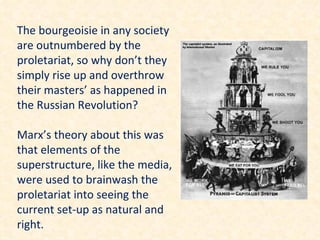
The bourgeoisie in any society
are outnumbered by the
proletariat, so why don’t they
simply rise up and overthrow
their masters’ as happened in
the Russian Revolution?

Marx’s theory about this was
that elements of the
superstructure, like the media,
were used to brainwash the
proletariat into seeing the
current set-up as natural and
right.
The media, amongst other
elements, created a sense of
false consciousness – a fake
view that the world is exactly as
it should be. This view reassures
the proletariat and stops them
feeling that anything should be
done about their lot. In other
words, they are rendered
unaware of the true nature of
their exploitation and the
unfairness of the system they
live in.
It becomes the objective of
the most powerful ruling
group to stay in power, to
preserve their privileged
position. It is for this reason
that they use the media and
other elements of the
superstructure to try and
get others to agree to keep
society the way it is.
Two later theorists developed ideas about
the role the media plays in this pacification
and hoodwinking of the masses.
Althusser identified two types of
mechanism that states use to control the
masses:
•Repressive State Apparatuses – physical bodies
that can restrain people if they step over the lines
the ruling group sets, institutions like the army
and the police
•Ideological state Apparatuses (ISAs)- structures
which use ideology to try to dominate people, a
subtler approach. Includes institutions like the
media, education and religion.
Gramsci developed ideas about
hegemony, describing the
process whereby the ruling
classes own and control the ISAs
like the media. They can, thus,
use them to promote the
ideologies of the ruling classes.
Through repetition and the
absence or marginalisation of
other views, the proletariat
eventually accept them as
‘common sense’ and the natural
way to view things.
These views show how
Marxist’s view media in a
capitalist culture as agents of
the ruling elite. The media is
used as a more subtle, less
objectionable control
mechanism than the army.
They aim to gain people’s
agreement to the way
society is rather than having
to beat them into
submission.
The ideas of the ruling class are in every epoch the
ruling ideas
Karl Marx
Obviously, communism tried to create
a society that ran on very different
lines to capitalism:

•There should be no private ownership of
business or industry, so no one person gets
all the profit
•All work and share in the outcome –
common ownership
•No classes, so no one group can set
themselves up over others
•State control of media and other ISAs like
religion etc to avoid the creation of false
consciousness
The ideas behind communism
were to eliminate the
problems people like Marx
saw in capitalist societies
during the Industrial
Revolution.

Countries like Russia and China
ran their countries on these
lines. However, as with all
systems, their implementation
was not problem free, nor did
they arguably produce fairer
societies.
Just because Marx wrote in 1883, does that mean his
ideas are still relevant today?
Many think so, although it is true that many capitalist
societies have seen changes that may affect some of
Marx’s original ideas:
•Poverty today in the UK is much less than it was when Marx
wrote his treatise (he gained many ideas during a sojourn in
Manchester) – maybe divisions are less stark? Although, you may
like to consider how much some bankers and footballers earn!
•Big companies are less likely to be owned by a few private
individuals but often belong to shareholders, who may well be
workers from a variety of backgrounds
•The internet is allowing more and more people to work for
themselves
How does Marxism apply to media texts?

• You can look at who owns a media production and who
  benefits the most financially
• Texts can be examined to see if they promote ideologies that
  support the ruling classes/ the status quo – is it being used to
  exert hegemonic control – ask what ideologies are being
  pushed? Who do they benefit?
• Do texts naturalise inequality between groups based on power
  – are men privileged over women? White groups over other
  cultures? Capitalism over any other economic system and
  values?
• Are media texts produced just like any other product in
  the capitalist system – for maximum profit? The need
  for efficient mass production may lead to a formula
  approach to media creation, weakening elements of
  creativity and imagination. Some Marxist critics, like
  Theodore Adorno, certainly saw capitalist media
  systems as antithetical to the production of ‘good’ and
  valuable culture. Some products will never get made as
  they are unlikely to yield a profit.

Marxism made easy

  • 1.
  • 2.
    The following ideas summarisethe section on Marxist Perspective in Media Studies A2: The Essential Introduction for WJEC. It would be a good idea to read the entire section in the original, if you want to fully get to grips with these ideas and ways of looking at media texts.
  • 3.
    Marxism derived fromthe political and social ideologies written by Karl Marx in the 1867 book Das Kapital. It developed into a political system that became the basis of communism, central to the old Soviet Union and still part of the social fabric of China and North Korea.
  • 4.
    Since Marx’s deathin 1883, his ideas have ben taken and expanded by others, so modern Marxism is more than just the work of Karl Marx.
  • 5.
    One of Marx’score ideas about society was that all societies have an economic base. This is seen to be the central core and focus of any society – what makes the rest of it tick. In Western cultures this economic base is essentially capitalist – in other words, the whole system is based on the pursuit of wealth. The problem is that this does not benefit all – the rich get richer and the poor poorer in this type of system. It leads to social inequality.
  • 7.
    A capitalist systemencourages individuals to pursue wealth and prosperity and allows them, after due taxes have ben paid, to keep the profit. This is seen to motivate economic success. As a result capitalism has valued individuality, competitiveness, conspicuous consumption (as an obvious sign of success) and materialism. Greed is not necessarily a vice, as it promotes the desire to produce wealth.
  • 8.
    Marx sees acapitalist society as a split society. Those who control or have power are called the bourgeoisie. Those who do not and who have to sell their labour for minimal pay and often no share of the profit are called the proletariat.
  • 9.
    Marx saw thatthe economic base supported a superstructure – the institutions that exist in a society such as those linked to the law, education, politics and the media. These are shaped by the economic base and exist to support, serve and legitimise the base to society – they partly exist to convince people that the way the country works is the right way.
  • 10.
    The bourgeoisie inany society are outnumbered by the proletariat, so why don’t they simply rise up and overthrow their masters’ as happened in the Russian Revolution? Marx’s theory about this was that elements of the superstructure, like the media, were used to brainwash the proletariat into seeing the current set-up as natural and right.
  • 11.
    The media, amongstother elements, created a sense of false consciousness – a fake view that the world is exactly as it should be. This view reassures the proletariat and stops them feeling that anything should be done about their lot. In other words, they are rendered unaware of the true nature of their exploitation and the unfairness of the system they live in.
  • 12.
    It becomes theobjective of the most powerful ruling group to stay in power, to preserve their privileged position. It is for this reason that they use the media and other elements of the superstructure to try and get others to agree to keep society the way it is.
  • 13.
    Two later theoristsdeveloped ideas about the role the media plays in this pacification and hoodwinking of the masses. Althusser identified two types of mechanism that states use to control the masses: •Repressive State Apparatuses – physical bodies that can restrain people if they step over the lines the ruling group sets, institutions like the army and the police •Ideological state Apparatuses (ISAs)- structures which use ideology to try to dominate people, a subtler approach. Includes institutions like the media, education and religion.
  • 14.
    Gramsci developed ideasabout hegemony, describing the process whereby the ruling classes own and control the ISAs like the media. They can, thus, use them to promote the ideologies of the ruling classes. Through repetition and the absence or marginalisation of other views, the proletariat eventually accept them as ‘common sense’ and the natural way to view things.
  • 15.
    These views showhow Marxist’s view media in a capitalist culture as agents of the ruling elite. The media is used as a more subtle, less objectionable control mechanism than the army. They aim to gain people’s agreement to the way society is rather than having to beat them into submission.
  • 16.
    The ideas ofthe ruling class are in every epoch the ruling ideas Karl Marx
  • 17.
    Obviously, communism triedto create a society that ran on very different lines to capitalism: •There should be no private ownership of business or industry, so no one person gets all the profit •All work and share in the outcome – common ownership •No classes, so no one group can set themselves up over others •State control of media and other ISAs like religion etc to avoid the creation of false consciousness
  • 18.
    The ideas behindcommunism were to eliminate the problems people like Marx saw in capitalist societies during the Industrial Revolution. Countries like Russia and China ran their countries on these lines. However, as with all systems, their implementation was not problem free, nor did they arguably produce fairer societies.
  • 19.
    Just because Marxwrote in 1883, does that mean his ideas are still relevant today? Many think so, although it is true that many capitalist societies have seen changes that may affect some of Marx’s original ideas: •Poverty today in the UK is much less than it was when Marx wrote his treatise (he gained many ideas during a sojourn in Manchester) – maybe divisions are less stark? Although, you may like to consider how much some bankers and footballers earn! •Big companies are less likely to be owned by a few private individuals but often belong to shareholders, who may well be workers from a variety of backgrounds •The internet is allowing more and more people to work for themselves
  • 20.
    How does Marxismapply to media texts? • You can look at who owns a media production and who benefits the most financially • Texts can be examined to see if they promote ideologies that support the ruling classes/ the status quo – is it being used to exert hegemonic control – ask what ideologies are being pushed? Who do they benefit? • Do texts naturalise inequality between groups based on power – are men privileged over women? White groups over other cultures? Capitalism over any other economic system and values?
  • 21.
    • Are mediatexts produced just like any other product in the capitalist system – for maximum profit? The need for efficient mass production may lead to a formula approach to media creation, weakening elements of creativity and imagination. Some Marxist critics, like Theodore Adorno, certainly saw capitalist media systems as antithetical to the production of ‘good’ and valuable culture. Some products will never get made as they are unlikely to yield a profit.