Lyotard
Lyotard 
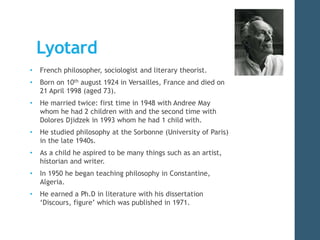
‱ French philosopher, sociologist and literary theorist. 
‱ Born on 10th august 1924 in Versailles, France and died on 
21 April 1998 (aged 73). 
‱ He married twice: first time in 1948 with Andree May 
whom he had 2 children with and the second time with 
Dolores Djidzek in 1993 whom he had 1 child with. 
‱ He studied philosophy at the Sorbonne (University of Paris) 
in the late 1940s. 
‱ As a child he aspired to be many things such as an artist, 
historian and writer. 
‱ In 1950 he began teaching philosophy in Constantine, 
Algeria. 
‱ He earned a Ph.D in literature with his dissertation 
‘Discours, figure’ which was published in 1971.
Main theories 
‱ He rejects “grand narratives” or universal “meta narratives”. An example is that he 
rejects the ideas that everything is knowable by science or that as history moves 
forward in time, humanity makes progress. He opposes universal political “solutions” 
such as communism and capitalism as well as the idea of absolute freedom. 
‱ He notes that no one seemed to agree on what, if anything, was real and everyone 
had their own perspective and story. 
‱ He proposes what he calls an extreme simplification of the “postmodern” as an 
‘incredulity* towards meta-narratives’. 
*incredulity–the state of being unwilling or unable to believe something 
‱ Grand narratives involve at least 3 features: 
-A marked increase in scope of the issues covered by the ‘grand narrative’ 
-A greater degree of explanation of these issues (rather than mere description of the 
issue since narratives are often more descriptive than explanatory) 
-A justification (Lyotard talks of ‘legitimation’) for many of the claims that come 
within its scope.
Main theories 
‱ He looked at how knowledge comes into being, who controls it, who has access to it, 
and how it becomes accepted as valid. He concluded that science's claim to possess a 
higher kind of knowledge was seriously flawed. 
‱ He argues that theory is never neutral. He says that scientists have no more direct 
access to the truth than philosophers or historians and that scientists are storytellers. 
‱ The narrative produced by scientists such as research papers and hypotheses are 
always governed by the protocols of the field in which they work in. Each discipline is 
like a game. It has a special terminology which only makes sense within its own 
boundaries. In reality, a theorist or researcher is not faced with infinite possibilities 
to explore and can only play within the limits of a system of permissible moves. 
‱ This view goes against the common sense view of science as a superior form of 
knowledge. 
‱ He argues that one day, in order for knowledge to be seen as useful it must be 
converted into computerized data.
Quotes 
‱ "Simplifying to the extreme, I define postmodern as incredulity towards 
metanarratives". 
‱ “That is what the postmodern world is all about. Many people have lost the nostalgia 
for the lost narrative.” 
‱ “In contemporary society and culture — postindustrial society, postmodern culture — 

 the grand narrative has lost its credibility, regardless of what mode of unification it 
uses, regardless of whether it is a speculative narrative or a narrative of 
emancipation.” 
‱ “Narratives, as we have seen, determine criteria of competence and/or illustrate 
how they are to be applied. They thus define what has the right to be said and done 
in the culture in question, and since they are themselves a part of that culture, they 
are legitimated by the simple fact that they do what they do.” 
‱ “I shall call modern that art which ... presents the fact that the unpresentable exists. 
To make visible that there is something which can be conceived and which can 
neither be seen nor made visible.”
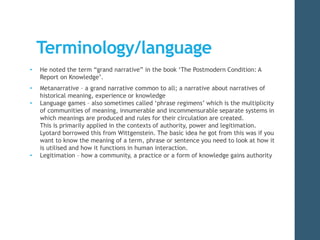
Terminology/language 
‱ He noted the term “grand narrative” in the book ‘The Postmodern Condition: A 
Report on Knowledge’. 
‱ Metanarrative – a grand narrative common to all; a narrative about narratives of 
historical meaning, experience or knowledge 
‱ Language games – also sometimes called ‘phrase regimens’ which is the multiplicity 
of communities of meaning, innumerable and incommensurable separate systems in 
which meanings are produced and rules for their circulation are created. 
This is primarily applied in the contexts of authority, power and legitimation. 
Lyotard borrowed this from Wittgenstein. The basic idea he got from this was if you 
want to know the meaning of a term, phrase or sentence you need to look at how it 
is utilised and how it functions in human interaction. 
‱ Legitimation – how a community, a practice or a form of knowledge gains authority
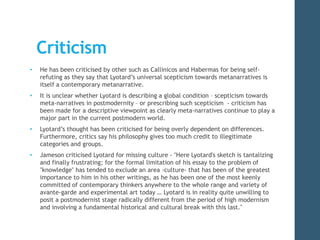
Criticism 
‱ He has been criticised by other such as Callinicos and Habermas for being self-refuting 
as they say that Lyotard’s universal scepticism towards metanarratives is 
itself a contemporary metanarrative. 
‱ It is unclear whether Lyotard is describing a global condition – scepticism towards 
meta-narratives in postmodernity – or prescribing such scepticism - criticism has 
been made for a descriptive viewpoint as clearly meta-narratives continue to play a 
major part in the current postmodern world. 
‱ Lyotard’s thought has been criticised for being overly dependent on differences. 
Furthermore, critics say his philosophy gives too much credit to illegitimate 
categories and groups. 
‱ Jameson criticised Lyotard for missing culture - "Here Lyotard's sketch is tantalizing 
and finally frustrating; for the formal limitation of his essay to the problem of 
"knowledge" has tended to exclude an area -culture- that has been of the greatest 
importance to him in his other writings, as he has been one of the most keenly 
committed of contemporary thinkers anywhere to the whole range and variety of 
avante-garde and experimental art today 
 Lyotard is in reality quite unwilling to 
posit a postmodernist stage radically different from the period of high modernism 
and involving a fundamental historical and cultural break with this last."

Lyotard

  • 1.
  • 2.
    Lyotard ‱ Frenchphilosopher, sociologist and literary theorist. ‱ Born on 10th august 1924 in Versailles, France and died on 21 April 1998 (aged 73). ‱ He married twice: first time in 1948 with Andree May whom he had 2 children with and the second time with Dolores Djidzek in 1993 whom he had 1 child with. ‱ He studied philosophy at the Sorbonne (University of Paris) in the late 1940s. ‱ As a child he aspired to be many things such as an artist, historian and writer. ‱ In 1950 he began teaching philosophy in Constantine, Algeria. ‱ He earned a Ph.D in literature with his dissertation ‘Discours, figure’ which was published in 1971.
  • 3.
    Main theories ‱He rejects “grand narratives” or universal “meta narratives”. An example is that he rejects the ideas that everything is knowable by science or that as history moves forward in time, humanity makes progress. He opposes universal political “solutions” such as communism and capitalism as well as the idea of absolute freedom. ‱ He notes that no one seemed to agree on what, if anything, was real and everyone had their own perspective and story. ‱ He proposes what he calls an extreme simplification of the “postmodern” as an ‘incredulity* towards meta-narratives’. *incredulity–the state of being unwilling or unable to believe something ‱ Grand narratives involve at least 3 features: -A marked increase in scope of the issues covered by the ‘grand narrative’ -A greater degree of explanation of these issues (rather than mere description of the issue since narratives are often more descriptive than explanatory) -A justification (Lyotard talks of ‘legitimation’) for many of the claims that come within its scope.
  • 4.
    Main theories ‱He looked at how knowledge comes into being, who controls it, who has access to it, and how it becomes accepted as valid. He concluded that science's claim to possess a higher kind of knowledge was seriously flawed. ‱ He argues that theory is never neutral. He says that scientists have no more direct access to the truth than philosophers or historians and that scientists are storytellers. ‱ The narrative produced by scientists such as research papers and hypotheses are always governed by the protocols of the field in which they work in. Each discipline is like a game. It has a special terminology which only makes sense within its own boundaries. In reality, a theorist or researcher is not faced with infinite possibilities to explore and can only play within the limits of a system of permissible moves. ‱ This view goes against the common sense view of science as a superior form of knowledge. ‱ He argues that one day, in order for knowledge to be seen as useful it must be converted into computerized data.
  • 5.
    Quotes ‱ "Simplifyingto the extreme, I define postmodern as incredulity towards metanarratives". ‱ “That is what the postmodern world is all about. Many people have lost the nostalgia for the lost narrative.” ‱ “In contemporary society and culture — postindustrial society, postmodern culture — 
 the grand narrative has lost its credibility, regardless of what mode of unification it uses, regardless of whether it is a speculative narrative or a narrative of emancipation.” ‱ “Narratives, as we have seen, determine criteria of competence and/or illustrate how they are to be applied. They thus define what has the right to be said and done in the culture in question, and since they are themselves a part of that culture, they are legitimated by the simple fact that they do what they do.” ‱ “I shall call modern that art which ... presents the fact that the unpresentable exists. To make visible that there is something which can be conceived and which can neither be seen nor made visible.”
  • 6.
    Terminology/language ‱ Henoted the term “grand narrative” in the book ‘The Postmodern Condition: A Report on Knowledge’. ‱ Metanarrative – a grand narrative common to all; a narrative about narratives of historical meaning, experience or knowledge ‱ Language games – also sometimes called ‘phrase regimens’ which is the multiplicity of communities of meaning, innumerable and incommensurable separate systems in which meanings are produced and rules for their circulation are created. This is primarily applied in the contexts of authority, power and legitimation. Lyotard borrowed this from Wittgenstein. The basic idea he got from this was if you want to know the meaning of a term, phrase or sentence you need to look at how it is utilised and how it functions in human interaction. ‱ Legitimation – how a community, a practice or a form of knowledge gains authority
  • 7.
    Criticism ‱ Hehas been criticised by other such as Callinicos and Habermas for being self-refuting as they say that Lyotard’s universal scepticism towards metanarratives is itself a contemporary metanarrative. ‱ It is unclear whether Lyotard is describing a global condition – scepticism towards meta-narratives in postmodernity – or prescribing such scepticism - criticism has been made for a descriptive viewpoint as clearly meta-narratives continue to play a major part in the current postmodern world. ‱ Lyotard’s thought has been criticised for being overly dependent on differences. Furthermore, critics say his philosophy gives too much credit to illegitimate categories and groups. ‱ Jameson criticised Lyotard for missing culture - "Here Lyotard's sketch is tantalizing and finally frustrating; for the formal limitation of his essay to the problem of "knowledge" has tended to exclude an area -culture- that has been of the greatest importance to him in his other writings, as he has been one of the most keenly committed of contemporary thinkers anywhere to the whole range and variety of avante-garde and experimental art today 
 Lyotard is in reality quite unwilling to posit a postmodernist stage radically different from the period of high modernism and involving a fundamental historical and cultural break with this last."