

A
PRESENTATIONON
DISTRIBUTEDSYSTEMS
• What are the Distributed
Systems ???
1
• Why distributed systems
???
2
• Organization of
Distribution systems.
3
• Goals of Distributed
Systems…
4
Outlines:
HISTORY
• 1945~1985
− Computers were large and expensive.
− No way to connect them.
− All systems were Centralized Systems.
 Mid-1980s
− Powerful microprocessors.
− High Speed Computer Networks (LANs , WANs).
Then came the
DISTRIBUTED
SYSTEMS…
HISTORY (Contd.)
What are Distributed
Systems????
Distributed Systems ? ?
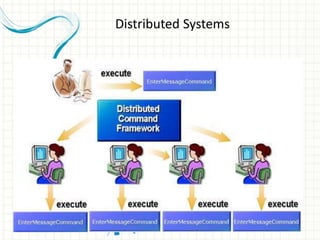
• A distributed system is a s/w system through which a
collection of independent computers appears to its users as a
single, coherent system.
• A distributed system is one in which components located at
networked computers communicate and coordinate their
actions only by passing messages.
Distributed Systems
EXAMPLES
• World Wide Web (WWW) is the biggest example
of distributed system.
• Others are
– The internet
– An intranet which is a portion of the internet managed
by an organization
WHY DISTRIBUTED
SYSTEMS ? ?
• Availability of powerful yet cheap
microprocessors (PCs, workstations),
• Continuing advances in communication
technology
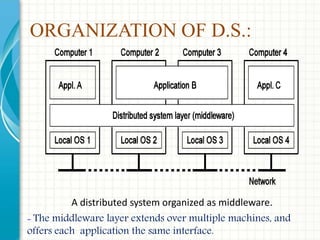
ORGANIZATION OF D.S.:
A distributed system organized as middleware.
− The middleware layer extends over multiple machines, and
offers each application the same interface.
GOALS OF D.S. :
Resource Sharing.
Openness.
Transparency.
Scalability.
Concurrency.
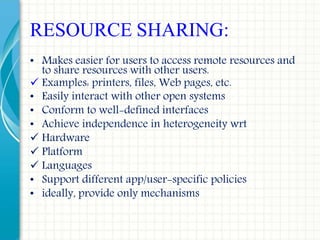
RESOURCE SHARING:
• Makes easier for users to access remote resources and
to share resources with other users.
 Examples: printers, files, Web pages, etc.
• Easily interact with other open systems
• Conform to well-defined interfaces
• Achieve independence in heterogeneity wrt
 Hardware
 Platform
 Languages
• Support different app/user-specific policies
• ideally, provide only mechanisms
• Determined primarily the degree to which new
resource-sharing services can be added and be
made available for use by a variety of client
programs.
OPENNESS:
• It hides the fact that the processes and
resources are physically distributed across
multiple computers.
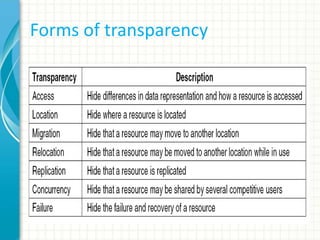
• Transparency is of various forms as follows:
TRANSPARENCY:
Forms of transparency
• Size scalability
- number of users and processes
• Geographical scalability
- maximum distance between nodes
• Administrative scalability
- number of administrative domains
SCALABILITY
• Several clients may attempt to access a shared
resource at the same time.
• Any object that represents a shared resource in a
distributed system must be responsible for
ensuring that operates correctly in a concurrent
environment.
CONCURRENCY
Distributed system
Distributed system

Distributed system

  • 1.
  • 2.
    • What arethe Distributed Systems ??? 1 • Why distributed systems ??? 2 • Organization of Distribution systems. 3 • Goals of Distributed Systems… 4 Outlines:
  • 3.
    HISTORY • 1945~1985 − Computerswere large and expensive. − No way to connect them. − All systems were Centralized Systems.  Mid-1980s − Powerful microprocessors. − High Speed Computer Networks (LANs , WANs).
  • 4.
  • 5.
  • 6.
    Distributed Systems ?? • A distributed system is a s/w system through which a collection of independent computers appears to its users as a single, coherent system. • A distributed system is one in which components located at networked computers communicate and coordinate their actions only by passing messages.
  • 7.
  • 8.
    EXAMPLES • World WideWeb (WWW) is the biggest example of distributed system. • Others are – The internet – An intranet which is a portion of the internet managed by an organization
  • 9.
    WHY DISTRIBUTED SYSTEMS ?? • Availability of powerful yet cheap microprocessors (PCs, workstations), • Continuing advances in communication technology
  • 10.
    ORGANIZATION OF D.S.: Adistributed system organized as middleware. − The middleware layer extends over multiple machines, and offers each application the same interface.
  • 11.
    GOALS OF D.S.: Resource Sharing. Openness. Transparency. Scalability. Concurrency.
  • 12.
    RESOURCE SHARING: • Makeseasier for users to access remote resources and to share resources with other users.  Examples: printers, files, Web pages, etc. • Easily interact with other open systems • Conform to well-defined interfaces • Achieve independence in heterogeneity wrt  Hardware  Platform  Languages • Support different app/user-specific policies • ideally, provide only mechanisms
  • 13.
    • Determined primarilythe degree to which new resource-sharing services can be added and be made available for use by a variety of client programs. OPENNESS:
  • 14.
    • It hidesthe fact that the processes and resources are physically distributed across multiple computers. • Transparency is of various forms as follows: TRANSPARENCY:
  • 15.
  • 16.
    • Size scalability -number of users and processes • Geographical scalability - maximum distance between nodes • Administrative scalability - number of administrative domains SCALABILITY
  • 17.
    • Several clientsmay attempt to access a shared resource at the same time. • Any object that represents a shared resource in a distributed system must be responsible for ensuring that operates correctly in a concurrent environment. CONCURRENCY