Aim: How was Europe organized during the Middle Ages? Do Now: While China, India, The Byzantines, and the Islamic Empires were experiencing a golden age, what was going on in Western Europe? For review, briefly describe what happened to western Europe at the end of the Roman Empire. What do you think a dark age is?
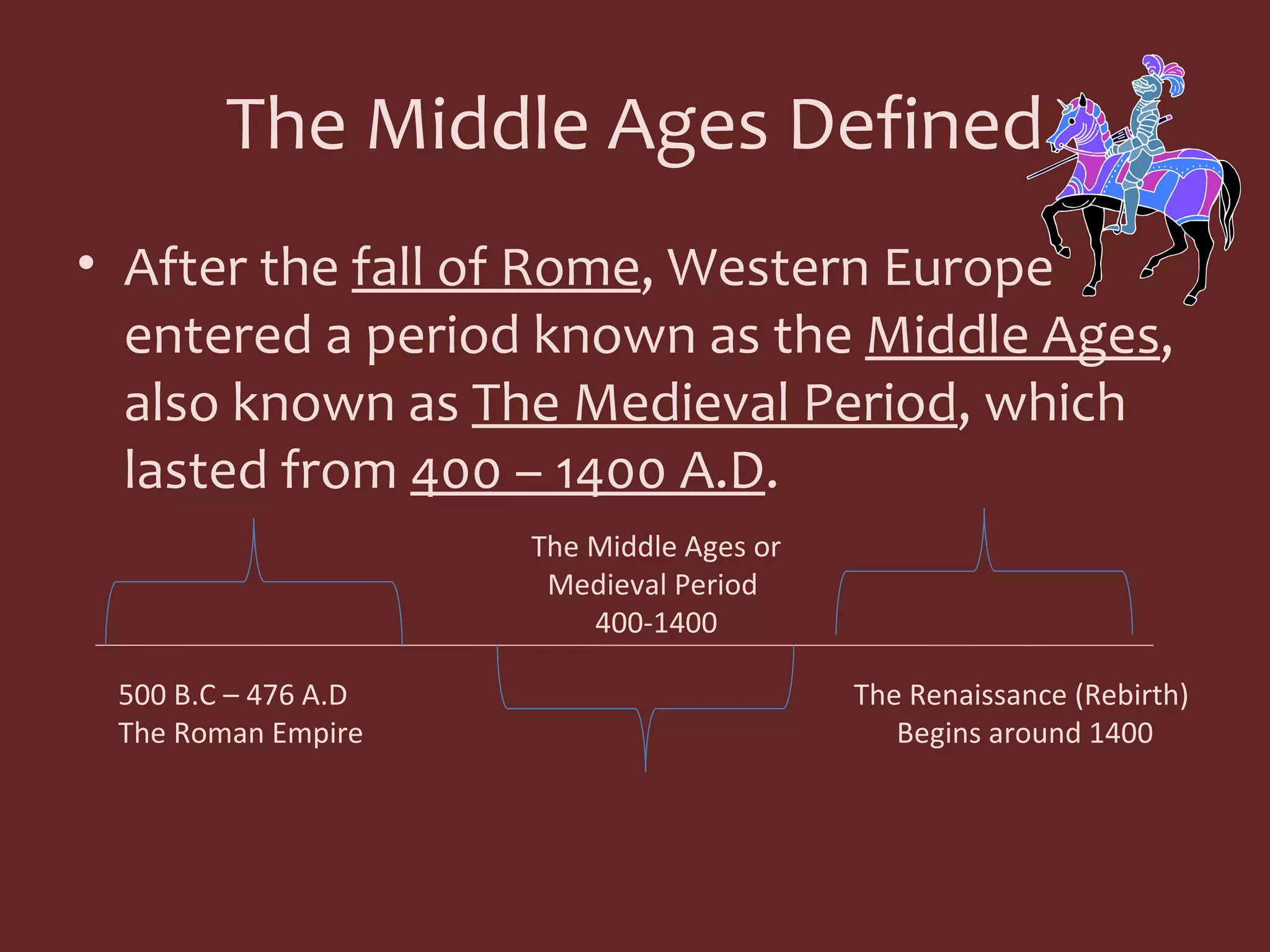
The Middle Ages Defined After the  fall of Rome , Western Europe entered a period known as the  Middle Ages , also known as  The Medieval Period , which lasted from  400 – 1400 A.D .  500 B.C – 476 A.D The Roman Empire The Middle Ages or Medieval Period  400-1400 The Renaissance (Rebirth) Begins around 1400
In general, the Middle Ages are defined by a lack of  central government ,  decline of trade, population shift to rural areas, decrease in learning,  and a rise in the power of  The Roman Catholic Church .  The Middle Ages Defined
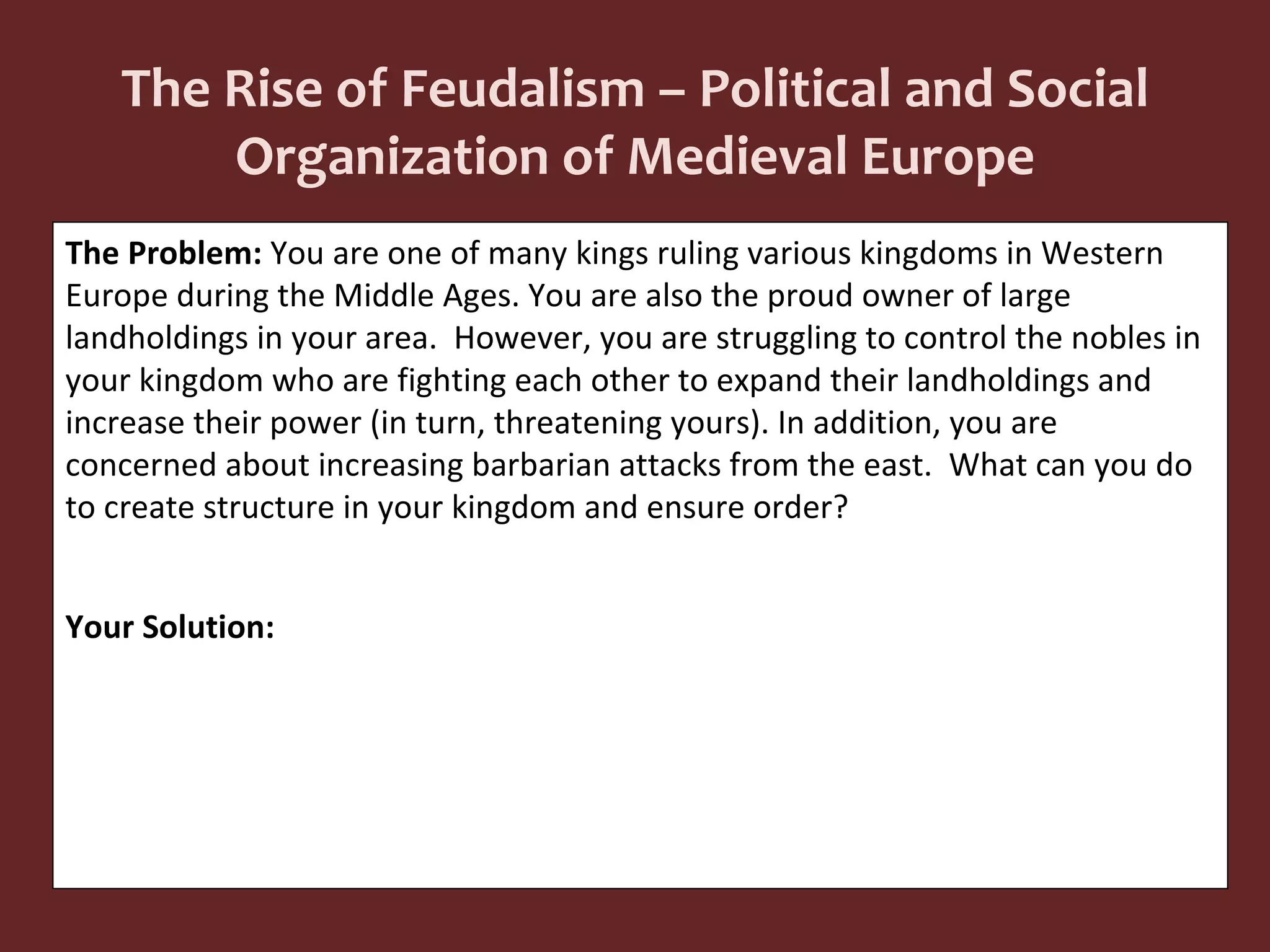
The Rise of Feudalism – Political and Social Organization of Medieval Europe The Problem:  You are one of many kings ruling various kingdoms in Western Europe during the Middle Ages. You are also the proud owner of large landholdings in your area.  However, you are struggling to control the nobles in your kingdom who are fighting each other to expand their landholdings and increase their power (in turn, threatening yours). In addition, you are concerned about increasing barbarian attacks from the east.  What can you do to create structure in your kingdom and ensure order? Your Solution:
The Rise of Feudalism – Political and Social Organization of Medieval Europe Grant Fief (land) Oath of loyalty/military support Shelter/food Loyalty/military Shelter/food And protection Labor, rent
Feudalism
The Rise of Feudalism
The Rise of Feudalism – Political and Social Organization of Medieval Europe Causes of Feudalism : After the fall of Rome, Western Europe was a scary place! With no  strong, central  government to raise a large  army , there was no  protection  from invaders.  The Feudal system emerged as a means to create  social/political  order and  stability  in society as well as to provide a system of  protection The Role of Serfs: They were  bound to the land .  In other words,  slaves.  No social mobility! Your place in this feudal pyramid was determined by  birth !
Medieval Social Structure
Sometimes the manor system is referred to as  manorialism .   The manor was completely  self sufficient  meaning that  everything that was needed  was on the manor. Very little reason  to leave or travel  beyond your manor.   The Manor System – The Medieval Economic System
Serfs
Knights
The  self sufficient manor  contributed to the  decline  of learning.  No new ideas were  exchanged .  Technology was  slow to progress .   Little use of  money .  Wealth based on  land . The Manor System – The Medieval Economic System
Strict social hierarchy based on the feudal pyramid. Social Status determined by birth Lack of social Mobility Code of Chivalry Feudalism – Kings and nobles exchange land for loyalty and protection. Decentralized government People followed religious Canon Law – Led by Pope Rise in the power of the Pope and Roman Catholic Church Pope had power of excommunication Religious Political Social
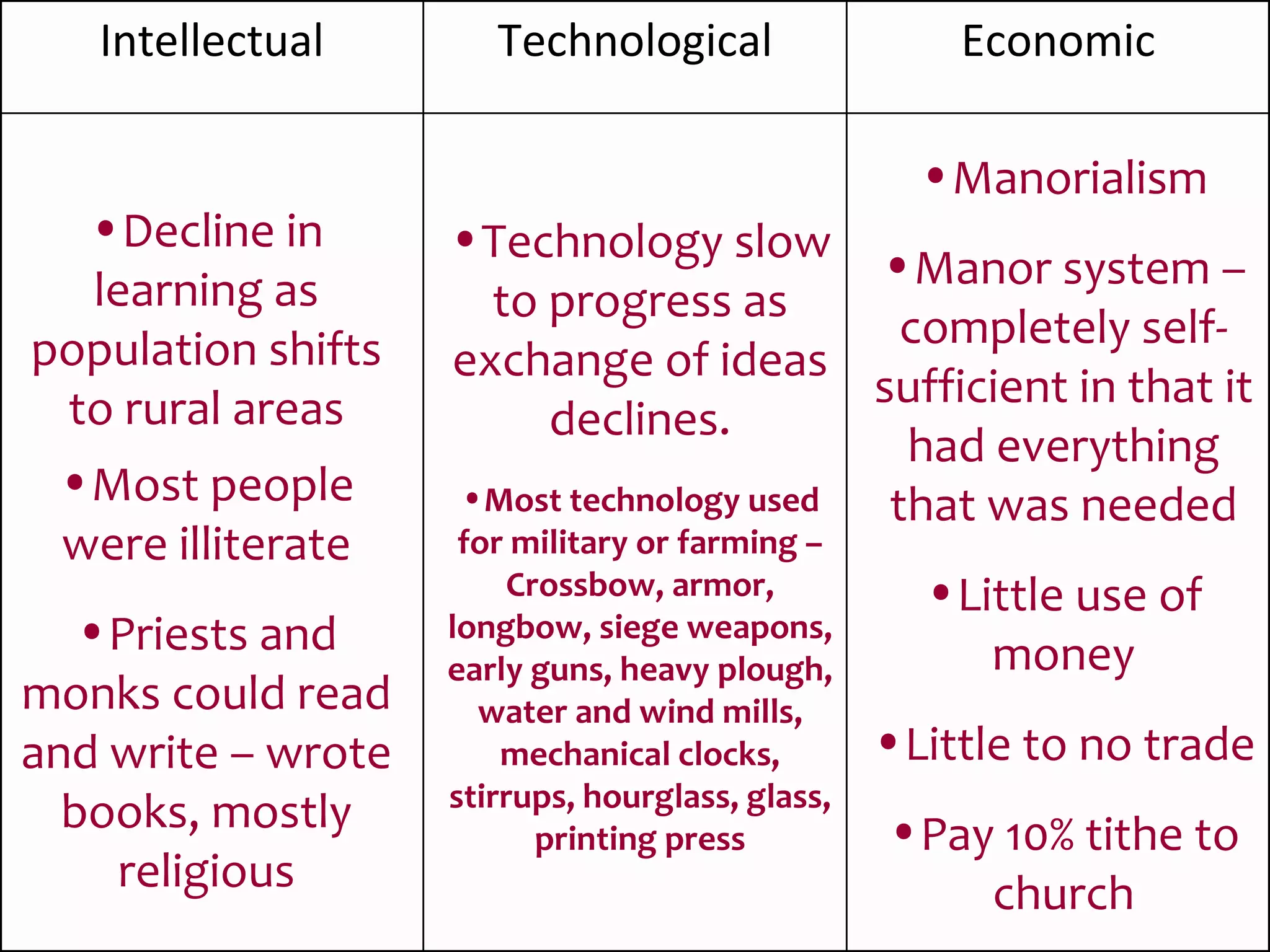
Decline in learning as population shifts to rural areas Technology slow to progress as exchange of ideas declines. Manorialism Manor system – completely self-sufficient in that it had everything that was needed Little use of money Little to no trade Pay 10% tithe to church Most technology used for military or farming – Crossbow, armor, longbow, siege weapons, early guns, heavy plough, water and wind mills, mechanical clocks, stirrups, hourglass, glass, printing press Most people were illiterate Priests and monks could read and write – wrote books, mostly religious Economic Technological Intellectual
Feudalism
Medieval Castles

Middle ages feudalism and manor lesson ppt

  • 1.
    Aim: How wasEurope organized during the Middle Ages? Do Now: While China, India, The Byzantines, and the Islamic Empires were experiencing a golden age, what was going on in Western Europe? For review, briefly describe what happened to western Europe at the end of the Roman Empire. What do you think a dark age is?
  • 2.
    The Middle AgesDefined After the fall of Rome , Western Europe entered a period known as the Middle Ages , also known as The Medieval Period , which lasted from 400 – 1400 A.D . 500 B.C – 476 A.D The Roman Empire The Middle Ages or Medieval Period 400-1400 The Renaissance (Rebirth) Begins around 1400
  • 3.
    In general, theMiddle Ages are defined by a lack of central government , decline of trade, population shift to rural areas, decrease in learning, and a rise in the power of The Roman Catholic Church . The Middle Ages Defined
  • 4.
    The Rise ofFeudalism – Political and Social Organization of Medieval Europe The Problem: You are one of many kings ruling various kingdoms in Western Europe during the Middle Ages. You are also the proud owner of large landholdings in your area. However, you are struggling to control the nobles in your kingdom who are fighting each other to expand their landholdings and increase their power (in turn, threatening yours). In addition, you are concerned about increasing barbarian attacks from the east. What can you do to create structure in your kingdom and ensure order? Your Solution:
  • 5.
    The Rise ofFeudalism – Political and Social Organization of Medieval Europe Grant Fief (land) Oath of loyalty/military support Shelter/food Loyalty/military Shelter/food And protection Labor, rent
  • 6.
  • 7.
    The Rise ofFeudalism
  • 8.
    The Rise ofFeudalism – Political and Social Organization of Medieval Europe Causes of Feudalism : After the fall of Rome, Western Europe was a scary place! With no strong, central government to raise a large army , there was no protection from invaders. The Feudal system emerged as a means to create social/political order and stability in society as well as to provide a system of protection The Role of Serfs: They were bound to the land . In other words, slaves. No social mobility! Your place in this feudal pyramid was determined by birth !
  • 9.
  • 10.
    Sometimes the manorsystem is referred to as manorialism . The manor was completely self sufficient meaning that everything that was needed was on the manor. Very little reason to leave or travel beyond your manor. The Manor System – The Medieval Economic System
  • 11.
  • 12.
  • 13.
    The selfsufficient manor contributed to the decline of learning. No new ideas were exchanged . Technology was slow to progress . Little use of money . Wealth based on land . The Manor System – The Medieval Economic System
  • 14.
    Strict social hierarchybased on the feudal pyramid. Social Status determined by birth Lack of social Mobility Code of Chivalry Feudalism – Kings and nobles exchange land for loyalty and protection. Decentralized government People followed religious Canon Law – Led by Pope Rise in the power of the Pope and Roman Catholic Church Pope had power of excommunication Religious Political Social
  • 15.
    Decline in learningas population shifts to rural areas Technology slow to progress as exchange of ideas declines. Manorialism Manor system – completely self-sufficient in that it had everything that was needed Little use of money Little to no trade Pay 10% tithe to church Most technology used for military or farming – Crossbow, armor, longbow, siege weapons, early guns, heavy plough, water and wind mills, mechanical clocks, stirrups, hourglass, glass, printing press Most people were illiterate Priests and monks could read and write – wrote books, mostly religious Economic Technological Intellectual
  • 16.
  • 17.