Aspergillus
Aspergillus spp.
 Rate of growth
• Usually rapid
• Mature within 3 days
• Some species are slower growing
Aspergillus spp.
 Colony morphology
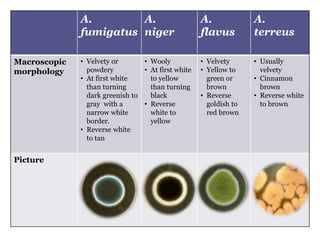
 Surface at first white than any shade of
yellow, green, brown or black depending on
species
 Texture velvety and cottony
 Reverse is white, golden or brown
Aspergillus spp.
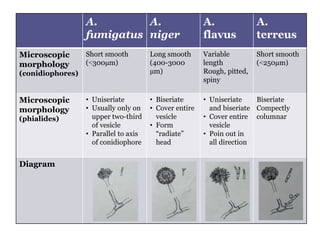
 Microscopic morphology
 Septate hyphae(2.5-8.0 µm)
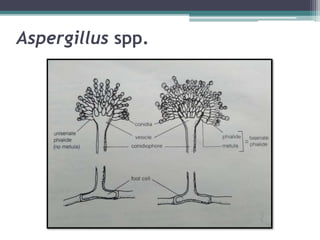
 Unbranched conidiophore arises from foot cells
 The conidiophore is enlarged at the tip forming
vesicle
 Vesicles are completely or partially covered with
flask shaped phialides
 Phialides may develop directly on the
vesicle(Uniseriate form) or be supported by metula
(biseriate form)
 The phialides produce chain of round conidia(2-5
µm)
Aspergillus spp.
A.
fumigatus
A.
niger
A.
flavus
A.
terreus
Macroscopic
morphology
• Velvety or
powdery
• At first white
than turning
dark greenish to
gray with a
narrow white
border.
• Reverse white
to tan
• Wooly
• At first white
to yellow
than turning
black
• Reverse
white to
yellow
• Velvety
• Yellow to
green or
brown
• Reverse
goldish to
red brown
• Usually
velvety
• Cinnamon
brown
• Reverse white
to brown
Picture
A.
fumigatus
A.
niger
A.
flavus
A.
terreus
Microscopic
morphology
(conidiophores)
Short smooth
(˂300µm)
Long smooth
(400-3000
µm)
Variable
length
Rough, pitted,
spiny
Short smooth
(˂250µm)
Microscopic
morphology
(phialides)
• Uniseriate
• Usually only on
upper two-third
of vesicle
• Parallel to axis
of conidiophore
• Biseriate
• Cover entire
vesicle
• Form
“radiate”
head
• Uniseriate
and biseriate
• Cover entire
vesicle
• Poin out in
all direction
Biseriate
Compectly
columnar
Diagram
Thank You …

Aspergillus species