Micropropagation
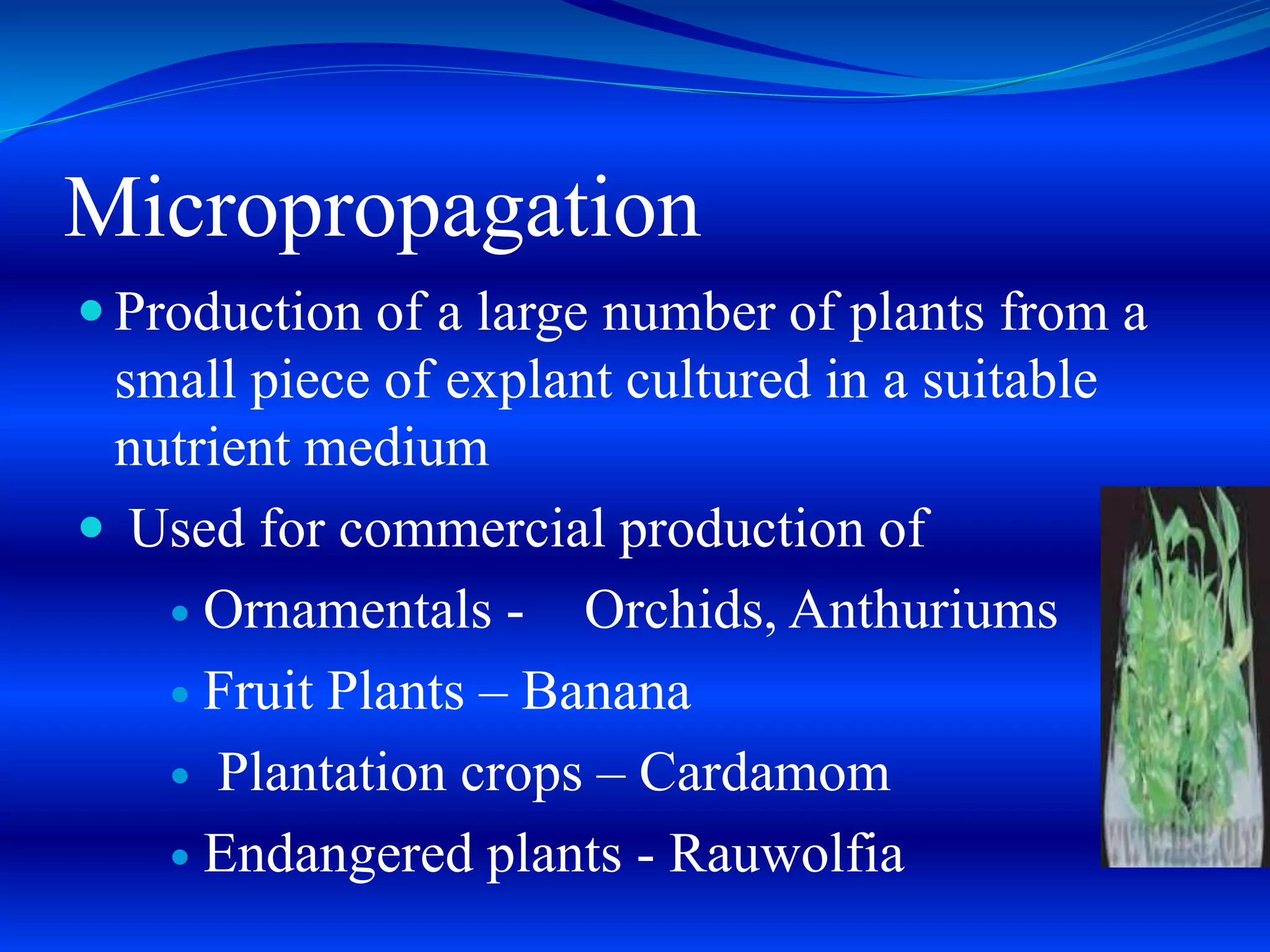
 Production of a large number of plants from a
small piece of explant cultured in a suitable
nutrient medium
 Used for commercial production of
 Ornamentals - Orchids, Anthuriums
 Fruit Plants – Banana
 Plantation crops – Cardamom
 Endangered plants - Rauwolfia
Methods of Micropropagation
i) Proliferation of axillary buds
 Shoot tip or nodal explants are cultured in a medium
supplemented with a cytokinin (1 -3mg/l BAP – Benzyl Amino
Purine) and often an auxin.
 Cytokinin stimulates apical meristem in shoot tip and axillary
buds in nodal explants to develop into shoots. Each leaf on such
shoots has an axillary bud which are also stimulated to develop
into shoots(eg. Strawberry)
 After 4 -6 weeks, the axillary branching in a culture reaches the
maximum.
 Individual shoots are excised and sub – cultured on to a fresh
medium to initiate a new cycle of multiplication by axillary
branching In most plant sps, each explant would produce 5 -6
shoots in 4- 5 weeks.
ii) Direct and indirect Organogenesis
 Direct organogenesis - Without callus
stage eg.
Asparagus (Murashiege
et.al)
 Indirect organogenesis - After going
through a callus stage eg Iranian edibe wild
Asparagus
Organogenesis starts with stimulation caused by
 Chemicals of the medium
 Substances carried over from the explant
 Endogenous compounds produced by the culture
 Light
 Temperature
 High Cytokinin to auxin – Caulogenesis
 High auxin to cytokinin - Rhizogenesis
 Indirect organogenesis in Iranian edible wild
Asparagus (Reuther 1977)
 Explants from lateral buds of spear (tender
unexpanded shoots) were cultured on MS Medium
containing 6% Sucrose and different NAA and BAP
concentrations for both callus induction and shoot
development
 Medium containing 0.015mg/l NAA and 0.05mg/l
BAP – highest number of shoots
 Medium with 1.5mg/l IBA – High rooting
percentage
iii) Somatic Embryogenesis
 Most widely used method – High rate of
multiplication
 Generally induced by auxin 2,4 D
 Somatic embryos are allowed to mature by
removing 2, 4 D.
 Somatic embryos are germinated in a medium with
reduced amounts of macro and micro nutrients and no
hormones.
 Automated system – Integrates a bioreactor
with a bioprocessor for separation, isolation
mainly based on size and subculturing
 Automated transplanting machine – transplants
up to 8000 plant lets/ hr into a soil mix.
Hardening
 Preparation of in vitro cultured plantlets for a natural
growth environment.
 In tissue cultures, the plant lets are grown in ideal
conditions such as
 Highly sterile environment
 High humidity
 Low light (is used to promote growth in explants
photosynthetic activity is only 10%)
 Optimum nutritional requirements provided by
culture medium
Plantlets grown in these conditions do not
form a functional cuticle.
 Plantlets need time to adjust to natural
environments (acclimatization)
 To acclimatize the tissue cultured plants
to natural environmental conditions,
different methods of hardening are
employed.
Examples
 Tissue cultured Orchids
 Hardened in vitro by using 1/10th liquid MS basal
medium, subsequently replaced by tap water with
chips of charcoal, bricks and decayed wood as
substratum. The newly formed roots will attach to
the charcoal chips.
 Tissue cultured Banana plantlets
 Primary hardening in green houses.
 Secondary hardening in shade houses.
Tissue Cultured Date palm plantlets
 Transfer plantlets to large bags ( 7 to 10 litres
capacity) filled with sand, vermiculite and gravel in
1:1:1 ratio.
 Kept in Nursery for 8 to 12 months (4 pinnae leaf
stage)
 Gradually decrease humidity and increase light
 Transplant the plant lets to larger plastic bags and
keep in a large glass house having a fog system for
3 to 4 months
 Transfer to a less environmentally controlled
nursery.
Advantages of Micropropagation
 Very high multiplication rate –
 Possible to produce thousands of propagules
 Suitable for rapid multiplication of endangered plants
and those plants having low multiplication rates.
 Production of virus free plants by meristem culture
 A small piece of tissue can be used as an explant – valuable
when only limited tissue is available as explant
 Mature elite forest trees can be rapidly cloned.
 Micropropagation can be carried out throughout the year
independent of seasons.
 Tissue culture plants in many ornamentals give better
growth, more flowers etc.
 Micropropagation is the only method for regeneration of
genetically modified cells or somatic hybrid cells obtained
by protoplast fusion technique.
 Disadvantages of
Micropropagation
Expensive
A monoculture is produced – All the
progeny may be vulnerable to the same
infection.
 Suitable techniques are not available
for many crops – Mango , Coconut
palm etc.
Occurrence of Somaclonal variation.
Somaclonal Variations
 Genetic variability present in tissue cultured
cells or plants.
 Variations may be found both in qualitative
and quantitative traits.
 Somaclonal variants in homozygous
conditions are obtained either in tissue
cultured plants or from their selfed progeny.
Causes of Somaclonal Variations
 Changes in chromosome number or structure
 Gene mutation
 Plasma gene mutation
 Alteration in gene expression
 Gene amplification
 Mitotic crossing over
 Transposable element activation
 Re arrangements in cytoplasmic genes.
1. Calliclonal Variations - Genetic variations obtained
from callus cultures
2. Protoclonal Variations – Genetic variations
obtained from protoplast cultures.
Gametoclonal variations – Genetic or heritable
variations obtained in plants raised from Anther
culture, Pollen culture and Ovule Culture (from
gamete or gametophytic cells)
Types of Somaclonal Variations
Applications of Somaclonal
Variations in Plant Breeding
 Somaclonal variations can be used for genetic
improvement of crops.
 The regenerated variants are tested for resistance (for
diseases, herbicides, heavy metals, temperature,
drought etc) and productivity.
 Selected clones are multiplied by micropropagation.
 Eg. Bio – 13 – a Somaclonal variant of the medicinal
plant Citronella java is used for commercial
cultivation.
THANK YOU

MICROPROPAGATION SMG

  • 2.
    Micropropagation  Production ofa large number of plants from a small piece of explant cultured in a suitable nutrient medium  Used for commercial production of  Ornamentals - Orchids, Anthuriums  Fruit Plants – Banana  Plantation crops – Cardamom  Endangered plants - Rauwolfia
  • 3.
    Methods of Micropropagation i)Proliferation of axillary buds  Shoot tip or nodal explants are cultured in a medium supplemented with a cytokinin (1 -3mg/l BAP – Benzyl Amino Purine) and often an auxin.  Cytokinin stimulates apical meristem in shoot tip and axillary buds in nodal explants to develop into shoots. Each leaf on such shoots has an axillary bud which are also stimulated to develop into shoots(eg. Strawberry)  After 4 -6 weeks, the axillary branching in a culture reaches the maximum.  Individual shoots are excised and sub – cultured on to a fresh medium to initiate a new cycle of multiplication by axillary branching In most plant sps, each explant would produce 5 -6 shoots in 4- 5 weeks.
  • 4.
    ii) Direct andindirect Organogenesis  Direct organogenesis - Without callus stage eg. Asparagus (Murashiege et.al)  Indirect organogenesis - After going through a callus stage eg Iranian edibe wild Asparagus
  • 5.
    Organogenesis starts withstimulation caused by  Chemicals of the medium  Substances carried over from the explant  Endogenous compounds produced by the culture  Light  Temperature  High Cytokinin to auxin – Caulogenesis  High auxin to cytokinin - Rhizogenesis
  • 6.
     Indirect organogenesisin Iranian edible wild Asparagus (Reuther 1977)  Explants from lateral buds of spear (tender unexpanded shoots) were cultured on MS Medium containing 6% Sucrose and different NAA and BAP concentrations for both callus induction and shoot development  Medium containing 0.015mg/l NAA and 0.05mg/l BAP – highest number of shoots  Medium with 1.5mg/l IBA – High rooting percentage
  • 7.
    iii) Somatic Embryogenesis Most widely used method – High rate of multiplication  Generally induced by auxin 2,4 D  Somatic embryos are allowed to mature by removing 2, 4 D.  Somatic embryos are germinated in a medium with reduced amounts of macro and micro nutrients and no hormones.
  • 8.
     Automated system– Integrates a bioreactor with a bioprocessor for separation, isolation mainly based on size and subculturing  Automated transplanting machine – transplants up to 8000 plant lets/ hr into a soil mix.
  • 9.
    Hardening  Preparation ofin vitro cultured plantlets for a natural growth environment.  In tissue cultures, the plant lets are grown in ideal conditions such as  Highly sterile environment  High humidity  Low light (is used to promote growth in explants photosynthetic activity is only 10%)  Optimum nutritional requirements provided by culture medium
  • 10.
    Plantlets grown inthese conditions do not form a functional cuticle.  Plantlets need time to adjust to natural environments (acclimatization)  To acclimatize the tissue cultured plants to natural environmental conditions, different methods of hardening are employed.
  • 11.
    Examples  Tissue culturedOrchids  Hardened in vitro by using 1/10th liquid MS basal medium, subsequently replaced by tap water with chips of charcoal, bricks and decayed wood as substratum. The newly formed roots will attach to the charcoal chips.  Tissue cultured Banana plantlets  Primary hardening in green houses.  Secondary hardening in shade houses.
  • 12.
    Tissue Cultured Datepalm plantlets  Transfer plantlets to large bags ( 7 to 10 litres capacity) filled with sand, vermiculite and gravel in 1:1:1 ratio.  Kept in Nursery for 8 to 12 months (4 pinnae leaf stage)  Gradually decrease humidity and increase light  Transplant the plant lets to larger plastic bags and keep in a large glass house having a fog system for 3 to 4 months  Transfer to a less environmentally controlled nursery.
  • 13.
    Advantages of Micropropagation Very high multiplication rate –  Possible to produce thousands of propagules  Suitable for rapid multiplication of endangered plants and those plants having low multiplication rates.  Production of virus free plants by meristem culture  A small piece of tissue can be used as an explant – valuable when only limited tissue is available as explant  Mature elite forest trees can be rapidly cloned.  Micropropagation can be carried out throughout the year independent of seasons.  Tissue culture plants in many ornamentals give better growth, more flowers etc.  Micropropagation is the only method for regeneration of genetically modified cells or somatic hybrid cells obtained by protoplast fusion technique.
  • 14.
     Disadvantages of Micropropagation Expensive Amonoculture is produced – All the progeny may be vulnerable to the same infection.  Suitable techniques are not available for many crops – Mango , Coconut palm etc. Occurrence of Somaclonal variation.
  • 15.
    Somaclonal Variations  Geneticvariability present in tissue cultured cells or plants.  Variations may be found both in qualitative and quantitative traits.  Somaclonal variants in homozygous conditions are obtained either in tissue cultured plants or from their selfed progeny.
  • 16.
    Causes of SomaclonalVariations  Changes in chromosome number or structure  Gene mutation  Plasma gene mutation  Alteration in gene expression  Gene amplification  Mitotic crossing over  Transposable element activation  Re arrangements in cytoplasmic genes.
  • 17.
    1. Calliclonal Variations- Genetic variations obtained from callus cultures 2. Protoclonal Variations – Genetic variations obtained from protoplast cultures. Gametoclonal variations – Genetic or heritable variations obtained in plants raised from Anther culture, Pollen culture and Ovule Culture (from gamete or gametophytic cells) Types of Somaclonal Variations
  • 18.
    Applications of Somaclonal Variationsin Plant Breeding  Somaclonal variations can be used for genetic improvement of crops.  The regenerated variants are tested for resistance (for diseases, herbicides, heavy metals, temperature, drought etc) and productivity.  Selected clones are multiplied by micropropagation.  Eg. Bio – 13 – a Somaclonal variant of the medicinal plant Citronella java is used for commercial cultivation.
  • 19.