SEED DETERIORATION
The process by which seed lose its vigour and
eventually loses viability and die
An outlook......
1.definition
2.types
3.characteristics
4.manifestation
5.changes associated
6.factors
7.methods for testing deterioration
8.prevention methods
Various views of seed deterioration
 Seed deterioration is defined as deteriorative
changes occurring with time that increase the
seed’s vulnerability to external challenges and
decreases the ability of the seed to survive.
 Seed deterioration is an inexorable and
irreversible processes and it varies among seed
population
 Seed deterioration is an irreversible
degenerative change in the quality of a seed
after it has reached its maximum quality level
 The Maximum quality level is the theoretical
maximum attainable level of seed quality
under the most favoured seed × environmental
interaction.
 Generally, seeds reached its maximum quality
level at physiological maturity, and beyond
this point of time only degeneration occurs
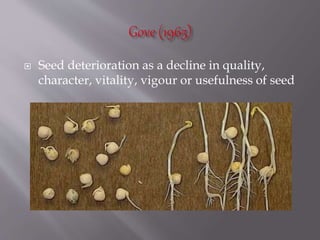
 Seed deterioration as a decline in quality,
character, vitality, vigour or usefulness of seed
 Seed deterioration is loss of seed quality,
viability and vigor due to effect of adverse
environmental factors
 The process has been described as cumulative,
irreversible, degenerative and inexorable
process
 Plants that have originated from deteriorate
seed can also reduce growth rate
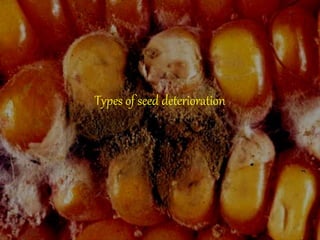
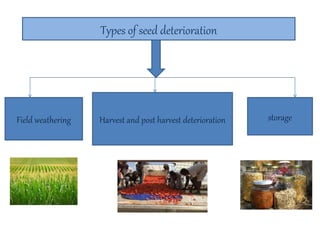
Types of seed deterioration
Field weathering storageHarvest and post harvest deterioration

Field weathering
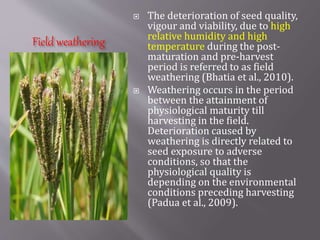
 The deterioration of seed quality,
vigour and viability, due to high
relative humidity and high
temperature during the post-
maturation and pre-harvest
period is referred to as field
weathering (Bhatia et al., 2010).
 Weathering occurs in the period
between the attainment of
physiological maturity till
harvesting in the field.
Deterioration caused by
weathering is directly related to
seed exposure to adverse
conditions, so that the
physiological quality is
depending on the environmental
conditions preceding harvesting
(Padua et al., 2009).
Field weathering
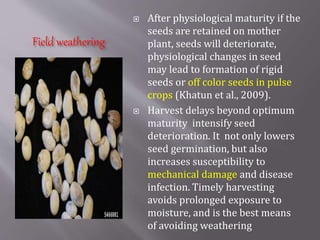
 After physiological maturity if the
seeds are retained on mother
plant, seeds will deteriorate,
physiological changes in seed
may lead to formation of rigid
seeds or off color seeds in pulse
crops (Khatun et al., 2009).
 Harvest delays beyond optimum
maturity intensify seed
deterioration. It not only lowers
seed germination, but also
increases susceptibility to
mechanical damage and disease
infection. Timely harvesting
avoids prolonged exposure to
moisture, and is the best means
of avoiding weathering
Harvest and post harvest
deterioration
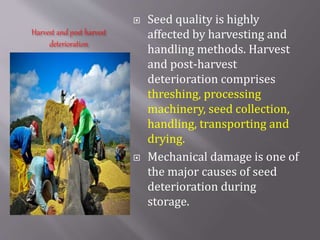
 Seed quality is highly
affected by harvesting and
handling methods. Harvest
and post-harvest
deterioration comprises
threshing, processing
machinery, seed collection,
handling, transporting and
drying.
 Mechanical damage is one of
the major causes of seed
deterioration during
storage.
Harvest and post harvest
deterioration
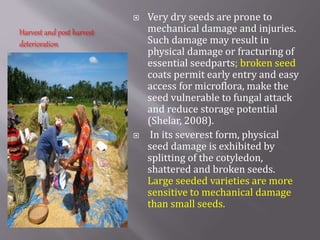
 Very dry seeds are prone to
mechanical damage and injuries.
Such damage may result in
physical damage or fracturing of
essential seedparts; broken seed
coats permit early entry and easy
access for microflora, make the
seed vulnerable to fungal attack
and reduce storage potential
(Shelar, 2008).
 In its severest form, physical
seed damage is exhibited by
splitting of the cotyledon,
shattered and broken seeds.
Large seeded varieties are more
sensitive to mechanical damage
than small seeds.
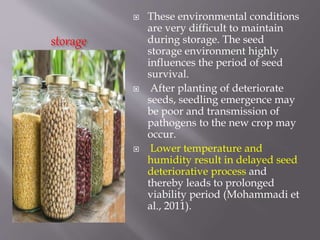
storage
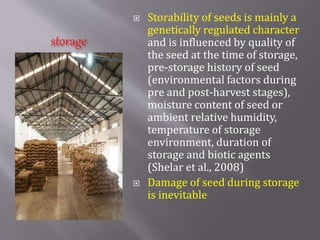
 Storability of seeds is mainly a
genetically regulated character
and is influenced by quality of
the seed at the time of storage,
pre-storage history of seed
(environmental factors during
pre and post-harvest stages),
moisture content of seed or
ambient relative humidity,
temperature of storage
environment, duration of
storage and biotic agents
(Shelar et al., 2008)
 Damage of seed during storage
is inevitable
storage
 These environmental conditions
are very difficult to maintain
during storage. The seed
storage environment highly
influences the period of seed
survival.
 After planting of deteriorate
seeds, seedling emergence may
be poor and transmission of
pathogens to the new crop may
occur.
 Lower temperature and
humidity result in delayed seed
deteriorative process and
thereby leads to prolonged
viability period (Mohammadi et
al., 2011).
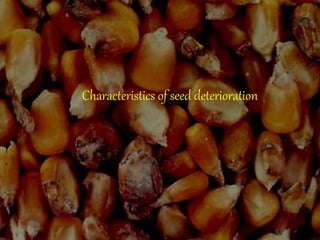
Characteristics of seed deterioration
james c. Delouche’s concept regarding the
characteristics of seed deterioration as follows
1. Seed deterioration is an inexorable process:
This means that seed deterioration must be
considered as an unalterable fact. We cannot prevent
deterioration; we can, however, influence or control
its rate .
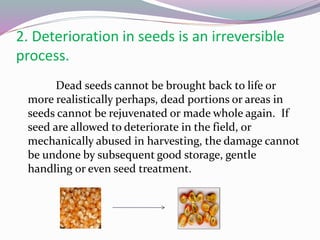
2. Deterioration in seeds is an irreversible
process.
Dead seeds cannot be brought back to life or
more realistically perhaps, dead portions or areas in
seeds cannot be rejuvenated or made whole again. If
seed are allowed to deteriorate in the field, or
mechanically abused in harvesting, the damage cannot
be undone by subsequent good storage, gentle
handling or even seed treatment.
3. Deterioration is at its lowest level at the
time of seed maturation.
 By seed maturation we mean the point in the
developmental history of a seed when it is
physiologically and morphologically capable of
developing into a highly vigorous seedling. Although it
is generally not realized, seeds usually reach maturity
long before normal harvest and at relatively high
moisture contents - 30 to 45%. Once the peak of
maturation is attained, the seeds having reached
maximum dry weight, vigour and viability, there is
only one direction to go, downhill. There can be
considerable deterioration before harvest.
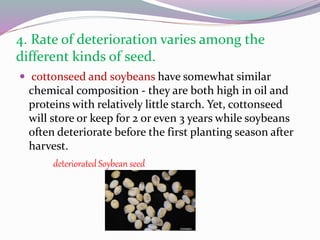
4. Rate of deterioration varies among the
different kinds of seed.
 cottonseed and soybeans have somewhat similar
chemical composition - they are both high in oil and
proteins with relatively little starch. Yet, cottonseed
will store or keep for 2 or even 3 years while soybeans
often deteriorate before the first planting season after
harvest.
deteriorated Soybean seed
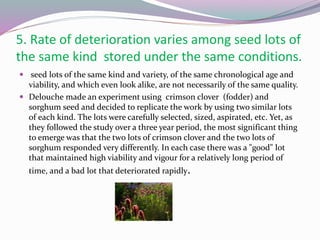
5. Rate of deterioration varies among seed lots of
the same kind stored under the same conditions.
 seed lots of the same kind and variety, of the same chronological age and
viability, and which even look alike, are not necessarily of the same quality.
 Delouche made an experiment using crimson clover (fodder) and
sorghum seed and decided to replicate the work by using two similar lots
of each kind. The lots were carefully selected, sized, aspirated, etc. Yet, as
they followed the study over a three year period, the most significant thing
to emerge was that the two lots of crimson clover and the two lots of
sorghum responded very differently. In each case there was a "good" lot
that maintained high viability and vigour for a relatively long period of
time, and a bad lot that deteriorated rapidly.
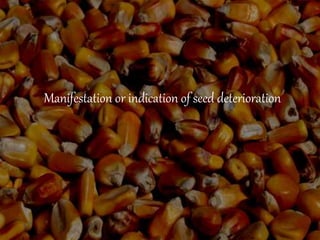
Manifestation or indication of seed deterioration
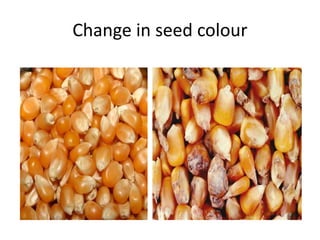
 Changes in seed coat colour or embryo or
endosperm
 Delay of radicle emergence and seedling growth
 Reduced total germination of seed population
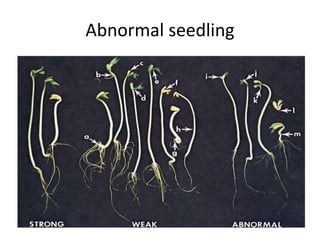
 Increase in the number of abnormal seedlings
 Lower tolerance to adverse storage conditions
 Loss of vigour
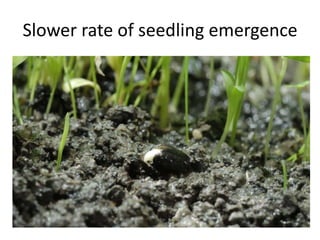
 Slower rate of seedling growth and development
 Decreased germination percentage
 Stunting of radicle
 Decreased resistance to environmental stress
during germination and early seedling growth
 Reduced yield potential
 The ultimate perform symptom is the complete
loss of germinability and death of the seed
Change in seed colour
Abnormal seedling
Slower rate of seedling emergence
Changes associated with seed deterioration
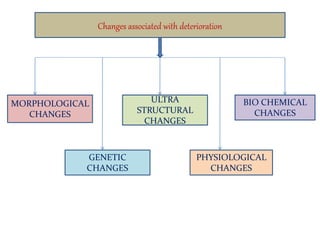
Changes associated with deterioration
MORPHOLOGICAL
CHANGES
ULTRA
STRUCTURAL
CHANGES
BIO CHEMICAL
CHANGES
GENETIC
CHANGES
PHYSIOLOGICAL
CHANGES
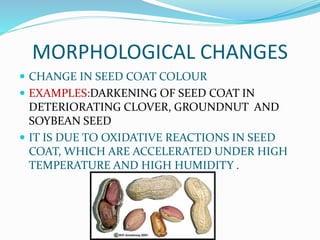
MORPHOLOGICAL CHANGES
 CHANGE IN SEED COAT COLOUR
 EXAMPLES:DARKENING OF SEED COAT IN
DETERIORATING CLOVER, GROUNDNUT AND
SOYBEAN SEED
 IT IS DUE TO OXIDATIVE REACTIONS IN SEED
COAT, WHICH ARE ACCELERATED UNDER HIGH
TEMPERATURE AND HIGH HUMIDITY .
Ultra structural changes
 Mitochondria
It become permanently swollen and loss their natural
swelling contracting ability
Decrease in the respiration rate of the seeds.
 Ribosomes
Protein synthesis retarded
 Nucleus
Develop a peculiar lobed condition in maize
 Endoplasmic reticulum
Partially aged seeds have short ER
Completely degenerates
BIOCHEMICAL CHANGES
 LOSS OF ENZYME ACTIVITY
The activity of certain enzyme associated with
breakdown of food reserves or biosynthesis of new tissue
during germination is reduced. Enzymes that reduced are
amylase, catalase, glutathione etc.,
 REDUCED RESPIRATION
As seed deteriorate, respiration becomes
progressively weaker, and ultimately leads to loss in
germination
BIOCHEMICAL CHANGES
 LIPID PEROXIDATION
It refers to oxidative degeneration of lipids. The free
radical steal the e- from the lipids in cell membranes,
resulting in cell damage
Loss of membrane structures and increases in leakiness
of o2 is able to damage plant tissue in inhibiting chloroplast
development
 DEGRADATION OF FOOD RESERVES
In bamboo – carbohydrate content is reduced
In maize - protein and lipid content is reduced
GENETIC CHANGES
 IT IS OF TWO POSSIBILITIES
1.DNA is somewhat degraded and fails to produce
mRNA(transcription fails) that results in no enzyme
formation causing a reduction in germination
2.DNA functional, formation of functional stored mRNA.
During storage, stored mRNA may be degraded. Impaired
transcription causing incomplete or faulty enzyme
synthesis leads to slower seedling growth
 Production of free radicals (unstable molecules that can
damage the cells)
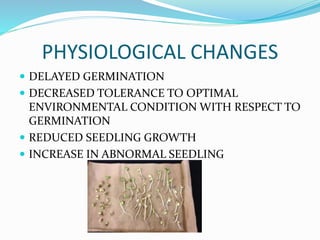
PHYSIOLOGICAL CHANGES
 DELAYED GERMINATION
 DECREASED TOLERANCE TO OPTIMAL
ENVIRONMENTAL CONDITION WITH RESPECT TO
GERMINATION
 REDUCED SEEDLING GROWTH
 INCREASE IN ABNORMAL SEEDLING
Factors of seed deterioration
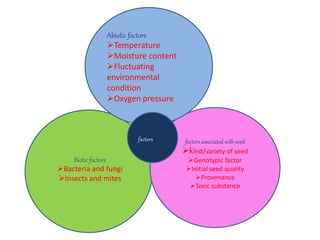
factors associated with seed
kind/variety of seed
Genotypic factor
Initial seed quality
Provenance
Toxic substance
Abiotic factors
Temperature
Moisture content
Fluctuating
environmental
condition
Oxygen pressure
Biotic factors
Bacteria and fungi
Insects and mites
factors
Effect of Temperature
Effect of Moisture content
Effect of Fluctuating
environmental condition
Effect of Oxygen pressure
High temperature hastened the rate of
these biochemical processes triggering more rapid
deterioration that resulted in rapid losses in seed
having high moisture content (Shelar et al., 2008).
Seeds sensitivity to high temperatures is
strongly dependent on their water content, loss of
viability being quicker with increasing moisture
content (Kibinza et al., 2006).
Temperature is important because it
influences the amount of moisture and also
enhances the rate of deteriorative reactions
occurring in seeds as temperature increases
Effect of temperature
Effect of moisture content
 Seeds stored at high moisture content demonstrate
increased respiration, heating, and fungal invasion
resulting in reduced seed vigour and viability. After
physiological maturity the rate of seed quality loss depends
on the degree of unfavorable environmental conditions
surrounding the seed. Environmental moisture,
predominantly intermittent or prolonged rainfall, during
the post maturation and pre-harvest period, is quite
detrimental to seed quality and cause rapid deterioration.
moisture = seed deterioration
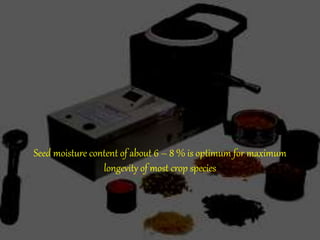
Seed moisture content of about 6 – 8 % is optimum for maximum
longevity of most crop species
Effect of fluctuating environmental condition
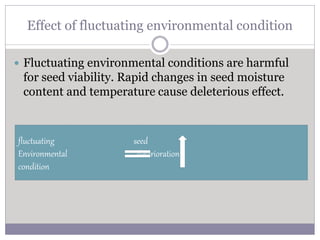
 Fluctuating environmental conditions are harmful
for seed viability. Rapid changes in seed moisture
content and temperature cause deleterious effect.
fluctuating seed
Environmental deterioration
condition
Effect of oxygen pressure
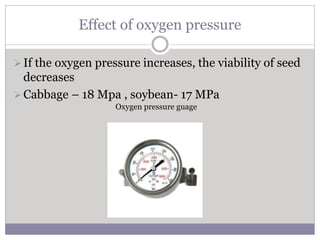
If the oxygen pressure increases, the viability of seed
decreases
Cabbage – 18 Mpa , soybean- 17 MPa
Oxygen pressure guage
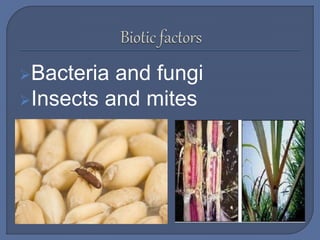
Bacteria and fungi
Insects and mites
Bacteria and fungi
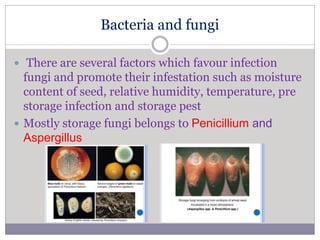
 There are several factors which favour infection
fungi and promote their infestation such as moisture
content of seed, relative humidity, temperature, pre
storage infection and storage pest
 Mostly storage fungi belongs to Penicillium and
Aspergillus
Bacteria and fungi
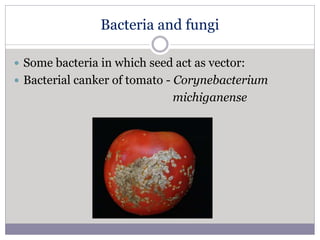
 Some bacteria in which seed act as vector:
 Bacterial canker of tomato - Corynebacterium
michiganense
BACTERIA
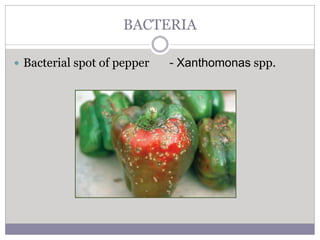
 Bacterial spot of pepper - Xanthomonas spp.
BACTERIA
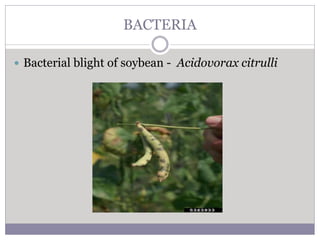
 Bacterial blight of soybean - Acidovorax citrulli
BACTERIA AND FUNGI
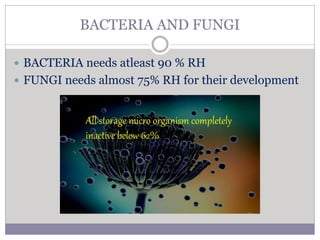
 BACTERIA needs atleast 90 % RH
 FUNGI needs almost 75% RH for their development
All storage micro organism completely
inactive below 62%
INSECTS AND MITES
 THE OPTIMUM TEMPERATURE FOR INSECT
ACTIVITY ON STORAGE RANGES FROM 28 TO
38°C. THE TEMPERATURE BELOW 17 TO 20ºC
ARE CONSIDERED UNSAFE FOR INSECT
ACTIVITY
 NO INSECT ACTIVITY AT SEED MOISTURE
CONTENTS BELOW 8% . INSECT ACTIVITY IS
COMMON ON 15% MOISTURE CONTENT
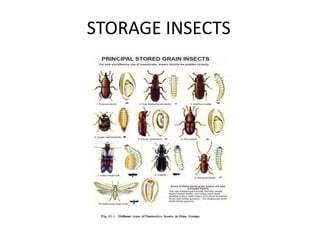
STORAGE INSECTS
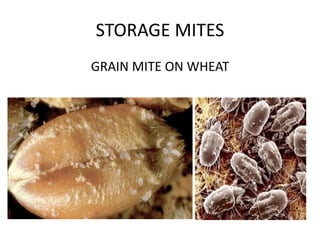
STORAGE MITES
GRAIN MITE ON WHEAT
kind/variety of seed
Genotypic factor
Initial seed quality
Provenance
Toxic substance
KIND OR VARIETY OF SEED
•The seed storability is considerably
determined by the kind or variety of
seeds.
• Some seeds are naturally short-lived,
e.g., onion, soybeans, peanuts, etc.,
whereas some seeds like tall fescue and
annual rye grass appear very similar but
differ in storability.
• Genetic make-up of varieties also
influences storability
GENOTYPIC FACTORS
Some types of seeds are
inherently long lived; others
are short lived, while others
have an intermediate life span
owing to their differences on
genetic makeup
 High initial viability of seeds maintains their
quality in storage longer than those with less
initial viability.
 Vigorous and un deteriorated seeds can store
longer than deteriorated seeds. Seeds that have
been broken, cracked, or bruised due to handling
deteriorate more rapidly in storage than
undamaged seeds.
 Cracks in seeds serve as entrance to pathogens
causing consequent deterioration.
 Seeds that have been developed under
environmental stress conditions (such as drought,
nutrient deficiency and high temperatures)
become more susceptible to rapid deterioration.
Seeds obtained from different
sources may show differences in
viability and storability.
 Nevertheless, the seed begins
its existence before it harvest
and it is expected that seeds
harvested in different pre-
harvest condition.
TOXIC SUBSTANCES
•Loss in seed viability is due to the
accumulation of toxic metabolites is the is
one of the most attractive explanation of
seed deterioration
•Bio chemicals suggested to be the cause of
loss in seed viability are Indole derivatives
and some Phenolics
•Example: 1. Coumarin
2.Ferulic acid
3. Abscisic acid etc.,
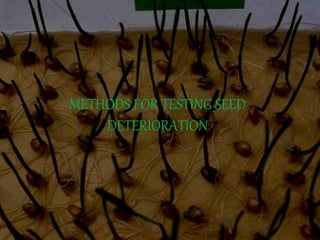
METHODS FOR TESTING SEED
DETERIORATION
METHODS FOR TESTING SEED DETERIORATION
There is no direct meth0d for
estimating seed deterioration .
However, by assessing seed
viability, vigour and enzyme
activity seed deterioration is
measured.
METHODS INVOLVED
 GERMINATION TEST
 TETRAZOLIUM (TZ) TEST
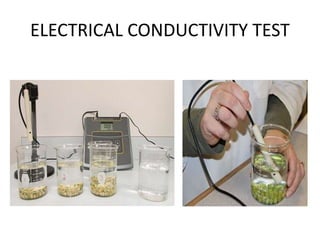
 ELECTRICAL CONDUCTIVITY TEST
 VITAL COLOURING TEST
 ENZYME ACTIVITY TEST
 X-RAY PHOTOGRAPHY
 FERRIC CHLORIDE TEST
 FAST GREEN TEST
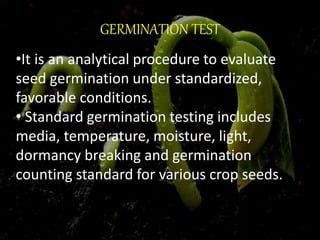
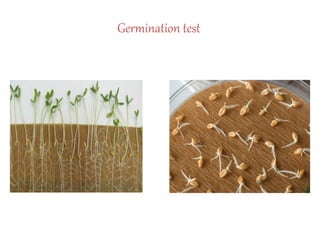
GERMINATION TEST
•It is an analytical procedure to evaluate
seed germination under standardized,
favorable conditions.
• Standard germination testing includes
media, temperature, moisture, light,
dormancy breaking and germination
counting standard for various crop seeds.
Germination test
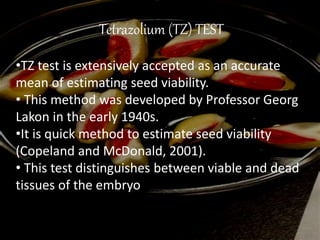
Tetrazolium (TZ) TEST
•TZ test is extensively accepted as an accurate
mean of estimating seed viability.
• This method was developed by Professor Georg
Lakon in the early 1940s.
•It is quick method to estimate seed viability
(Copeland and McDonald, 2001).
• This test distinguishes between viable and dead
tissues of the embryo
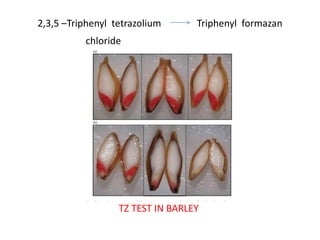
2,3,5 –Triphenyl tetrazolium Triphenyl formazan
chloride
TZ TEST IN BARLEY
 As seed deterioration progresses, the cell
membranes become less rigid and become
more water permeable.
 It allows the cell contents to leakage into
solution with the water and increasing
electrical conductivity.
 It provides a rapid indication of seed viability
for seed lots.
ELECTRICAL CONDUCTIVITY TEST
The principle of this method is the
differential coloration of live against dead
tissues when exhibited to certain dyes
such. as sulfuric acid, indigo carmine and
aniline dyes.
 These dyes stain the dead tissue blue and
the live tissue leftovers unstained. This
method is particularly useful for
determining viability of tree seeds
ENZYME ACTIVITY TEST
These methods measure enzyme
activity (such as lipase, amylase,
diastase, catalase, peroxidase and
dehydrogenase) of imbibed seeds
as an indication of their viability.
 It is generally used to test the viability in
FOREST SEEDS.
 PRINCIPLE:
BaCl2 penetrate into the dead cells , but
do not penetrate into living cells because of
their semi-permeability.
Thus dead parts of the embryo and
endosperm show up clearly as contrast
areas on X- ray photographs.
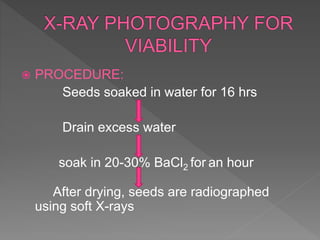
 PROCEDURE:
Seeds soaked in water for 16 hrs
Drain excess water
soak in 20-30% BaCl2 for an hour
After drying, seeds are radiographed
using soft X-rays
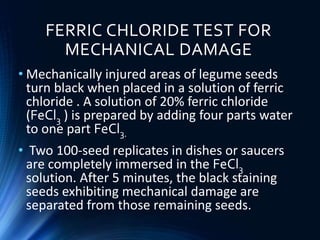
FERRIC CHLORIDE TEST FOR
MECHANICAL DAMAGE
• Mechanically injured areas of legume seeds
turn black when placed in a solution of ferric
chloride . A solution of 20% ferric chloride
(FeCl3 ) is prepared by adding four parts water
to one part FeCl3.
• Two 100-seed replicates in dishes or saucers
are completely immersed in the FeCl3
solution. After 5 minutes, the black staining
seeds exhibiting mechanical damage are
separated from those remaining seeds.
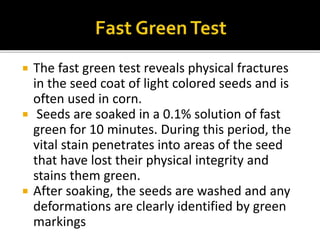
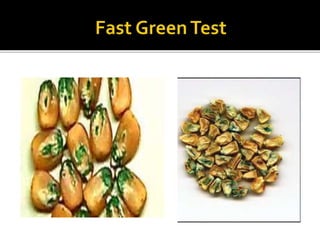
 The fast green test reveals physical fractures
in the seed coat of light colored seeds and is
often used in corn.
 Seeds are soaked in a 0.1% solution of fast
green for 10 minutes. During this period, the
vital stain penetrates into areas of the seed
that have lost their physical integrity and
stains them green.
 After soaking, the seeds are washed and any
deformations are clearly identified by green
markings
Prevention of seed deterioration
The rate of ageing and deterioration of
seeds in a seed lot can be greatly reduced
by controlling external factors like
temperature, humidity and infestation by
diseases and pests.
Anti-crypto-biotic factors affecting seed
viability thereby causing deterioration can
be prevented or rate of deterioration is
slowed down from influencing the seed lot
by improvement of storage conditions.
 Seed stored in dehumidified storage
environment at low temperature (-10ºCto -
30ºC)or kept in cryo–preservation retains
viability and longer shelf-life of un-
deteriorated seeds.
 Preventive measures taken and treatments
against pathogenic infection of seeds in
storage .
 Dormancy act as a physiological switch and
turns off the undesirable cell activities and
improves the shelf-life of seeds during
storage.
 Use only approved seeds for multiplication.
 Inspection and approval of field prior to planting.
 Provide adequate and approved isolation
distance with a view to prevent natural out
crossing or mechanical mixture.
 Rouging of off types before flowering.
 Certification of the seed crop.
 Sampling and sealing of cleaned seed lot.
Seed treatments to retrieved the viability of
partially deteriorated seed
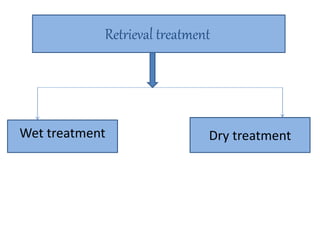
Retrieval treatment
Wet treatment Dry treatment
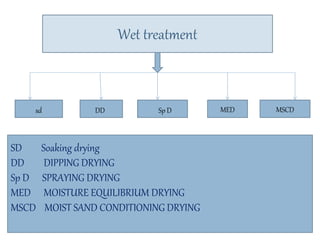
Wet treatment
 It requires hydration to raise seed moisture as high
as 25 % to 30% in water alone or in solution of
different chemicals followed by drying back to safe
limit of seed moisture for dry storage.
 The choice of a particular treatment would depend
on the seed material concerned and its initial seed
vigour.
Wet treatment
MED MSCDsd DD Sp D
SD Soaking drying
DD DIPPING DRYING
Sp D SPRAYING DRYING
MED MOISTURE EQUILIBRIUM DRYING
MSCD MOIST SAND CONDITIONING DRYING
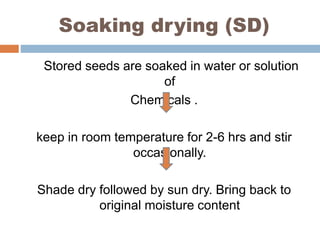
Soaking drying (SD)
Stored seeds are soaked in water or solution
of
Chemicals .
keep in room temperature for 2-6 hrs and stir
occasionally.
Shade dry followed by sun dry. Bring back to
original moisture content
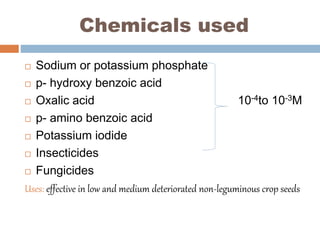
Chemicals used
 Sodium or potassium phosphate
 p- hydroxy benzoic acid
 Oxalic acid 10-4to 10-3M
 p- amino benzoic acid
 Potassium iodide
 Insecticides
 Fungicides
Uses: effective in low and medium deteriorated non-leguminous crop seeds
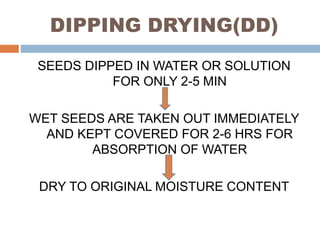
DIPPING DRYING(DD)
SEEDS DIPPED IN WATER OR SOLUTION
FOR ONLY 2-5 MIN
WET SEEDS ARE TAKEN OUT IMMEDIATELY
AND KEPT COVERED FOR 2-6 HRS FOR
ABSORPTION OF WATER
DRY TO ORIGINAL MOISTURE CONTENT
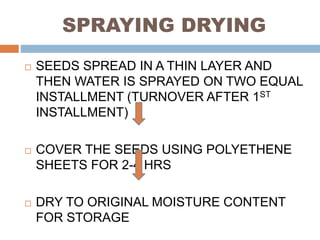
SPRAYING DRYING
 SEEDS SPREAD IN A THIN LAYER AND
THEN WATER IS SPRAYED ON TWO EQUAL
INSTALLMENT (TURNOVER AFTER 1ST
INSTALLMENT)
 COVER THE SEEDS USING POLYETHENE
SHEETS FOR 2-4 HRS
 DRY TO ORIGINAL MOISTURE CONTENT
FOR STORAGE
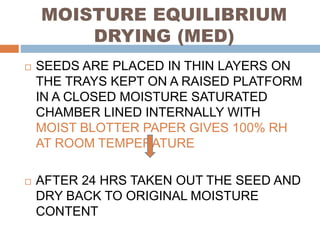
MOISTURE EQUILIBRIUM
DRYING (MED)
 SEEDS ARE PLACED IN THIN LAYERS ON
THE TRAYS KEPT ON A RAISED PLATFORM
IN A CLOSED MOISTURE SATURATED
CHAMBER LINED INTERNALLY WITH
MOIST BLOTTER PAPER GIVES 100% RH
AT ROOM TEMPERATURE
 AFTER 24 HRS TAKEN OUT THE SEED AND
DRY BACK TO ORIGINAL MOISTURE
CONTENT
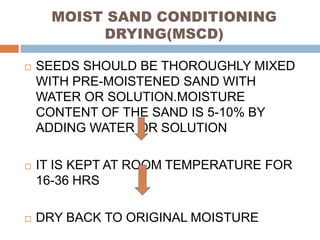
MOIST SAND CONDITIONING
DRYING(MSCD)
 SEEDS SHOULD BE THOROUGHLY MIXED
WITH PRE-MOISTENED SAND WITH
WATER OR SOLUTION.MOISTURE
CONTENT OF THE SAND IS 5-10% BY
ADDING WATER OR SOLUTION
 IT IS KEPT AT ROOM TEMPERATURE FOR
16-36 HRS
 DRY BACK TO ORIGINAL MOISTURE
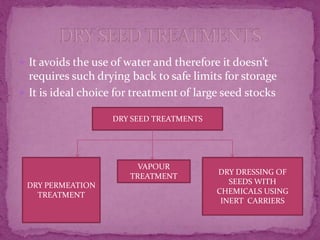
 It avoids the use of water and therefore it doesn’t
requires such drying back to safe limits for storage
 It is ideal choice for treatment of large seed stocks
DRY SEED TREATMENTS
DRY PERMEATION
TREATMENT
VAPOUR
TREATMENT
DRY DRESSING OF
SEEDS WITH
CHEMICALS USING
INERT CARRIERS
 DRY SEEDS ARE IMMERSED IN ORGANIC
SOLVENTS LIKE ACETONE, DI-CHLORO-
METHANE ETC., WHICH ACT AS QUICK
PENETRATION CARRIERS OF DESIRED
HORMONAL AND NON HORMONAL CHEMICALS
CHEMICAL FOR 2-3 HRS
 FOLLOWED BY EVAPORATION OF SOLVENT BY
AIR
 THIS METHOD IS ALSO CALLED AS SOLVENT INFUSION METHOD
VAPOUR TREATMENT
 SEEDS ARE EXPOSED TO VERY LOW
CONCENTRATION OF HALOGENS
LIKE CHLORINE, BROMINE,IODINE
OR ALCHOLS FOR 16-72HRS ALONG
WITH CHEMICALS IN CLOSED
CONTAINER
DRY DRESSING OF SEEDS WITH CHEMICALS USING
INERT MATTER
 CALCIUM CARBONATE , CHALK, CHARCOAL,
ACTIVATED CLAY ARE FIRST EXPOSED TO VAPOURS
OF HALOGEN OR ALCOHOLS
 CARRIER IS MIXED WITH SEEDS (2-5gm /Kg seed)
•Seeds are the foundation of agriculture.
•Technology has modernized much of
farming's day-to-day operations, but
without a steady supply of high-quality
seed, yields and crop quality would be
greatly decreased.
•Characteristics such as trueness to variety,
germination percentage, purity, vigour and
appearance are important to farmers to
plant crops.
References
Singh,B.D. and A.K.Joshi.2004.Seed science and
technology.Kalyani publishers,NewDelhi.
Sen subir and Nabinananda Ghosh.2014.Seed
science and technology. Kalyani publishers.New
Delhi.
Vanangamudi,K.2014.An illustarated text book
Seed science and technology.New India
Publishing Agency.New Delhi.
http://www.ijlpr.com/currenttissue.php
Seed deterioration

Seed deterioration

  • 1.
  • 2.
    The process bywhich seed lose its vigour and eventually loses viability and die
  • 3.
  • 4.
    Various views ofseed deterioration
  • 5.
     Seed deteriorationis defined as deteriorative changes occurring with time that increase the seed’s vulnerability to external challenges and decreases the ability of the seed to survive.  Seed deterioration is an inexorable and irreversible processes and it varies among seed population
  • 6.
     Seed deteriorationis an irreversible degenerative change in the quality of a seed after it has reached its maximum quality level  The Maximum quality level is the theoretical maximum attainable level of seed quality under the most favoured seed × environmental interaction.  Generally, seeds reached its maximum quality level at physiological maturity, and beyond this point of time only degeneration occurs
  • 7.
     Seed deteriorationas a decline in quality, character, vitality, vigour or usefulness of seed
  • 8.
     Seed deteriorationis loss of seed quality, viability and vigor due to effect of adverse environmental factors  The process has been described as cumulative, irreversible, degenerative and inexorable process  Plants that have originated from deteriorate seed can also reduce growth rate
  • 9.
    Types of seeddeterioration
  • 10.
    Types of seeddeterioration Field weathering storageHarvest and post harvest deterioration
  • 11.
    Field weathering  Thedeterioration of seed quality, vigour and viability, due to high relative humidity and high temperature during the post- maturation and pre-harvest period is referred to as field weathering (Bhatia et al., 2010).  Weathering occurs in the period between the attainment of physiological maturity till harvesting in the field. Deterioration caused by weathering is directly related to seed exposure to adverse conditions, so that the physiological quality is depending on the environmental conditions preceding harvesting (Padua et al., 2009).
  • 12.
    Field weathering  Afterphysiological maturity if the seeds are retained on mother plant, seeds will deteriorate, physiological changes in seed may lead to formation of rigid seeds or off color seeds in pulse crops (Khatun et al., 2009).  Harvest delays beyond optimum maturity intensify seed deterioration. It not only lowers seed germination, but also increases susceptibility to mechanical damage and disease infection. Timely harvesting avoids prolonged exposure to moisture, and is the best means of avoiding weathering
  • 13.
    Harvest and postharvest deterioration  Seed quality is highly affected by harvesting and handling methods. Harvest and post-harvest deterioration comprises threshing, processing machinery, seed collection, handling, transporting and drying.  Mechanical damage is one of the major causes of seed deterioration during storage.
  • 14.
    Harvest and postharvest deterioration  Very dry seeds are prone to mechanical damage and injuries. Such damage may result in physical damage or fracturing of essential seedparts; broken seed coats permit early entry and easy access for microflora, make the seed vulnerable to fungal attack and reduce storage potential (Shelar, 2008).  In its severest form, physical seed damage is exhibited by splitting of the cotyledon, shattered and broken seeds. Large seeded varieties are more sensitive to mechanical damage than small seeds.
  • 15.
    storage  Storability ofseeds is mainly a genetically regulated character and is influenced by quality of the seed at the time of storage, pre-storage history of seed (environmental factors during pre and post-harvest stages), moisture content of seed or ambient relative humidity, temperature of storage environment, duration of storage and biotic agents (Shelar et al., 2008)  Damage of seed during storage is inevitable
  • 16.
    storage  These environmentalconditions are very difficult to maintain during storage. The seed storage environment highly influences the period of seed survival.  After planting of deteriorate seeds, seedling emergence may be poor and transmission of pathogens to the new crop may occur.  Lower temperature and humidity result in delayed seed deteriorative process and thereby leads to prolonged viability period (Mohammadi et al., 2011).
  • 17.
  • 18.
    Characteristics of seeddeterioration james c. Delouche’s concept regarding the characteristics of seed deterioration as follows 1. Seed deterioration is an inexorable process: This means that seed deterioration must be considered as an unalterable fact. We cannot prevent deterioration; we can, however, influence or control its rate .
  • 19.
    2. Deterioration inseeds is an irreversible process. Dead seeds cannot be brought back to life or more realistically perhaps, dead portions or areas in seeds cannot be rejuvenated or made whole again. If seed are allowed to deteriorate in the field, or mechanically abused in harvesting, the damage cannot be undone by subsequent good storage, gentle handling or even seed treatment.
  • 20.
    3. Deterioration isat its lowest level at the time of seed maturation.  By seed maturation we mean the point in the developmental history of a seed when it is physiologically and morphologically capable of developing into a highly vigorous seedling. Although it is generally not realized, seeds usually reach maturity long before normal harvest and at relatively high moisture contents - 30 to 45%. Once the peak of maturation is attained, the seeds having reached maximum dry weight, vigour and viability, there is only one direction to go, downhill. There can be considerable deterioration before harvest.
  • 21.
    4. Rate ofdeterioration varies among the different kinds of seed.  cottonseed and soybeans have somewhat similar chemical composition - they are both high in oil and proteins with relatively little starch. Yet, cottonseed will store or keep for 2 or even 3 years while soybeans often deteriorate before the first planting season after harvest. deteriorated Soybean seed
  • 22.
    5. Rate ofdeterioration varies among seed lots of the same kind stored under the same conditions.  seed lots of the same kind and variety, of the same chronological age and viability, and which even look alike, are not necessarily of the same quality.  Delouche made an experiment using crimson clover (fodder) and sorghum seed and decided to replicate the work by using two similar lots of each kind. The lots were carefully selected, sized, aspirated, etc. Yet, as they followed the study over a three year period, the most significant thing to emerge was that the two lots of crimson clover and the two lots of sorghum responded very differently. In each case there was a "good" lot that maintained high viability and vigour for a relatively long period of time, and a bad lot that deteriorated rapidly.
  • 23.
    Manifestation or indicationof seed deterioration
  • 24.
     Changes inseed coat colour or embryo or endosperm  Delay of radicle emergence and seedling growth  Reduced total germination of seed population  Increase in the number of abnormal seedlings  Lower tolerance to adverse storage conditions  Loss of vigour  Slower rate of seedling growth and development
  • 25.
     Decreased germinationpercentage  Stunting of radicle  Decreased resistance to environmental stress during germination and early seedling growth  Reduced yield potential  The ultimate perform symptom is the complete loss of germinability and death of the seed
  • 26.
  • 27.
  • 28.
    Slower rate ofseedling emergence
  • 29.
    Changes associated withseed deterioration
  • 30.
    Changes associated withdeterioration MORPHOLOGICAL CHANGES ULTRA STRUCTURAL CHANGES BIO CHEMICAL CHANGES GENETIC CHANGES PHYSIOLOGICAL CHANGES
  • 31.
    MORPHOLOGICAL CHANGES  CHANGEIN SEED COAT COLOUR  EXAMPLES:DARKENING OF SEED COAT IN DETERIORATING CLOVER, GROUNDNUT AND SOYBEAN SEED  IT IS DUE TO OXIDATIVE REACTIONS IN SEED COAT, WHICH ARE ACCELERATED UNDER HIGH TEMPERATURE AND HIGH HUMIDITY .
  • 32.
    Ultra structural changes Mitochondria It become permanently swollen and loss their natural swelling contracting ability Decrease in the respiration rate of the seeds.  Ribosomes Protein synthesis retarded  Nucleus Develop a peculiar lobed condition in maize  Endoplasmic reticulum Partially aged seeds have short ER Completely degenerates
  • 33.
    BIOCHEMICAL CHANGES  LOSSOF ENZYME ACTIVITY The activity of certain enzyme associated with breakdown of food reserves or biosynthesis of new tissue during germination is reduced. Enzymes that reduced are amylase, catalase, glutathione etc.,  REDUCED RESPIRATION As seed deteriorate, respiration becomes progressively weaker, and ultimately leads to loss in germination
  • 34.
    BIOCHEMICAL CHANGES  LIPIDPEROXIDATION It refers to oxidative degeneration of lipids. The free radical steal the e- from the lipids in cell membranes, resulting in cell damage Loss of membrane structures and increases in leakiness of o2 is able to damage plant tissue in inhibiting chloroplast development  DEGRADATION OF FOOD RESERVES In bamboo – carbohydrate content is reduced In maize - protein and lipid content is reduced
  • 35.
    GENETIC CHANGES  ITIS OF TWO POSSIBILITIES 1.DNA is somewhat degraded and fails to produce mRNA(transcription fails) that results in no enzyme formation causing a reduction in germination 2.DNA functional, formation of functional stored mRNA. During storage, stored mRNA may be degraded. Impaired transcription causing incomplete or faulty enzyme synthesis leads to slower seedling growth  Production of free radicals (unstable molecules that can damage the cells)
  • 36.
    PHYSIOLOGICAL CHANGES  DELAYEDGERMINATION  DECREASED TOLERANCE TO OPTIMAL ENVIRONMENTAL CONDITION WITH RESPECT TO GERMINATION  REDUCED SEEDLING GROWTH  INCREASE IN ABNORMAL SEEDLING
  • 37.
    Factors of seeddeterioration
  • 38.
    factors associated withseed kind/variety of seed Genotypic factor Initial seed quality Provenance Toxic substance Abiotic factors Temperature Moisture content Fluctuating environmental condition Oxygen pressure Biotic factors Bacteria and fungi Insects and mites factors
  • 39.
    Effect of Temperature Effectof Moisture content Effect of Fluctuating environmental condition Effect of Oxygen pressure
  • 40.
    High temperature hastenedthe rate of these biochemical processes triggering more rapid deterioration that resulted in rapid losses in seed having high moisture content (Shelar et al., 2008). Seeds sensitivity to high temperatures is strongly dependent on their water content, loss of viability being quicker with increasing moisture content (Kibinza et al., 2006). Temperature is important because it influences the amount of moisture and also enhances the rate of deteriorative reactions occurring in seeds as temperature increases Effect of temperature
  • 41.
    Effect of moisturecontent  Seeds stored at high moisture content demonstrate increased respiration, heating, and fungal invasion resulting in reduced seed vigour and viability. After physiological maturity the rate of seed quality loss depends on the degree of unfavorable environmental conditions surrounding the seed. Environmental moisture, predominantly intermittent or prolonged rainfall, during the post maturation and pre-harvest period, is quite detrimental to seed quality and cause rapid deterioration. moisture = seed deterioration
  • 42.
    Seed moisture contentof about 6 – 8 % is optimum for maximum longevity of most crop species
  • 43.
    Effect of fluctuatingenvironmental condition  Fluctuating environmental conditions are harmful for seed viability. Rapid changes in seed moisture content and temperature cause deleterious effect. fluctuating seed Environmental deterioration condition
  • 44.
    Effect of oxygenpressure If the oxygen pressure increases, the viability of seed decreases Cabbage – 18 Mpa , soybean- 17 MPa Oxygen pressure guage
  • 45.
  • 46.
    Bacteria and fungi There are several factors which favour infection fungi and promote their infestation such as moisture content of seed, relative humidity, temperature, pre storage infection and storage pest  Mostly storage fungi belongs to Penicillium and Aspergillus
  • 47.
    Bacteria and fungi Some bacteria in which seed act as vector:  Bacterial canker of tomato - Corynebacterium michiganense
  • 48.
    BACTERIA  Bacterial spotof pepper - Xanthomonas spp.
  • 49.
    BACTERIA  Bacterial blightof soybean - Acidovorax citrulli
  • 50.
    BACTERIA AND FUNGI BACTERIA needs atleast 90 % RH  FUNGI needs almost 75% RH for their development All storage micro organism completely inactive below 62%
  • 51.
    INSECTS AND MITES THE OPTIMUM TEMPERATURE FOR INSECT ACTIVITY ON STORAGE RANGES FROM 28 TO 38°C. THE TEMPERATURE BELOW 17 TO 20ºC ARE CONSIDERED UNSAFE FOR INSECT ACTIVITY  NO INSECT ACTIVITY AT SEED MOISTURE CONTENTS BELOW 8% . INSECT ACTIVITY IS COMMON ON 15% MOISTURE CONTENT
  • 52.
  • 53.
  • 54.
    kind/variety of seed Genotypicfactor Initial seed quality Provenance Toxic substance
  • 55.
    KIND OR VARIETYOF SEED •The seed storability is considerably determined by the kind or variety of seeds. • Some seeds are naturally short-lived, e.g., onion, soybeans, peanuts, etc., whereas some seeds like tall fescue and annual rye grass appear very similar but differ in storability. • Genetic make-up of varieties also influences storability
  • 56.
    GENOTYPIC FACTORS Some typesof seeds are inherently long lived; others are short lived, while others have an intermediate life span owing to their differences on genetic makeup
  • 57.
     High initialviability of seeds maintains their quality in storage longer than those with less initial viability.  Vigorous and un deteriorated seeds can store longer than deteriorated seeds. Seeds that have been broken, cracked, or bruised due to handling deteriorate more rapidly in storage than undamaged seeds.  Cracks in seeds serve as entrance to pathogens causing consequent deterioration.  Seeds that have been developed under environmental stress conditions (such as drought, nutrient deficiency and high temperatures) become more susceptible to rapid deterioration.
  • 58.
    Seeds obtained fromdifferent sources may show differences in viability and storability.  Nevertheless, the seed begins its existence before it harvest and it is expected that seeds harvested in different pre- harvest condition.
  • 59.
    TOXIC SUBSTANCES •Loss inseed viability is due to the accumulation of toxic metabolites is the is one of the most attractive explanation of seed deterioration •Bio chemicals suggested to be the cause of loss in seed viability are Indole derivatives and some Phenolics •Example: 1. Coumarin 2.Ferulic acid 3. Abscisic acid etc.,
  • 60.
    METHODS FOR TESTINGSEED DETERIORATION
  • 61.
    METHODS FOR TESTINGSEED DETERIORATION There is no direct meth0d for estimating seed deterioration . However, by assessing seed viability, vigour and enzyme activity seed deterioration is measured.
  • 62.
    METHODS INVOLVED  GERMINATIONTEST  TETRAZOLIUM (TZ) TEST  ELECTRICAL CONDUCTIVITY TEST  VITAL COLOURING TEST  ENZYME ACTIVITY TEST  X-RAY PHOTOGRAPHY  FERRIC CHLORIDE TEST  FAST GREEN TEST
  • 63.
    GERMINATION TEST •It isan analytical procedure to evaluate seed germination under standardized, favorable conditions. • Standard germination testing includes media, temperature, moisture, light, dormancy breaking and germination counting standard for various crop seeds.
  • 64.
  • 65.
    Tetrazolium (TZ) TEST •TZtest is extensively accepted as an accurate mean of estimating seed viability. • This method was developed by Professor Georg Lakon in the early 1940s. •It is quick method to estimate seed viability (Copeland and McDonald, 2001). • This test distinguishes between viable and dead tissues of the embryo
  • 66.
    2,3,5 –Triphenyl tetrazoliumTriphenyl formazan chloride TZ TEST IN BARLEY
  • 67.
     As seeddeterioration progresses, the cell membranes become less rigid and become more water permeable.  It allows the cell contents to leakage into solution with the water and increasing electrical conductivity.  It provides a rapid indication of seed viability for seed lots.
  • 68.
  • 69.
    The principle ofthis method is the differential coloration of live against dead tissues when exhibited to certain dyes such. as sulfuric acid, indigo carmine and aniline dyes.  These dyes stain the dead tissue blue and the live tissue leftovers unstained. This method is particularly useful for determining viability of tree seeds
  • 70.
    ENZYME ACTIVITY TEST Thesemethods measure enzyme activity (such as lipase, amylase, diastase, catalase, peroxidase and dehydrogenase) of imbibed seeds as an indication of their viability.
  • 71.
     It isgenerally used to test the viability in FOREST SEEDS.  PRINCIPLE: BaCl2 penetrate into the dead cells , but do not penetrate into living cells because of their semi-permeability. Thus dead parts of the embryo and endosperm show up clearly as contrast areas on X- ray photographs.
  • 72.
     PROCEDURE: Seeds soakedin water for 16 hrs Drain excess water soak in 20-30% BaCl2 for an hour After drying, seeds are radiographed using soft X-rays
  • 73.
    FERRIC CHLORIDE TESTFOR MECHANICAL DAMAGE • Mechanically injured areas of legume seeds turn black when placed in a solution of ferric chloride . A solution of 20% ferric chloride (FeCl3 ) is prepared by adding four parts water to one part FeCl3. • Two 100-seed replicates in dishes or saucers are completely immersed in the FeCl3 solution. After 5 minutes, the black staining seeds exhibiting mechanical damage are separated from those remaining seeds.
  • 74.
     The fastgreen test reveals physical fractures in the seed coat of light colored seeds and is often used in corn.  Seeds are soaked in a 0.1% solution of fast green for 10 minutes. During this period, the vital stain penetrates into areas of the seed that have lost their physical integrity and stains them green.  After soaking, the seeds are washed and any deformations are clearly identified by green markings
  • 76.
    Prevention of seeddeterioration
  • 77.
    The rate ofageing and deterioration of seeds in a seed lot can be greatly reduced by controlling external factors like temperature, humidity and infestation by diseases and pests. Anti-crypto-biotic factors affecting seed viability thereby causing deterioration can be prevented or rate of deterioration is slowed down from influencing the seed lot by improvement of storage conditions.
  • 78.
     Seed storedin dehumidified storage environment at low temperature (-10ºCto - 30ºC)or kept in cryo–preservation retains viability and longer shelf-life of un- deteriorated seeds.  Preventive measures taken and treatments against pathogenic infection of seeds in storage .  Dormancy act as a physiological switch and turns off the undesirable cell activities and improves the shelf-life of seeds during storage.
  • 79.
     Use onlyapproved seeds for multiplication.  Inspection and approval of field prior to planting.  Provide adequate and approved isolation distance with a view to prevent natural out crossing or mechanical mixture.  Rouging of off types before flowering.  Certification of the seed crop.  Sampling and sealing of cleaned seed lot.
  • 80.
    Seed treatments toretrieved the viability of partially deteriorated seed
  • 81.
  • 82.
    Wet treatment  Itrequires hydration to raise seed moisture as high as 25 % to 30% in water alone or in solution of different chemicals followed by drying back to safe limit of seed moisture for dry storage.  The choice of a particular treatment would depend on the seed material concerned and its initial seed vigour.
  • 83.
    Wet treatment MED MSCDsdDD Sp D SD Soaking drying DD DIPPING DRYING Sp D SPRAYING DRYING MED MOISTURE EQUILIBRIUM DRYING MSCD MOIST SAND CONDITIONING DRYING
  • 84.
    Soaking drying (SD) Storedseeds are soaked in water or solution of Chemicals . keep in room temperature for 2-6 hrs and stir occasionally. Shade dry followed by sun dry. Bring back to original moisture content
  • 85.
    Chemicals used  Sodiumor potassium phosphate  p- hydroxy benzoic acid  Oxalic acid 10-4to 10-3M  p- amino benzoic acid  Potassium iodide  Insecticides  Fungicides Uses: effective in low and medium deteriorated non-leguminous crop seeds
  • 86.
    DIPPING DRYING(DD) SEEDS DIPPEDIN WATER OR SOLUTION FOR ONLY 2-5 MIN WET SEEDS ARE TAKEN OUT IMMEDIATELY AND KEPT COVERED FOR 2-6 HRS FOR ABSORPTION OF WATER DRY TO ORIGINAL MOISTURE CONTENT
  • 87.
    SPRAYING DRYING  SEEDSSPREAD IN A THIN LAYER AND THEN WATER IS SPRAYED ON TWO EQUAL INSTALLMENT (TURNOVER AFTER 1ST INSTALLMENT)  COVER THE SEEDS USING POLYETHENE SHEETS FOR 2-4 HRS  DRY TO ORIGINAL MOISTURE CONTENT FOR STORAGE
  • 88.
    MOISTURE EQUILIBRIUM DRYING (MED) SEEDS ARE PLACED IN THIN LAYERS ON THE TRAYS KEPT ON A RAISED PLATFORM IN A CLOSED MOISTURE SATURATED CHAMBER LINED INTERNALLY WITH MOIST BLOTTER PAPER GIVES 100% RH AT ROOM TEMPERATURE  AFTER 24 HRS TAKEN OUT THE SEED AND DRY BACK TO ORIGINAL MOISTURE CONTENT
  • 89.
    MOIST SAND CONDITIONING DRYING(MSCD) SEEDS SHOULD BE THOROUGHLY MIXED WITH PRE-MOISTENED SAND WITH WATER OR SOLUTION.MOISTURE CONTENT OF THE SAND IS 5-10% BY ADDING WATER OR SOLUTION  IT IS KEPT AT ROOM TEMPERATURE FOR 16-36 HRS  DRY BACK TO ORIGINAL MOISTURE
  • 90.
     It avoidsthe use of water and therefore it doesn’t requires such drying back to safe limits for storage  It is ideal choice for treatment of large seed stocks DRY SEED TREATMENTS DRY PERMEATION TREATMENT VAPOUR TREATMENT DRY DRESSING OF SEEDS WITH CHEMICALS USING INERT CARRIERS
  • 91.
     DRY SEEDSARE IMMERSED IN ORGANIC SOLVENTS LIKE ACETONE, DI-CHLORO- METHANE ETC., WHICH ACT AS QUICK PENETRATION CARRIERS OF DESIRED HORMONAL AND NON HORMONAL CHEMICALS CHEMICAL FOR 2-3 HRS  FOLLOWED BY EVAPORATION OF SOLVENT BY AIR  THIS METHOD IS ALSO CALLED AS SOLVENT INFUSION METHOD
  • 92.
    VAPOUR TREATMENT  SEEDSARE EXPOSED TO VERY LOW CONCENTRATION OF HALOGENS LIKE CHLORINE, BROMINE,IODINE OR ALCHOLS FOR 16-72HRS ALONG WITH CHEMICALS IN CLOSED CONTAINER
  • 93.
    DRY DRESSING OFSEEDS WITH CHEMICALS USING INERT MATTER  CALCIUM CARBONATE , CHALK, CHARCOAL, ACTIVATED CLAY ARE FIRST EXPOSED TO VAPOURS OF HALOGEN OR ALCOHOLS  CARRIER IS MIXED WITH SEEDS (2-5gm /Kg seed)
  • 94.
    •Seeds are thefoundation of agriculture. •Technology has modernized much of farming's day-to-day operations, but without a steady supply of high-quality seed, yields and crop quality would be greatly decreased. •Characteristics such as trueness to variety, germination percentage, purity, vigour and appearance are important to farmers to plant crops.
  • 95.
    References Singh,B.D. and A.K.Joshi.2004.Seedscience and technology.Kalyani publishers,NewDelhi. Sen subir and Nabinananda Ghosh.2014.Seed science and technology. Kalyani publishers.New Delhi. Vanangamudi,K.2014.An illustarated text book Seed science and technology.New India Publishing Agency.New Delhi. http://www.ijlpr.com/currenttissue.php