Thursday, October 26, 2017
1
GROUP MEMBERS :
•Muhammad Umar (R1F15Bscs0015)
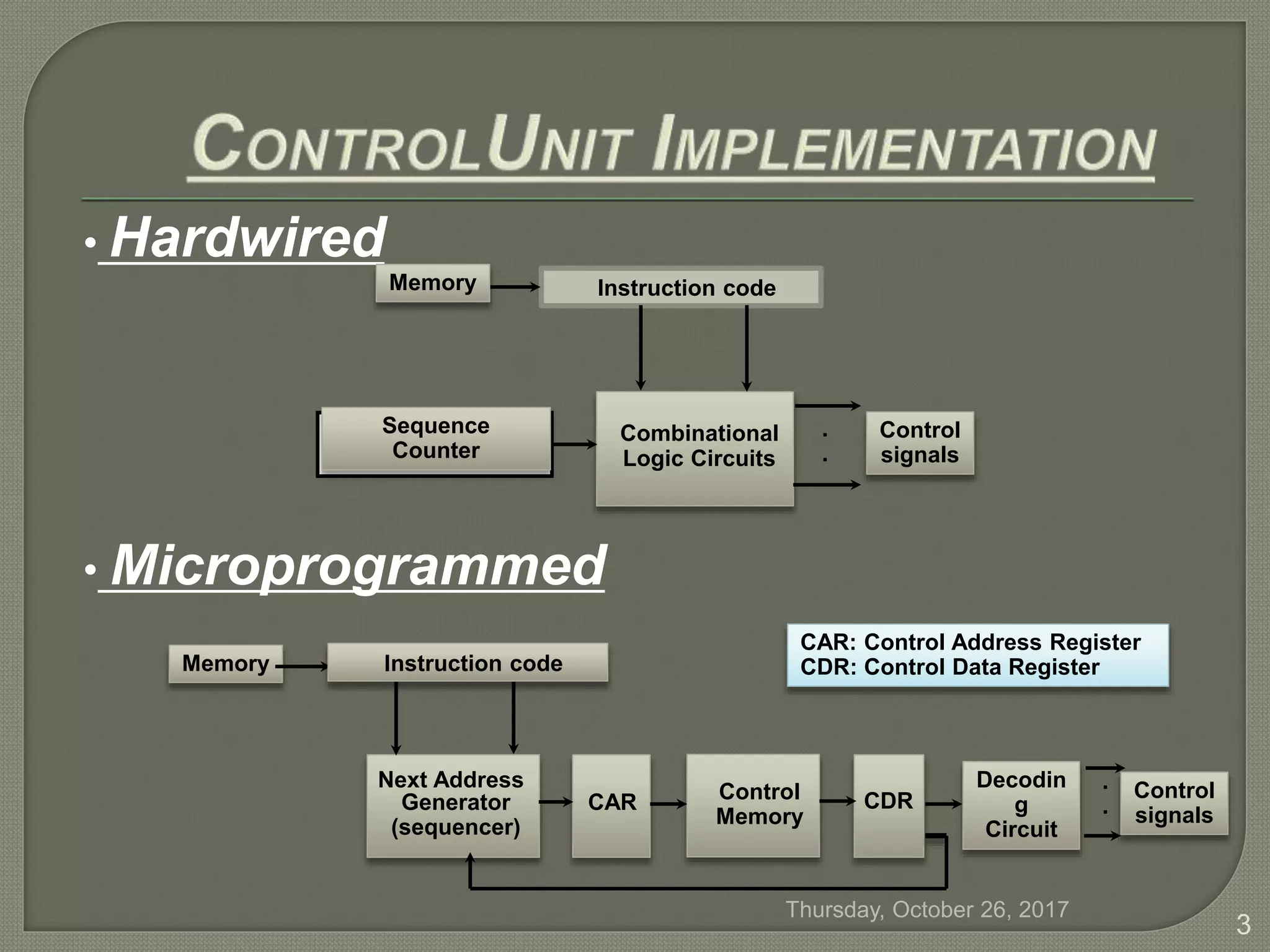
• Hardwired
• Microprogrammed
Instruction code
Combinational
Logic Circuits
Memory
Sequence
Counter
.
.
Control
signals
Control
signals
Next Address
Generator
(sequencer)
CAR Control
Memory
CDR
Decodin
g
Circuit
Memory
.
.
CAR: Control Address Register
CDR: Control Data RegisterInstruction code
Thursday, October 26, 2017
3
Control Unit :
The control unit (CU) is a component of a
computer's central processing unit (CPU)
that directs the operation of the processor.
It tells the computer's memory,
arithmetic/logic unit and input and output
devices on how to respond to a program's
instructions.
Thursday, October 26, 2017
4
Hardwire :
Hardwire control is a control
mechanism that generates control signals
by using an appropriate Finite State
Machine (FSM). Actually we sort it on
circuit.
The disadvantage is that wrong wiring
waste waste the whole circuit and time .
Thursday, October 26, 2017
5
Microprogrammed :
Microprogrammed control is a control
mechanism that generates control signals
by reading a memory called a Control
Storage (CS) that certain control signals.
It’s like a chips or bio’s and digital clock
watch (Masjid) is a chiped
microprogrammed.
Flexibility (change time etc )…
Thursday, October 26, 2017
6
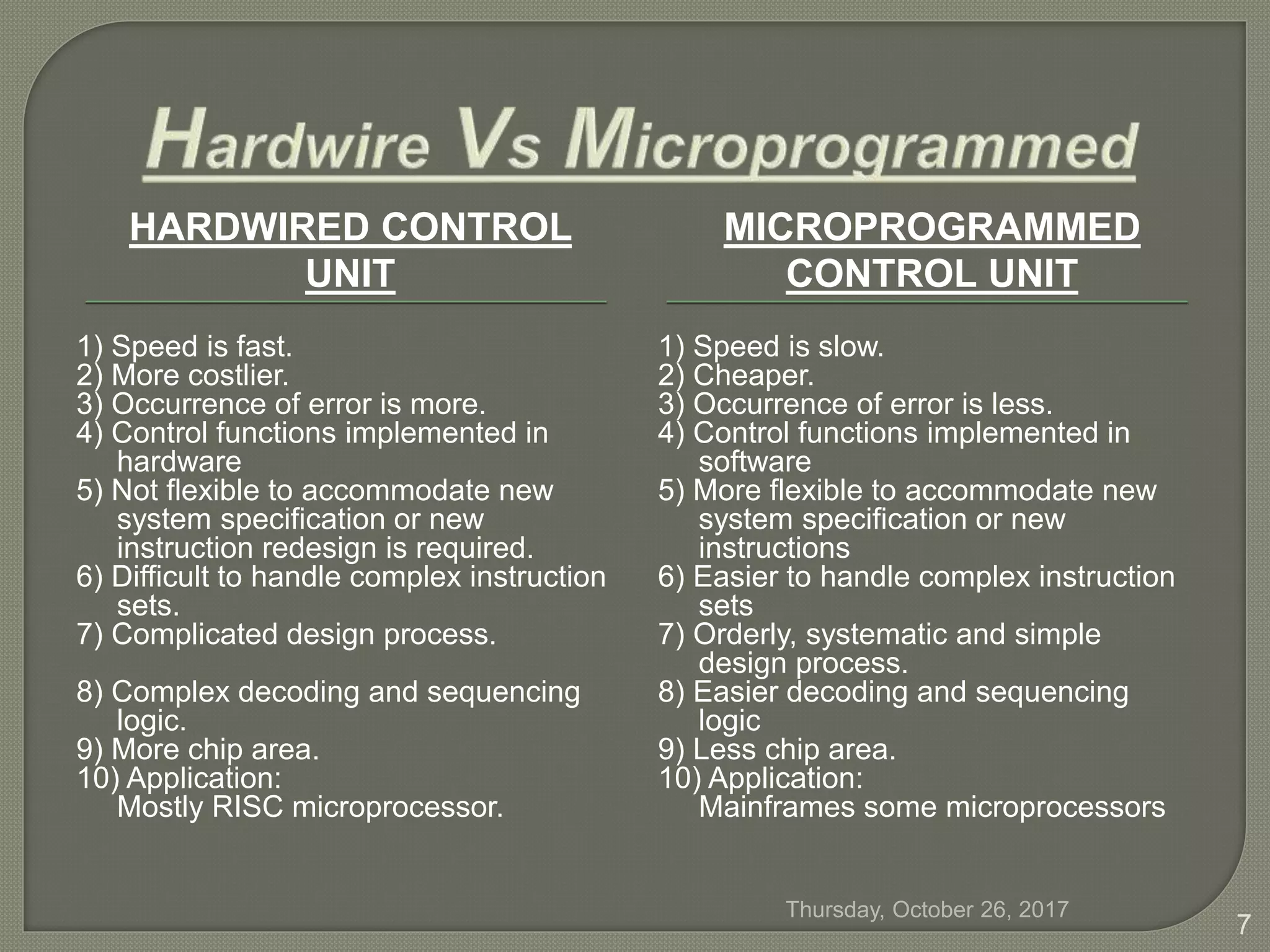
HARDWIRED CONTROL
UNIT
MICROPROGRAMMED
CONTROL UNIT
1) Speed is fast.
2) More costlier.
3) Occurrence of error is more.
4) Control functions implemented in
hardware
5) Not flexible to accommodate new
system specification or new
instruction redesign is required.
6) Difficult to handle complex instruction
sets.
7) Complicated design process.
8) Complex decoding and sequencing
logic.
9) More chip area.
10) Application:
Mostly RISC microprocessor.
1) Speed is slow.
2) Cheaper.
3) Occurrence of error is less.
4) Control functions implemented in
software
5) More flexible to accommodate new
system specification or new
instructions
6) Easier to handle complex instruction
sets
7) Orderly, systematic and simple
design process.
8) Easier decoding and sequencing
logic
9) Less chip area.
10) Application:
Mainframes some microprocessors
Thursday, October 26, 2017
7
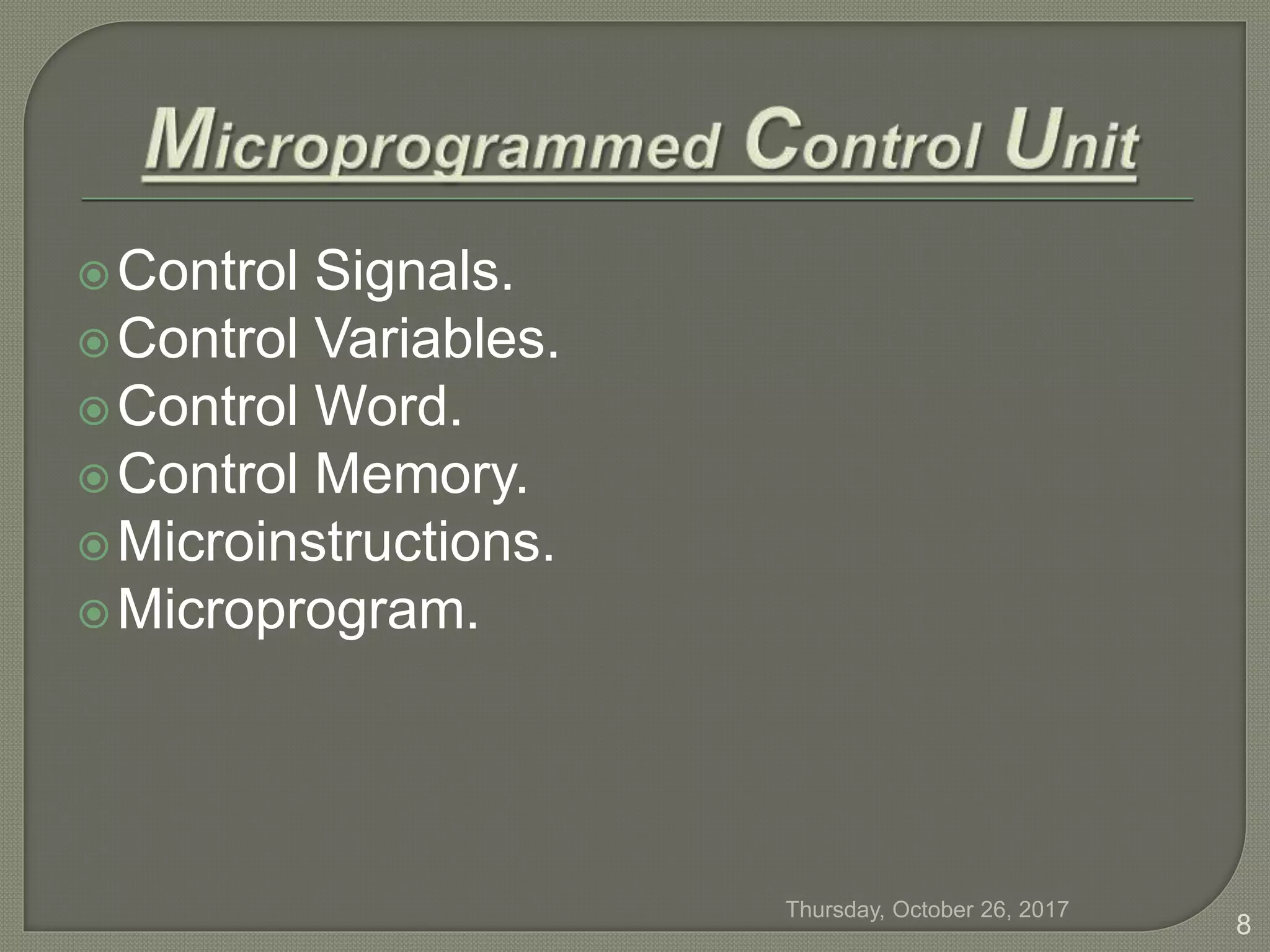
Control Signals.
Control Variables.
Control Word.
Control Memory.
Microinstructions.
Microprogram.
Thursday, October 26, 2017
8
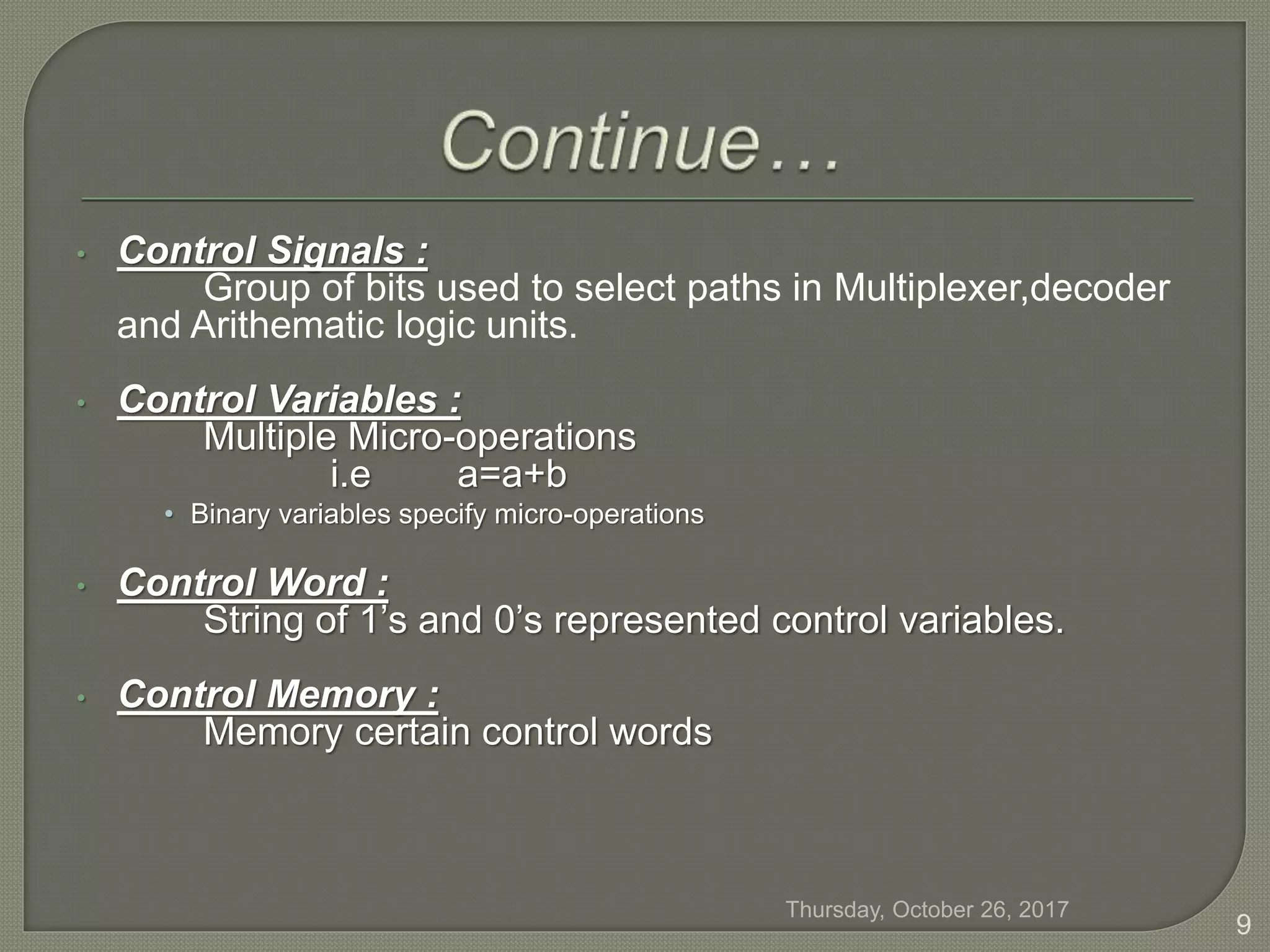
• Control Signals :
Group of bits used to select paths in Multiplexer,decoder
and Arithematic logic units.
• Control Variables :
Multiple Micro-operations
i.e a=a+b
• Binary variables specify micro-operations
• Control Word :
String of 1’s and 0’s represented control variables.
• Control Memory :
Memory certain control words
Thursday, October 26, 2017
9
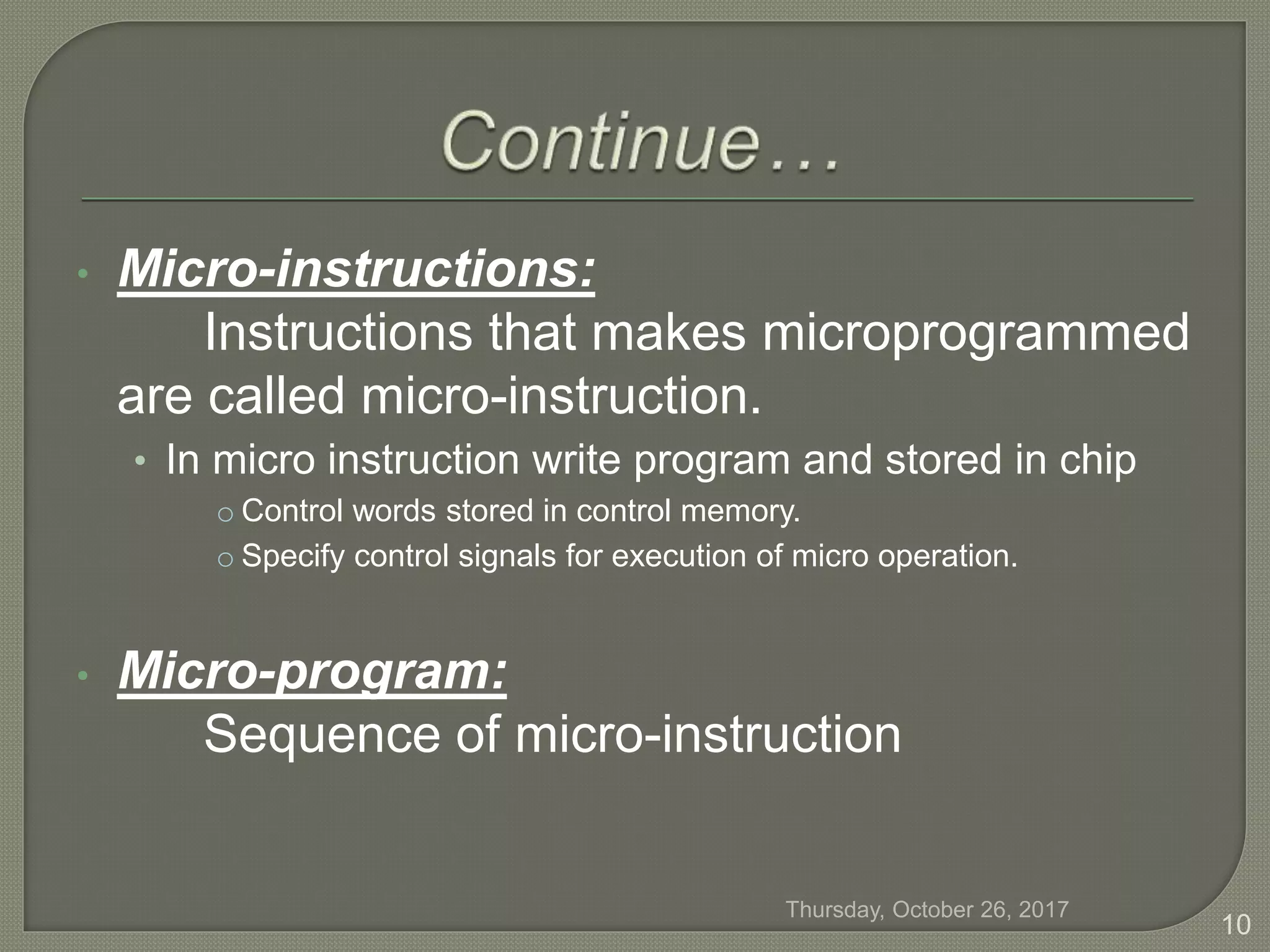
• Micro-instructions:
Instructions that makes microprogrammed
are called micro-instruction.
• In micro instruction write program and stored in chip
o Control words stored in control memory.
o Specify control signals for execution of micro operation.
• Micro-program:
Sequence of micro-instruction
Thursday, October 26, 2017
10
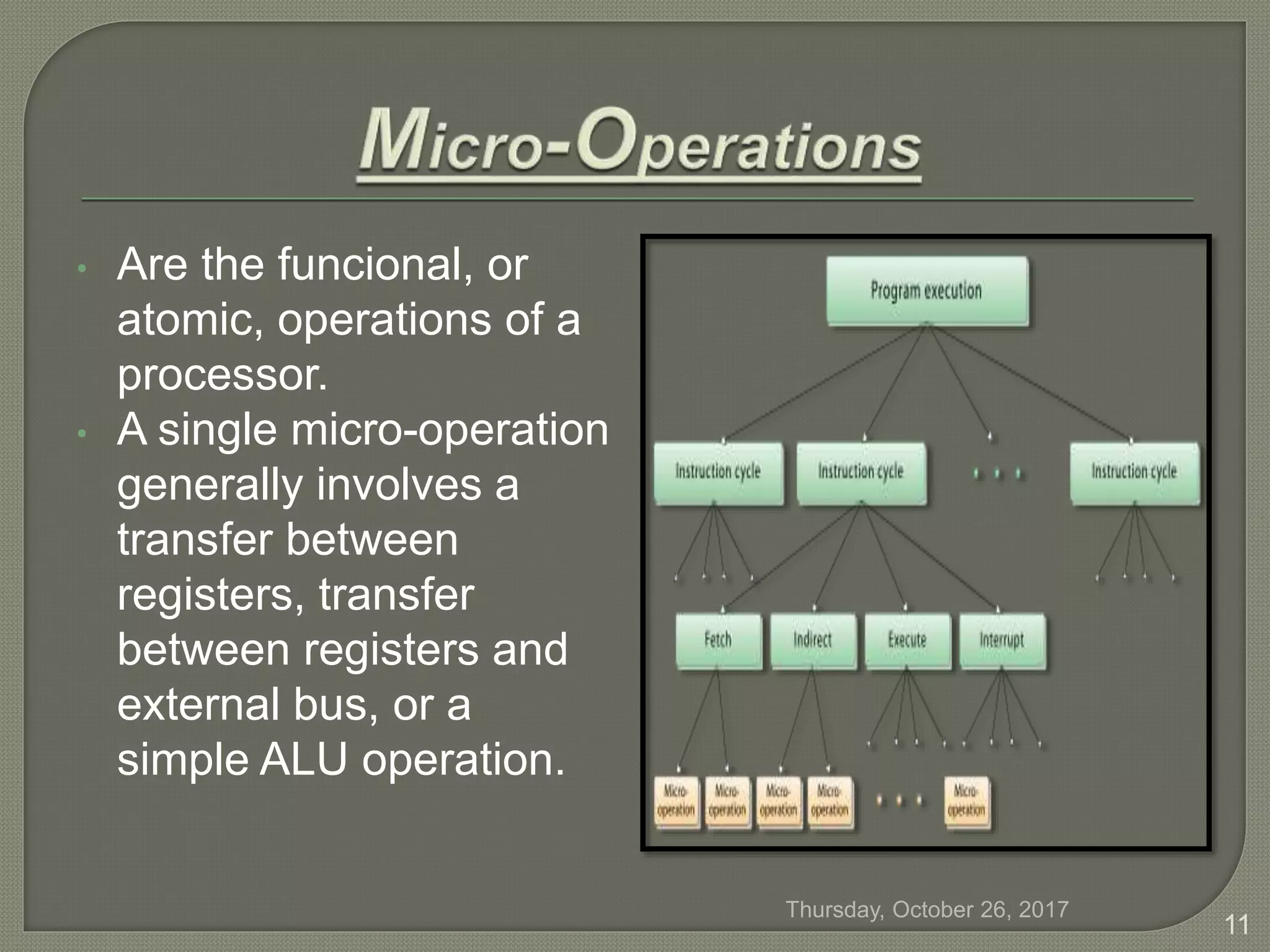
• Are the funcional, or
atomic, operations of a
processor.
• A single micro-operation
generally involves a
transfer between
registers, transfer
between registers and
external bus, or a
simple ALU operation.
Thursday, October 26, 2017
11
 Read-only memory (ROM)
 Content of word in ROM at given address specifies
microinstruction
 Each computer instruction initiates series of
microinstructions (micro program) in control memory
 These microinstructions generate micro operations to
• Fetch instruction from main memory
• Evaluate effective address
• Execute operation specified by instruction
• Return control to fetch phase for next instruction
Thursday, October 26, 2017
12
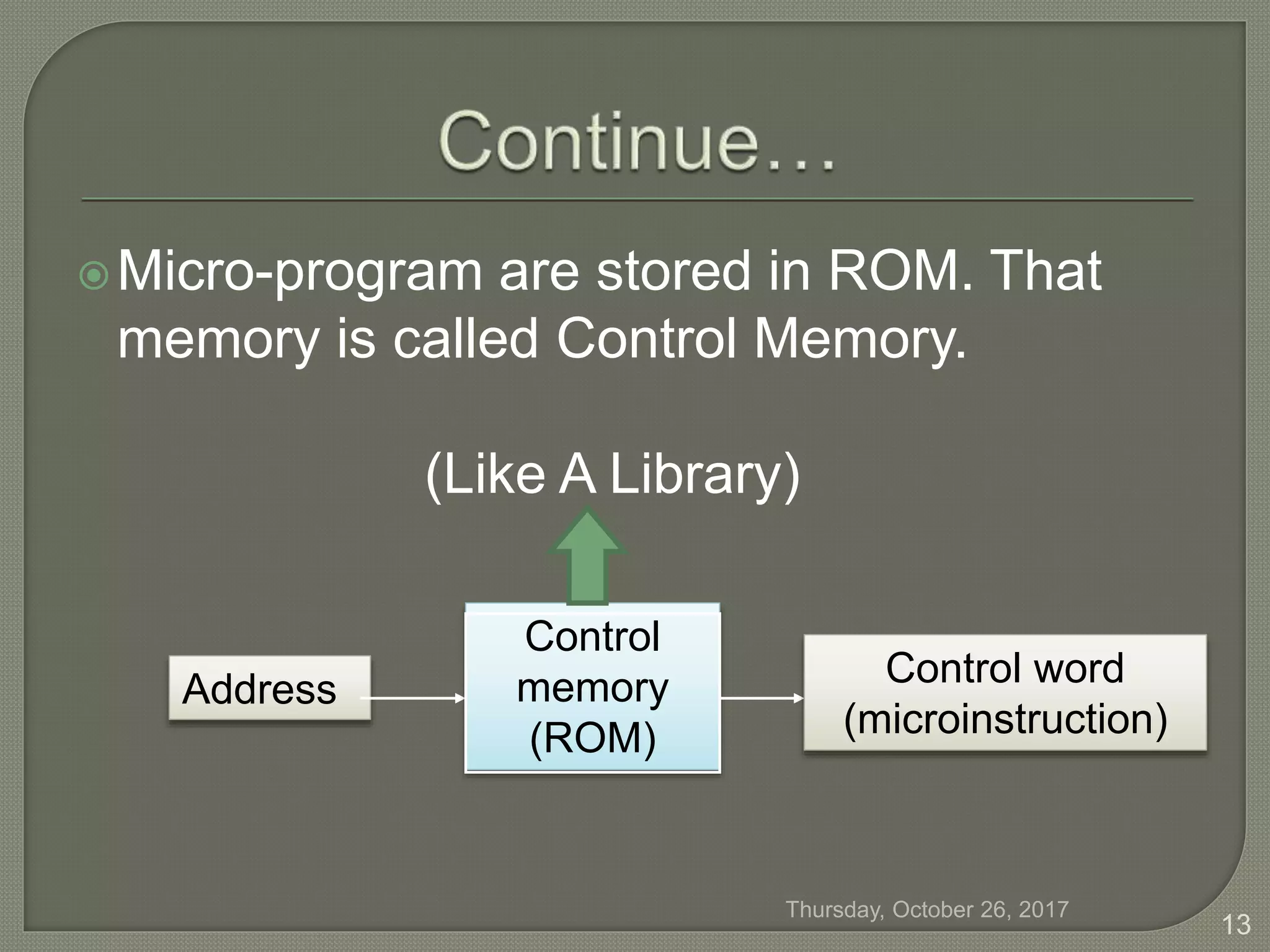
Micro-program are stored in ROM. That
memory is called Control Memory.
(Like A Library)
Address
Control
memory
(ROM)
Control word
(microinstruction)
Thursday, October 26, 2017
13
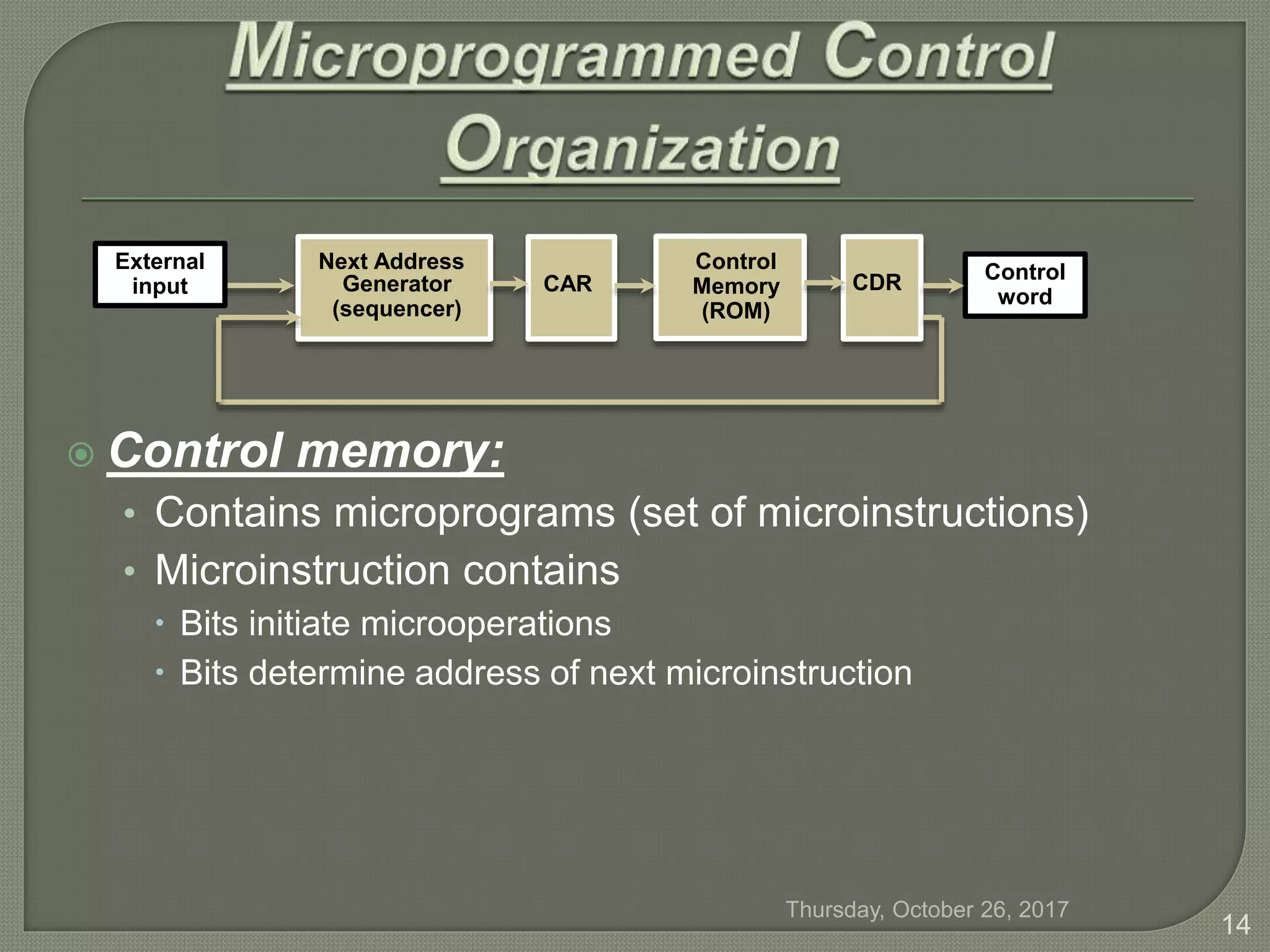
 Control memory:
• Contains microprograms (set of microinstructions)
• Microinstruction contains
 Bits initiate microoperations
 Bits determine address of next microinstruction
Control
word
Next Address
Generator
(sequencer)
CAR
Control
Memory
(ROM)
CDR
External
input
Thursday, October 26, 2017
14
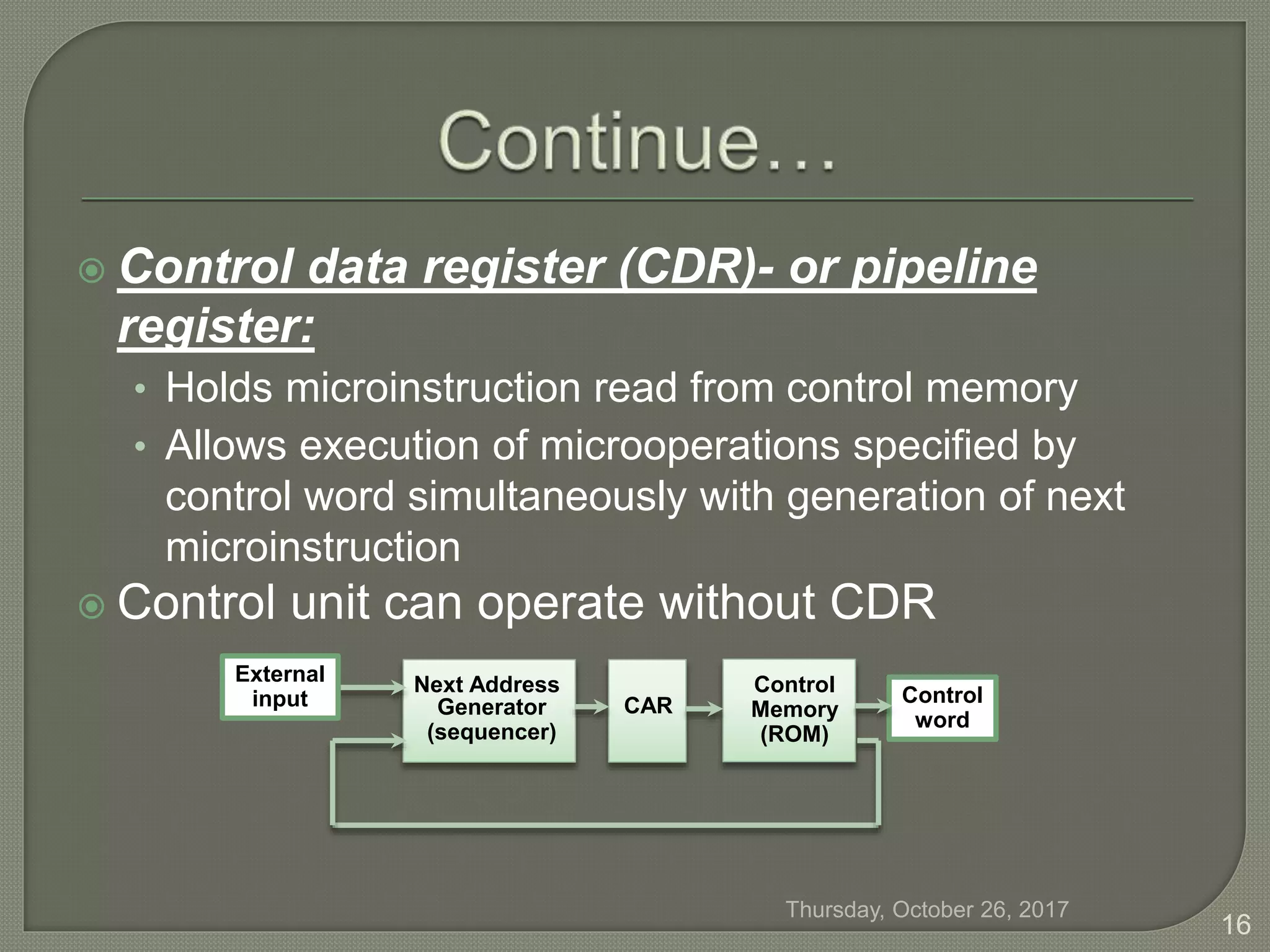
 Control address register (CAR) :
• Specifies address of next microinstruction
 Next address generator (microprogram
sequencer)
• Determines address sequence for control memory
 Microprogram sequencer functions
• Increment CAR by one
• Transfer external address into CAR
• Load initial address into CAR to start control
operations
Thursday, October 26, 2017
15
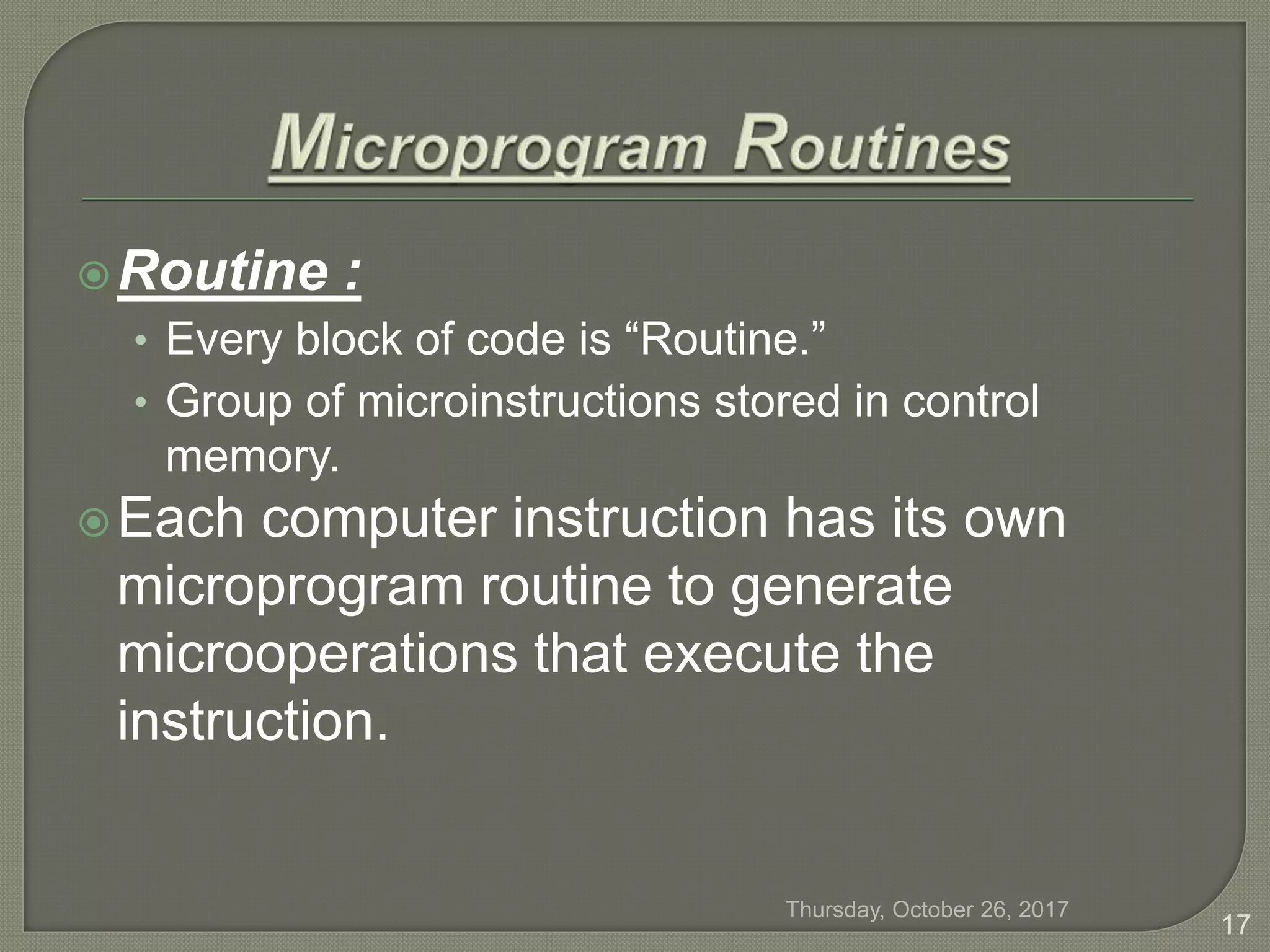
 Control data register (CDR)- or pipeline
register:
• Holds microinstruction read from control memory
• Allows execution of microoperations specified by
control word simultaneously with generation of next
microinstruction
 Control unit can operate without CDR
Control
word
Next Address
Generator
(sequencer)
CAR
Control
Memory
(ROM)
External
input
Thursday, October 26, 2017
16
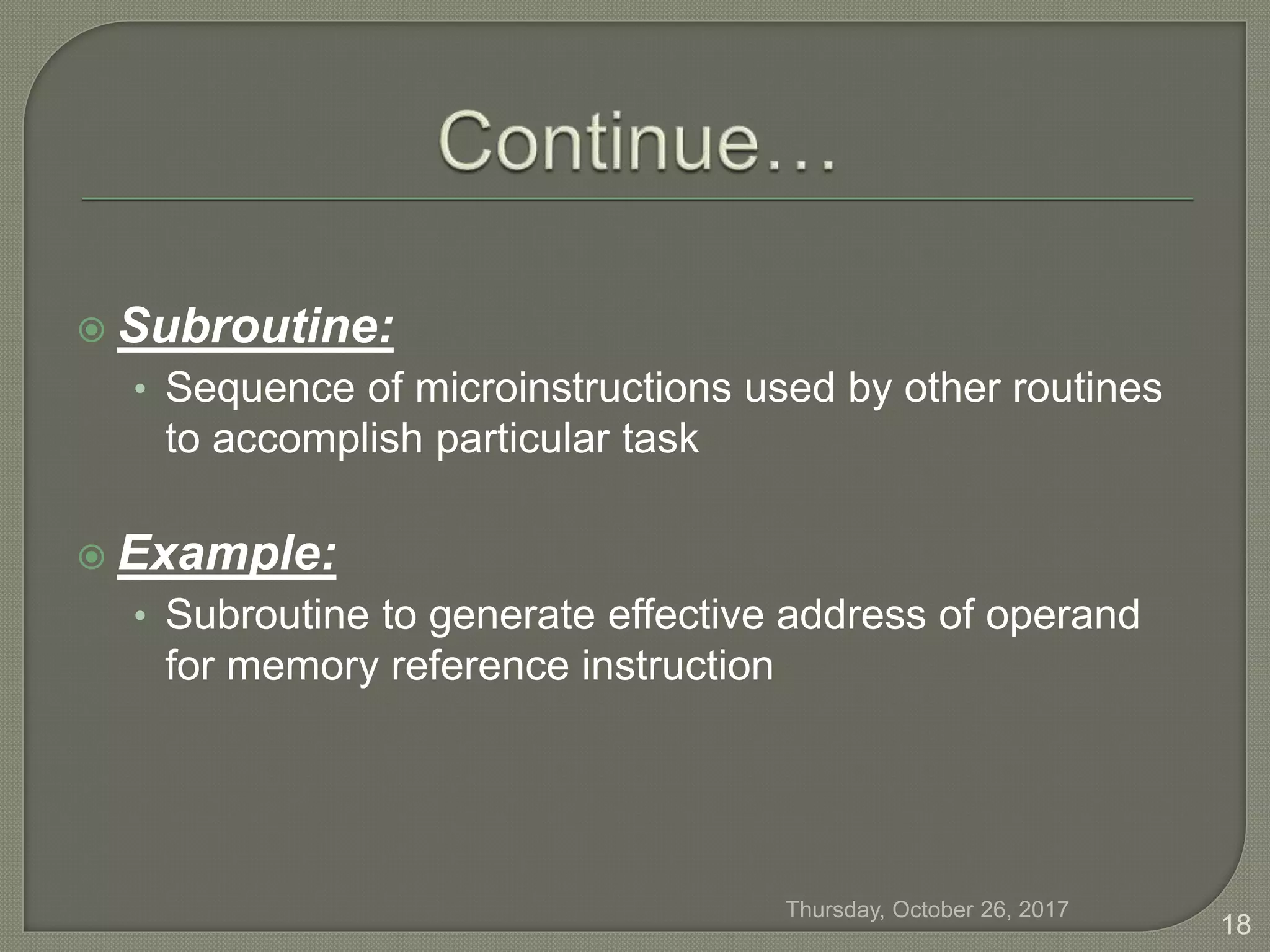
Routine :
• Every block of code is “Routine.”
• Group of microinstructions stored in control
memory.
Each computer instruction has its own
microprogram routine to generate
microoperations that execute the
instruction.
Thursday, October 26, 2017
17
 Subroutine:
• Sequence of microinstructions used by other routines
to accomplish particular task
 Example:
• Subroutine to generate effective address of operand
for memory reference instruction
Thursday, October 26, 2017
18
 Branching from one routine to another depends on
status bit conditions.
 Working on the base of condition.
e.g :
{ if a>50;
cout<<message;
----------
----------
----------
}
 Unconditional branch
• Fix value of status bit to 1
e.g :
Goto X;
Thursday, October 26, 2017
19
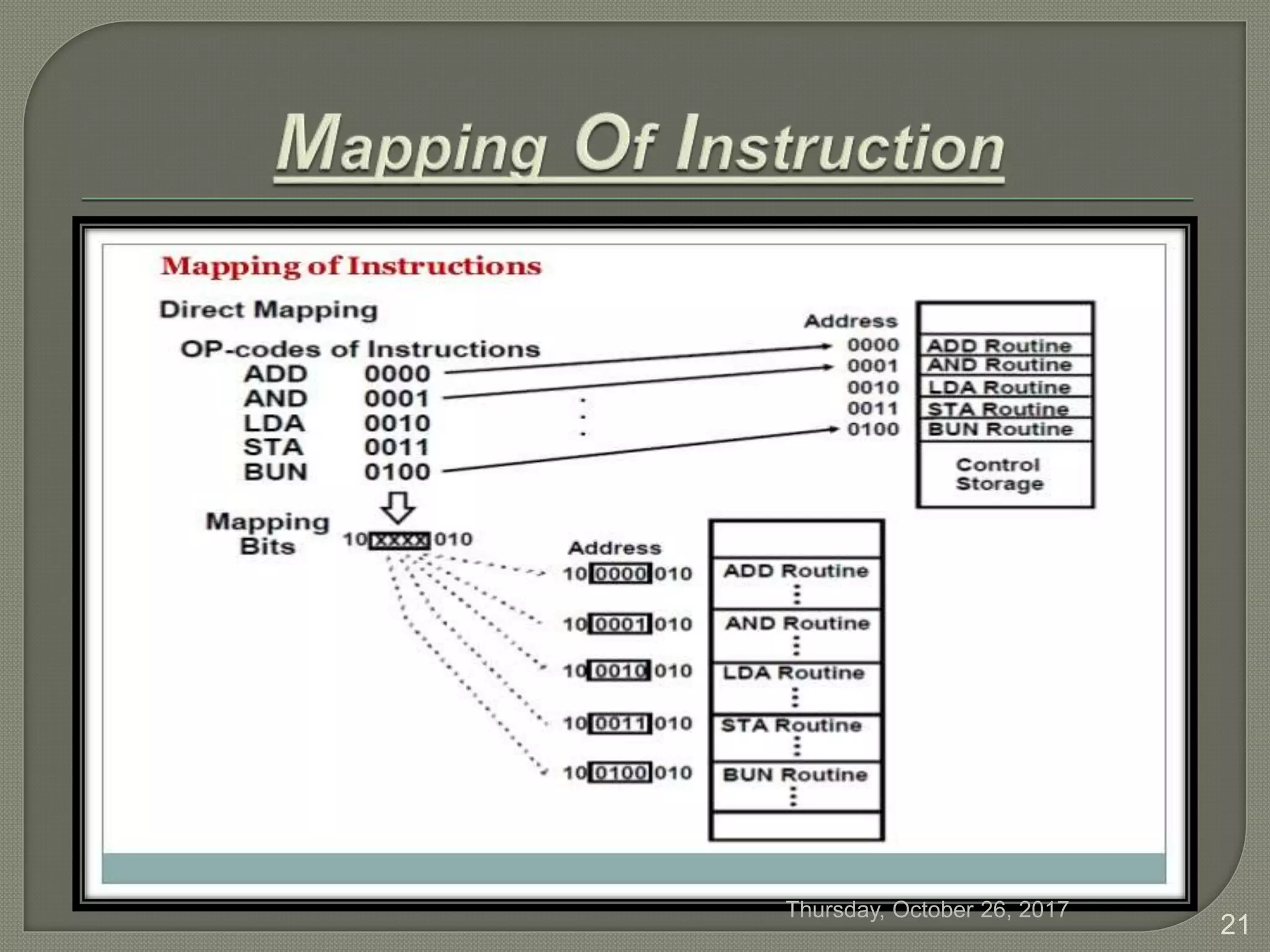
Each computer instruction has its own
microprogram routine stored in a given
location of the control memory
Mapping:
• Transformation from instruction code bits to
address in control memory where routine is
located
Thursday, October 26, 2017
20
Thursday, October 26, 2017
21
 Each routine must be able to branch to the next routine
in the sequence. An initial address is loaded into the
CAR when power is turned on; this is usually the
address of the first microinstruction in the instruction
fetch routine. Next, the control unit must determine the
effective address of the instruction.
 Address sequencing capabilities required in control
unit
• Incrementing CAR
• Unconditional or conditional branch, depending on status bit
conditions
• Mapping from bits of instruction to address for control memory
• Facility for subroutine call and return
Thursday, October 26, 2017
22
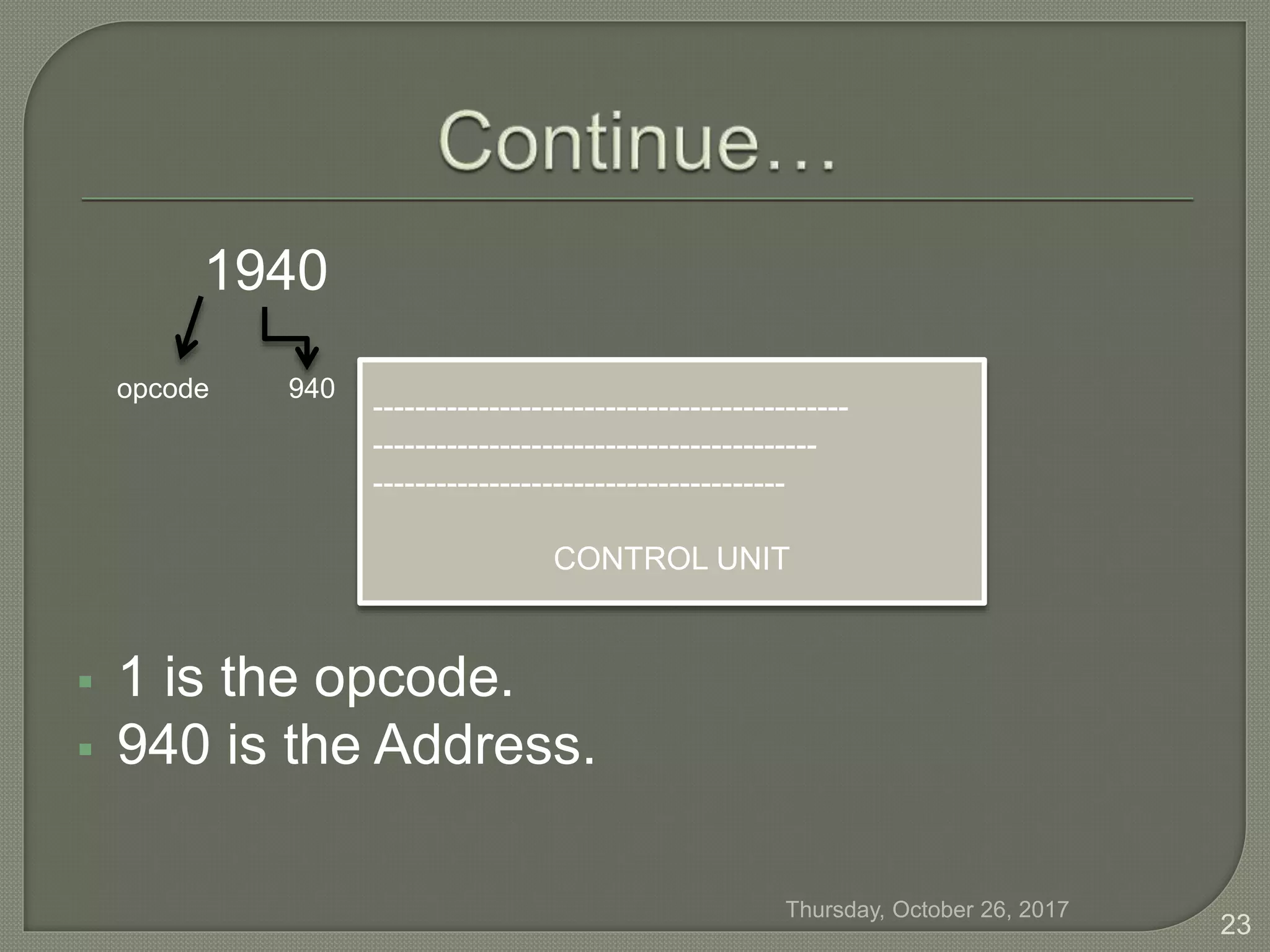
1940
opcode 940
 1 is the opcode.
 940 is the Address.
---------------------------------------------
------------------------------------------
---------------------------------------
CONTROL UNIT
Thursday, October 26, 2017
23
 Computer instruction format:
 Four computer instructions:
(EA is Effective Address)
I Opcode Address
15 14 11 10 0
ADD 0000 AC  AC + M[EA]
BRANCH 0001 if (AC < 0) then (PC  EA)
STORE 0010 M[EA]  AC
EXCHANGE 0011 AC  M[EA], M[EA]  AC
Symbol OP-code Description
Thursday, October 26, 2017
24
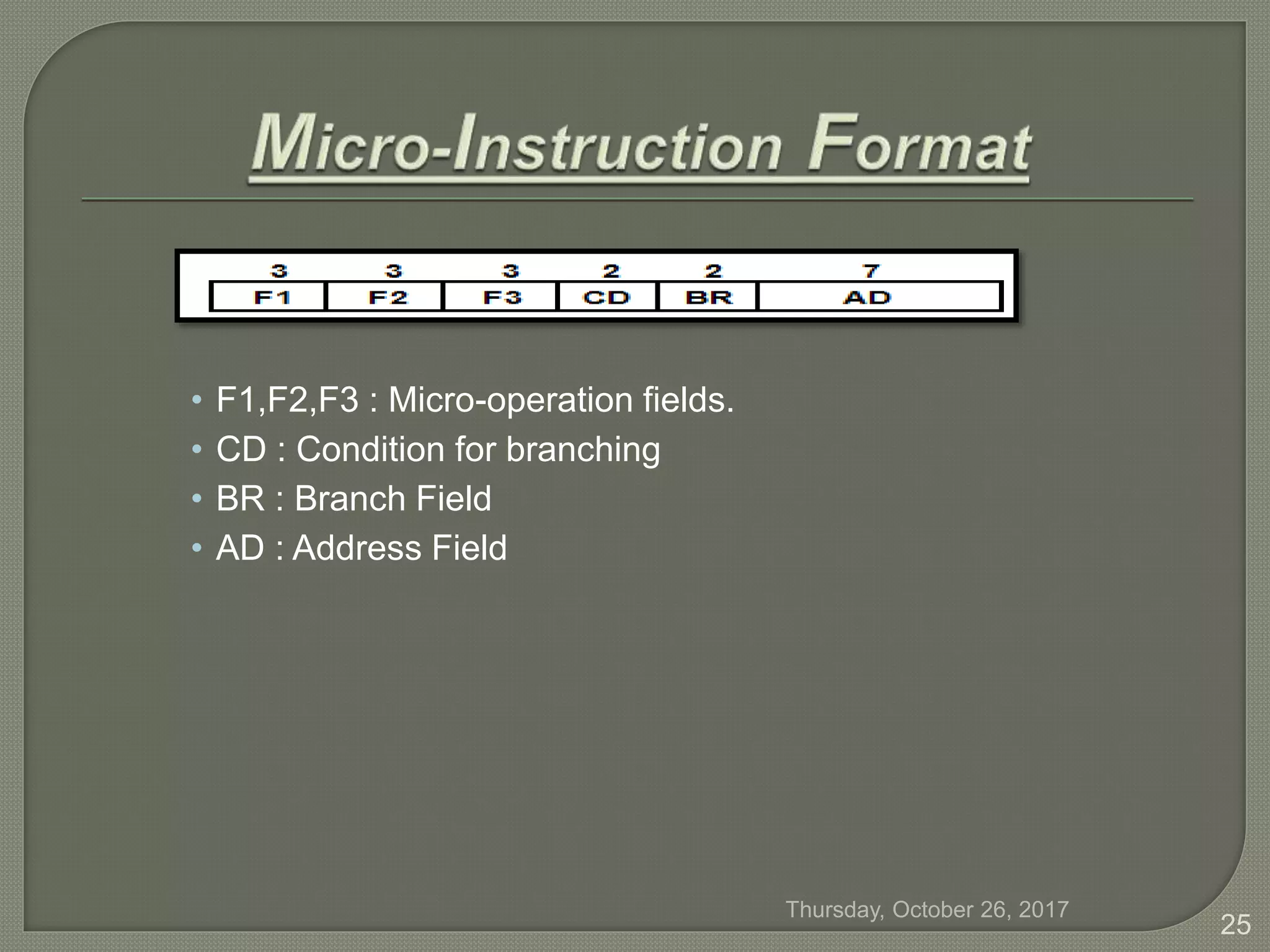
• F1,F2,F3 : Micro-operation fields.
• CD : Condition for branching
• BR : Branch Field
• AD : Address Field
Thursday, October 26, 2017
25
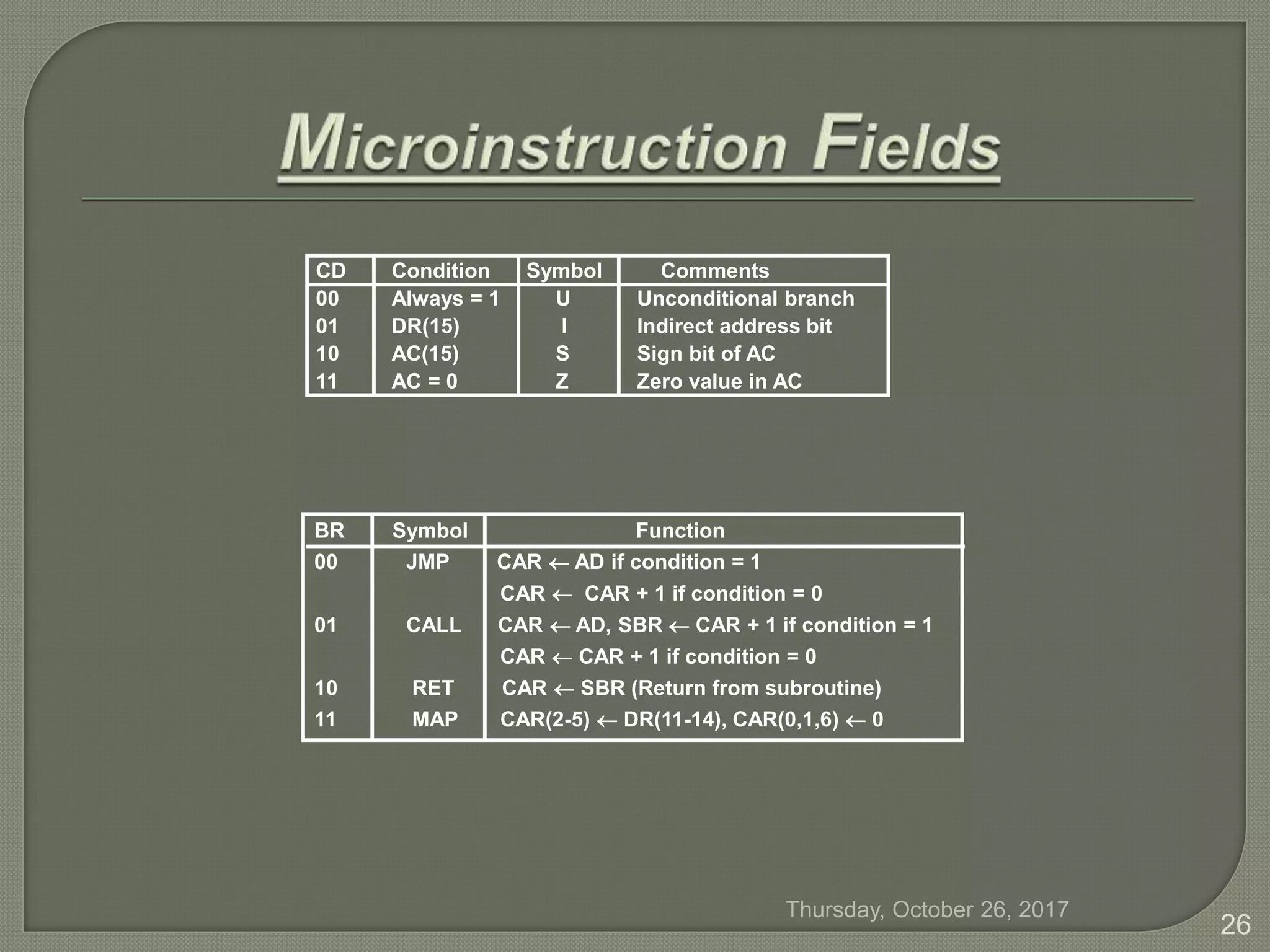
CD Condition Symbol Comments
00 Always = 1 U Unconditional branch
01 DR(15) I Indirect address bit
10 AC(15) S Sign bit of AC
11 AC = 0 Z Zero value in AC
BR Symbol Function
00 JMP CAR  AD if condition = 1
CAR  CAR + 1 if condition = 0
01 CALL CAR  AD, SBR  CAR + 1 if condition = 1
CAR  CAR + 1 if condition = 0
10 RET CAR  SBR (Return from subroutine)
11 MAP CAR(2-5)  DR(11-14), CAR(0,1,6)  0
Thursday, October 26, 2017
26
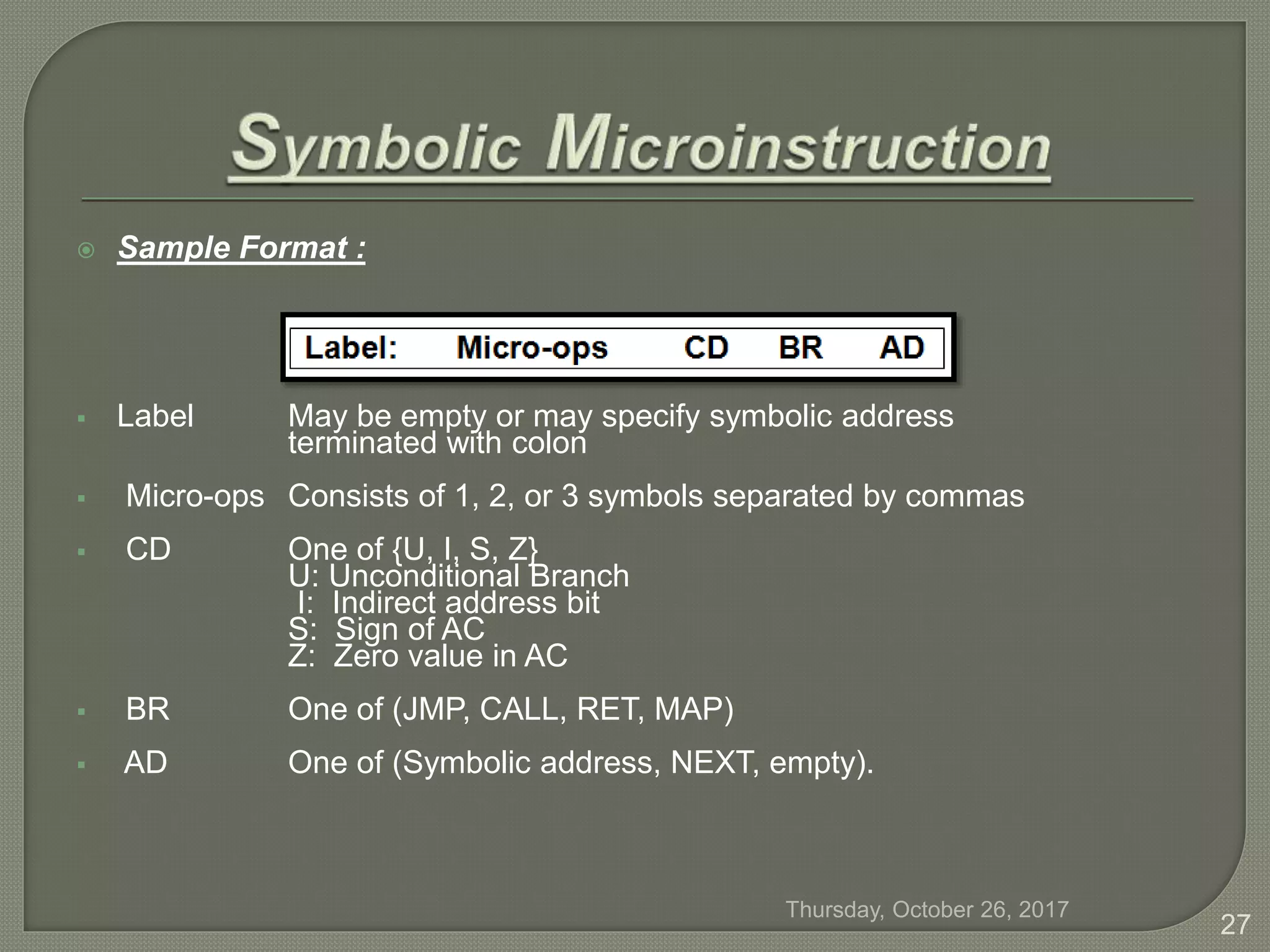
 Sample Format :
 Label May be empty or may specify symbolic address
terminated with colon
 Micro-ops Consists of 1, 2, or 3 symbols separated by commas
 CD One of {U, I, S, Z}
U: Unconditional Branch
I: Indirect address bit
S: Sign of AC
Z: Zero value in AC
 BR One of (JMP, CALL, RET, MAP)
 AD One of (Symbolic address, NEXT, empty).
Thursday, October 26, 2017
27
Thursday, October 26, 2017
28

MicroProgrammed Explained .

  • 1.
  • 2.
    GROUP MEMBERS : •MuhammadUmar (R1F15Bscs0015)
  • 3.
    • Hardwired • Microprogrammed Instructioncode Combinational Logic Circuits Memory Sequence Counter . . Control signals Control signals Next Address Generator (sequencer) CAR Control Memory CDR Decodin g Circuit Memory . . CAR: Control Address Register CDR: Control Data RegisterInstruction code Thursday, October 26, 2017 3
  • 4.
    Control Unit : Thecontrol unit (CU) is a component of a computer's central processing unit (CPU) that directs the operation of the processor. It tells the computer's memory, arithmetic/logic unit and input and output devices on how to respond to a program's instructions. Thursday, October 26, 2017 4
  • 5.
    Hardwire : Hardwire controlis a control mechanism that generates control signals by using an appropriate Finite State Machine (FSM). Actually we sort it on circuit. The disadvantage is that wrong wiring waste waste the whole circuit and time . Thursday, October 26, 2017 5
  • 6.
    Microprogrammed : Microprogrammed controlis a control mechanism that generates control signals by reading a memory called a Control Storage (CS) that certain control signals. It’s like a chips or bio’s and digital clock watch (Masjid) is a chiped microprogrammed. Flexibility (change time etc )… Thursday, October 26, 2017 6
  • 7.
    HARDWIRED CONTROL UNIT MICROPROGRAMMED CONTROL UNIT 1)Speed is fast. 2) More costlier. 3) Occurrence of error is more. 4) Control functions implemented in hardware 5) Not flexible to accommodate new system specification or new instruction redesign is required. 6) Difficult to handle complex instruction sets. 7) Complicated design process. 8) Complex decoding and sequencing logic. 9) More chip area. 10) Application: Mostly RISC microprocessor. 1) Speed is slow. 2) Cheaper. 3) Occurrence of error is less. 4) Control functions implemented in software 5) More flexible to accommodate new system specification or new instructions 6) Easier to handle complex instruction sets 7) Orderly, systematic and simple design process. 8) Easier decoding and sequencing logic 9) Less chip area. 10) Application: Mainframes some microprocessors Thursday, October 26, 2017 7
  • 8.
    Control Signals. Control Variables. ControlWord. Control Memory. Microinstructions. Microprogram. Thursday, October 26, 2017 8
  • 9.
    • Control Signals: Group of bits used to select paths in Multiplexer,decoder and Arithematic logic units. • Control Variables : Multiple Micro-operations i.e a=a+b • Binary variables specify micro-operations • Control Word : String of 1’s and 0’s represented control variables. • Control Memory : Memory certain control words Thursday, October 26, 2017 9
  • 10.
    • Micro-instructions: Instructions thatmakes microprogrammed are called micro-instruction. • In micro instruction write program and stored in chip o Control words stored in control memory. o Specify control signals for execution of micro operation. • Micro-program: Sequence of micro-instruction Thursday, October 26, 2017 10
  • 11.
    • Are thefuncional, or atomic, operations of a processor. • A single micro-operation generally involves a transfer between registers, transfer between registers and external bus, or a simple ALU operation. Thursday, October 26, 2017 11
  • 12.
     Read-only memory(ROM)  Content of word in ROM at given address specifies microinstruction  Each computer instruction initiates series of microinstructions (micro program) in control memory  These microinstructions generate micro operations to • Fetch instruction from main memory • Evaluate effective address • Execute operation specified by instruction • Return control to fetch phase for next instruction Thursday, October 26, 2017 12
  • 13.
    Micro-program are storedin ROM. That memory is called Control Memory. (Like A Library) Address Control memory (ROM) Control word (microinstruction) Thursday, October 26, 2017 13
  • 14.
     Control memory: •Contains microprograms (set of microinstructions) • Microinstruction contains  Bits initiate microoperations  Bits determine address of next microinstruction Control word Next Address Generator (sequencer) CAR Control Memory (ROM) CDR External input Thursday, October 26, 2017 14
  • 15.
     Control addressregister (CAR) : • Specifies address of next microinstruction  Next address generator (microprogram sequencer) • Determines address sequence for control memory  Microprogram sequencer functions • Increment CAR by one • Transfer external address into CAR • Load initial address into CAR to start control operations Thursday, October 26, 2017 15
  • 16.
     Control dataregister (CDR)- or pipeline register: • Holds microinstruction read from control memory • Allows execution of microoperations specified by control word simultaneously with generation of next microinstruction  Control unit can operate without CDR Control word Next Address Generator (sequencer) CAR Control Memory (ROM) External input Thursday, October 26, 2017 16
  • 17.
    Routine : • Everyblock of code is “Routine.” • Group of microinstructions stored in control memory. Each computer instruction has its own microprogram routine to generate microoperations that execute the instruction. Thursday, October 26, 2017 17
  • 18.
     Subroutine: • Sequenceof microinstructions used by other routines to accomplish particular task  Example: • Subroutine to generate effective address of operand for memory reference instruction Thursday, October 26, 2017 18
  • 19.
     Branching fromone routine to another depends on status bit conditions.  Working on the base of condition. e.g : { if a>50; cout<<message; ---------- ---------- ---------- }  Unconditional branch • Fix value of status bit to 1 e.g : Goto X; Thursday, October 26, 2017 19
  • 20.
    Each computer instructionhas its own microprogram routine stored in a given location of the control memory Mapping: • Transformation from instruction code bits to address in control memory where routine is located Thursday, October 26, 2017 20
  • 21.
  • 22.
     Each routinemust be able to branch to the next routine in the sequence. An initial address is loaded into the CAR when power is turned on; this is usually the address of the first microinstruction in the instruction fetch routine. Next, the control unit must determine the effective address of the instruction.  Address sequencing capabilities required in control unit • Incrementing CAR • Unconditional or conditional branch, depending on status bit conditions • Mapping from bits of instruction to address for control memory • Facility for subroutine call and return Thursday, October 26, 2017 22
  • 23.
    1940 opcode 940  1is the opcode.  940 is the Address. --------------------------------------------- ------------------------------------------ --------------------------------------- CONTROL UNIT Thursday, October 26, 2017 23
  • 24.
     Computer instructionformat:  Four computer instructions: (EA is Effective Address) I Opcode Address 15 14 11 10 0 ADD 0000 AC  AC + M[EA] BRANCH 0001 if (AC < 0) then (PC  EA) STORE 0010 M[EA]  AC EXCHANGE 0011 AC  M[EA], M[EA]  AC Symbol OP-code Description Thursday, October 26, 2017 24
  • 25.
    • F1,F2,F3 :Micro-operation fields. • CD : Condition for branching • BR : Branch Field • AD : Address Field Thursday, October 26, 2017 25
  • 26.
    CD Condition SymbolComments 00 Always = 1 U Unconditional branch 01 DR(15) I Indirect address bit 10 AC(15) S Sign bit of AC 11 AC = 0 Z Zero value in AC BR Symbol Function 00 JMP CAR  AD if condition = 1 CAR  CAR + 1 if condition = 0 01 CALL CAR  AD, SBR  CAR + 1 if condition = 1 CAR  CAR + 1 if condition = 0 10 RET CAR  SBR (Return from subroutine) 11 MAP CAR(2-5)  DR(11-14), CAR(0,1,6)  0 Thursday, October 26, 2017 26
  • 27.
     Sample Format:  Label May be empty or may specify symbolic address terminated with colon  Micro-ops Consists of 1, 2, or 3 symbols separated by commas  CD One of {U, I, S, Z} U: Unconditional Branch I: Indirect address bit S: Sign of AC Z: Zero value in AC  BR One of (JMP, CALL, RET, MAP)  AD One of (Symbolic address, NEXT, empty). Thursday, October 26, 2017 27
  • 28.