Chapter 16
Control Unit Implemntation
A Basic Computer Model
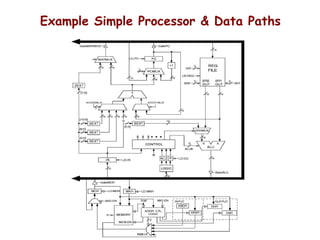
Example Simple Processor & Data Paths
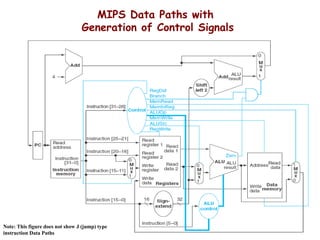
MIPS Data Paths with
Generation of Control Signals
Note: This figure does not show J (jump) type
instruction Data Paths
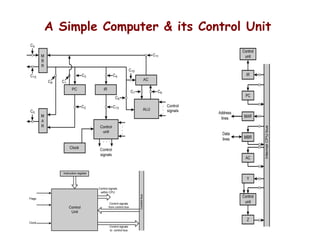
A Simple Computer & its Control Unit
Control Signal Sources
• Clock
— One micro-instruction (or set of parallel micro-instructions)
per clock cycle
• Instruction Register
— Op-code for current instruction
— Determines which micro-instructions are performed
• Flags
— State of CPU
— Results of previous operations
• From Control Bus
— Interrupts / Bus Requests
— Acknowledgements
Control Signals Outputs
• Within CPU
—Cause data movement
—Activate specific functions
• Via Main Bus
—To memory
—To I/O modules
Control Signals
The Internal Bus ?
Example Simple Processor & Data Paths
State Machine for Example Simple Processor
http://highered.mcgraw-hill.com/sites/dl/premium/0072467509/instructor/104653/figurec9.xls
Control Unit with Decoded Inputs
MIPS Instruction Formats
MIPS Data Paths with
Generation of Control Signals
Note: This figure does not show J (jump) type
instruction Data Paths
MIPs Pipelined Machine with Controls
IF | ID | EX | MEM | WB
(64 bits)
(142 bits)
(107 bits)
(71 bits)
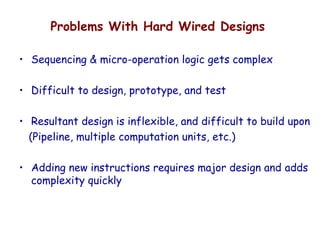
Problems With Hard Wired Designs
• Sequencing & micro-operation logic gets complex
• Difficult to design, prototype, and test
• Resultant design is inflexible, and difficult to build upon
(Pipeline, multiple computation units, etc.)
• Adding new instructions requires major design and adds
complexity quickly
Chapter 17
Micro-Programmed Control
Example Simple Processor Micro-Programed Control
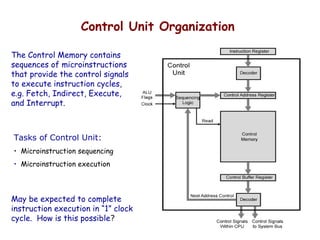
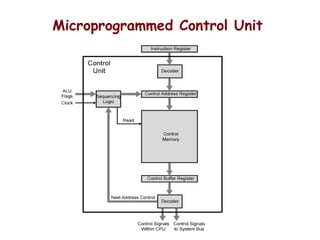
Control Unit Organization
Tasks of Control Unit:
• Microinstruction sequencing
• Microinstruction execution
The Control Memory contains
sequences of microinstructions
that provide the control signals
to execute instruction cycles,
e.g. Fetch, Indirect, Execute,
and Interrupt.
May be expected to complete
instruction execution in “1” clock
cycle. How is this possible?
Recall: Micro-sequencing
Example of Control Memory Organization
Microinstructions:
• Generate Control Signals
• Provide Branching
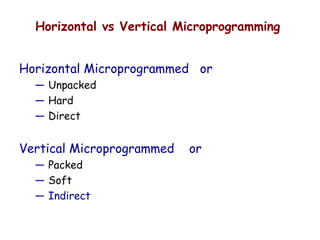
Horizontal vs Vertical Microprogramming
Horizontal Microprogrammed or
— Unpacked
— Hard
— Direct
Vertical Microprogrammed or
— Packed
— Soft
— Indirect
Microinstruction Encoding - Direct Encoding
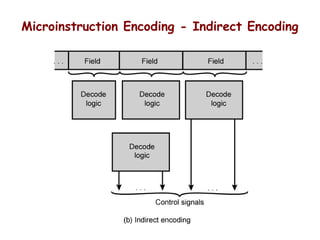
Microinstruction Encoding - Indirect Encoding
Horizontal Micro-programming
• Wide control memory word
• High degree of parallel operations possible
• Little encoding of control information
• Faster
Vertical Micro-programming
• Width can be much narrower
• Control signals encoded into function codes –
need to be decoded
• More complex, more complicated to program,
less flexibility
• More difficult to modify
• Slower
Typical Microinstruction Formats
Example Microprogramming Formats
• MicroProgram Counter
• Subroutines
• Stack
• Control Register (MicroProgram Format)
Next Address Decision
• Depending on ALU flags and control buffer register:
— Get next instruction
– Add 1 to control address register
— Jump to new routine based on jump microinstruction
– Load address field of control buffer register into control address
register
— Jump to machine instruction routine
– Load control address register based on opcode in IR
Microprogrammed Control Unit
Design Considerations
• Necessity of speed
• Size of Microinstructions
• Address generation
—Branches
– Both conditional and unconditional
– Based on current microinstruction, condition flags,
contents of IR
– Based on format of address information
+ Two address fields
+ Single address field
+ Variable format
Branch Control: Two Address Fields
Branch based upon:
• Instruction Opcode
• Address 1
• Address 2
Does require a wide
microinstruction, but no
address calculation is needed
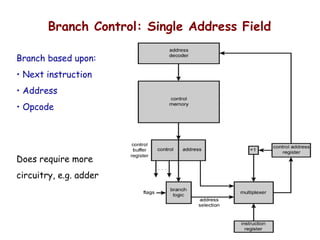
Branch Control: Single Address Field
Branch based upon:
• Next instruction
• Address
• Opcode
Does require more
circuitry, e.g. adder
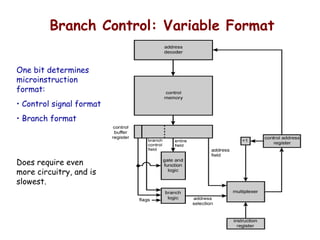
Branch Control: Variable Format
One bit determines
microinstruction
format:
• Control signal format
• Branch format
Does require even
more circuitry, and is
slowest.
Advantages and Disadvantages of
Microprogramming
Advantage:
• Simplifies design of control unit
— Cheaper to design
— Less error-prone
— Much easier to modify
— Supports having multiple versions / models
Disadvantage:
• Slower
• More expensive to produce in quantities

15 control-computer organization and archietecture-CO-COA

  • 1.
  • 2.
  • 3.
  • 4.
    MIPS Data Pathswith Generation of Control Signals Note: This figure does not show J (jump) type instruction Data Paths
  • 5.
    A Simple Computer& its Control Unit
  • 6.
    Control Signal Sources •Clock — One micro-instruction (or set of parallel micro-instructions) per clock cycle • Instruction Register — Op-code for current instruction — Determines which micro-instructions are performed • Flags — State of CPU — Results of previous operations • From Control Bus — Interrupts / Bus Requests — Acknowledgements
  • 7.
    Control Signals Outputs •Within CPU —Cause data movement —Activate specific functions • Via Main Bus —To memory —To I/O modules
  • 8.
  • 9.
  • 10.
  • 11.
  • 12.
    State Machine forExample Simple Processor http://highered.mcgraw-hill.com/sites/dl/premium/0072467509/instructor/104653/figurec9.xls
  • 13.
    Control Unit withDecoded Inputs
  • 14.
  • 15.
    MIPS Data Pathswith Generation of Control Signals Note: This figure does not show J (jump) type instruction Data Paths
  • 16.
    MIPs Pipelined Machinewith Controls IF | ID | EX | MEM | WB (64 bits) (142 bits) (107 bits) (71 bits)
  • 17.
    Problems With HardWired Designs • Sequencing & micro-operation logic gets complex • Difficult to design, prototype, and test • Resultant design is inflexible, and difficult to build upon (Pipeline, multiple computation units, etc.) • Adding new instructions requires major design and adds complexity quickly
  • 18.
  • 19.
    Example Simple ProcessorMicro-Programed Control
  • 20.
    Control Unit Organization Tasksof Control Unit: • Microinstruction sequencing • Microinstruction execution The Control Memory contains sequences of microinstructions that provide the control signals to execute instruction cycles, e.g. Fetch, Indirect, Execute, and Interrupt. May be expected to complete instruction execution in “1” clock cycle. How is this possible?
  • 21.
  • 22.
    Example of ControlMemory Organization Microinstructions: • Generate Control Signals • Provide Branching
  • 23.
    Horizontal vs VerticalMicroprogramming Horizontal Microprogrammed or — Unpacked — Hard — Direct Vertical Microprogrammed or — Packed — Soft — Indirect
  • 24.
  • 25.
    Microinstruction Encoding -Indirect Encoding
  • 26.
    Horizontal Micro-programming • Widecontrol memory word • High degree of parallel operations possible • Little encoding of control information • Faster
  • 27.
    Vertical Micro-programming • Widthcan be much narrower • Control signals encoded into function codes – need to be decoded • More complex, more complicated to program, less flexibility • More difficult to modify • Slower
  • 28.
  • 29.
    Example Microprogramming Formats •MicroProgram Counter • Subroutines • Stack • Control Register (MicroProgram Format)
  • 30.
    Next Address Decision •Depending on ALU flags and control buffer register: — Get next instruction – Add 1 to control address register — Jump to new routine based on jump microinstruction – Load address field of control buffer register into control address register — Jump to machine instruction routine – Load control address register based on opcode in IR
  • 31.
  • 32.
    Design Considerations • Necessityof speed • Size of Microinstructions • Address generation —Branches – Both conditional and unconditional – Based on current microinstruction, condition flags, contents of IR – Based on format of address information + Two address fields + Single address field + Variable format
  • 33.
    Branch Control: TwoAddress Fields Branch based upon: • Instruction Opcode • Address 1 • Address 2 Does require a wide microinstruction, but no address calculation is needed
  • 34.
    Branch Control: SingleAddress Field Branch based upon: • Next instruction • Address • Opcode Does require more circuitry, e.g. adder
  • 35.
    Branch Control: VariableFormat One bit determines microinstruction format: • Control signal format • Branch format Does require even more circuitry, and is slowest.
  • 36.
    Advantages and Disadvantagesof Microprogramming Advantage: • Simplifies design of control unit — Cheaper to design — Less error-prone — Much easier to modify — Supports having multiple versions / models Disadvantage: • Slower • More expensive to produce in quantities