MICROMERITICS
Binamra Rai
M. Pharm. (Industrial Pharmacy)
Kathmandu University
INTRODUCTION
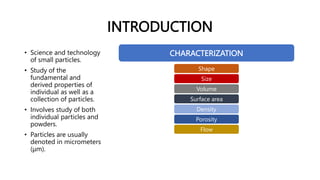
• Science and technology
of small particles.
• Study of the
fundamental and
derived properties of
individual as well as a
collection of particles.
• Involves study of both
individual particles and
powders.
• Particles are usually
denoted in micrometers
(μm).
CHARACTERIZATION
Shape
Size
Volume
Surface area
Density
Porosity
Flow
SIZE & SIZE DISTRIBUTION
• Size and size distribution are important in pharmacy.
• Size distribution states the range of particle size present in a given powder.
• Not all particles are of the same size and shape.
• Related to physical, chemical, and pharmacological properties of dosage
form.
• Affects release of API from dosage form.
• Other formulation processes such as mixing and filling due to powder flow
are also affected.
SIZE & SIZE DISTRIBUTION
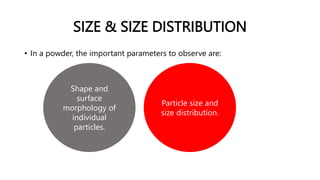
• In a powder, the important parameters to observe are:
Shape and
surface
morphology of
individual
particles.
Particle size and
size distribution.
SIZE & SIZE DISTRIBUTION
• Pharmaceutical powders and granules are usually
polydisperse.
• Size and size distribution determination is a key QC
component.
• Importance:
a) Proper mixing
b) Proper coating formulations
c) To avoid irritation
Particle size
and size
distribution.
SIZE & SIZE DISTRIBUTION
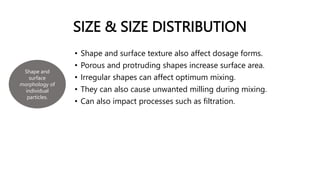
• Shape and surface texture also affect dosage forms.
• Porous and protruding shapes increase surface area.
• Irregular shapes can affect optimum mixing.
• They can also cause unwanted milling during mixing.
• Can also impact processes such as filtration.
Shape and
surface
morphology of
individual
particles.
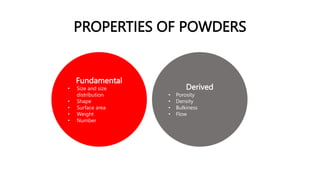
PROPERTIES OF POWDERS
Derived
• Porosity
• Density
• Bulkiness
• Flow
Fundamental
• Size and size
distribution
• Shape
• Surface area
• Weight
• Number
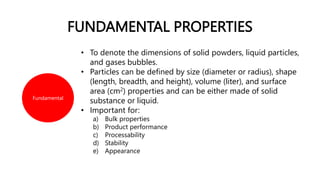
FUNDAMENTAL PROPERTIES
Fundamental
• To denote the dimensions of solid powders, liquid particles,
and gases bubbles.
• Particles can be defined by size (diameter or radius), shape
(length, breadth, and height), volume (liter), and surface
area (cm2) properties and can be either made of solid
substance or liquid.
• Important for:
a) Bulk properties
b) Product performance
c) Processability
d) Stability
e) Appearance
FUNDAMENTAL PROPERTIES
Fundamental
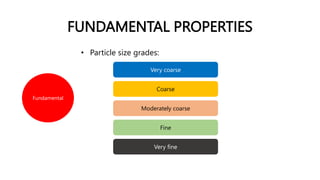
• Particle size grades:
Very coarse
Coarse
Moderately coarse
Fine
Very fine
FUNDAMENTAL PROPERTIES
Fundamental
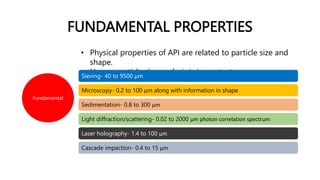
• Physical properties of API are related to particle size and
shape.
• Hence, particle size analysis is important.
Sieving- 40 to 9500 μm
Microscopy- 0.2 to 100 μm along with information in shape
Sedimentation- 0.8 to 300 μm
Light diffraction/scattering- 0.02 to 2000 μm photon correlation spectrum
Laser holography- 1.4 to 100 μm
Cascade impaction- 0.4 to 15 μm
SIZE DETERMINATION METHODS
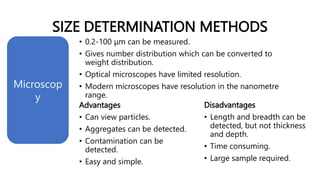
• 0.2-100 μm can be measured.
• Gives number distribution which can be converted to
weight distribution.
• Optical microscopes have limited resolution.
• Modern microscopes have resolution in the nanometre
range.
Microscop
y
Advantages
• Can view particles.
• Aggregates can be detected.
• Contamination can be
detected.
• Easy and simple.
Disadvantages
• Length and breadth can be
detected, but not thickness
and depth.
• Time consuming.
• Large sample required.
SIZE DETERMINATION METHODS
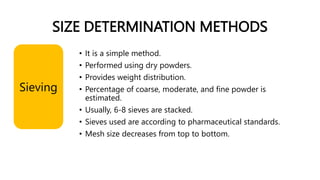
• It is a simple method.
• Performed using dry powders.
• Provides weight distribution.
• Percentage of coarse, moderate, and fine powder is
estimated.
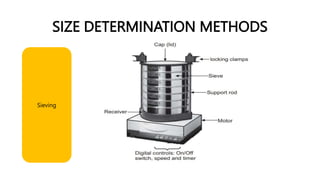
• Usually, 6-8 sieves are stacked.
• Sieves used are according to pharmaceutical standards.
• Mesh size decreases from top to bottom.
Sieving
SIZE DETERMINATION METHODS
Sieving
SIZE DETERMINATION METHODS
Sievin
g
Advantages
• Inexpensive.
• Reproducible.
• Quick.
Disadvantages
• Lower limit is 50 μm.
• Moist powder can clog
aperture.
• Attrition among particles
during shaking can cause
milling and lead to erroneous
data.
SIZE DETERMINATION METHODS
Sedimentatio
n
• Examined as powder particles as they sediment.
• Powder is dispersed in suitable solvent.
• If powder is hydrophobic, dispersing agent is required to
wet the powder.
• If powder is water-soluble, non-aqueous liquids or gas is
used.
SIZE DETERMINATION METHODS
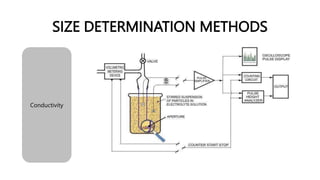
Conductivity
• Two types:
a) Electrical stream sensing zone method (Coulter counter)
b) Laser light scattering method
• Principle- change in light intensity.
• Measurement of light intensity change gives particle size
estimate.
SIZE DETERMINATION METHODS
Conductivity
Electrical stream sensing zone method (Coulter counter)
• Dilute suspension of powder in electrolyte is prepared.
• Subjected to ultrasonic agitation to break of particle
agglomerates.
• Suspension is drawn through an aperture drilled through a
sapphire crystal set into the wall of a hollow glass tube.
• Electrodes are present on either side and are surrounded
by electrolyte solution.
• Particles occupy orifice space and displace equal volume of
electrolyte. Change in fluid volume= change in electrical
resistance.
• The change in resistance is proportional to the particle
volume.
SIZE DETERMINATION METHODS
Conductivity
SHAPE DETERMINATION METHODS
Adsorption
• Surface area determination.
• Using Brunauer-Emmett-Teller (BET) theory of adsorption.
• Most substances adsorb a mono-molecular layer of gas.
• Under specific conditions of partial pressure and
temperature.
• This process is done with liquid nitrogen at -196oC.
• Surface adsorption reaches equilibrium.
• Sample is heated at RT and desorbed nitrogen gas is
collected and measured.
SHAPE DETERMINATION METHODS
Air
permeability
• Powder is packed in a capillary sample holder.
• Air is passed through at constant pressure.
• Resistance occurs as air passes through capillaries.
• Greater the surface area= greater the resistance.
• Air permeability is inversely proportional to the surface
area.
DERIVED PROPERTIES
Derived
• Volume, density, porosity, flow etc. are derived properties
of powder.
• Volume can be calculated from the diameter of particles.
• However, can be calculated without the use of fundamental
properties.
DERIVED PROPERTIES
• Bulk density- determined by pouring pre-sieved bulk drug into a
graduated cylinder.
• Volume is noted without subjecting to any agitation.
• Bulk density= powder mass/bulk volume
• Tapped density- Cylinder is subjected to a fixed number of taps until
the powder bed reaches a minimum.
• Tapped density= powder mass/tapped volume
• True density- Volume occupied by voids and intra-particulate pores.
• Calculated by suspending drug in solvents of various densities.
• Vigorously agitated, centrifuged briefly, and left to stand.
• Sample that remains suspended corresponds to the true density of
material.
• Two methods:
a) Helium displacement method (for porous powders)
b) Liquid displacement method (for non-porous powders)
Density
DERIVED PROPERTIES
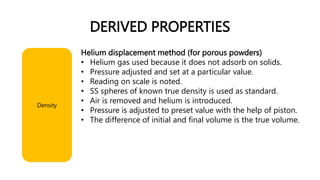
Helium displacement method (for porous powders)
• Helium gas used because it does not adsorb on solids.
• Pressure adjusted and set at a particular value.
• Reading on scale is noted.
• SS spheres of known true density is used as standard.
• Air is removed and helium is introduced.
• Pressure is adjusted to preset value with the help of piston.
• The difference of initial and final volume is the true volume.
Density
DERIVED PROPERTIES
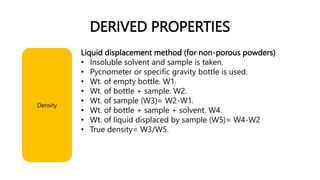
Liquid displacement method (for non-porous powders)
• Insoluble solvent and sample is taken.
• Pycnometer or specific gravity bottle is used.
• Wt. of empty bottle. W1.
• Wt. of bottle + sample. W2.
• Wt. of sample (W3)= W2-W1.
• Wt. of bottle + sample + solvent. W4.
• Wt. of liquid displaced by sample (W5)= W4-W2
• True density= W3/W5.
Density
DERIVED PROPERTIES
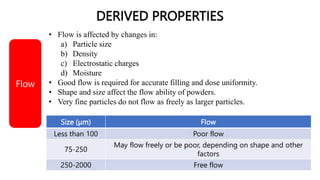
• Flow is affected by changes in:
a) Particle size
b) Density
c) Electrostatic charges
d) Moisture
• Good flow is required for accurate filling and dose uniformity.
• Shape and size affect the flow ability of powders.
• Very fine particles do not flow as freely as larger particles.
Flow
Size (μm) Flow
Less than 100 Poor flow
75-250
May flow freely or be poor, depending on shape and other
factors
250-2000 Free flow
DERIVED PROPERTIES
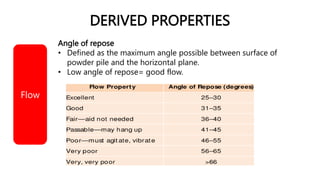
Angle of repose
• Defined as the maximum angle possible between surface of
powder pile and the horizontal plane.
• Low angle of repose= good flow.
Flow
DERIVED PROPERTIES
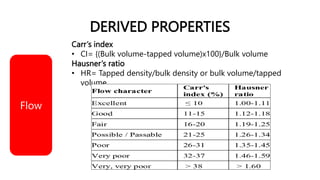
Carr’s index
• CI= {(Bulk volume-tapped volume)x100}/Bulk volume
Hausner’s ratio
• HR= Tapped density/bulk density or bulk volume/tapped
volume
Flow
DERIVED PROPERTIES
• Ratio of the volume of voids between particles and
volume of pores to the total volume occupied by the
powder which includes voids and pores.
• A set of particles can be filled into a volume of space in
different ways.
• Slight vibrations can rearrange the particles.
• Particles can occupy different spatial volume.
• This can affect the packing geometry and can alter the
packing properties.
• Bulk density is always less than true density.
• Bulk density contains voids.
• A powder has only one true density but can have various
bulk densities.
Porosity
SIZE REDUCTION METHODS
Cutting Compression Impact Attrition
Impact &
attrition
SIZE REDUCTION METHODS
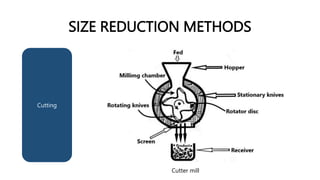
Cutting
• Cutter mill is used.
• Consists a series of rotating knives attached to a
horizontal rotor.
• Act against a series of stationary knives on the mill wall.
• Fracture of particles occurs between the two sets of
knives.
• Receiver at the bottom to retain materials.
• Used for fibrous crude drugs such as roots, peels, and
barks prior to extraction.
SIZE REDUCTION METHODS
Cutting
Cutter mill
SIZE REDUCTION METHODS
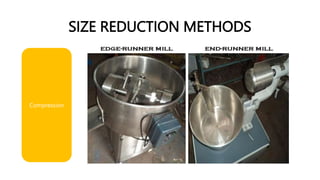
• Size reduction by compression on a small scale.
• Two types of mills:
a) End runner
b) Edge runner
• End runner- heavy pestle is turned by friction of material
passing beneath it as mortar rotates under pressure.
• Edge runner- horizontally mounted pestles rotate
against powder bed and size reduction occurs due to
attrition as well as compression.
• Scraper continuously scrapes material from the bottom
of the vessel.
Compression
SIZE REDUCTION METHODS
Compression
SIZE REDUCTION METHODS
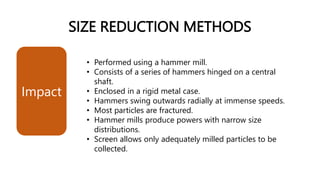
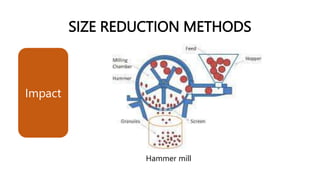
• Performed using a hammer mill.
• Consists of a series of hammers hinged on a central
shaft.
• Enclosed in a rigid metal case.
• Hammers swing outwards radially at immense speeds.
• Most particles are fractured.
• Hammer mills produce powers with narrow size
distributions.
• Screen allows only adequately milled particles to be
collected.
Impact
SIZE REDUCTION METHODS
Impact
Hammer mill
SIZE REDUCTION METHODS
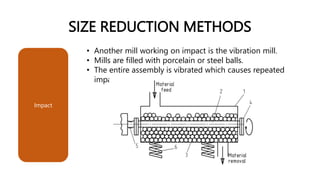
• Another mill working on impact is the vibration mill.
• Mills are filled with porcelain or steel balls.
• The entire assembly is vibrated which causes repeated
impact.
Impact
SIZE REDUCTION METHODS
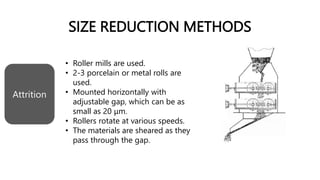
• Roller mills are used.
• 2-3 porcelain or metal rolls are
used.
• Mounted horizontally with
adjustable gap, which can be as
small as 20 μm.
• Rollers rotate at various speeds.
• The materials are sheared as they
pass through the gap.
Attrition
SIZE REDUCTION METHODS
Ball mill
• Ball mill uses both impaction and attrition.
• Consists of a hollow cylinder which can be rotated on its
horizontal longitudinal axis.
• Contain balls of various sizes inside.
• Larger balls break down the coarse feed.
• Smaller balls form fine powders by reducing void spaces.
• Amount of feed in the mill is important.
• Too much feed causes cushioning effect,
• Too little causes efficiency loss.
Impact &
attrition
SIZE REDUCTION METHODS
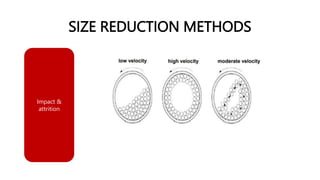
• Speed of drum rotation should be optimum.
• The most important factor is speed.
• At low speeds, balls move with drum.
• This results in minimal size reduction.
• At high speeds, balls are thrown on to the walls by
centrifugal force.
• This too results in no size reduction.
Impact &
attrition
SIZE REDUCTION METHODS
Impact &
attrition
SIZE REDUCTION METHODS
Impact &
attrition
SIZE REDUCTION METHODS
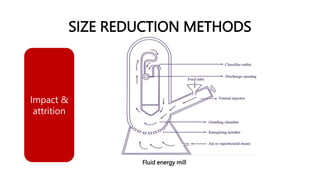
Fluid energy mill
• Consists of a hollow toroid.
• Diameter of 20-200 mm.
• Height of up to 2 m.
• Air is injected as jets of high pressure from the bottom.
• Movement causes particles to impact with each other.
• Turbulence ensures particle collisions are high enough to
produce substantial size reduction by both impact and
attrition.
Impact &
attrition
SIZE REDUCTION METHODS
Impact &
attrition
Fluid energy mill
APPLICATIONS
• Particle size and surface area influence the release of a drug
from a dosage form.
• Greater surface area= more intimate contact of drug with
dissolution fluids.
Increases drug solubility and dissolution.
• Small particle size can also penetrate phospholipid bilayer.
Improves uptake.
• Particle sizes also affect formulation processes such as
mixing and filling.
PK of drugs
APPLICATIONS
• Particle size affects drug absorption and ultimately
therapeutic action.
• Higher dissolution= faster absorption= quicker onset of
action.
Absorption &
drug action
Physical
stability
• Particle size in a formulation influences the physical
stability of the suspensions & emulsions.
• Smaller size= greater stability.
Due to Brownian motion.
FACTORS INFLUENCED BY SURFACE AREA
Surface area
• Increased surface area increases stability of dosage forms.
• By increasing the interactions between particles.
• Affects the therapeutic efficiency of medicinal compounds that possess
a low solubility in body fluid.
Extraction
• Time required for extraction is shortened.
• Due to increased contact area between solute and solvent.
• Reduced distance for solvent to penetrate.
• Results in faster solvation of extraction molecules.
FACTORS INFLUENCED BY SURFACE AREA
Dissolution
• Time required for dissolving solid particles is shortened.
• Due to increased contact area between solute and solvent.
• Reduced distance for solvent to penetrate.
• Results in faster solvation of molecules.
• Faster dissolution= faster absorption and onset of action.
Drying
• Milling can facilitate drying.
• Occurs by the increment in surface area for heat.
• Also, reduces distance for moisture to travel.
FACTORS INFLUENCED BY SURFACE AREA
Mixing
• Mixing is easier when particles are smaller.
• Uniform particle size distribution is also required for proper mixing.
• Varying shapes can also cause sub-optimal mixing.
Lubrication
• Lubricants are very fine solid particles.
• They coat the surface of granules or powders.
• Ensures optimum flow.

Micromeritics The Physical Pharmacy pptx

  • 1.
    MICROMERITICS Binamra Rai M. Pharm.(Industrial Pharmacy) Kathmandu University
  • 2.
    INTRODUCTION • Science andtechnology of small particles. • Study of the fundamental and derived properties of individual as well as a collection of particles. • Involves study of both individual particles and powders. • Particles are usually denoted in micrometers (μm). CHARACTERIZATION Shape Size Volume Surface area Density Porosity Flow
  • 3.
    SIZE & SIZEDISTRIBUTION • Size and size distribution are important in pharmacy. • Size distribution states the range of particle size present in a given powder. • Not all particles are of the same size and shape. • Related to physical, chemical, and pharmacological properties of dosage form. • Affects release of API from dosage form. • Other formulation processes such as mixing and filling due to powder flow are also affected.
  • 4.
    SIZE & SIZEDISTRIBUTION • In a powder, the important parameters to observe are: Shape and surface morphology of individual particles. Particle size and size distribution.
  • 5.
    SIZE & SIZEDISTRIBUTION • Pharmaceutical powders and granules are usually polydisperse. • Size and size distribution determination is a key QC component. • Importance: a) Proper mixing b) Proper coating formulations c) To avoid irritation Particle size and size distribution.
  • 6.
    SIZE & SIZEDISTRIBUTION • Shape and surface texture also affect dosage forms. • Porous and protruding shapes increase surface area. • Irregular shapes can affect optimum mixing. • They can also cause unwanted milling during mixing. • Can also impact processes such as filtration. Shape and surface morphology of individual particles.
  • 7.
    PROPERTIES OF POWDERS Derived •Porosity • Density • Bulkiness • Flow Fundamental • Size and size distribution • Shape • Surface area • Weight • Number
  • 8.
    FUNDAMENTAL PROPERTIES Fundamental • Todenote the dimensions of solid powders, liquid particles, and gases bubbles. • Particles can be defined by size (diameter or radius), shape (length, breadth, and height), volume (liter), and surface area (cm2) properties and can be either made of solid substance or liquid. • Important for: a) Bulk properties b) Product performance c) Processability d) Stability e) Appearance
  • 9.
    FUNDAMENTAL PROPERTIES Fundamental • Particlesize grades: Very coarse Coarse Moderately coarse Fine Very fine
  • 10.
    FUNDAMENTAL PROPERTIES Fundamental • Physicalproperties of API are related to particle size and shape. • Hence, particle size analysis is important. Sieving- 40 to 9500 μm Microscopy- 0.2 to 100 μm along with information in shape Sedimentation- 0.8 to 300 μm Light diffraction/scattering- 0.02 to 2000 μm photon correlation spectrum Laser holography- 1.4 to 100 μm Cascade impaction- 0.4 to 15 μm
  • 11.
    SIZE DETERMINATION METHODS •0.2-100 μm can be measured. • Gives number distribution which can be converted to weight distribution. • Optical microscopes have limited resolution. • Modern microscopes have resolution in the nanometre range. Microscop y Advantages • Can view particles. • Aggregates can be detected. • Contamination can be detected. • Easy and simple. Disadvantages • Length and breadth can be detected, but not thickness and depth. • Time consuming. • Large sample required.
  • 12.
    SIZE DETERMINATION METHODS •It is a simple method. • Performed using dry powders. • Provides weight distribution. • Percentage of coarse, moderate, and fine powder is estimated. • Usually, 6-8 sieves are stacked. • Sieves used are according to pharmaceutical standards. • Mesh size decreases from top to bottom. Sieving
  • 13.
  • 14.
    SIZE DETERMINATION METHODS Sievin g Advantages •Inexpensive. • Reproducible. • Quick. Disadvantages • Lower limit is 50 μm. • Moist powder can clog aperture. • Attrition among particles during shaking can cause milling and lead to erroneous data.
  • 15.
    SIZE DETERMINATION METHODS Sedimentatio n •Examined as powder particles as they sediment. • Powder is dispersed in suitable solvent. • If powder is hydrophobic, dispersing agent is required to wet the powder. • If powder is water-soluble, non-aqueous liquids or gas is used.
  • 16.
    SIZE DETERMINATION METHODS Conductivity •Two types: a) Electrical stream sensing zone method (Coulter counter) b) Laser light scattering method • Principle- change in light intensity. • Measurement of light intensity change gives particle size estimate.
  • 17.
    SIZE DETERMINATION METHODS Conductivity Electricalstream sensing zone method (Coulter counter) • Dilute suspension of powder in electrolyte is prepared. • Subjected to ultrasonic agitation to break of particle agglomerates. • Suspension is drawn through an aperture drilled through a sapphire crystal set into the wall of a hollow glass tube. • Electrodes are present on either side and are surrounded by electrolyte solution. • Particles occupy orifice space and displace equal volume of electrolyte. Change in fluid volume= change in electrical resistance. • The change in resistance is proportional to the particle volume.
  • 18.
  • 19.
    SHAPE DETERMINATION METHODS Adsorption •Surface area determination. • Using Brunauer-Emmett-Teller (BET) theory of adsorption. • Most substances adsorb a mono-molecular layer of gas. • Under specific conditions of partial pressure and temperature. • This process is done with liquid nitrogen at -196oC. • Surface adsorption reaches equilibrium. • Sample is heated at RT and desorbed nitrogen gas is collected and measured.
  • 20.
    SHAPE DETERMINATION METHODS Air permeability •Powder is packed in a capillary sample holder. • Air is passed through at constant pressure. • Resistance occurs as air passes through capillaries. • Greater the surface area= greater the resistance. • Air permeability is inversely proportional to the surface area.
  • 21.
    DERIVED PROPERTIES Derived • Volume,density, porosity, flow etc. are derived properties of powder. • Volume can be calculated from the diameter of particles. • However, can be calculated without the use of fundamental properties.
  • 22.
    DERIVED PROPERTIES • Bulkdensity- determined by pouring pre-sieved bulk drug into a graduated cylinder. • Volume is noted without subjecting to any agitation. • Bulk density= powder mass/bulk volume • Tapped density- Cylinder is subjected to a fixed number of taps until the powder bed reaches a minimum. • Tapped density= powder mass/tapped volume • True density- Volume occupied by voids and intra-particulate pores. • Calculated by suspending drug in solvents of various densities. • Vigorously agitated, centrifuged briefly, and left to stand. • Sample that remains suspended corresponds to the true density of material. • Two methods: a) Helium displacement method (for porous powders) b) Liquid displacement method (for non-porous powders) Density
  • 23.
    DERIVED PROPERTIES Helium displacementmethod (for porous powders) • Helium gas used because it does not adsorb on solids. • Pressure adjusted and set at a particular value. • Reading on scale is noted. • SS spheres of known true density is used as standard. • Air is removed and helium is introduced. • Pressure is adjusted to preset value with the help of piston. • The difference of initial and final volume is the true volume. Density
  • 24.
    DERIVED PROPERTIES Liquid displacementmethod (for non-porous powders) • Insoluble solvent and sample is taken. • Pycnometer or specific gravity bottle is used. • Wt. of empty bottle. W1. • Wt. of bottle + sample. W2. • Wt. of sample (W3)= W2-W1. • Wt. of bottle + sample + solvent. W4. • Wt. of liquid displaced by sample (W5)= W4-W2 • True density= W3/W5. Density
  • 25.
    DERIVED PROPERTIES • Flowis affected by changes in: a) Particle size b) Density c) Electrostatic charges d) Moisture • Good flow is required for accurate filling and dose uniformity. • Shape and size affect the flow ability of powders. • Very fine particles do not flow as freely as larger particles. Flow Size (μm) Flow Less than 100 Poor flow 75-250 May flow freely or be poor, depending on shape and other factors 250-2000 Free flow
  • 26.
    DERIVED PROPERTIES Angle ofrepose • Defined as the maximum angle possible between surface of powder pile and the horizontal plane. • Low angle of repose= good flow. Flow
  • 27.
    DERIVED PROPERTIES Carr’s index •CI= {(Bulk volume-tapped volume)x100}/Bulk volume Hausner’s ratio • HR= Tapped density/bulk density or bulk volume/tapped volume Flow
  • 28.
    DERIVED PROPERTIES • Ratioof the volume of voids between particles and volume of pores to the total volume occupied by the powder which includes voids and pores. • A set of particles can be filled into a volume of space in different ways. • Slight vibrations can rearrange the particles. • Particles can occupy different spatial volume. • This can affect the packing geometry and can alter the packing properties. • Bulk density is always less than true density. • Bulk density contains voids. • A powder has only one true density but can have various bulk densities. Porosity
  • 29.
    SIZE REDUCTION METHODS CuttingCompression Impact Attrition Impact & attrition
  • 30.
    SIZE REDUCTION METHODS Cutting •Cutter mill is used. • Consists a series of rotating knives attached to a horizontal rotor. • Act against a series of stationary knives on the mill wall. • Fracture of particles occurs between the two sets of knives. • Receiver at the bottom to retain materials. • Used for fibrous crude drugs such as roots, peels, and barks prior to extraction.
  • 31.
  • 32.
    SIZE REDUCTION METHODS •Size reduction by compression on a small scale. • Two types of mills: a) End runner b) Edge runner • End runner- heavy pestle is turned by friction of material passing beneath it as mortar rotates under pressure. • Edge runner- horizontally mounted pestles rotate against powder bed and size reduction occurs due to attrition as well as compression. • Scraper continuously scrapes material from the bottom of the vessel. Compression
  • 33.
  • 34.
    SIZE REDUCTION METHODS •Performed using a hammer mill. • Consists of a series of hammers hinged on a central shaft. • Enclosed in a rigid metal case. • Hammers swing outwards radially at immense speeds. • Most particles are fractured. • Hammer mills produce powers with narrow size distributions. • Screen allows only adequately milled particles to be collected. Impact
  • 35.
  • 36.
    SIZE REDUCTION METHODS •Another mill working on impact is the vibration mill. • Mills are filled with porcelain or steel balls. • The entire assembly is vibrated which causes repeated impact. Impact
  • 37.
    SIZE REDUCTION METHODS •Roller mills are used. • 2-3 porcelain or metal rolls are used. • Mounted horizontally with adjustable gap, which can be as small as 20 μm. • Rollers rotate at various speeds. • The materials are sheared as they pass through the gap. Attrition
  • 38.
    SIZE REDUCTION METHODS Ballmill • Ball mill uses both impaction and attrition. • Consists of a hollow cylinder which can be rotated on its horizontal longitudinal axis. • Contain balls of various sizes inside. • Larger balls break down the coarse feed. • Smaller balls form fine powders by reducing void spaces. • Amount of feed in the mill is important. • Too much feed causes cushioning effect, • Too little causes efficiency loss. Impact & attrition
  • 39.
    SIZE REDUCTION METHODS •Speed of drum rotation should be optimum. • The most important factor is speed. • At low speeds, balls move with drum. • This results in minimal size reduction. • At high speeds, balls are thrown on to the walls by centrifugal force. • This too results in no size reduction. Impact & attrition
  • 40.
  • 41.
  • 42.
    SIZE REDUCTION METHODS Fluidenergy mill • Consists of a hollow toroid. • Diameter of 20-200 mm. • Height of up to 2 m. • Air is injected as jets of high pressure from the bottom. • Movement causes particles to impact with each other. • Turbulence ensures particle collisions are high enough to produce substantial size reduction by both impact and attrition. Impact & attrition
  • 43.
    SIZE REDUCTION METHODS Impact& attrition Fluid energy mill
  • 44.
    APPLICATIONS • Particle sizeand surface area influence the release of a drug from a dosage form. • Greater surface area= more intimate contact of drug with dissolution fluids. Increases drug solubility and dissolution. • Small particle size can also penetrate phospholipid bilayer. Improves uptake. • Particle sizes also affect formulation processes such as mixing and filling. PK of drugs
  • 45.
    APPLICATIONS • Particle sizeaffects drug absorption and ultimately therapeutic action. • Higher dissolution= faster absorption= quicker onset of action. Absorption & drug action Physical stability • Particle size in a formulation influences the physical stability of the suspensions & emulsions. • Smaller size= greater stability. Due to Brownian motion.
  • 46.
    FACTORS INFLUENCED BYSURFACE AREA Surface area • Increased surface area increases stability of dosage forms. • By increasing the interactions between particles. • Affects the therapeutic efficiency of medicinal compounds that possess a low solubility in body fluid. Extraction • Time required for extraction is shortened. • Due to increased contact area between solute and solvent. • Reduced distance for solvent to penetrate. • Results in faster solvation of extraction molecules.
  • 47.
    FACTORS INFLUENCED BYSURFACE AREA Dissolution • Time required for dissolving solid particles is shortened. • Due to increased contact area between solute and solvent. • Reduced distance for solvent to penetrate. • Results in faster solvation of molecules. • Faster dissolution= faster absorption and onset of action. Drying • Milling can facilitate drying. • Occurs by the increment in surface area for heat. • Also, reduces distance for moisture to travel.
  • 48.
    FACTORS INFLUENCED BYSURFACE AREA Mixing • Mixing is easier when particles are smaller. • Uniform particle size distribution is also required for proper mixing. • Varying shapes can also cause sub-optimal mixing. Lubrication • Lubricants are very fine solid particles. • They coat the surface of granules or powders. • Ensures optimum flow.