Microgrids and Energy Storage
Systems: An Overview and
Control Aspects
KRISHNAKUMAR R. VASUDEVAN, M.E
DOCTORAL RESEARCHER
POWER QUALITY RESEARCH GROUP
UNIVERSITI TENAGA NASIONAL, MALAYSIA
11/6/2020 POWER QUALITY RESEARCH GROUP 1
Agenda
1. History and Transition of Power System
2. Distributed Energy Sources
3. Energy Storage Systems
4. Microgrid Control Strategies
5. Challenges in microgrid
6. Success stories in India
11/6/2020 POWER QUALITY RESEARCH GROUP 2
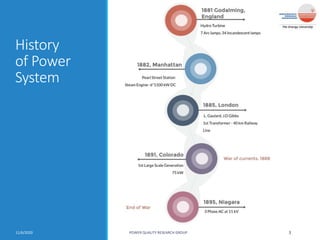
History
of Power
System
11/6/2020 POWER QUALITY RESEARCH GROUP 3
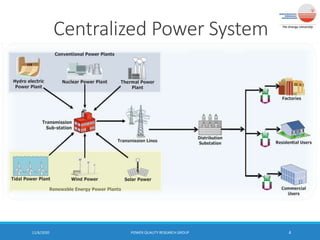
Centralized Power System
11/6/2020 POWER QUALITY RESEARCH GROUP 4
Cause for Transition???
(Distributed to Centralized)
1. Location of power plants away from load centre.
i. They are located close to the fuel reserves.
ii. Near ports for easy logistics.
iii. Near water bodies.
2. Economical
◦ Bulk power generation is cheaper than generation through distributed small
power plants.
3. Reliability
i. Diverse mix of technology and interconnection of spatially distributed power
plants.
ii. Ability to ride through contingency events.
4. Use of old power plants for peak load
◦ Old plants with low efficiency can be used to meet the peak demand.
11/6/2020 POWER QUALITY RESEARCH GROUP 5
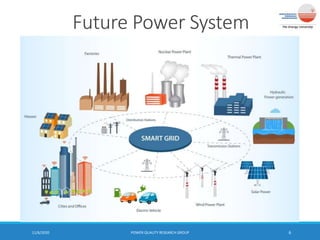
Future Power System
11/6/2020 POWER QUALITY RESEARCH GROUP 6
Cause for Transition???
(Centralized to Distributed)
1. High transmission losses in centralized grid.
2. Distributed generation offer high resiliency.
3. Improved end user participation.
11/6/2020 POWER QUALITY RESEARCH GROUP 7
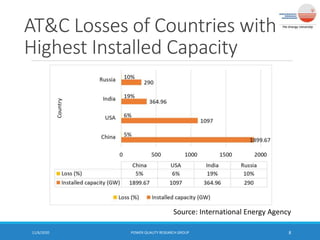
AT&C Losses of Countries with
Highest Installed Capacity
11/6/2020 POWER QUALITY RESEARCH GROUP 8
Source: International Energy Agency
Microgrids
11/6/2020 POWER QUALITY RESEARCH GROUP 9
What is a Microgrid?
The US Department of Energy defines the microgrid as
‘‘a group of interconnected loads and distributed energy resources
within clearly defined electrical boundaries that acts as a single
controllable entity with respect to the grid. A microgrid can connect and
disconnect from the grid to enable it to operate in both grid-connected
or island mode”.
11/6/2020 POWER QUALITY RESEARCH GROUP 10
A Typical Microgrid
11/6/2020 POWER QUALITY RESEARCH GROUP 11
Source: [4]
Need for Power Electronics
1. Nature of power output – AC/DC
◦ It depends on the source of generation.
2. Non grid friendly AC
◦ Different generation frequency.
◦ Different voltage levels.
3. Maximum power extraction
◦ Maximum power point tracking is achieved through control of power
converters.
4. Control Flexibility
◦ Complete control on real power, reactive power, voltage and frequency.
11/6/2020 POWER QUALITY RESEARCH GROUP 12
Distributed
Generation
Sources
(DGS)
1. Solar PV
2. Solar Thermal
3. Wind Electric System
4. Small Hydro
5. Fuel Cell
6. Microturbine
7. Biomass
8. Diesel Generators
Note: DGS are not limited to renewable energy
sources (RES). However, RES is a boon to develop a
sustainable microgrid.
11/6/2020 POWER QUALITY RESEARCH GROUP 13
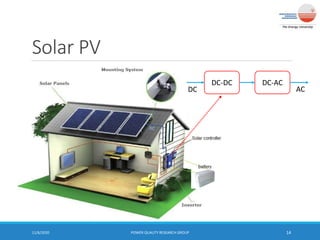
Solar PV
11/6/2020 POWER QUALITY RESEARCH GROUP 14
DC-DC DC-AC
ACDC
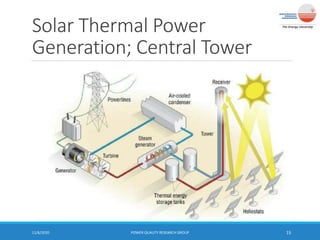
Solar Thermal Power
Generation; Central Tower
11/6/2020 POWER QUALITY RESEARCH GROUP 15
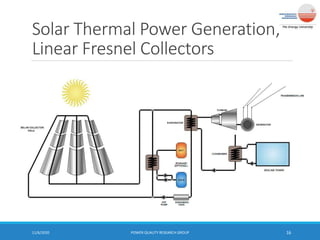
Solar Thermal Power Generation;
Linear Fresnel Collectors
11/6/2020 POWER QUALITY RESEARCH GROUP 16
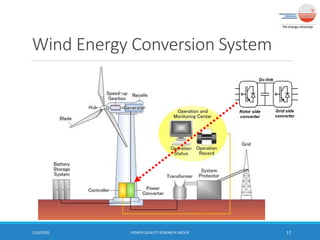
Wind Energy Conversion System
11/6/2020 POWER QUALITY RESEARCH GROUP 17
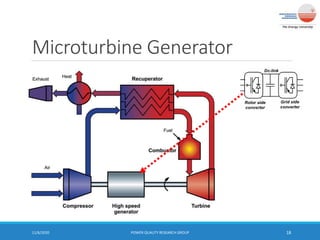
Microturbine Generator
11/6/2020 POWER QUALITY RESEARCH GROUP 18
Energy Storage
Systems (ESS)
11/6/2020 POWER QUALITY RESEARCH GROUP 19
Energy Storage Systems
1. Stores energy when there is surplus power in the microgrid.
2. Delivers energy when there is a deficit power in the microgrid.
3. So, they act as controllable loads and sources.
4. They are very critical in the operation of microgrids.
11/6/2020 POWER QUALITY RESEARCH GROUP 20
Classification of Energy Storage
Systems Based on Technology
11/6/2020 POWER QUALITY RESEARCH GROUP 21
Source: [1]
Pumped Hydro Storage (High
Energy)
11/6/2020 POWER QUALITY RESEARCH GROUP 22
AC-DC DC-AC
ACAC
Source: [2]
Battery Energy Storage
(High Energy)
11/6/2020 POWER QUALITY RESEARCH GROUP 23
DC-DC DC-AC
ACDC
Source: [1]
Thermal Energy Storage
(High Energy)
11/6/2020 POWER QUALITY RESEARCH GROUP 24
Source: [1]
Compressed Air Energy
Storage (High Energy)
11/6/2020 POWER QUALITY RESEARCH GROUP 25
AC-DC DC-AC
ACAC
Source: [1]
Hydrogen Storage & Fuel Cell
(High Energy)
11/6/2020 POWER QUALITY RESEARCH GROUP 26
DC-DC DC-AC
ACDC
Source: [1]
Super Conducting Magnetic
Energy Storage (High Power)
11/6/2020 POWER QUALITY RESEARCH GROUP 27
DC-DC DC-AC
ACDC
Source: [1]
Flywheel Energy Storage
(High Power)
11/6/2020 POWER QUALITY RESEARCH GROUP 28
AC-DC DC-AC
ACAC
Source: [1]
Super Capacitor
(High Power)
11/6/2020 POWER QUALITY RESEARCH GROUP 29
DC-DC DC-AC
ACDC
Source: [1]
Role of Energy Storage in
Microgrid
1. Intermittency Mitigation
◦ Stochastic variation of meteorological variables requires additional reserves.
◦ RES have poor load following capability.
2. Power quality
◦ Fluctuations in power
◦ Voltage and current
3. Maintain Stability
◦ Provide voltage and frequency support.
4. Time Shifting
◦ Nocturnal demand.
◦ Energy arbitrage in a dynamic pricing environment.
5. Black Start & Backup
◦ Starting and synchronization of sources require firm power source.
11/6/2020 POWER QUALITY RESEARCH GROUP 30
An Important challenge to
overcome
1. Energy storage systems either have high power capacity or high
energy capacity.
2. Every application demands a storage which has high energy and high
power capacity.
3. None of the energy storage systems possess the ideal requirement.
4. It paved a way for the development of hybrid energy storage
systems.
5. A high power capacity ESS and a low power capacity ESS are
combined to form an ideal ESS.
11/6/2020 POWER QUALITY RESEARCH GROUP 31
Microgrid
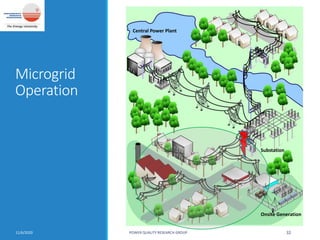
Operation
11/6/2020 POWER QUALITY RESEARCH GROUP 32
Onsite Generation
Central Power Plant
Substation
Types of
microgrid
1. AC
2. DC
3. Hybrid
Note: Another classification
based on location of
microgrid.
1. Urban
2. Rural/Remote
3. Military
4. Industrial
11/6/2020 POWER QUALITY RESEARCH GROUP 33
Interlinking
converter
Source: [4]
Control
of
Microgrids
11/6/2020 POWER QUALITY RESEARCH GROUP 34
Control Hierarchy of Microgrid
11/6/2020 POWER QUALITY RESEARCH GROUP 35
Source: [5]
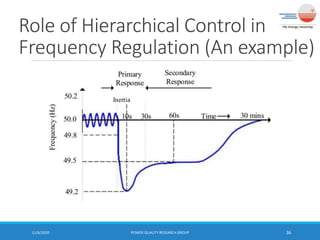
Role of Hierarchical Control in
Frequency Regulation (An example)
11/6/2020 POWER QUALITY RESEARCH GROUP 36
Inner Control or Level Zero
Control
1. Grid forming converters (Voltage Control)
1. Set frequency and voltage reference.
2. Stable sources like Diesel Generator, Fuel Cell.
2. Grid supporting converters (Voltage or Current Control)
1. Regulate the frequency and voltage.
2. Energy Storage Systems.
3. Grid following converters (PQ control)
1. Inject the real and reactive power set by higher control.
2. All renewable energy sources.
11/6/2020 POWER QUALITY RESEARCH GROUP 37
Source: [15]
Primary Control
Objectives of Primary Control
1. Frequency stability
2. Voltage stability
3. Plug and Play Capability of DGS
4. Avoid circulating currents
11/6/2020 POWER QUALITY RESEARCH GROUP 38
Primary Control
1. Active load sharing (With Communication)
i. Centralized control
• The load is shared equally by all the sources.
• The current references are equal for all the converters.
ii. Master slave
• One converter operates as grid forming converter (Master).
• Other converters (slave) follow the command from the Master.
11/6/2020 POWER QUALITY RESEARCH GROUP 39
Source:[6] [7],[9]
Primary Control
1. Active load sharing (With Communication)
iii. Average load sharing
• Weighted average current of all the converters is used as current reference to the individual
converters.
iv. Circular chain
• The converters are cascaded to form a chain.
• The reference of nth converter is determined by the (n-1)th converter.
11/6/2020 POWER QUALITY RESEARCH GROUP 40
Source:[6] [7],[9]
Primary Control
1. Advantages of Communication based controls
1. Accurate sharing of power.
2. Accurate frequency and voltage regulation.
2. Disadvantages of Communication based controls
1. High cost of reliable communication link.
2. Complex control structures.
3. Low reliability due to single point of failure.
11/6/2020 POWER QUALITY RESEARCH GROUP 41
Source:[6] [7],[9]
Primary Control
2. Droop control ( Without Communication)
i. P-f droop
ii. Q-V droop
Note: There are different variations of droop control refer to [8].
11/6/2020 POWER QUALITY RESEARCH GROUP 42
Source:[6] [7],[9]
Primary Control
1. Advantages of droop control
1. Simple control structure with less computation.
2. High reliability due to absence of communication link.
2. Limitations of droop control
1. Degree of freedom is limited to one (Only the droop coefficients).
2. Difficult to achieve trade-off between response and steady state deviation.
3. Droop relation fails for highly resistive networks.
11/6/2020 POWER QUALITY RESEARCH GROUP 43
Source:[6] [7],[9]
Secondary Control
Objectives of Secondary Control
Restore the frequency and voltage of the microgrid.
Types of Control
1. Centralized
2. Decentralized
11/6/2020 POWER QUALITY RESEARCH GROUP 44
Source:[6] [7],[9]
11/6/2020 POWER QUALITY RESEARCH GROUP 45
Centralized Secondary Control
Source: [12]
11/6/2020 POWER QUALITY RESEARCH GROUP 46
Decentralized Secondary Control
Source: [12]
Tertiary Control - EMS
(MGCC)
11/6/2020 POWER QUALITY RESEARCH GROUP 47
Objectives of Tertiary Control
1. Grid connected mode:
1. Follow the voltage and frequency set points of the grid.
2. Control the power exchanged with the grid.
3. Seamless transfer of modes.
4. Islanding detection.
2. Islanded mode:
1. Performs all the operation of a grid operator in the central grid.
2. Set the frequency and voltage references for the lower control.
3. Day ahead scheduling based on weather forecast. (Optimization)
4. Real time dispatching of DGs. (May not use optimization)
Challenges
in
Microgrids
11/6/2020 POWER QUALITY RESEARCH GROUP 48
Operation and Stability Issues
1. Stochastic Generation
1. Renewables are non dispatchable sources.
2. They predominantly operate at maximum power point (MPPT).
3. Off MPPT control results in reduced efficiency.
2. Small Signal Stability
1. Frequency stability
2. Voltage stability
3. No rotor angle stability due to the absence of rotating machines.
11/6/2020 POWER QUALITY RESEARCH GROUP 49
Source:[18],[19]
Operation and Stability Issues
3. Low Inertia
Overview:
1. Inertia is the critical entity which holds the stability of power system.
2. Large synchronous machines provide inertia to the grid.
3. Predominantly renewable energy sources and energy storage systems are static .
4. Variable speed wind turbines have hidden inertia.
Effects:
1. Operation of ROCOF relays for a small power unbalance.
2. Increased frequency nadir causes maloperation of under frequency load shedding
control.
Solution:
1. Virtual inertia emulation
2. Hidden inertia emulation
11/6/2020 POWER QUALITY RESEARCH GROUP 50
Source:[16],[17]
Economic Issues
1. High capital investment
2. Grid Parity
◦ The cost of energy of RES is higher than the cost of energy from grid.
3. Long payback period
◦ A renewable energy project has a project lifetime of 10 years or more.
11/6/2020 POWER QUALITY RESEARCH GROUP 51
Economic Justification
1. Social Cost of Carbon emission.
i. It is the marginal cost of impacts due to emission of an extra tonne of
CO2.
ii. In other words, it is the loss in revenue due to emission of CO2.
iii. India has the highest SCC of 86 $/tCO2.
iv. India faces a loss of about $210 billion/yr.
11/6/2020 POWER QUALITY RESEARCH GROUP 52
Economic Justification
2. Revenue generation by feeding in power to the grid.
3. Appropriate valuing of probable revenue generation in a dynamic
pricing environment will attract investments.
4. Exploiting the dynamic price signals
1. Energy Arbitrage
◦ The energy is consumed from the grid during low price period.
◦ The energy is injected to the grid during high price period.
2. Demand Side Management
◦ Control of loads in the microgrid to achieve various objectives.
◦ It can be controlled by microgrid controller.
◦ Users can also control their use.
11/6/2020 POWER QUALITY RESEARCH GROUP 53
Research Avenues in Microgrid
1. Microgrid Stability
2. Energy Storage Systems
3. Application of Energy Storage Systems
4. Energy Management Strategies (Tertiary Control)
5. Optimal sizing and placement of DGs
6. Integrated Energy System
7. Islanding detection
8. Protection of Microgrids
9. Heuristics and Metaheuristics play a major role in every field of
microgrid research.
11/6/2020 POWER QUALITY RESEARCH GROUP 54
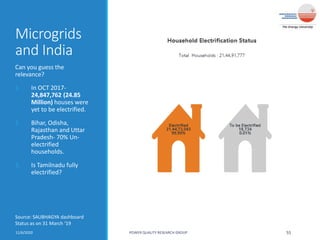
Microgrids
and India
Can you guess the
relevance?
1. In OCT 2017-
24,847,762 (24.85
Million) houses were
yet to be electrified.
2. Bihar, Odisha,
Rajasthan and Uttar
Pradesh- 70% Un-
electrified
households.
3. Is Tamilnadu fully
electrified?
11/6/2020 POWER QUALITY RESEARCH GROUP 55
Source: SAUBHAGYA dashboard
Status as on 31 March ‘19
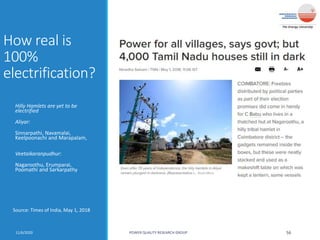
How real is
100%
electrification?
Hilly Hamlets are yet to be
electrified
Aliyar:
Sinnarpathi, Navamalai,
Keelpoonachi and Marapalam,
Veetaikaranpudhur:
Nagaroothu, Erumparai,
Poomathi and Sarkarpathy
11/6/2020 POWER QUALITY RESEARCH GROUP 56
Source: Times of India, May 1, 2018
Barriers to 100%
electrification?
1. Geographical constraints
2. Affordability to grid supply
3. High connection costs
4. Unreliable power supply
11/6/2020 POWER QUALITY RESEARCH GROUP 57
Success Stories
in India
11/6/2020 POWER QUALITY RESEARCH GROUP 58
Few Successful Microgrids Under
Operation in India
Project Location Capacity
(kW)
Source No. of
Houses
Cost of
Electricity ₹
/kWh
Dharnai Solar
City
Dharnai,
Bihar
100 Solar PV 350 12-14
Sagar Island
Microgrid
Sundarbans 26 Solar PV 1400 7
Amrita self-
reliant villages
Kerala 8 Mini hydro 40 -
Biomass energy
for rural India
Karnataka 500 Biomass 80 -
11/6/2020 POWER QUALITY RESEARCH GROUP 59
(source [20])
A Road not Taken!
11/6/2020 POWER QUALITY RESEARCH GROUP 60
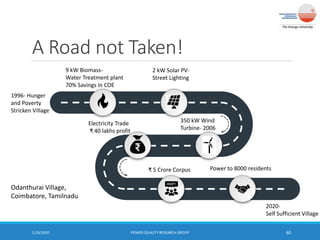
9 kW Biomass-
Water Treatment plant
70% Savings in COE
2 kW Solar PV-
Street Lighting
350 kW Wind
Turbine- 2006
Electricity Trade
₹ 40 lakhs profit
₹ 5 Crore Corpus Power to 8000 residents
1996- Hunger
and Poverty
Stricken Village
2020-
Self Sufficient Village
Odanthurai Village,
Coimbatore, Tamilnadu
Concluding Remarks
1. Developed countries are fighting over the reliable and resilient of
power supply.
2. Whereas, people in developing countries like India are still fighting
for the lifeline power supply to cater for their basic needs.
3. Thus, microgrids are a boon to developing nations to power the
remote communities and decarbonize their grid.
11/6/2020 POWER QUALITY RESEARCH GROUP 61
References
[1] J. S. John, X. Luo, J. Wang, and M. Dooner, “Overview of current development in electrical energy
storage technologies and the application potential in power system operation,” Appl. Energy, vol. 137,
pp. 511–536, 2015.
[2] V. Krishnakumar R., K. R. Vigna, V. Gomathi, J. B. Ekanayake, and S. K. Tiong, “Modelling and
simulation of variable speed pico hydel energy storage system for microgrid applications,” J. Energy
Storage, vol. 24, Aug. 2019.
[3] N. Sivakumar, D. Das, and N. P. Padhy, “Variable speed operation of reversible pump-turbines at
Kadamparai pumped storage plant - A case study,” Energy Convers. Manag., vol. 78, pp. 96–104, 2014.
[4] M. A. Hossain, H. R. Pota, M. J. Hossain, and F. Blaabjerg, “Evolution of microgrids with converter-
interfaced generations: Challenges and opportunities,” Int. J. Electr. Power Energy Syst., vol. 109, no.
January, pp. 160–186, 2019.
[5] O. Palizban, K. Kauhaniemi, and J. M. Guerrero, “Microgrids in active network management - Part I:
Hierarchical control, energy storage, virtual power plants, and market participation,” Renew. Sustain.
Energy Rev., vol. 36, pp. 428–439, 2014.
[6] P. Monica and M. Kowsalya, “Control strategies of parallel operated inverters in renewable energy
application: A review,” Renew. Sustain. Energy Rev., vol. 65, pp. 885–901, 2016.
[7] A. Bidram and A. Davoudi, “Hierarchical structure of microgrids control system,” IEEE Trans. Smart
Grid, vol. 3, no. 4, pp. 1963–1976, 2012.
11/6/2020 POWER QUALITY RESEARCH GROUP 62
References
[8] U. B. Tayab, M. A. Bin Roslan, L. J. Hwai, and M. Kashif, “A review of droop control techniques for
microgrid,” Renew. Sustain. Energy Rev., vol. 76, no. May 2016, pp. 717–727, 2017.
[9] T. L. Vandoorn, J. D. M. De Kooning, B. Meersman, and L. Vandevelde, “Review of primary control
strategies for islanded microgrids with power-electronic interfaces,” Renew. Sustain. Energy Rev., vol.
19, pp. 613–628, 2013.
[10] M. S. Mahmoud, N. M. Alyazidi, and M. I. Abouheaf, “Adaptive intelligent techniques for microgrid
control systems: A survey,” Int. J. Electr. Power Energy Syst., vol. 90, pp. 292–305, 2017.
[11] J. M. Guerrero, M. Chandorkar, T. L. Lee, and P. C. Loh, “Advanced control architectures for
intelligent microgrids-part I: Decentralized and hierarchical control,” IEEE Trans. Ind. Electron., vol. 60,
no. 4, pp. 1254–1262, 2013.
[12] O. Palizban and K. Kauhaniemi, “Hierarchical control structure in microgrids with distributed
generation: Island and grid-connected mode,” Renew. Sustain. Energy Rev., vol. 44, pp. 797–813, 2015.
[13] O. Palizban and K. Kauhaniemi, “Energy storage systems in modern grids—Matrix of technologies
and applications,” J. Energy Storage, vol. 6, pp. 248–259, 2016.
[14] V. Krishnakumar R, V. K. Ramachandaramurthy, and S. B. Thanikanti, “Enhancing Resiliency
Through Sustainable Microgrids and Value Creation Using Smart Grid Paradigms.” IEEE Smartgrid, 2020.
[15] J. Rocabert, A. Luna, F. Blaabjerg, and P. Rodríguez, “Control of power converters in AC microgrids,”
IEEE Trans. Power Electron., vol. 27, no. 11, pp. 4734–4749, 2012.
11/6/2020 POWER QUALITY RESEARCH GROUP 63
References
[16] K. S. Ratnam, K. Palanisamy, and G. Yang, “Future low-inertia power systems: Requirements, issues, and
solutions - A review,” Renew. Sustain. Energy Rev., vol. 124, no. July 2019, p. 109773, 2020.
[17] M. Dreidy, H. Mokhlis, and S. Mekhilef, “Inertia response and frequency control techniques for renewable
energy sources: A review,” Renew. Sustain. Energy Rev., vol. 69, no. November 2016, pp. 144–155, 2017.
[18] Z. Shuai et al., “Microgrid stability: Classification and a review,” Renew. Sustain. Energy Rev., vol. 58, pp.
167–179, 2016.
[19] G. San, W. Zhang, X. Guo, C. Hua, H. Xin, and F. Blaabjerg, “Large-disturbance stability for power-
converter-dominated microgrid: A review,” Renew. Sustain. Energy Rev., vol. 127, no. May 2019, p. 109859,
2020.
[20] V. A. Subramony, S. Doolla, and M. Chandorkar, “Microgrids in India: Possibilities and challenges,” IEEE
Electrif. Mag., vol. 5, no. 2, pp. 47–55, 2017.
[21] M. Uddin, M. F. Romlie, M. F. Abdullah, S. Abd Halim, A. H. Abu Bakar, and T. Chia Kwang, “A review on
peak load shaving strategies,” Renew. Sustain. Energy Rev., vol. 82, no. February 2017, pp. 3323–3332, 2018.
11/6/2020 POWER QUALITY RESEARCH GROUP 64
11/6/2020 POWER QUALITY RESEARCH GROUP 65
Queries?
11/6/2020 POWER QUALITY RESEARCH GROUP 66
Contact
11/6/2020 POWER QUALITY RESEARCH GROUP 67
Krishnakumar R. Vasudevan
vasudevkrishna.ceg@gmail.com / vasudevkrishna@ieee.org
+91 7299514208 / +60 163585420

Microgrids and energy storage system: An overview and control aspects

  • 1.
    Microgrids and EnergyStorage Systems: An Overview and Control Aspects KRISHNAKUMAR R. VASUDEVAN, M.E DOCTORAL RESEARCHER POWER QUALITY RESEARCH GROUP UNIVERSITI TENAGA NASIONAL, MALAYSIA 11/6/2020 POWER QUALITY RESEARCH GROUP 1
  • 2.
    Agenda 1. History andTransition of Power System 2. Distributed Energy Sources 3. Energy Storage Systems 4. Microgrid Control Strategies 5. Challenges in microgrid 6. Success stories in India 11/6/2020 POWER QUALITY RESEARCH GROUP 2
  • 3.
  • 4.
    Centralized Power System 11/6/2020POWER QUALITY RESEARCH GROUP 4
  • 5.
    Cause for Transition??? (Distributedto Centralized) 1. Location of power plants away from load centre. i. They are located close to the fuel reserves. ii. Near ports for easy logistics. iii. Near water bodies. 2. Economical ◦ Bulk power generation is cheaper than generation through distributed small power plants. 3. Reliability i. Diverse mix of technology and interconnection of spatially distributed power plants. ii. Ability to ride through contingency events. 4. Use of old power plants for peak load ◦ Old plants with low efficiency can be used to meet the peak demand. 11/6/2020 POWER QUALITY RESEARCH GROUP 5
  • 6.
    Future Power System 11/6/2020POWER QUALITY RESEARCH GROUP 6
  • 7.
    Cause for Transition??? (Centralizedto Distributed) 1. High transmission losses in centralized grid. 2. Distributed generation offer high resiliency. 3. Improved end user participation. 11/6/2020 POWER QUALITY RESEARCH GROUP 7
  • 8.
    AT&C Losses ofCountries with Highest Installed Capacity 11/6/2020 POWER QUALITY RESEARCH GROUP 8 Source: International Energy Agency
  • 9.
  • 10.
    What is aMicrogrid? The US Department of Energy defines the microgrid as ‘‘a group of interconnected loads and distributed energy resources within clearly defined electrical boundaries that acts as a single controllable entity with respect to the grid. A microgrid can connect and disconnect from the grid to enable it to operate in both grid-connected or island mode”. 11/6/2020 POWER QUALITY RESEARCH GROUP 10
  • 11.
    A Typical Microgrid 11/6/2020POWER QUALITY RESEARCH GROUP 11 Source: [4]
  • 12.
    Need for PowerElectronics 1. Nature of power output – AC/DC ◦ It depends on the source of generation. 2. Non grid friendly AC ◦ Different generation frequency. ◦ Different voltage levels. 3. Maximum power extraction ◦ Maximum power point tracking is achieved through control of power converters. 4. Control Flexibility ◦ Complete control on real power, reactive power, voltage and frequency. 11/6/2020 POWER QUALITY RESEARCH GROUP 12
  • 13.
    Distributed Generation Sources (DGS) 1. Solar PV 2.Solar Thermal 3. Wind Electric System 4. Small Hydro 5. Fuel Cell 6. Microturbine 7. Biomass 8. Diesel Generators Note: DGS are not limited to renewable energy sources (RES). However, RES is a boon to develop a sustainable microgrid. 11/6/2020 POWER QUALITY RESEARCH GROUP 13
  • 14.
    Solar PV 11/6/2020 POWERQUALITY RESEARCH GROUP 14 DC-DC DC-AC ACDC
  • 15.
    Solar Thermal Power Generation;Central Tower 11/6/2020 POWER QUALITY RESEARCH GROUP 15
  • 16.
    Solar Thermal PowerGeneration; Linear Fresnel Collectors 11/6/2020 POWER QUALITY RESEARCH GROUP 16
  • 17.
    Wind Energy ConversionSystem 11/6/2020 POWER QUALITY RESEARCH GROUP 17
  • 18.
    Microturbine Generator 11/6/2020 POWERQUALITY RESEARCH GROUP 18
  • 19.
    Energy Storage Systems (ESS) 11/6/2020POWER QUALITY RESEARCH GROUP 19
  • 20.
    Energy Storage Systems 1.Stores energy when there is surplus power in the microgrid. 2. Delivers energy when there is a deficit power in the microgrid. 3. So, they act as controllable loads and sources. 4. They are very critical in the operation of microgrids. 11/6/2020 POWER QUALITY RESEARCH GROUP 20
  • 21.
    Classification of EnergyStorage Systems Based on Technology 11/6/2020 POWER QUALITY RESEARCH GROUP 21 Source: [1]
  • 22.
    Pumped Hydro Storage(High Energy) 11/6/2020 POWER QUALITY RESEARCH GROUP 22 AC-DC DC-AC ACAC Source: [2]
  • 23.
    Battery Energy Storage (HighEnergy) 11/6/2020 POWER QUALITY RESEARCH GROUP 23 DC-DC DC-AC ACDC Source: [1]
  • 24.
    Thermal Energy Storage (HighEnergy) 11/6/2020 POWER QUALITY RESEARCH GROUP 24 Source: [1]
  • 25.
    Compressed Air Energy Storage(High Energy) 11/6/2020 POWER QUALITY RESEARCH GROUP 25 AC-DC DC-AC ACAC Source: [1]
  • 26.
    Hydrogen Storage &Fuel Cell (High Energy) 11/6/2020 POWER QUALITY RESEARCH GROUP 26 DC-DC DC-AC ACDC Source: [1]
  • 27.
    Super Conducting Magnetic EnergyStorage (High Power) 11/6/2020 POWER QUALITY RESEARCH GROUP 27 DC-DC DC-AC ACDC Source: [1]
  • 28.
    Flywheel Energy Storage (HighPower) 11/6/2020 POWER QUALITY RESEARCH GROUP 28 AC-DC DC-AC ACAC Source: [1]
  • 29.
    Super Capacitor (High Power) 11/6/2020POWER QUALITY RESEARCH GROUP 29 DC-DC DC-AC ACDC Source: [1]
  • 30.
    Role of EnergyStorage in Microgrid 1. Intermittency Mitigation ◦ Stochastic variation of meteorological variables requires additional reserves. ◦ RES have poor load following capability. 2. Power quality ◦ Fluctuations in power ◦ Voltage and current 3. Maintain Stability ◦ Provide voltage and frequency support. 4. Time Shifting ◦ Nocturnal demand. ◦ Energy arbitrage in a dynamic pricing environment. 5. Black Start & Backup ◦ Starting and synchronization of sources require firm power source. 11/6/2020 POWER QUALITY RESEARCH GROUP 30
  • 31.
    An Important challengeto overcome 1. Energy storage systems either have high power capacity or high energy capacity. 2. Every application demands a storage which has high energy and high power capacity. 3. None of the energy storage systems possess the ideal requirement. 4. It paved a way for the development of hybrid energy storage systems. 5. A high power capacity ESS and a low power capacity ESS are combined to form an ideal ESS. 11/6/2020 POWER QUALITY RESEARCH GROUP 31
  • 32.
    Microgrid Operation 11/6/2020 POWER QUALITYRESEARCH GROUP 32 Onsite Generation Central Power Plant Substation
  • 33.
    Types of microgrid 1. AC 2.DC 3. Hybrid Note: Another classification based on location of microgrid. 1. Urban 2. Rural/Remote 3. Military 4. Industrial 11/6/2020 POWER QUALITY RESEARCH GROUP 33 Interlinking converter Source: [4]
  • 34.
  • 35.
    Control Hierarchy ofMicrogrid 11/6/2020 POWER QUALITY RESEARCH GROUP 35 Source: [5]
  • 36.
    Role of HierarchicalControl in Frequency Regulation (An example) 11/6/2020 POWER QUALITY RESEARCH GROUP 36
  • 37.
    Inner Control orLevel Zero Control 1. Grid forming converters (Voltage Control) 1. Set frequency and voltage reference. 2. Stable sources like Diesel Generator, Fuel Cell. 2. Grid supporting converters (Voltage or Current Control) 1. Regulate the frequency and voltage. 2. Energy Storage Systems. 3. Grid following converters (PQ control) 1. Inject the real and reactive power set by higher control. 2. All renewable energy sources. 11/6/2020 POWER QUALITY RESEARCH GROUP 37 Source: [15]
  • 38.
    Primary Control Objectives ofPrimary Control 1. Frequency stability 2. Voltage stability 3. Plug and Play Capability of DGS 4. Avoid circulating currents 11/6/2020 POWER QUALITY RESEARCH GROUP 38
  • 39.
    Primary Control 1. Activeload sharing (With Communication) i. Centralized control • The load is shared equally by all the sources. • The current references are equal for all the converters. ii. Master slave • One converter operates as grid forming converter (Master). • Other converters (slave) follow the command from the Master. 11/6/2020 POWER QUALITY RESEARCH GROUP 39 Source:[6] [7],[9]
  • 40.
    Primary Control 1. Activeload sharing (With Communication) iii. Average load sharing • Weighted average current of all the converters is used as current reference to the individual converters. iv. Circular chain • The converters are cascaded to form a chain. • The reference of nth converter is determined by the (n-1)th converter. 11/6/2020 POWER QUALITY RESEARCH GROUP 40 Source:[6] [7],[9]
  • 41.
    Primary Control 1. Advantagesof Communication based controls 1. Accurate sharing of power. 2. Accurate frequency and voltage regulation. 2. Disadvantages of Communication based controls 1. High cost of reliable communication link. 2. Complex control structures. 3. Low reliability due to single point of failure. 11/6/2020 POWER QUALITY RESEARCH GROUP 41 Source:[6] [7],[9]
  • 42.
    Primary Control 2. Droopcontrol ( Without Communication) i. P-f droop ii. Q-V droop Note: There are different variations of droop control refer to [8]. 11/6/2020 POWER QUALITY RESEARCH GROUP 42 Source:[6] [7],[9]
  • 43.
    Primary Control 1. Advantagesof droop control 1. Simple control structure with less computation. 2. High reliability due to absence of communication link. 2. Limitations of droop control 1. Degree of freedom is limited to one (Only the droop coefficients). 2. Difficult to achieve trade-off between response and steady state deviation. 3. Droop relation fails for highly resistive networks. 11/6/2020 POWER QUALITY RESEARCH GROUP 43 Source:[6] [7],[9]
  • 44.
    Secondary Control Objectives ofSecondary Control Restore the frequency and voltage of the microgrid. Types of Control 1. Centralized 2. Decentralized 11/6/2020 POWER QUALITY RESEARCH GROUP 44 Source:[6] [7],[9]
  • 45.
    11/6/2020 POWER QUALITYRESEARCH GROUP 45 Centralized Secondary Control Source: [12]
  • 46.
    11/6/2020 POWER QUALITYRESEARCH GROUP 46 Decentralized Secondary Control Source: [12]
  • 47.
    Tertiary Control -EMS (MGCC) 11/6/2020 POWER QUALITY RESEARCH GROUP 47 Objectives of Tertiary Control 1. Grid connected mode: 1. Follow the voltage and frequency set points of the grid. 2. Control the power exchanged with the grid. 3. Seamless transfer of modes. 4. Islanding detection. 2. Islanded mode: 1. Performs all the operation of a grid operator in the central grid. 2. Set the frequency and voltage references for the lower control. 3. Day ahead scheduling based on weather forecast. (Optimization) 4. Real time dispatching of DGs. (May not use optimization)
  • 48.
  • 49.
    Operation and StabilityIssues 1. Stochastic Generation 1. Renewables are non dispatchable sources. 2. They predominantly operate at maximum power point (MPPT). 3. Off MPPT control results in reduced efficiency. 2. Small Signal Stability 1. Frequency stability 2. Voltage stability 3. No rotor angle stability due to the absence of rotating machines. 11/6/2020 POWER QUALITY RESEARCH GROUP 49 Source:[18],[19]
  • 50.
    Operation and StabilityIssues 3. Low Inertia Overview: 1. Inertia is the critical entity which holds the stability of power system. 2. Large synchronous machines provide inertia to the grid. 3. Predominantly renewable energy sources and energy storage systems are static . 4. Variable speed wind turbines have hidden inertia. Effects: 1. Operation of ROCOF relays for a small power unbalance. 2. Increased frequency nadir causes maloperation of under frequency load shedding control. Solution: 1. Virtual inertia emulation 2. Hidden inertia emulation 11/6/2020 POWER QUALITY RESEARCH GROUP 50 Source:[16],[17]
  • 51.
    Economic Issues 1. Highcapital investment 2. Grid Parity ◦ The cost of energy of RES is higher than the cost of energy from grid. 3. Long payback period ◦ A renewable energy project has a project lifetime of 10 years or more. 11/6/2020 POWER QUALITY RESEARCH GROUP 51
  • 52.
    Economic Justification 1. SocialCost of Carbon emission. i. It is the marginal cost of impacts due to emission of an extra tonne of CO2. ii. In other words, it is the loss in revenue due to emission of CO2. iii. India has the highest SCC of 86 $/tCO2. iv. India faces a loss of about $210 billion/yr. 11/6/2020 POWER QUALITY RESEARCH GROUP 52
  • 53.
    Economic Justification 2. Revenuegeneration by feeding in power to the grid. 3. Appropriate valuing of probable revenue generation in a dynamic pricing environment will attract investments. 4. Exploiting the dynamic price signals 1. Energy Arbitrage ◦ The energy is consumed from the grid during low price period. ◦ The energy is injected to the grid during high price period. 2. Demand Side Management ◦ Control of loads in the microgrid to achieve various objectives. ◦ It can be controlled by microgrid controller. ◦ Users can also control their use. 11/6/2020 POWER QUALITY RESEARCH GROUP 53
  • 54.
    Research Avenues inMicrogrid 1. Microgrid Stability 2. Energy Storage Systems 3. Application of Energy Storage Systems 4. Energy Management Strategies (Tertiary Control) 5. Optimal sizing and placement of DGs 6. Integrated Energy System 7. Islanding detection 8. Protection of Microgrids 9. Heuristics and Metaheuristics play a major role in every field of microgrid research. 11/6/2020 POWER QUALITY RESEARCH GROUP 54
  • 55.
    Microgrids and India Can youguess the relevance? 1. In OCT 2017- 24,847,762 (24.85 Million) houses were yet to be electrified. 2. Bihar, Odisha, Rajasthan and Uttar Pradesh- 70% Un- electrified households. 3. Is Tamilnadu fully electrified? 11/6/2020 POWER QUALITY RESEARCH GROUP 55 Source: SAUBHAGYA dashboard Status as on 31 March ‘19
  • 56.
    How real is 100% electrification? HillyHamlets are yet to be electrified Aliyar: Sinnarpathi, Navamalai, Keelpoonachi and Marapalam, Veetaikaranpudhur: Nagaroothu, Erumparai, Poomathi and Sarkarpathy 11/6/2020 POWER QUALITY RESEARCH GROUP 56 Source: Times of India, May 1, 2018
  • 57.
    Barriers to 100% electrification? 1.Geographical constraints 2. Affordability to grid supply 3. High connection costs 4. Unreliable power supply 11/6/2020 POWER QUALITY RESEARCH GROUP 57
  • 58.
    Success Stories in India 11/6/2020POWER QUALITY RESEARCH GROUP 58
  • 59.
    Few Successful MicrogridsUnder Operation in India Project Location Capacity (kW) Source No. of Houses Cost of Electricity ₹ /kWh Dharnai Solar City Dharnai, Bihar 100 Solar PV 350 12-14 Sagar Island Microgrid Sundarbans 26 Solar PV 1400 7 Amrita self- reliant villages Kerala 8 Mini hydro 40 - Biomass energy for rural India Karnataka 500 Biomass 80 - 11/6/2020 POWER QUALITY RESEARCH GROUP 59 (source [20])
  • 60.
    A Road notTaken! 11/6/2020 POWER QUALITY RESEARCH GROUP 60 9 kW Biomass- Water Treatment plant 70% Savings in COE 2 kW Solar PV- Street Lighting 350 kW Wind Turbine- 2006 Electricity Trade ₹ 40 lakhs profit ₹ 5 Crore Corpus Power to 8000 residents 1996- Hunger and Poverty Stricken Village 2020- Self Sufficient Village Odanthurai Village, Coimbatore, Tamilnadu
  • 61.
    Concluding Remarks 1. Developedcountries are fighting over the reliable and resilient of power supply. 2. Whereas, people in developing countries like India are still fighting for the lifeline power supply to cater for their basic needs. 3. Thus, microgrids are a boon to developing nations to power the remote communities and decarbonize their grid. 11/6/2020 POWER QUALITY RESEARCH GROUP 61
  • 62.
    References [1] J. S.John, X. Luo, J. Wang, and M. Dooner, “Overview of current development in electrical energy storage technologies and the application potential in power system operation,” Appl. Energy, vol. 137, pp. 511–536, 2015. [2] V. Krishnakumar R., K. R. Vigna, V. Gomathi, J. B. Ekanayake, and S. K. Tiong, “Modelling and simulation of variable speed pico hydel energy storage system for microgrid applications,” J. Energy Storage, vol. 24, Aug. 2019. [3] N. Sivakumar, D. Das, and N. P. Padhy, “Variable speed operation of reversible pump-turbines at Kadamparai pumped storage plant - A case study,” Energy Convers. Manag., vol. 78, pp. 96–104, 2014. [4] M. A. Hossain, H. R. Pota, M. J. Hossain, and F. Blaabjerg, “Evolution of microgrids with converter- interfaced generations: Challenges and opportunities,” Int. J. Electr. Power Energy Syst., vol. 109, no. January, pp. 160–186, 2019. [5] O. Palizban, K. Kauhaniemi, and J. M. Guerrero, “Microgrids in active network management - Part I: Hierarchical control, energy storage, virtual power plants, and market participation,” Renew. Sustain. Energy Rev., vol. 36, pp. 428–439, 2014. [6] P. Monica and M. Kowsalya, “Control strategies of parallel operated inverters in renewable energy application: A review,” Renew. Sustain. Energy Rev., vol. 65, pp. 885–901, 2016. [7] A. Bidram and A. Davoudi, “Hierarchical structure of microgrids control system,” IEEE Trans. Smart Grid, vol. 3, no. 4, pp. 1963–1976, 2012. 11/6/2020 POWER QUALITY RESEARCH GROUP 62
  • 63.
    References [8] U. B.Tayab, M. A. Bin Roslan, L. J. Hwai, and M. Kashif, “A review of droop control techniques for microgrid,” Renew. Sustain. Energy Rev., vol. 76, no. May 2016, pp. 717–727, 2017. [9] T. L. Vandoorn, J. D. M. De Kooning, B. Meersman, and L. Vandevelde, “Review of primary control strategies for islanded microgrids with power-electronic interfaces,” Renew. Sustain. Energy Rev., vol. 19, pp. 613–628, 2013. [10] M. S. Mahmoud, N. M. Alyazidi, and M. I. Abouheaf, “Adaptive intelligent techniques for microgrid control systems: A survey,” Int. J. Electr. Power Energy Syst., vol. 90, pp. 292–305, 2017. [11] J. M. Guerrero, M. Chandorkar, T. L. Lee, and P. C. Loh, “Advanced control architectures for intelligent microgrids-part I: Decentralized and hierarchical control,” IEEE Trans. Ind. Electron., vol. 60, no. 4, pp. 1254–1262, 2013. [12] O. Palizban and K. Kauhaniemi, “Hierarchical control structure in microgrids with distributed generation: Island and grid-connected mode,” Renew. Sustain. Energy Rev., vol. 44, pp. 797–813, 2015. [13] O. Palizban and K. Kauhaniemi, “Energy storage systems in modern grids—Matrix of technologies and applications,” J. Energy Storage, vol. 6, pp. 248–259, 2016. [14] V. Krishnakumar R, V. K. Ramachandaramurthy, and S. B. Thanikanti, “Enhancing Resiliency Through Sustainable Microgrids and Value Creation Using Smart Grid Paradigms.” IEEE Smartgrid, 2020. [15] J. Rocabert, A. Luna, F. Blaabjerg, and P. Rodríguez, “Control of power converters in AC microgrids,” IEEE Trans. Power Electron., vol. 27, no. 11, pp. 4734–4749, 2012. 11/6/2020 POWER QUALITY RESEARCH GROUP 63
  • 64.
    References [16] K. S.Ratnam, K. Palanisamy, and G. Yang, “Future low-inertia power systems: Requirements, issues, and solutions - A review,” Renew. Sustain. Energy Rev., vol. 124, no. July 2019, p. 109773, 2020. [17] M. Dreidy, H. Mokhlis, and S. Mekhilef, “Inertia response and frequency control techniques for renewable energy sources: A review,” Renew. Sustain. Energy Rev., vol. 69, no. November 2016, pp. 144–155, 2017. [18] Z. Shuai et al., “Microgrid stability: Classification and a review,” Renew. Sustain. Energy Rev., vol. 58, pp. 167–179, 2016. [19] G. San, W. Zhang, X. Guo, C. Hua, H. Xin, and F. Blaabjerg, “Large-disturbance stability for power- converter-dominated microgrid: A review,” Renew. Sustain. Energy Rev., vol. 127, no. May 2019, p. 109859, 2020. [20] V. A. Subramony, S. Doolla, and M. Chandorkar, “Microgrids in India: Possibilities and challenges,” IEEE Electrif. Mag., vol. 5, no. 2, pp. 47–55, 2017. [21] M. Uddin, M. F. Romlie, M. F. Abdullah, S. Abd Halim, A. H. Abu Bakar, and T. Chia Kwang, “A review on peak load shaving strategies,” Renew. Sustain. Energy Rev., vol. 82, no. February 2017, pp. 3323–3332, 2018. 11/6/2020 POWER QUALITY RESEARCH GROUP 64
  • 65.
    11/6/2020 POWER QUALITYRESEARCH GROUP 65
  • 66.
  • 67.
    Contact 11/6/2020 POWER QUALITYRESEARCH GROUP 67 Krishnakumar R. Vasudevan vasudevkrishna.ceg@gmail.com / vasudevkrishna@ieee.org +91 7299514208 / +60 163585420

Editor's Notes

  • #2 We are going to travel from initial inception of the power system to the present trend.
  • #8 Resiliency: What happens when a storm hits the coastal districts of Tamilnadu? Resiliency can be improved through DGs
  • #9 What is AT&C losses?
  • #12 Explaui
  • #14 DGS includes but not limited to renewables. Diesel Generators are
  • #16 Rankine cycle (common)- water is the working fluid; water is used when T>370o Organic Rankine cycle – fluids with low boiling point; hydrocarbons and refrigerants. Solar thermal is feasible at locations with high solar insolation.
  • #19 Fuels- Natural gas, biogas, biofuels, kerosene etc. Recuperator is a air to air heat exchanger Nominal operating speed: 90000 rpm to 120000.
  • #23 It offers superior part load performance in generating mode. It can provide flexibility of 30% in pumping mode.
  • #26 Recuperator reduces fuel consumption by 25% and increases cycle efficiency from 42% to 54%. Intercoolers and after coolers are used to reduce the work done by the compressor.
  • #28 Stores energy in magnetic field
  • #29 Kinetic energy
  • #31 Time shifting has different objectives in a grid and microgrid. In the grid,
  • #33 How does the
  • #36 All the loops have different dynamics (temporal difference) to have a decoupled control.
  • #41 Advantages: Precise control Disadvantages_ High bandwidth communication
  • #43 Advantages: Simple and reliable
  • #48 Energy Management System (EMS)
  • #52 Solution: various optimization have been carried out to optimize the cost of generation.
  • #61 A rural microgrid could generate jobs to local community.