Microfinance: Shades of Sustainability
Presented By: Group 5
IMIS,Bhubaneswar
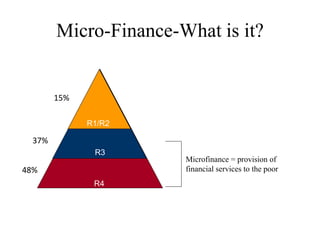
Micro-Finance-What is it?
R4
R3
R1/R2
Microfinance = provision of
financial services to the poor48%
15%
37%
Microfinance: Concept
What it is often
 Micro-Credit
 Group Lending
 Social/Charitable Activity
What it should be
 Range of financial Services
 Group & Individual lending
 Profitable activity
Microfinance reach in India
 Microfinance in India through its 2 major channels – SHG Linkage and MFIs
served
 over 33% of the total population in India
 4 out of 5 microfinance clients in India are women
 Micro-credit portfolio of India Microfinance was Rs. 22,000 cr.
 75% are accounted for by SHG Linkage, 20% by large MFIs and 5% by
medium and small MFIs
 SHG Linkage reports over Rs. 3,500 cr. savings, only MFI Bank, KBS Bank
 reports about Rs. 40 cr. savings portfolio
 MFIs operate in 209 out of 331 districts of the country, 28% of the new clients
are from Urban areas.
Clients Profile
 75% population lives in rural areas: geographical access
difficult
 Informal activities: need access at flexible times
 Illiteracy: difficult to deal with traditional services
 Low value of transactions
 Lack of collateral
Operational Challenges
 High Volume of Financial Transaction but value wise very low
 Majority of the financial transactions are off-site in nature
 Geographic spread of operations and density of customers
 Lack of infrastructure facilities like power, broadband etc
 Unsecured lending and no documented financial history is
available
 Combination of above, lead to high operating cost
Human Resources Challenge
 Lack of trained talents
 Lack of motivated talents
 Difficult to appropriately incentivise the operation
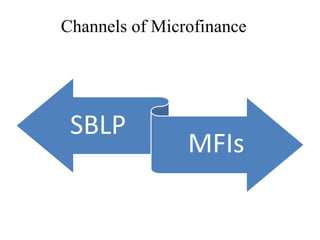
Channels of Microfinance
SBLP
MFIs
Legal Structure & Regulation
 SHG-Bank linkage model is well managed in India by
NABARD
 Reserve Bank of India’s role regarding loan portfolio
 The Micro Finance Institutions (Development and regulation)
Bill, 2011
Financial Illiteracy
 Difficulty in creating awareness.
 SHG and JLG members are taught is to do their own
signature.
 Many MFIs think that this is what financial literacy means
Inability to generate sufficient funds
 Lack of private equity investment
 No way other than depending upon grants & donations
 Major source is Bank Loans
Dropouts and Migration of group members
 Group Lending concept & Past records
 Dropouts & Migration
 Absence of decent past record
Transparent Pricing
 Non-transparent pricing by MFIs confines the bargaining power
 Suppressing their actual/effective interest rates
 Interest rates are linked with the loan amount
 interest rate cap may encourage MFIs
Microfinance Paradigm
 SHGs – Facilitators for collective decision making by the poor
and for providing doorstep banking.
 Banks – Wholesalers of credit and providers of resources.
 NGOs – Agencies to organize the poor, build their capacities
and facilitate the process of empowering them.
The Self Help Group (SHG). . What is it ?
 A homogeneous group of about 15 to 20
 Every member to save a small amount regularly. Pooled
savings kept in a savings bank account in SHG’s name
*transaction costs of both the poor and bank reduced !
 SHG to use pooled thrift to give interest bearing loans to
members – decisions taken in group meetings
*Every member learns prioritization and financial
discipline. Their capacities to think and handle larger
resources improves!
 Depending on the SHG’s maturity, bank gives loan to the SHG
as a multiple of the pooled savings. Bank loan added to the
SHG kitty.
*Adequate & sustained access to financial services!
SHG Benefits
 Role in social-economic development & help the
Governmental, semi-governmental and non-governmental
agencies
 SHG movement created an institutional framework
 Participation of women in SHGs improved their access to
credit
 Culture of thrift and disciplined loan repayment
 Winning confidence of mainstream financial sector as credit
worthy institutions
 Interest rates in the informal credit sector decreased
Challenges & SHPI
 Low levels of credit absorption, low skill base and low asset base
 Interior and tribal villages have not benefited
 SCs and women headed households have not benefited
 Pressures by govt. to push sterilization and birth control methods
 Non-governmental organizations (NGOs)
 Govt. agencies
 Bank staff
 Farmers' clubs
 Rural volunteers
Criterion of APL & BPL by SHPIs
 Non-economic criteria
 No access to pucca housing
 No access to safe drinking water
 No access to sanitary latrines
 Unemployed person in the household
 Eat less than two meals a day
 Regularly borrow from moneylenders
 More than two children in the family
 Family belonging to weaker caste
 Old illiterate members in the family
 Permanently ill members in the family
 Alcoholic and/or drug addicts in the family
Design of SHGs
 Self-selection
 Focus on women (85% of SHGs)
 Savings first and credit later
 Group financed only after 6 months
 Intra group appraisal systems and prioritization
 Shorter repayment terms
 Market rates of interest
 Progressive lending
 Maintenance of accounts by SHGs
 Developing a relationship with Banks
 Flexibility in approach
SHGs Operation
 2-3 office bearers
 Rotation of office bearers
 Periodical meetings
 Decisions regarding thrifts loans interest rate etc in the
meeting
Types of Credit & JLG
 Term loans in multiple of thrifts mobilized-4 times or more -
increasing gradually
 Repayable in 3 or more years
 Cash Credit limit/revolving credit limit of 4 times or more of
group’s expected savings in 3 years
 Informal group comprising 4-10 individuals.
 For the purpose of availing bank loan against mutual guarantee.
 JLG members to engage in similar type of economic activities either
in Farm & Non farm sector.
 Simple management with little or no financial administration within
the group.
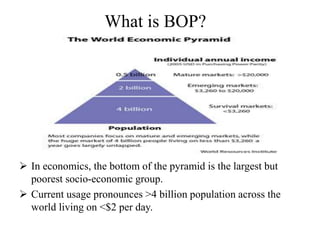
What is BOP?
 In economics, the bottom of the pyramid is the largest but
poorest socio-economic group.
 Current usage pronounces >4 billion population across the
world living on <$2 per day.
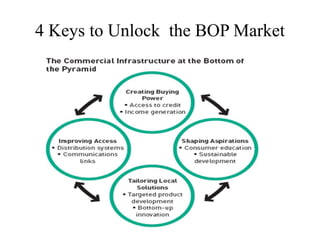
4 Keys to Unlock the BOP Market
Opportunities
BOP consumers suffer a poverty
penalty
Lack of access to
competitively and
efficiently-provided
goods and services
Higher prices for some
goods and services (i.e.
manufactured goods,
credit)
Poorer quality goods and
services
At the same time, BOP
consumers
 Are Brand-conscious
 Have well connected
communities(word of
mouth)
 Readily accept advanced
technology
 Collectively have
purchasing power
 Are always trying to
upgrade from their existing
condition
Incentivizing Mainstream financial services
 Small loans have been historically seen by banks as a social
obligation rather than a potential business opportunity.
 Over the last three years, some strides have been made to re-
engage mainstream FIs into micro-credit.
 The concept of Local Area Banks (LABs), with a lower start up
equity of Rs 50 million, has not yet been operationalized by the
RBI.
 At the moment there are only two options – either be a co-
operative or be an NBFC (non-banking finance company).
Financial Sustainability
Controlling
Costs
• Reducing average cost of funds
• Reducing cost of operations
• Reducing costs of bad debts
Increasing
Volumes
• Offer different loan products to suit the credit requirements of the poor.
Adopt flexible repayment schedule to suit borrower’s cash flows.
• Identify intermediaries of small borrowers such as fertilizer dealers
• Increase customer base in the areas of operation and expand in
neighboring villages
Increasing
Services
• MFI's financial sustainability can be enhanced by broadening the range
of financial services.
• The services are complementary in terms of risk
• Insurance is another important financial service
Initiating financial inclusion
 New Banking License
 Mobile Payments
 White Label ATM Rollout
 Use of Aadhaar Number and Direct Benefits Transfer
News@ a glance
 Govt. plans to open 7.5 cr. Bank A/Cs by 15 Aug
 Govt. Banks on mobiles to meet inclusion target
 New Kisan Bonds to sidestep KYC norms
 Small Banks are here, but are they dead on arrival
 MFIs,Local Banks,& NBFCs can convert themselves into
small banks
Recommendations
 Incentivizing existing mainstream financial service providers
(NABARD, SIDBI, etc) to enter the microfinance sector as a
serious business proposition.
 Encouraging new microfinance institutions (MFIs) with a
supportive policy and regulatory framework.
 Building a strong demand system in the form of community-
based development financial institutions (CDFIs), with the help
of NGOs and others.
Happy Learning

Microfinance

  • 1.
    Microfinance: Shades ofSustainability Presented By: Group 5 IMIS,Bhubaneswar
  • 2.
    Micro-Finance-What is it? R4 R3 R1/R2 Microfinance= provision of financial services to the poor48% 15% 37%
  • 3.
    Microfinance: Concept What itis often  Micro-Credit  Group Lending  Social/Charitable Activity What it should be  Range of financial Services  Group & Individual lending  Profitable activity
  • 4.
    Microfinance reach inIndia  Microfinance in India through its 2 major channels – SHG Linkage and MFIs served  over 33% of the total population in India  4 out of 5 microfinance clients in India are women  Micro-credit portfolio of India Microfinance was Rs. 22,000 cr.  75% are accounted for by SHG Linkage, 20% by large MFIs and 5% by medium and small MFIs  SHG Linkage reports over Rs. 3,500 cr. savings, only MFI Bank, KBS Bank  reports about Rs. 40 cr. savings portfolio  MFIs operate in 209 out of 331 districts of the country, 28% of the new clients are from Urban areas.
  • 5.
    Clients Profile  75%population lives in rural areas: geographical access difficult  Informal activities: need access at flexible times  Illiteracy: difficult to deal with traditional services  Low value of transactions  Lack of collateral
  • 6.
    Operational Challenges  HighVolume of Financial Transaction but value wise very low  Majority of the financial transactions are off-site in nature  Geographic spread of operations and density of customers  Lack of infrastructure facilities like power, broadband etc  Unsecured lending and no documented financial history is available  Combination of above, lead to high operating cost
  • 7.
    Human Resources Challenge Lack of trained talents  Lack of motivated talents  Difficult to appropriately incentivise the operation
  • 8.
  • 9.
    Legal Structure &Regulation  SHG-Bank linkage model is well managed in India by NABARD  Reserve Bank of India’s role regarding loan portfolio  The Micro Finance Institutions (Development and regulation) Bill, 2011
  • 10.
    Financial Illiteracy  Difficultyin creating awareness.  SHG and JLG members are taught is to do their own signature.  Many MFIs think that this is what financial literacy means
  • 11.
    Inability to generatesufficient funds  Lack of private equity investment  No way other than depending upon grants & donations  Major source is Bank Loans
  • 12.
    Dropouts and Migrationof group members  Group Lending concept & Past records  Dropouts & Migration  Absence of decent past record
  • 13.
    Transparent Pricing  Non-transparentpricing by MFIs confines the bargaining power  Suppressing their actual/effective interest rates  Interest rates are linked with the loan amount  interest rate cap may encourage MFIs
  • 14.
    Microfinance Paradigm  SHGs– Facilitators for collective decision making by the poor and for providing doorstep banking.  Banks – Wholesalers of credit and providers of resources.  NGOs – Agencies to organize the poor, build their capacities and facilitate the process of empowering them.
  • 15.
    The Self HelpGroup (SHG). . What is it ?  A homogeneous group of about 15 to 20  Every member to save a small amount regularly. Pooled savings kept in a savings bank account in SHG’s name *transaction costs of both the poor and bank reduced !  SHG to use pooled thrift to give interest bearing loans to members – decisions taken in group meetings *Every member learns prioritization and financial discipline. Their capacities to think and handle larger resources improves!  Depending on the SHG’s maturity, bank gives loan to the SHG as a multiple of the pooled savings. Bank loan added to the SHG kitty. *Adequate & sustained access to financial services!
  • 16.
    SHG Benefits  Rolein social-economic development & help the Governmental, semi-governmental and non-governmental agencies  SHG movement created an institutional framework  Participation of women in SHGs improved their access to credit  Culture of thrift and disciplined loan repayment  Winning confidence of mainstream financial sector as credit worthy institutions  Interest rates in the informal credit sector decreased
  • 17.
    Challenges & SHPI Low levels of credit absorption, low skill base and low asset base  Interior and tribal villages have not benefited  SCs and women headed households have not benefited  Pressures by govt. to push sterilization and birth control methods  Non-governmental organizations (NGOs)  Govt. agencies  Bank staff  Farmers' clubs  Rural volunteers
  • 18.
    Criterion of APL& BPL by SHPIs  Non-economic criteria  No access to pucca housing  No access to safe drinking water  No access to sanitary latrines  Unemployed person in the household  Eat less than two meals a day  Regularly borrow from moneylenders  More than two children in the family  Family belonging to weaker caste  Old illiterate members in the family  Permanently ill members in the family  Alcoholic and/or drug addicts in the family
  • 19.
    Design of SHGs Self-selection  Focus on women (85% of SHGs)  Savings first and credit later  Group financed only after 6 months  Intra group appraisal systems and prioritization  Shorter repayment terms  Market rates of interest  Progressive lending  Maintenance of accounts by SHGs  Developing a relationship with Banks  Flexibility in approach
  • 20.
    SHGs Operation  2-3office bearers  Rotation of office bearers  Periodical meetings  Decisions regarding thrifts loans interest rate etc in the meeting
  • 21.
    Types of Credit& JLG  Term loans in multiple of thrifts mobilized-4 times or more - increasing gradually  Repayable in 3 or more years  Cash Credit limit/revolving credit limit of 4 times or more of group’s expected savings in 3 years  Informal group comprising 4-10 individuals.  For the purpose of availing bank loan against mutual guarantee.  JLG members to engage in similar type of economic activities either in Farm & Non farm sector.  Simple management with little or no financial administration within the group.
  • 22.
    What is BOP? In economics, the bottom of the pyramid is the largest but poorest socio-economic group.  Current usage pronounces >4 billion population across the world living on <$2 per day.
  • 23.
    4 Keys toUnlock the BOP Market
  • 24.
    Opportunities BOP consumers suffera poverty penalty Lack of access to competitively and efficiently-provided goods and services Higher prices for some goods and services (i.e. manufactured goods, credit) Poorer quality goods and services At the same time, BOP consumers  Are Brand-conscious  Have well connected communities(word of mouth)  Readily accept advanced technology  Collectively have purchasing power  Are always trying to upgrade from their existing condition
  • 25.
    Incentivizing Mainstream financialservices  Small loans have been historically seen by banks as a social obligation rather than a potential business opportunity.  Over the last three years, some strides have been made to re- engage mainstream FIs into micro-credit.  The concept of Local Area Banks (LABs), with a lower start up equity of Rs 50 million, has not yet been operationalized by the RBI.  At the moment there are only two options – either be a co- operative or be an NBFC (non-banking finance company).
  • 26.
    Financial Sustainability Controlling Costs • Reducingaverage cost of funds • Reducing cost of operations • Reducing costs of bad debts Increasing Volumes • Offer different loan products to suit the credit requirements of the poor. Adopt flexible repayment schedule to suit borrower’s cash flows. • Identify intermediaries of small borrowers such as fertilizer dealers • Increase customer base in the areas of operation and expand in neighboring villages Increasing Services • MFI's financial sustainability can be enhanced by broadening the range of financial services. • The services are complementary in terms of risk • Insurance is another important financial service
  • 28.
    Initiating financial inclusion New Banking License  Mobile Payments  White Label ATM Rollout  Use of Aadhaar Number and Direct Benefits Transfer
  • 29.
    News@ a glance Govt. plans to open 7.5 cr. Bank A/Cs by 15 Aug  Govt. Banks on mobiles to meet inclusion target  New Kisan Bonds to sidestep KYC norms  Small Banks are here, but are they dead on arrival  MFIs,Local Banks,& NBFCs can convert themselves into small banks
  • 30.
    Recommendations  Incentivizing existingmainstream financial service providers (NABARD, SIDBI, etc) to enter the microfinance sector as a serious business proposition.  Encouraging new microfinance institutions (MFIs) with a supportive policy and regulatory framework.  Building a strong demand system in the form of community- based development financial institutions (CDFIs), with the help of NGOs and others.
  • 31.