WHAT IS MICRO FINANCE ? Micro Finance is the supply of loans, savings, and other basic financial service to the poor .   ->  CGAP To most, micro finance means providing very poor families with very small loans (micro credit) to help them engage in productive activities or grow their tiny businesses.   -> Financial Gateway
ABOUT MICRO FINANCE The modern micro finance movement dates back to the 1970s when experimental programs in Bangladesh, Brazil, and a few other countries began to extend tiny loans to groups of poor women to invest in micro enterprises By lending to groups of women where every member of the group guaranteed the repayment of all members, these micro credit programs challenged the prevailing conventional wisdom and proved that poor people without collateral could be "credit worthy". When offered the opportunity, they would repay loans with interest, at extraordinary rates of repayment.
MICRO FINANCE IN INDIA Evolution of Micro finance in India Micro finance has been in practice for ages ( though informally). Legal framework for establishing the co-operative movement set up in 1904. Reserve Bank of India Act, 1934 provided for the establishment of the Agricultural Credit Department. Nationalization of banks in 1969 Regional Rural Banks created in 1975. established as an apex agency for rural finance in 1982. Passing of Mutually Aided Co-op. Act in AP in 1995.
FEATURES OF INDIAN MF About 60 % of the MFIs are registered as societies. About 20 % are Trusts About 65 % of the MFIs follow the operating model of SHGs. Large concentration in South India 600 MFI initiatives have a cumulative outreach of 1.25 crore poor households NABARD’s bank linkage program has cumulatively reached a total of 9.4 lakh SHGs with about 1.4 crore households.
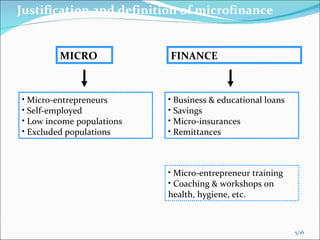
/16 Justification and definition of microfinance FINANCE  MICRO Micro-entrepreneurs Self-employed  Low income populations Excluded populations Business & educational loans Savings Micro-insurances Remittances Micro-entrepreneur training Coaching & workshops on  health, hygiene, etc.
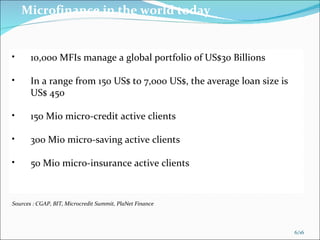
/16 10,000 MFIs manage a global portfolio of US$30 Billions  In a range from 150 US$ to 7,000 US$, the average loan size is US$ 450 150 Mio micro-credit active clients 300 Mio micro-saving active clients 50 Mio  micro-insurance active clients Sources : CGAP, BIT, Microcredit Summit, PlaNet Finance Microfinance in the world today
/16 Development of MF in industrialized countries (e.g. Israel, France, USA) thanks to the adaptation of the tools and methodologies Commercialization of the stakeholders Use of new technologies as a new development tool New trends
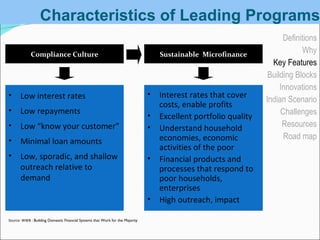
Characteristics of Leading Programs Definitions Why Key Features Building Blocks Innovations Indian Scenario Challenges Resources Road map Source: WWB :  Building   Domestic Financial Systems that Work for the Majority Low interest rates Low repayments Low “know your customer” Minimal loan amounts Low, sporadic, and shallow  outreach relative to demand Interest rates that cover costs, enable profits Excellent portfolio quality Understand household economies, economic activities of the poor  Financial products and processes that respond to  poor households, enterprises High outreach, impact Compliance Culture Sustainable  Microfinance
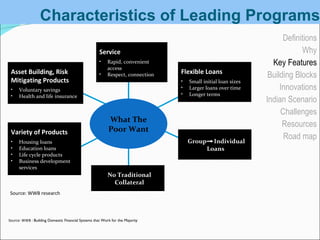
Characteristics of Leading Programs Definitions Why Key Features Building Blocks Innovations Indian Scenario Challenges Resources Road map Source: WWB :  Building   Domestic Financial Systems that Work for the Majority What The Poor Want Asset Building, Risk Mitigating Products   Voluntary savings Health and life insurance Variety of Products Housing loans Education loans Life cycle products Business development services Group  Individual Loans  Flexible Loans Small initial loan sizes Larger loans over time Longer terms No Traditional Collateral Service Rapid, convenient access Respect, connection Source: WWB research
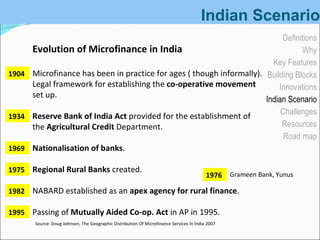
Indian Scenario Definitions Why Key Features Building Blocks Innovations Indian Scenario Challenges Resources Road map Source: Doug Johnson, The Geographic Distribution Of Microfinance Services In India 2007 Evolution of Microfinance in India Microfinance has been in practice for ages ( though informally). Legal framework for establishing the  co-operative movement  set up. Reserve Bank of India Act  provided for the establishment of the  Agricultural Credit  Department. Nationalisation of banks . Regional Rural Banks  created. NABARD established as an  apex agency for rural finance . Passing of  Mutually Aided Co-op. Act  in AP in 1995. 1904 1934 1969 1975 1982 1995 1976 Grameen Bank, Yunus
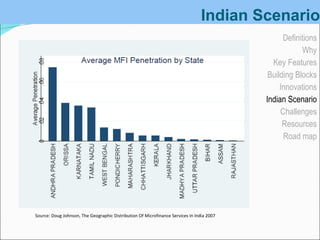
Indian Scenario Definitions Why Key Features Building Blocks Innovations Indian Scenario Challenges Resources Road map Source: Doug Johnson, The Geographic Distribution Of Microfinance Services In India 2007

Introduction of microfinance

  • 1.
    WHAT IS MICROFINANCE ? Micro Finance is the supply of loans, savings, and other basic financial service to the poor . -> CGAP To most, micro finance means providing very poor families with very small loans (micro credit) to help them engage in productive activities or grow their tiny businesses. -> Financial Gateway
  • 2.
    ABOUT MICRO FINANCEThe modern micro finance movement dates back to the 1970s when experimental programs in Bangladesh, Brazil, and a few other countries began to extend tiny loans to groups of poor women to invest in micro enterprises By lending to groups of women where every member of the group guaranteed the repayment of all members, these micro credit programs challenged the prevailing conventional wisdom and proved that poor people without collateral could be "credit worthy". When offered the opportunity, they would repay loans with interest, at extraordinary rates of repayment.
  • 3.
    MICRO FINANCE ININDIA Evolution of Micro finance in India Micro finance has been in practice for ages ( though informally). Legal framework for establishing the co-operative movement set up in 1904. Reserve Bank of India Act, 1934 provided for the establishment of the Agricultural Credit Department. Nationalization of banks in 1969 Regional Rural Banks created in 1975. established as an apex agency for rural finance in 1982. Passing of Mutually Aided Co-op. Act in AP in 1995.
  • 4.
    FEATURES OF INDIANMF About 60 % of the MFIs are registered as societies. About 20 % are Trusts About 65 % of the MFIs follow the operating model of SHGs. Large concentration in South India 600 MFI initiatives have a cumulative outreach of 1.25 crore poor households NABARD’s bank linkage program has cumulatively reached a total of 9.4 lakh SHGs with about 1.4 crore households.
  • 5.
    /16 Justification anddefinition of microfinance FINANCE MICRO Micro-entrepreneurs Self-employed Low income populations Excluded populations Business & educational loans Savings Micro-insurances Remittances Micro-entrepreneur training Coaching & workshops on health, hygiene, etc.
  • 6.
    /16 10,000 MFIsmanage a global portfolio of US$30 Billions In a range from 150 US$ to 7,000 US$, the average loan size is US$ 450 150 Mio micro-credit active clients 300 Mio micro-saving active clients 50 Mio micro-insurance active clients Sources : CGAP, BIT, Microcredit Summit, PlaNet Finance Microfinance in the world today
  • 7.
    /16 Development ofMF in industrialized countries (e.g. Israel, France, USA) thanks to the adaptation of the tools and methodologies Commercialization of the stakeholders Use of new technologies as a new development tool New trends
  • 8.
    Characteristics of LeadingPrograms Definitions Why Key Features Building Blocks Innovations Indian Scenario Challenges Resources Road map Source: WWB : Building Domestic Financial Systems that Work for the Majority Low interest rates Low repayments Low “know your customer” Minimal loan amounts Low, sporadic, and shallow outreach relative to demand Interest rates that cover costs, enable profits Excellent portfolio quality Understand household economies, economic activities of the poor Financial products and processes that respond to poor households, enterprises High outreach, impact Compliance Culture Sustainable Microfinance
  • 9.
    Characteristics of LeadingPrograms Definitions Why Key Features Building Blocks Innovations Indian Scenario Challenges Resources Road map Source: WWB : Building Domestic Financial Systems that Work for the Majority What The Poor Want Asset Building, Risk Mitigating Products Voluntary savings Health and life insurance Variety of Products Housing loans Education loans Life cycle products Business development services Group Individual Loans Flexible Loans Small initial loan sizes Larger loans over time Longer terms No Traditional Collateral Service Rapid, convenient access Respect, connection Source: WWB research
  • 10.
    Indian Scenario DefinitionsWhy Key Features Building Blocks Innovations Indian Scenario Challenges Resources Road map Source: Doug Johnson, The Geographic Distribution Of Microfinance Services In India 2007 Evolution of Microfinance in India Microfinance has been in practice for ages ( though informally). Legal framework for establishing the co-operative movement set up. Reserve Bank of India Act provided for the establishment of the Agricultural Credit Department. Nationalisation of banks . Regional Rural Banks created. NABARD established as an apex agency for rural finance . Passing of Mutually Aided Co-op. Act in AP in 1995. 1904 1934 1969 1975 1982 1995 1976 Grameen Bank, Yunus
  • 11.
    Indian Scenario DefinitionsWhy Key Features Building Blocks Innovations Indian Scenario Challenges Resources Road map Source: Doug Johnson, The Geographic Distribution Of Microfinance Services In India 2007

Editor's Notes

  • #6 Rural Finance Presentation